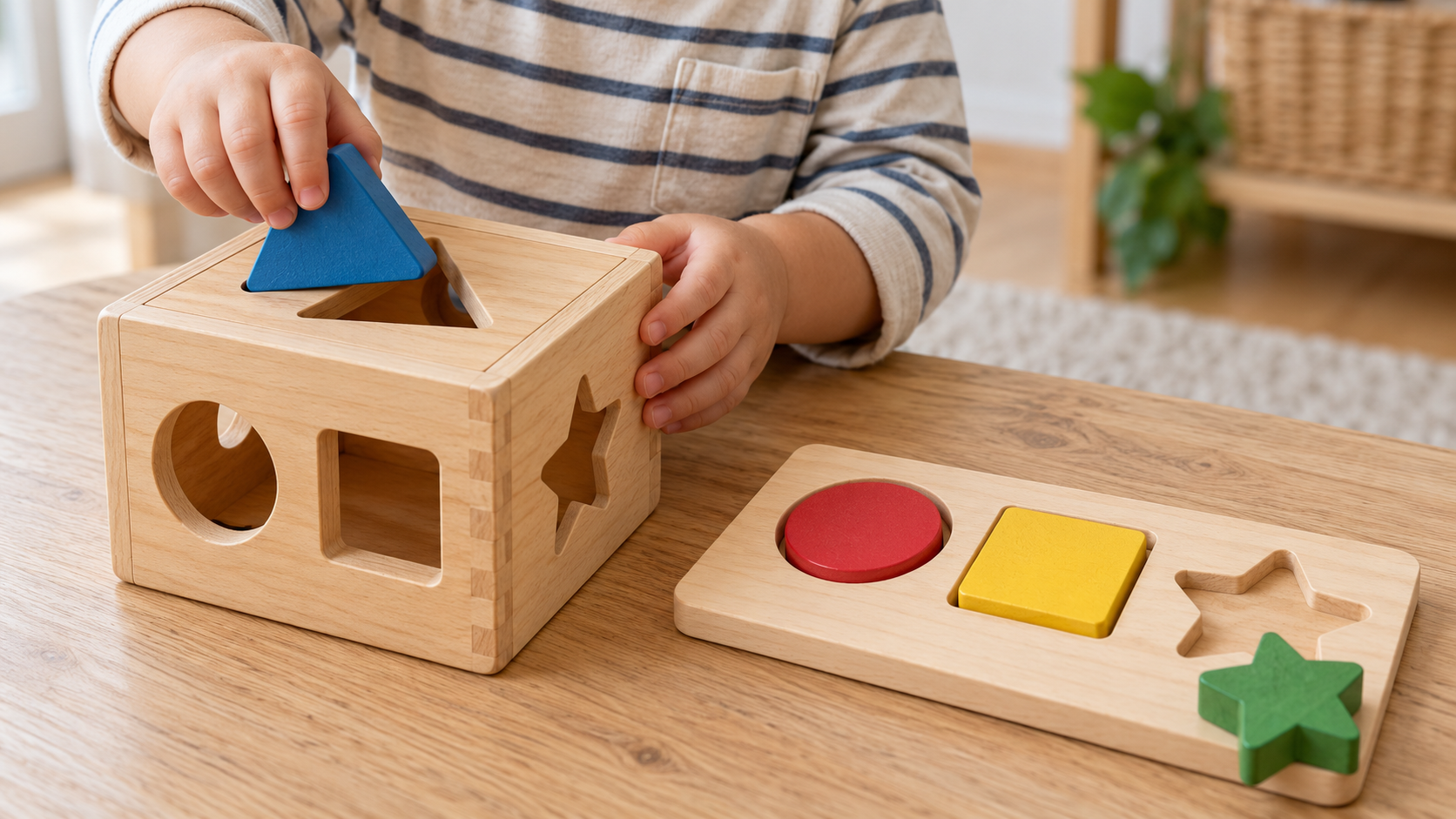
A child presses a triangle against an opening. It does not fit. They turn it, look again, and try another way. That moment of reconsideration is more interesting than the finished puzzle.
Good puzzles give children a reason to make a choice, see what happens, and adjust. But different puzzles call for different kinds of thinking. Jigsaws draw attention to visual details. Mazes require route planning. Logic puzzles ask children to use clues and rule out possibilities.
When choosing a puzzle, I would pay less attention to its label and more attention to the decisions the child has to make. Here are eight types of problem-solving puzzles for kids that offer distinct ways to practice problem-solving, along with ways to make each one easier or harder.
Where should a child start?
| If the child is… | Try… | Watch for… |
| Beginning to match objects and shapes | A shape sorter, inset puzzle, or simple jigsaw | Comparing pieces and turning them to check the fit |
| Comfortable with matching and ready for a new challenge | A tangram with an outline, short maze, or pattern puzzle | Looking ahead, noticing a rule, or changing an approach |
| Interested in clues, words, or quantities | A picture logic, number, or word puzzle | Explaining why an answer works |
These are starting points, not age rules. The picture, number of choices, reading demands, and available help can all change how difficult a puzzle feels.
1. Shape sorters and inset puzzles
A shape sorter presents a clear question: Which piece fits this opening? A child can compare the outlines, turn a piece, and find out whether their idea works. An inset puzzle offers the same kind of immediate feedback.
Begin with large pieces that have distinct shapes. Once the child understands the task, add pieces that look more alike or need turning before they fit. If every square is blue and every circle is red, the child may rely on color alone. Mixing up the colors draws attention back to shape.
There is no need to insist on the correct answer immediately. “What is different about this opening?” gives the child something useful to inspect.
2. Jigsaw puzzles
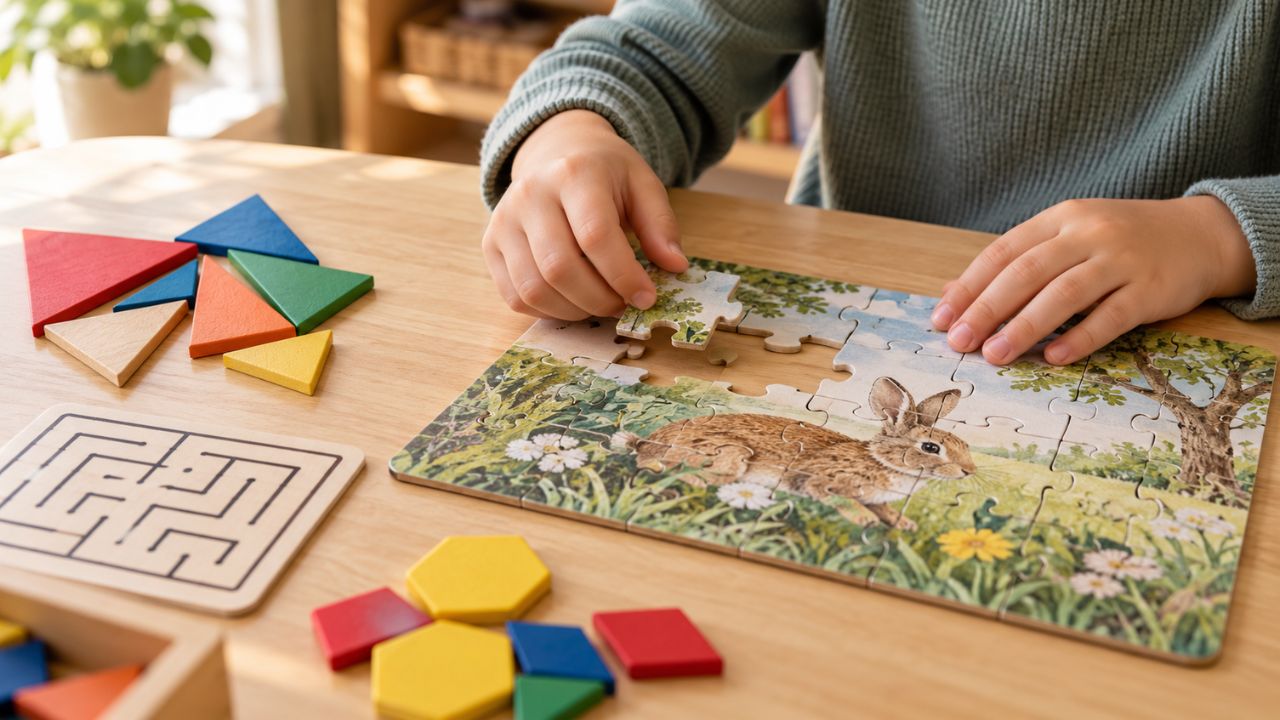
A jigsaw piece carries several clues: its shape, colors, and the small part of a picture printed on it. Children have to decide which clue helps. A piece may appear to show the right object but still refuse to connect.
For a first jigsaw, choose a familiar image and keep the completed picture visible. A child might start with a character’s face or a bright section of sky. Starting with the border is one possible strategy, not a rule.
As the child becomes more confident, increase the challenge gradually. A picture with similar colors throughout may be harder than a more colorful picture with the same number of pieces. Ask what they noticed before offering a suggestion: “Did you match the picture, the shape, or both?”
3. Tangrams and shape-assembly puzzles
Tangrams ask children to make a larger figure from smaller geometric pieces. A triangle that seems wrong may work after a turn or flip. The child has to think about how pieces relate to one another, rather than finding a familiar bit of a picture.
An outlined design makes a good first challenge because the child can place pieces directly over it. Next, put the design beside the pieces so they must copy it. A solid silhouette with no internal lines is more demanding.
If the child gets stuck, choose one part of the outline and ask which piece might cover it. That narrows the problem while leaving the decision to them.
4. Mazes and route puzzles
Mazes are useful because a plan can fail visibly. A child follows a promising path, reaches a dead end, and returns to try another turn. Going back is part of solving the problem.
Start with a short route and an obvious destination. Invite the child to point out a possible path before tracing it. Later, add more branches or ask whether starting from the destination makes the route easier to see.
If they keep reaching the same dead end, focus on the earlier choice: “Where could you have turned differently?” It is a more useful prompt than simply pointing to the correct path.
5. Pattern and sequence puzzles
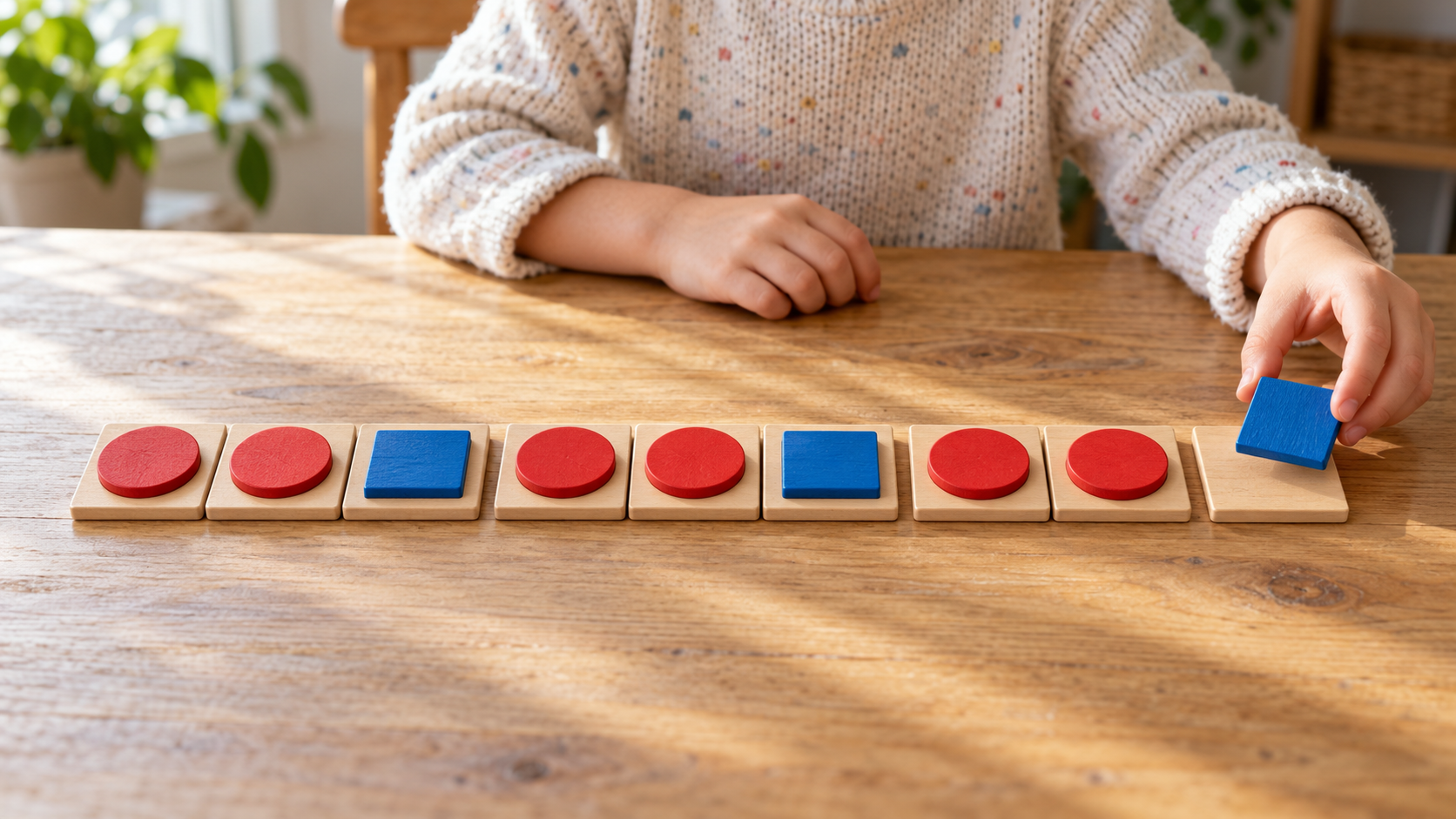
Put down a red block, then a blue block, and repeat. Once a child recognizes the pattern, they can predict the next piece. Change one block in the middle, and they have a new task: finding where the rule breaks.
Move beyond a simple red-blue sequence when the child is ready. Try two red blocks followed by one blue block, or use shapes, sounds, and actions. Children can also make patterns for an adult to solve.
The explanation matters. A correct next block might be a guess; “It goes here because the two reds come before each blue” shows that the child has found the rule.
6. Logic and deduction puzzles
Logic puzzles ask children to use clues together. Suppose a cat, dog, and bird each have a different colored mat. The cat has the blue mat, and the dog does not have the red one. The child can work out that the dog has green and the bird has red.
Animal pictures and colored paper make this easier to follow than a page full of written clues. Start with two or three choices, and let the child move the pictures as they reason. Later, introduce a small grid to record what has been ruled out.
Make the instructions clear. If a child misunderstands a clue, they may spend their effort solving a different problem. Once the rules make sense, ask, “How do you know the dog cannot have the red mat?”
A small symbol Sudoku is another option for a child ready to follow placement rules. Despite its use of numbers in the usual version, Sudoku is a logic puzzle; it does not require arithmetic.
7. Number puzzles
Number puzzles work best when children can connect an answer to a quantity. Put five large blocks on a table, cover two, and ask how many are hidden. The child can uncover them to check. Later, the same question can appear as 3 + ? = 5.
Missing numbers, number sequences, and puzzles that ask children to compare groups offer different challenges. A child who knows what “five” means has more to work with than one who is only trying to remember which numeral comes next.
Our team at Editorialge built 123 Magic Number Fun: Math Kid, which includes tile matching, math puzzles, and missing-number activities. I see those as ways to practice particular choices on a screen. An adult can extend the activity by posing a similar problem with blocks or a drawing and asking the child to explain the answer.
8. Word and clue puzzles
A word puzzle asks a child to consider what a clue means and test a possible answer. For a child who is not reading yet, the clue can be spoken: “I rhyme with cat and start with a /b/ sound.” A child who can read might try a picture crossword.
Choose clues that draw on words the child is likely to know. Otherwise, the difficult part may be unfamiliar vocabulary rather than solving the puzzle. A crossword adds another check: the answer must fit both its clue and the letters crossing it.
This category is also a reminder that problem-solving does not have to involve numbers or shapes. Children can compare sounds, consider meanings, and change an answer when a new clue shows it cannot be right.
Help without finishing the puzzle for them
When a child pauses, give them time to look. They may be comparing two pieces or working out why a clue does not fit. If they need help, offer one prompt that directs their attention:
- “What have you tried so far?”
- “Which part of the picture could help you find this piece?”
- “What do we know for certain from that clue?”
- “How could we check your answer?”
If the child cannot find a first move, make the task smaller. Set aside some jigsaw pieces, show part of the tangram outline, or solve one similar example together. Then return the next decision to the child.
I would also stop before frustration turns the activity into a battle. A puzzle can be put away and tried again. Finishing it is satisfying, but noticing a mistake and trying a different approach are worthwhile parts of the experience.
What can puzzle play actually do?
Research has linked early puzzle play with later spatial performance, and guided shape-assembly activities have improved children’s performance on closely related spatial tasks. Evidence for wider benefits, such as gains across all school subjects or a general increase in intelligence, is much less certain.
That distinction helps set a useful expectation. A maze gives a child practice planning a route. A pattern puzzle asks them to find a rule. A jigsaw makes them compare parts with a whole. Offering a mix of puzzles gives children different problems to think through, while play, conversation, reading, and everyday activities give them more places to use what they know.
For physical puzzles, choose pieces that suit the child’s abilities and follow the product’s safety guidance. Keep small pieces away from children under three. For digital puzzles, look for activities that ask the child to make and check a meaningful choice, then talk with them about how they solved it.
Frequently asked questions on Problem-Solving Puzzles for Kids
1. Which puzzle should I try first with a toddler?
A shape sorter or simple inset puzzle with large pieces is a reasonable starting point. Follow the product’s age and safety guidance, especially where smaller pieces are concerned. Watch whether the child is interested in matching and turning the pieces before increasing the challenge.
2. Are digital puzzles useful?
They can be, when the child has to make a meaningful choice and respond to feedback. In one preschool study, both concrete and digital guided shape-assembly activities improved performance on trained spatial tasks. Results depended on the task and outcome, so a screen format alone says little about educational value.
3. Is a harder puzzle always better?
No. Difficulty helps when a child can still find a way into the problem. If the first move is unclear, reduce the choices, show part of the solution, or solve an easier example together.
4. Do children need to finish every puzzle?
No. Working out why an approach failed, trying a different one, and deciding to return later are useful parts of the activity. A completed puzzle is satisfying, but it is not the only sign that a child has been thinking.