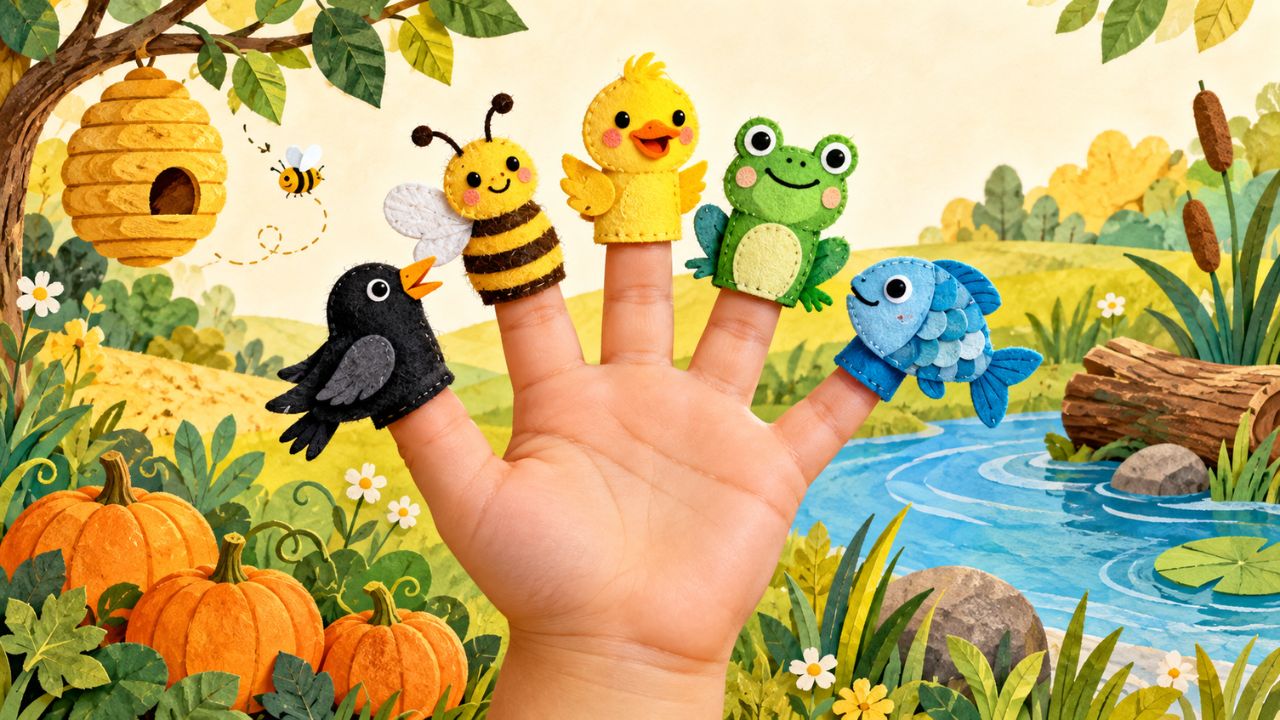
I taught these finger play rhymes to my nephew, Fariz. A bird flying away or a bee appearing from a fist gave us something to count together. We could see the number change instead of only saying the words in order.
That small difference matters. A child may happily recite “one, two, three, four, five” and still need practice matching each number word to one thing. With these rhymes, the things are right on our hands.
You can sing a version your family knows or use the short cues below. They are simple adaptations for the movements, since familiar counting fingerplay rhymes often have different words from one home or classroom to another. Go slowly enough for the child to watch. They can join in by pointing, moving a hand, making a sound, or simply asking for the rhyme again.
1. Two Little Blackbirds
Raise one index finger on each hand. The fingers are two birds resting together. Hide one hand behind your back as the first bird flies away, then hide the other. Bring them back one at a time.
Two birds rest where branches sway;
One flies off, the next flies away.
One comes back; its friend comes too.
Count the birds: one and two.
I add the count as the birds move: two, one, none, one, two. That sequence is easier to follow when the child can see each bird leave and return. Pause after the first one goes and ask, “How many birds are still here?”
This is a good first rhyme for a child who is just beginning to notice quantities. There are only two birds to keep track of, and the hiding hands make their return a little surprise.
2. Here Is the Beehive
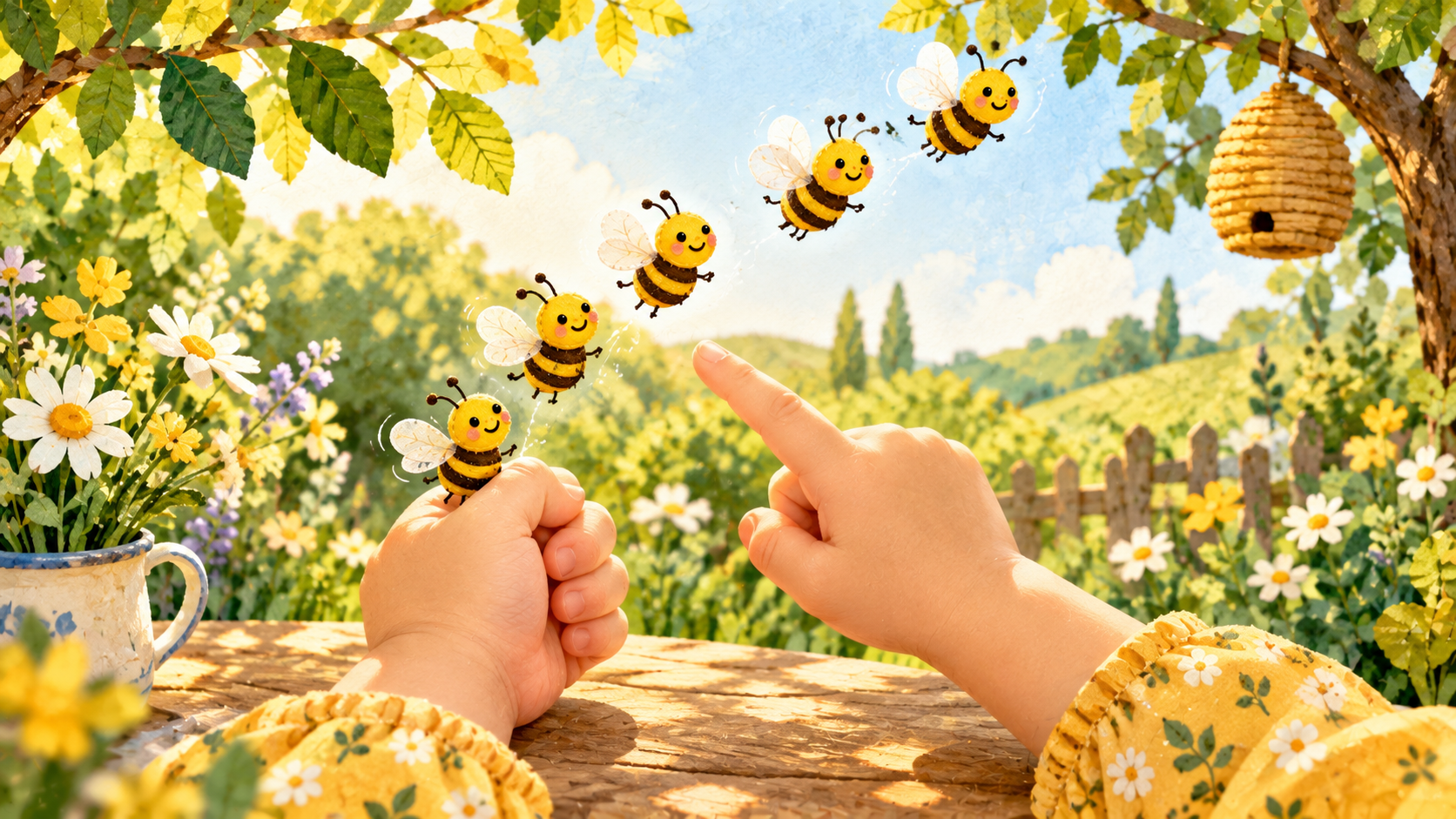
Close one hand into a fist for the hive. Keep the bees tucked away, then release one finger at a time. Once all five have appeared, wiggle your fingers and let them buzz.
One bee, two bees, three take flight;
Four and five buzz into sight.
Lift one finger with each number word. If Fariz or another child wants to buzz along without moving individual fingers, I would let the buzzing be their part of the game. They can still watch and count the bees on an adult’s hand.
When five bees are out, try hiding two again. Ask, “How many are still buzzing?” Count the visible fingers together. The extra question can wait until the child enjoys the basic rhyme.
3. Fishes in a Pool
Use your fingers as fish. Show one finger, then two, and keep changing the number until five fish are swimming. Wiggle the whole hand, hide it behind your back for a splash, and bring the fish out to count again.
One, two, three fish join the school;
Four and five splash in the pool.
Give the child time to see each new group. When you show three fingers, ask, “Can you find three fish?” Touch them one at a time as you count. The rhyme moves up from one to five, which gives it a different feel from the duck and frog countdowns later in this list.
Several fish rhymes have similar names and different stories. Use whichever one your child enjoys; for this counting game, keep the movement clear: each new number should match the fingers they can see.
4. Five Little Pumpkins
Hold up five fingers and rest that hand across your other forearm, as though the pumpkins are sitting on a gate. Point to the fingers in order as you introduce the first, second, third, fourth, and fifth pumpkins. Let them “roll away” by lowering and wiggling your hand.
First, second, third, fourth, fifth in a row;
Five round pumpkins, ready to go.
This rhyme is a chance to hear position words as well as count to five. “Five” tells us how many pumpkins there are. “Third” helps us pick out one pumpkin in the row. I would let the child enjoy the story first, then point and ask, “Which pumpkin is second?”
Count all five fingers again when the pumpkins return to the gate. That brings the playful story back to a group the child can see.
5. Five Little Ducks
Hold up five fingers for the ducklings. Move your hand over an imaginary hill while your other hand makes the mother duck’s calling beak. Fold down one finger when fewer ducklings come back. Continue until the hand is closed, then open it wide when all five return.
Five ducks set off down the track;
Count the ducklings waddling back.
Begin with five going out and four returning. On the next round, four go and three return. Leave a little pause before folding each finger so the child can notice what changed.
When I taught rhymes like this to Fariz, the movement gave us a natural place to stop and count. “How many came back?” is enough of a question. There is no need to hurry into the next verse.
The ending gives the child the full group again. If the disappearing ducks make a younger child uneasy, sing fewer rounds and bring all five home sooner.
6. Five Green and Speckled Frogs
Raise five fingers for frogs on a log. Fold one down each time a frog jumps into the pool. Count the fingers still raised before another frog takes its turn.
Five frogs wait where rushes grow;
One dives in; four still show.
Start with that simple countdown. Later, you can use a second hand to show the pool. Lower one finger on the “log” hand as a frog jumps, and raise one on the “pool” hand. Now four frogs are on the log, and one is in the pool.
I like this extension because it changes the question. Ask, “How many are still on the log?” Then count both hands and ask, “How many frogs are there altogether?” The frog has moved; there are still five in the story.
Using both hands can be fiddly for a young child. Let them watch your hands first, or take the part of either the log or the pool.
7. One, Two, Buckle My Shoe
Raise one finger for each number as you say this familiar action rhyme. After the first pair, mime fastening a shoe. Continue with the movements for the later number pairs until you reach ten.
If the longer version is new to the child, this short cue will get the count started:
One, two fingers, tap a shoe;
Three and four, there’s more to do.
Raise each finger, count again;
Keep it going up to ten.
The actions give a child a brief break between pairs of numbers. Say each number slowly enough to match it with one finger, then enjoy the movement. Some children will want to do every action; others may prefer to hold up their hands and let you speak.
Although the words come in pairs, keep counting each number in order. The aim is to reach ten while seeing the fingers appear one by one.
8. Ten Little Fingers
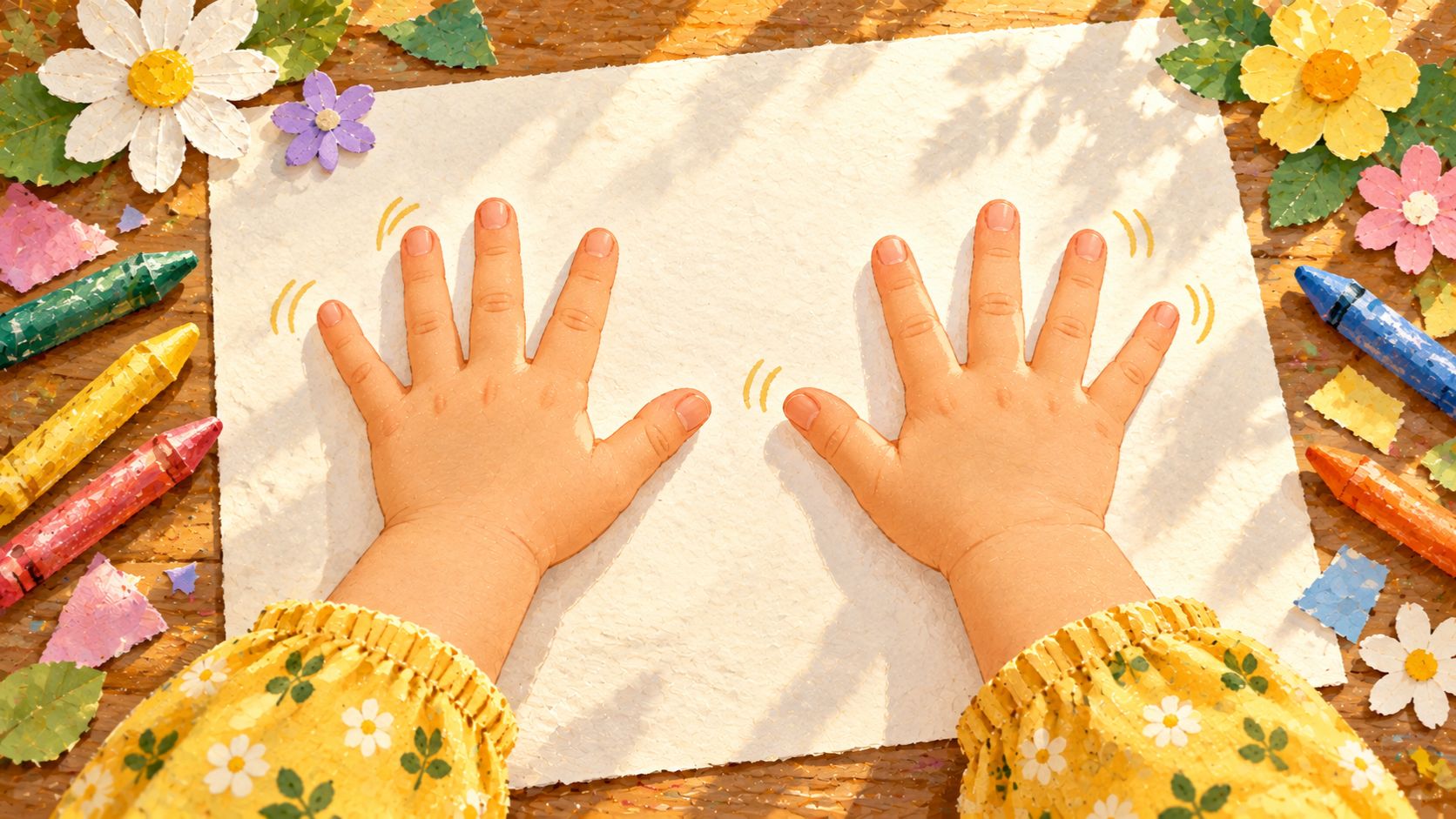
Open both hands and wiggle your fingers. Make them wave, close into fists, hide, and appear again as you say the rhyme. Then touch each finger once while counting from one to ten.
First five rise, then five more show;
Touch each finger, nice and slow.
Count the five fingers on one hand before moving to the other. For a child ready for a bigger question, ask, “How many do we have when we show both hands?” Let them look before counting all ten together.
A child can count your fingers or point to a drawing of hands if showing a particular number on their own fingers is difficult or uncomfortable. What helps is hearing one number word while seeing one finger counted.
Keep the number in view
The most useful moment often comes between verses. Hold your hand still for a second. Let the child look. Then ask, “How many now?” If they give a different answer, touch each visible finger and count together before continuing.
I would begin with one or two favourites rather than run through all eight at once. Repeat them while waiting, getting dressed, or settling down for a story. Use the family’s home language for the count if that makes the game more familiar.
Disclosure: Our team at Editorialge develops both 123 Magic Number Fun: Math Kid and Alphabet Magic trace & phonics. After a finger rhyme, the Count Objects activity in 123 Magic Number Fun can give a child another group to count, this time in pictures. I have used Alphabet Magic with Fariz for letter sounds and tracing; it fits when our play moves toward letters and words. I still like returning to fingers and real objects, where we can count and talk together.
Frequently Asked Questions on Counting Fingerplay Rhymes
1. What age can children start finger play rhymes?
Young toddlers can watch, buzz, quack, or copy a simple gesture. Preschoolers may begin to count the fingers, predict the next number, or notice how many remain. Follow the child’s interest and shorten a rhyme whenever that makes it more enjoyable.
2. Does reciting numbers mean a child understands counting?
Reciting the number words is one skill. Counting a group also means matching each word to one finger or object and noticing how many there are altogether. Slow finger movements and an occasional “How many?” question give children practice with that connection.
3. Do I have to sing the rhymes?
No. Speak them, chant them, or narrate the hand movements in your own words. Fariz and I could make a little story with our hands; the tune was never the essential part. A bird leaving, a bee appearing, or a duck coming home gives the child a reason to look, count, and join in.