Insurtech is short for insurance technology, and it covers the tools and systems that let insurers serve policies through software. Why did it become important? Because insurance was built for paper, and much of the industry never really left that world behind. Long before websites existed, a policy was something you typed, put in an envelope, and filed away.
That legacy still lingers. Prateek Sangal, who heads digital strategy at AmTrust, says most commercial insurance still runs in a way that “has not changed or been disrupted for the past 80 years”. The importance of insurtech, then, is not abstract. It shows up in what people actually feel: what they pay, how long they wait, and whether the claim check arrives.
Think of insurtech as a quiet correction that arrived decades late. What follows skips the buzzword tour. It covers what changed under the hood, how that change runs from quote to claim, and why insurtech’s importance compounds once big carriers start adopting it.
What Is Insurtech, Really?
A quote that once took weeks to arrive can now land in minutes. Software and data took over the running of insurance, and the work moved with them — from quoting and pricing through to selling and settling claims. Paper and phone calls gave way to systems that finish the job fast. The savings show up in two places a customer actually feels: the premium they pay and the time they wait for an answer.
The industry receiving this change was never going to be easy territory. AmTrust describes it as an industry with centuries of history, deeply cautious habits, and heavy regulation. Even so, insurtech’s innovations have already shifted how carriers operate and what customers receive. The caution is real. It just hasn’t stopped the shift.
A Definition That Stays Useful
Most definitions of insurtech describe it the same way: the tools and systems that help insurance companies function more efficiently and effectively. That wording has held up for a simple reason. It points at the technology and says nothing about who owns it.
That silence is the useful part. An old carrier using machine learning to price risk counts, and so does a small startup selling renters insurance through an app. Both sit under the same label, which keeps the term meaningful years after it first appeared.
The Industry It Set Out to Modernize
Around 700 to 800 insurtech firms operate worldwide, and together they serve an industry worth $4.5 trillion. Numbers of that size explain why the attention keeps growing.
The caution is earned, too. Insurance runs on promises that last decades, backed by reserves and watched by regulators, so any change must clear actuaries and auditors before lawmakers let it reach a single customer. Slow is the design, and for good reason.
Startups, Incumbents, and Everyone Between
A 2022 guide written for insurance carriers, focused on insurtech engagement, shows carriers treated the relationship as a subject worth studying on its own. They were participants from early on.
Most of the market now sits between the two camps. Some insurtech firms sell policies directly to customers, while others license software to incumbents, and some carriers simply buy the startups outright. If you want to place any given company, check what it sells and to whom.
What Actually Changed: The Technology Under the Hood
Insurance companies put about 3.8% of direct written premium into IT. For any insurer weighing modernization, that number frames the real question: where does the spend land, and what does it buy?
From Gut Feel to Data: AI and Machine Learning
Underwriting once rested on actuarial tables and personal judgment. Artificial intelligence (AI) and machine learning (ML) changed the inputs. An ML model trains on past policies and claims, then scores new risks automatically, working with patterns no person would ever hand-calculate.
Appetite for data is the hard part. A model is only as good as the examples it learns from, and insurance history is messy. The examples fed in tend to matter more than how clever the model is.
Blockchain and the Security Question
Insurers handle medical files, driving histories, and payment details every day. Blockchain offers a shared ledger where entries resist quiet rewriting afterward, which is where the talk of enhanced security begins.
A ledger can prove a document existed and stayed intact. That is a genuine gain. What it cannot do is stop a thief from stealing the digital key that controls it, so some security problems get solved while others are simply left alone.
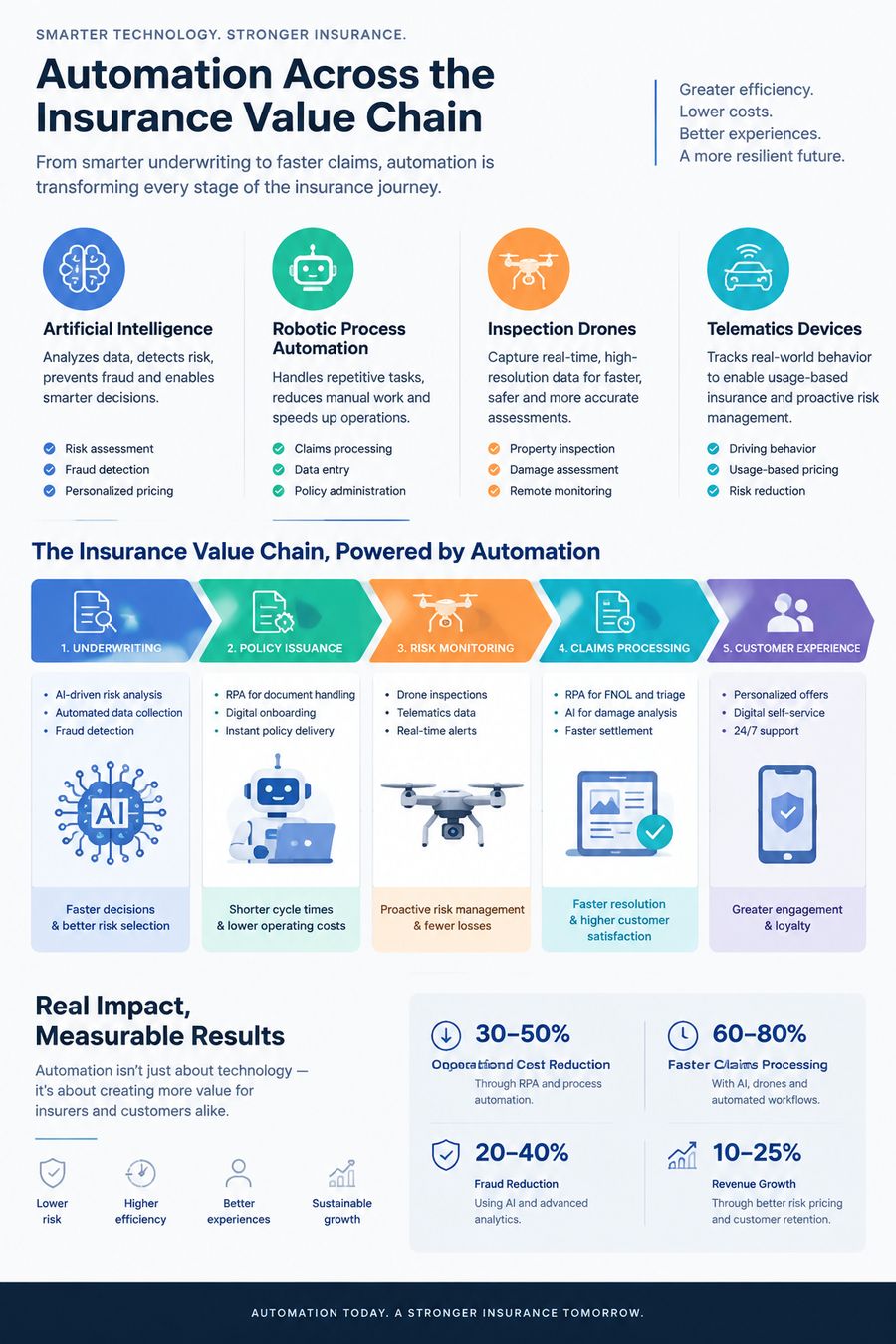
Automation Across the Value Chain
Incumbents feel the same pressure from the outside, as the AmTrust account explains. They face demands to rethink how products are built and priced and pushed to market, with efficiencies spreading across the commercial insurance value chain.
In practice, software drafts quotes and routes claims with few human hands involved. A January 2021 study of more than 100 insurer CIOs found active experiments with:
- AI
- Chatbots
- Drones
- Robotic process automation
- Telematics
- Wearables
From Quote to Claim: Insurtech in Practice
The experiment list explains what insurers are building. It says far less about what a customer feels when buying cover or filing a claim. That gap between lab and life is where insurtech earns or loses its reputation.
Underwriting That Takes Minutes, Not Weeks
Underwriting is the work of deciding what a risk costs. The traditional version collects documents, waits for review, and returns a price in days or weeks. Automated underwriting pulls data directly, applies rules a computer can repeat, and returns a decision while the applicant is still filling in the form.
Speed is the visible gain. Consistency is the quieter one: identical inputs produce identical answers, whoever submits them.
Policies Built Around Behavior
Data-fed pricing also changed what a policy can watch. Telematics devices and smartphone apps record real driving habits: mileage, braking, time of day. A careful driver can then pay less for the same cover, because the insurer sees behavior instead of guessing at it.
The trade-off is privacy. Behavioral pricing only works while customers accept the monitoring, and plenty do not.
Claims Handled by Software, Checked by People
Software reads photos of damage, checks policy terms, and calculates payouts for straightforward cases. Claims are the moment insurance proves its worth, and historically the slowest part of it.
People stay in the loop for the hard parts. Adjusters handle disputes, injuries, and anything the model flags as uncertain. Automation clears the routine queue so judgment goes where it matters.
Why Insurtech’s Importance Keeps Compounding
Each gain in this field funds the next one. Cheaper processing frees up money, and that money goes into data. The data sharpens pricing, the pricing wins customers, and those customers produce still more data to feed the cycle. This loop explains why carriers keep adopting, and why every deployment sets a speed standard rivals feel pressure to match. Investors have noticed: $4.5 billion went into insurtech in 2023 alone. If you want to track the trend, watch what carriers deploy rather than how many startups launch.
The Advantages That Add Up Over Time
What do the benefits actually look like? Industry write-ups credit insurtech with new products, real-time information with better accuracy, and lower costs.
Behind those benefits sits the same reinforcing loop described above. Money saved on processing buys better data, which improves pricing, which attracts customers, who then supply more data. Because each turn of the loop strengthens the next, the gains keep growing instead of flattening out. Any single year looks modest. Across a decade, the compounding adds up to something large.
The Money Says It’s Not a Fad
Investment numbers back this up. Earlier projections expected global insurance tech spending to reach $205 billion by 2019, but a 2021 industry estimate put it at $189 billion. CB Insights calculated that insurtech companies attract $1 of every $10 in fintech venture funding.
Market trackers point the same direction. Grand View Research valued the global insurtech market at $5.45 billion in 2022 and forecast 52.7% compound annual growth from 2023 to 2030.
Incumbents Are Adopting, Not Fighting
Who is buying tells you the most about staying power. A 2026 Datos Insights guide profiles 100 insurtech startups that serve life, annuity, and benefits carriers, sorted with an ABCD framework insurers can use for comparison.
Carriers are not building everything alone. They run pilots, strike partnerships, and buy companies outright. The 2022 carrier’s guide was written for exactly that kind of buyer.
The Core Technologies: AI, ML, and Blockchain
A $4.5 trillion industry runs on a short list of technologies, and three of them carry most of the weight. AI and machine learning handle prediction, while blockchain handles record integrity. Each attacks a different bottleneck, and each carries its own adoption cost.
Artificial Intelligence and Machine Learning in Underwriting and Claims
Underwriting starts the work. AI and ML models score risk using whatever history is available, from property records to past claims files. Claims continues it, with the same tools classifying damage and estimating repair costs before a person opens the file.
Insurers themselves named AI the top item on their experiment list in that CIO study. Governance is where the enthusiasm slows down. A model that cannot explain its answer has trouble passing a regulator, whatever its accuracy.
Blockchain and Enhanced Security for Sensitive Data
The security question keeps coming back because insurance data is a prime target. Attackers want medical histories and payment details. A single breach poisons trust in a business built on that trust.
What blockchain contributes is record integrity rather than protection from intrusion. A distributed ledger timestamps each entry and resists quiet edits, which helps verify documents and deter certain frauds. Think of it as a partner to encryption, not a replacement.
End-to-End Automation of the Insurance Value Chain
Automation is what connects the pieces. A single workflow can carry a policy from first quote to renewal while software handles the routine work end to end, from entering data and generating documents to collecting payments.
Breadth matters here as much as depth. Those same CIO experiments reached well beyond claims, into chatbots, drones, and telematics feeding pricing decisions. Link them together and they become the value-chain efficiency the AmTrust account described. Whether most carriers can actually join these tools up, rather than running each one in isolation, remains the open question.
How Insurtech Gets Applied Across Insurance
Customers notice none of the work that comes first. Licensing costs money, legacy data has to be moved onto new systems, and staff who already work full-time need retraining on top. Regulators review each step, and their sign-off arrives long before anything changes at the front counter. Underwriting, distribution, and claims absorb most of that effort.
Underwriting and Pricing
Give a pricing model accurate inputs and it prices risk on its own merits — this address, this driver, this building — rather than pulling a number from a broad class average. Speed is the reason this area moves first.
The same dependency explains why pricing intelligence starts with clean data. One small input error turns into a large pricing mistake, and everything downstream inherits it: reserves, reinsurance, all of it. Serious insurers fix data quality before they buy models.
Distribution, Brokers, and the Buying Experience
A generation ago, buying a policy meant phone calls, a trip to the broker’s office, and paper forms. Online quoting rebuilt that front end. Comparison sites and digital applications now produce coverage decisions on the spot.
Complex risks still go through brokers, though the toolkit has changed — client records and quotes sit in shared platforms now. Either way, buyers have homework. Collecting questions to ask before signing a policy is a habit that pays for itself.
Claims and Customer Service
This is where customers actually feel the change. Chat handles routine questions, photos replace paperwork when filing, and status tracking shortens a wait that used to be the worst part of the experience.
Service follows the same pattern. Once automated, faster first responses and clearer updates cost almost nothing — which is why this area gets funded early. For many customers a claim is the only real test of their insurer, so minutes saved here count double. Want to judge an insurtech investment? Watch the claims desk first.
Questions the Insurtech Conversation Keeps Raising
Three questions come back every time insurtech comes up, and each has a shorter honest answer than the surrounding debate suggests.
Will insurtech replace traditional insurers?
Not on the evidence so far. Copying an incumbent carrier takes more than software; the licenses alone can take years to secure, never mind the reserves and the decades of claims data sitting in its systems.
Absorption is what actually happens. Carriers adopt the tools, and many of the startups that built them end up selling to those same carriers.
Is policyholder data safer or more exposed?
There is movement in both directions. Every new system adds another place where a breach could start, and monitoring-based policies collect more personal detail than older coverage ever did.
Those same tools, though, can catch a fraud pattern no human reviewer would spot. How safe your data is depends on how well each insurer runs its own operation.
Does insurtech touch every kind of insurance?
Most lines feel some effect. Auto and home see the most activity, and insurtech firms also write life, health, and specialty commercial coverage.
Commercial insurance moves slowest, as the 80-year processing point showed. The deepest change still sits in high-volume personal lines.
Final Thoughts
Most readers face a modest decision: buy coverage from an insurtech, work with the technology inside the industry, or just pay attention to what it changes. Someone choosing a policy can weigh digital service alongside price. Someone working in insurance can watch where carriers point their IT budgets.
Either way, the importance of insurtech rests on a lasting shift in how insurance is made and sold: pricing built on data, processing handled by automation, claims paid faster. Investment keeps flowing into the space, and it sits inside an industry of enormous global size.