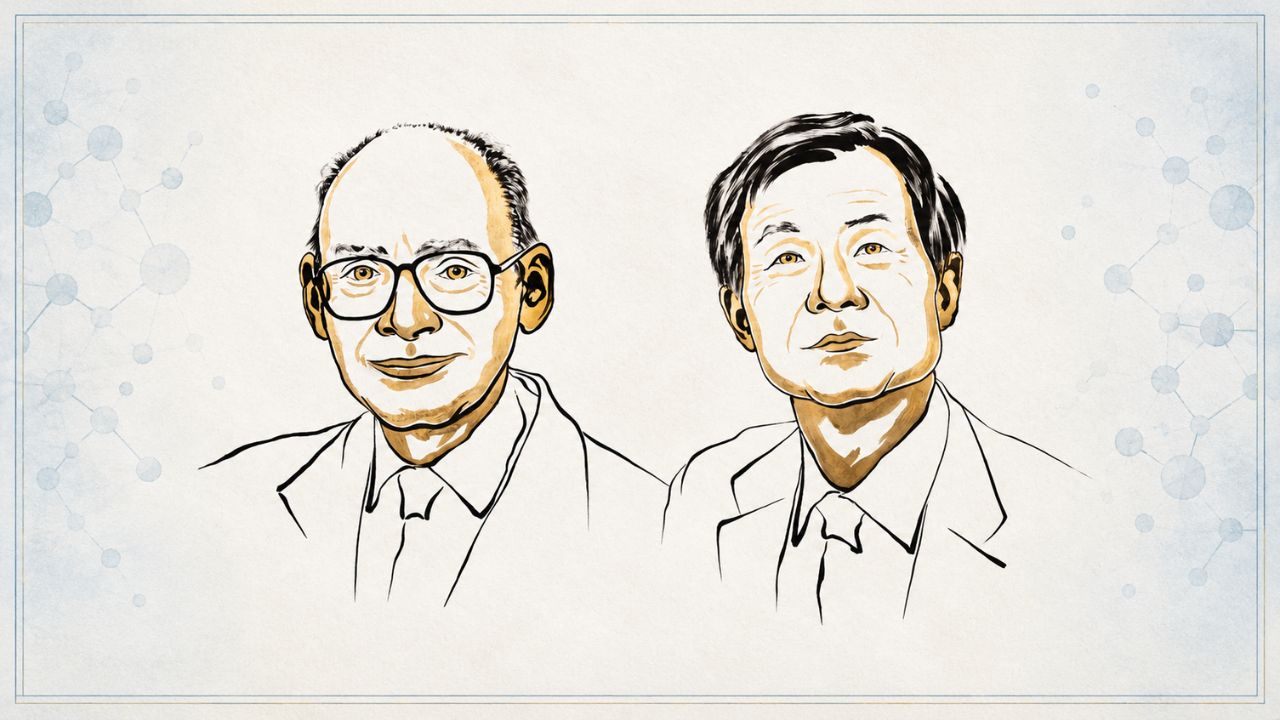
The Nobel Prize in Chemistry 2026 was awarded to Henri B. Kagan from France and Kenso Soai from Japan for discoveries that showed how chemical reactions can strongly favor one of two mirror-image forms of a molecule. Announcing the award on October 7, the Royal Swedish Academy of Sciences cited their work on “non-linear effects and autocatalysis in asymmetric organic synthesis.” They will share the prize of 12 million Swedish kronor equally.
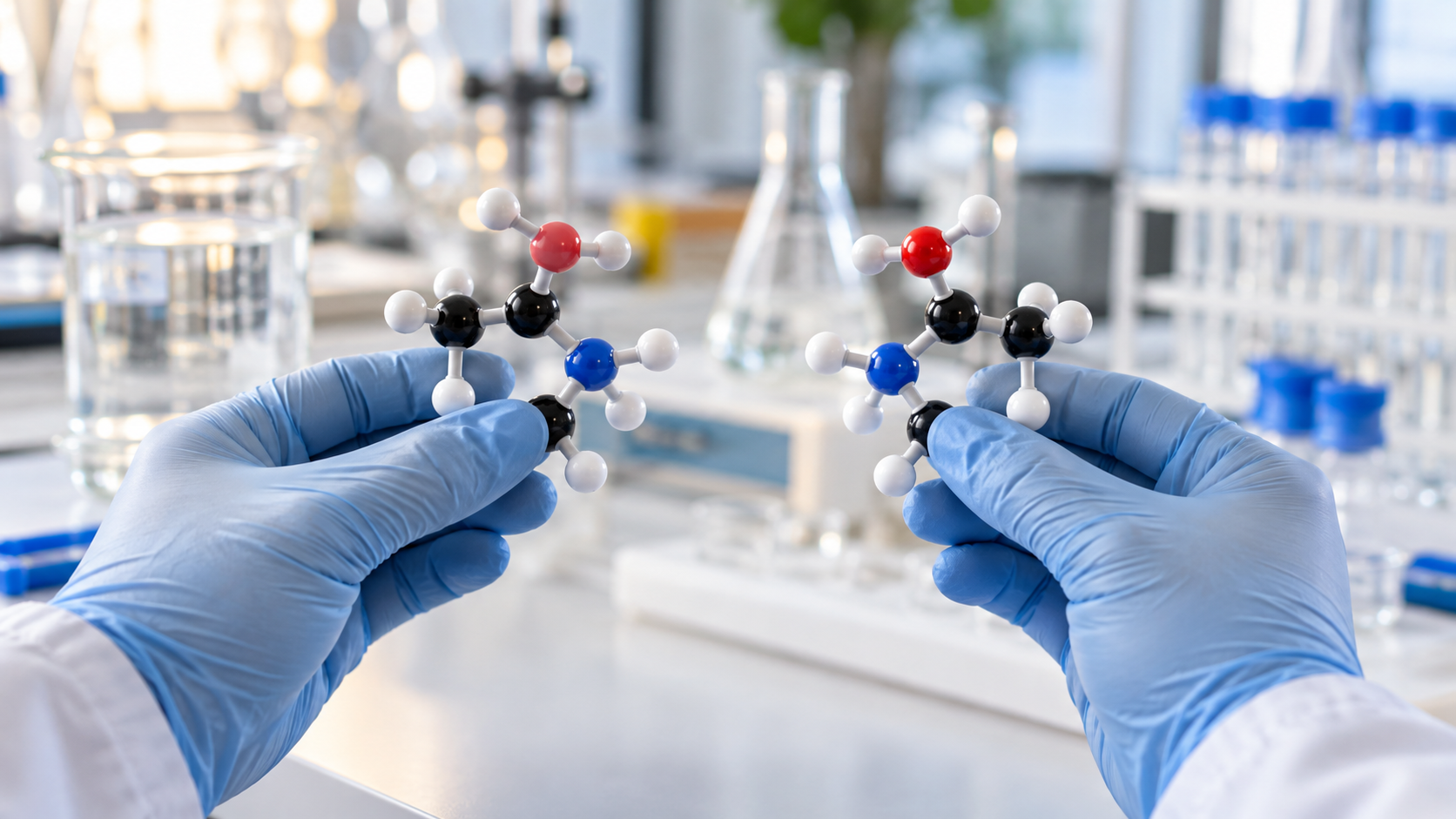
Hold up your hands. They have the same parts, but one cannot be placed over the other so that every finger lines up. Some molecules have the same property: their atoms are arranged in forms that are mirror images but cannot be superimposed.
That difference matters because living systems can distinguish between the two forms. For chemists, the challenge is both practical and fundamental. How can they make predominantly the form they need? And how can a slight preference for one form become an overwhelming one?
Kagan and Soai approached those questions through separate experiments years apart. Kagan found that a small bias in a catalyst could produce a surprisingly large bias in the molecules it made. Soai later demonstrated a reaction in which a favored product helped make more of itself. Their work shows how chemistry can acquire a strong sense of direction without proving that life followed the same path.
Why molecular handedness matters
This year’s chemistry prize centers on chirality, the term for an object’s handedness. At the molecular scale, a change in three-dimensional arrangement can alter how a substance interacts with the body.
The same atoms can make different forms
Two molecular forms that are non-superimposable mirror images are called enantiomers. Think of a left and a right glove: they have similar shapes, but only one fits a particular hand properly. A protein or other biological target can likewise interact differently with each enantiomer.
Proteins in our cells are built predominantly from L-amino acids. The sugars in DNA have a preference for the D form. The L and D labels describe molecular configuration; they do not by themselves tell us which way a substance rotates polarized light.
This strong preference for particular forms in living systems is called homochirality. It poses a lasting question. If a reaction begins without a built-in handed preference, why would one molecular form come to dominate rather than the two appearing in equal proportions?
The stakes for medicines
Some drug molecules can also be made in two mirror-image forms. They may bind differently to a biological target, be processed differently by the body, or have different effects. Manufacturers therefore need to know and control the composition of the medicine they produce.
That does not mean one form is always helpful and its mirror image is always harmful. Both can have useful effects, and a mixture may sometimes be appropriate. Each drug must be assessed on its own evidence. The chemistry recognized by this Nobel gives researchers better ways to investigate and control handedness; it does not make that medical judgment for them.
A puzzle stretching from Pasteur to the Nobel announcement
The 2026 award joins a long effort to understand how an uneven balance between mirror-image molecules can arise. The story begins with the discovery of molecular handedness and then moves to a question that took chemists much longer to test.
In the nineteenth century, Louis Pasteur separated mirror-image crystals of a tartaric-acid salt. He later found that living organisms did not necessarily treat the two forms alike. As researchers learned more about amino acids and sugars, the preference built into biology became more striking.
In 1953, physicist F. C. Frank proposed a mathematical model in which a tiny initial advantage for one handed form could grow. The model called for a form of self-reinforcement, along with a way to hold back its rival. One key idea was autocatalysis: the product of a reaction helps drive the production of more of that same product.
Frank showed that strong asymmetry was possible in principle. The next challenge was to find real chemical reactions that could magnify an imbalance rather than merely describe it on paper.
What Henri Kagan found in 1986
Kagan’s discovery grew out of a practical problem in asymmetric synthesis. Chemists use chiral catalysts to steer reactions toward one enantiomer, but the link between a catalyst’s handedness and the resulting product was not as simple as it appeared.
A modest input, a larger effect
A catalyst helps a reaction proceed without being used up in the overall process. Researchers had reason to expect that a catalyst mixture with a modest excess of one-handed form would make a product with a similarly modest excess. Kagan and his collaborators showed that, in some reactions, this relationship was not a straight line.
A small imbalance in a chiral catalyst could lead to a much stronger preference in the product. This is a non-linear effect: the product’s handedness does not change in simple proportion to the catalyst’s. Kagan reported such behavior in three asymmetric reactions in 1986. It was a finding about particular chemical systems, not a rule that every reaction amplifies a bias.
Why the catalyst behaved differently
In the systems highlighted by the Nobel committee, a metal center could associate with two chiral components. The resulting catalyst arrangements could contain two components of the same handedness or one of each. The mixed arrangement drove the reaction much more slowly than the matched ones.
That difference in speed changed which routes contributed most to the final product. A catalyst mixture that seemed only slightly tilted toward one form could yield a substantially more lopsided result.
The finding also gave chemists a way to learn about a catalyst’s hidden workings. If the product changed unexpectedly as the catalyst mixture changed, the shape of that relationship offered clues about how the catalyst assembled and reacted. Those clues could help researchers refine selective chemical processes.
How Kenso Soai made a preference grow by itself
Soai pursued a more dramatic question: could a reaction product encourage the creation of more product with the same handedness? His experiments showed that chemical feedback could take a slight initial difference and make it much larger.
The 1995 demonstration
Soai and his collaborators studied a chiral compound called a pyrimidyl alkanol. In their reaction, the alcohol produced could help catalyze the formation of more of itself. If one enantiomer had an early advantage, that advantage could grow as the reaction continued.
The chiral alcohol used to start a key 1995 experiment had an enantiomeric excess of 2%. This measure expresses the difference between the shares of the two forms: a 51-to-49 mixture has a 2% excess. After the reaction, the product’s excess reached 87%, equivalent to a 93.5-to-6.5 mixture.
The reaction did more than preserve the initial imbalance. It amplified it. Yet the experiment still began with a supplied chiral preference, leaving a further question: could an overwhelming preference arise without deliberately adding one?
The 2003 result: a tiny lead from chance
In work reported in 2003, Soai and a larger group of collaborators used starting ingredients without a chiral preference. As the reaction began, chance could produce a minute excess of one enantiomer. Autocatalysis then reinforced that early difference until the dominant form could account for 99.99% of the product.
That figure is the share of the dominant product, not the size of the starting imbalance. It also describes a near-exclusive result, not an absolute absence of the other form.
What strikes me most is that the winning side could change between runs. One experiment might favor one enantiomer; another could favor its mirror image. The reaction demonstrated how a slight lead can become decisive without specifying in advance which side must win.
What the discoveries change for chemistry and medicine
The laureates’ work has different kinds of value. Kagan’s results help chemists understand and improve selective reactions. Soai’s reaction provides a striking experimental model of how molecular handedness can reinforce itself.
When a catalyst shows a non-linear effect, researchers can use that behavior as a clue to its mechanism. A better picture of the reaction may help them produce more of the desired enantiomer. Such control matters in pharmaceutical chemistry and can also matter when making flavors, fragrances, agricultural chemicals, and some materials.
Soai’s specialized autocatalytic reaction established that a small difference can grow to near dominance through chemical feedback. It is chiefly a demonstration of that principle. Its existence does not mean that drug manufacturers routinely use this particular reaction to make medicines.
Drug development also involves questions that a synthesis experiment cannot answer. Researchers must examine the effects of each enantiomer, decide whether a single form or a mixture is appropriate, and check whether the forms can interconvert in the body. Better control over what a reaction produces makes those decisions more informed, but it cannot replace testing.
Did they explain why life uses one hand?
The Nobel committee recognizes a solution to the chemical question of how homochirality can emerge. That is a substantial achievement. It is narrower than proving what happened during the origin of life on Earth.
Soai’s reaction uses a purpose-built chemical system, not the amino acids and sugars central to biology. It shows that chemistry can amplify a slight imbalance, even when no chiral substance is deliberately added at the start. Whether a similar process operated under conditions on the early Earth is still unknown.
Nor does a reaction that can favor either mirror form explain, by itself, why living systems came to use the particular forms they do. The mechanism answers how one side could take over in a suitable system. The history of which side prevailed in biology remains a separate question.
Soai has described his work as something short of a final answer about life’s origins. That distinction protects the real result from an exaggerated claim. The experiments gave researchers a working model of powerful amplification; the route from early chemistry to living cells still needs to be established.
Why the 2026 prize recognizes a distinct advance
Asymmetric synthesis has been honored before. The 2001 Nobel Prize in Chemistry recognized catalytic asymmetric synthesis, while the 2021 prize recognized asymmetric organocatalysis. This year’s award addresses how an existing preference can be magnified and how a product can reinforce production of its own handed form.
The discoveries also span a long period. Kagan reported non-linear effects in 1986. Soai and colleagues published their amplifying autocatalytic reaction in 1995, followed by the result using achiral starting ingredients in 2003. These were separate projects built through the work of research teams, not one joint experiment by the two laureates.
The award recognizes Kagan, associated with France’s Université Paris-Sud, and Soai, of Tokyo University of Science, for advances that connect a fundamental puzzle to ways of studying and directing real reactions. It also recognizes the time it can take for the full meaning of an experimental finding to become clear.
The question that remains after the award
The next test is how far these principles can travel. Can comparable amplification occur with molecules closer to life’s building blocks? Could it happen under plausible early-Earth conditions? What would allow an emerging preference to persist?
Kagan and Soai gave chemists concrete reactions with which to investigate those questions. Their Nobel Prize recognizes a powerful answer about what chemistry can do: turn a small difference into a nearly exclusive outcome. Whether that capacity explains the particular handedness of life is the next, harder story to uncover.