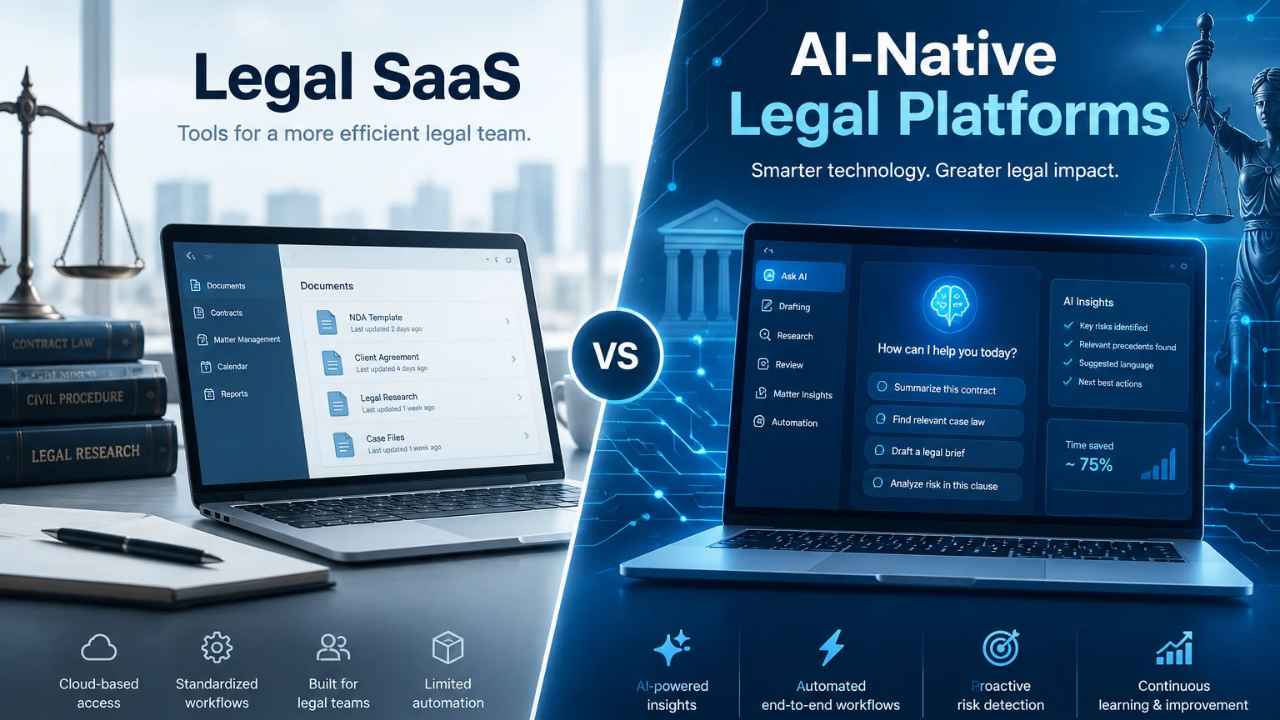
Law firms and company legal teams now have to choose between two kinds of tools. One is the cloud software they already know. The other was built around AI from the very first line of code. The legal SaaS vs. AI-native legal platforms choice matters more in 2026 than ever, because money, products, and court rules are all changing fast.
Here is the short answer. Legal SaaS helps lawyers store, track, and manage their work. AI-native platforms try to do part of the work for them, like reviewing a contract or drafting a brief. The line between the two gets thinner every month. The tools most likely to win will mix trusted legal data with AI that can finish real tasks.
What Legal SaaS Means Today
Legal SaaS is software you rent over the internet instead of installing it on your own computers. You usually pay a monthly or yearly fee for each user. It runs the business side of law: case files, time tracking, billing, client intake, calendars, and document storage. Research databases like Westlaw and LexisNexis are sold the same way.
Almost all of these products now have AI features. But in the legal SaaS vs. AI-native legal platforms comparison, what matters is where the AI sits. In classic legal SaaS, AI is an extra layer on top of a product that would still work fine without it. Turn the AI off, and your billing and calendars keep running.
What Makes a Legal Platform AI Native
A platform is AI native when the AI model is the product. Take the model away and very little is left. Harvey and Legora are the two best known names.
These tools start with a task, not a form. A lawyer can upload 200 supplier contracts and ask which ones let the other side walk away if the company is sold. The platform reads them, flags the risky ones, and drafts a short memo.
The newest versions use AI agents. An agent is a tool that can plan a job, work through many steps, check its own output, and hand back a draft. That is the real split in the legal SaaS vs. AI-native legal platforms debate. One helps you manage the work. The other tries to do it.
Harvey says 80% of Am Law 100 firms use its products. Legora reported about 800 customers in more than 50 markets in March 2026.
Legal SaaS vs. AI-Native Legal Platforms at a Glance
This table shows the legal SaaS vs. AI-native legal platform difference in its simplest form. Read it as a starting point, because real products now borrow from both columns.
| Area | Legal SaaS | AI native platforms |
|---|---|---|
| Built around | Records, files, and workflows | AI models and agents |
| Main job | Manage legal work | Do parts of legal work |
| Usual pricing | Fee per user each month | Fee per user, shifting toward pay per use |
| Main strength | Trusted data and stable systems | Speed in drafting, review, and research |
| Main risk | Falling behind on AI | Made-up answers and high cost |
| Examples | Clio Manage, Westlaw | Harvey, Legora |
The clean split in the table is mostly gone in real life. The next two sections show why.
The Money Is Pouring Into AI First
Investors are backing both sides of the legal SaaS vs. AI-native legal platforms split, but the biggest checks go to the AI side.
- Harvey raised $550 million in September 2026 at a $15.5 billion value, up from $11 billion in March. Reports put its yearly recurring revenue above $400 million and its customer count above 3,000.
- Legora raised $550 million in March 2026 at a $5.55 billion value, then added $50 million more in April at $5.6 billion.
- Clio bought vLex for $1 billion and raised $500 million at a $5 billion value.
High prices also bring high pressure. Companies valued this high must keep growing fast. Buyers should expect hard sales pushes and frequent product changes.
Old Players Are Rebuilding, Not Waiting
In early 2026, Anthropic released a legal plugin for its Claude Cowork tool. It could review contracts, sort NDAs, and track compliance tasks. On February 3, investors panicked. Thomson Reuters stock fell about 16% to 18% in one day. RELX, which owns LexisNexis, dropped 14%, and Wolters Kluwer fell 13%. The fear was simple: if a general AI tool can review contracts, why pay for special software?
The older companies answered by rebuilding. In August 2026, Thomson Reuters made its new CoCounsel Legal widely available in the US. The company rebuilt it from scratch on Anthropic’s Claude Agent SDK. It is built on Westlaw and Practical Law content, and its Brief Builder tool drafts briefs and motions with citation checks included.
Clio took a different path. It bought vLex to get Vincent AI and a library of more than one billion legal documents across 110 countries and regions.
Meanwhile, Harvey and Legora both depend on models from big AI labs. Harvey also released Tenet, its first legal model trained on top of an open model, to cut that reliance. So the legal SaaS vs. AI-native legal platforms question is turning into a race toward the same middle ground. SaaS companies are adding agents. AI startups are adding data and workflows.
Where the Technology Is Heading
Four shifts will shape the legal SaaS vs. AI-native legal platforms market over the next few years.
- From answers to finished work: Early legal AI answered one question at a time. The new tools take a whole task, such as a due diligence review, and return a draft memo with sources linked.
- Your own knowledge becomes the edge: Harvey framed its latest raise around helping legal teams own their intelligence. Thomson Reuters now lets CoCounsel draw on each firm’s own documents. The firm with the best organized past work will get the most from AI.
- Pricing moves away from the seat: Paying per user is still the norm. But Bloomberg Law reported in June 2026 that pay per use models are spreading, and buyers find them harder to compare. Prices already run from free to more than $1,200 per seat each month.
- Checking work becomes a selling point: A public tracker run by researcher Damien Charlotin listed more than 1,600 court cases with AI-made content by mid-June 2026. In late May, the Florida Supreme Court changed its rules so filings must confirm that every cited authority exists and is cited correctly. Tools that link every citation to a real source will earn trust faster.
How to Choose AI for Your Firm or Legal Team
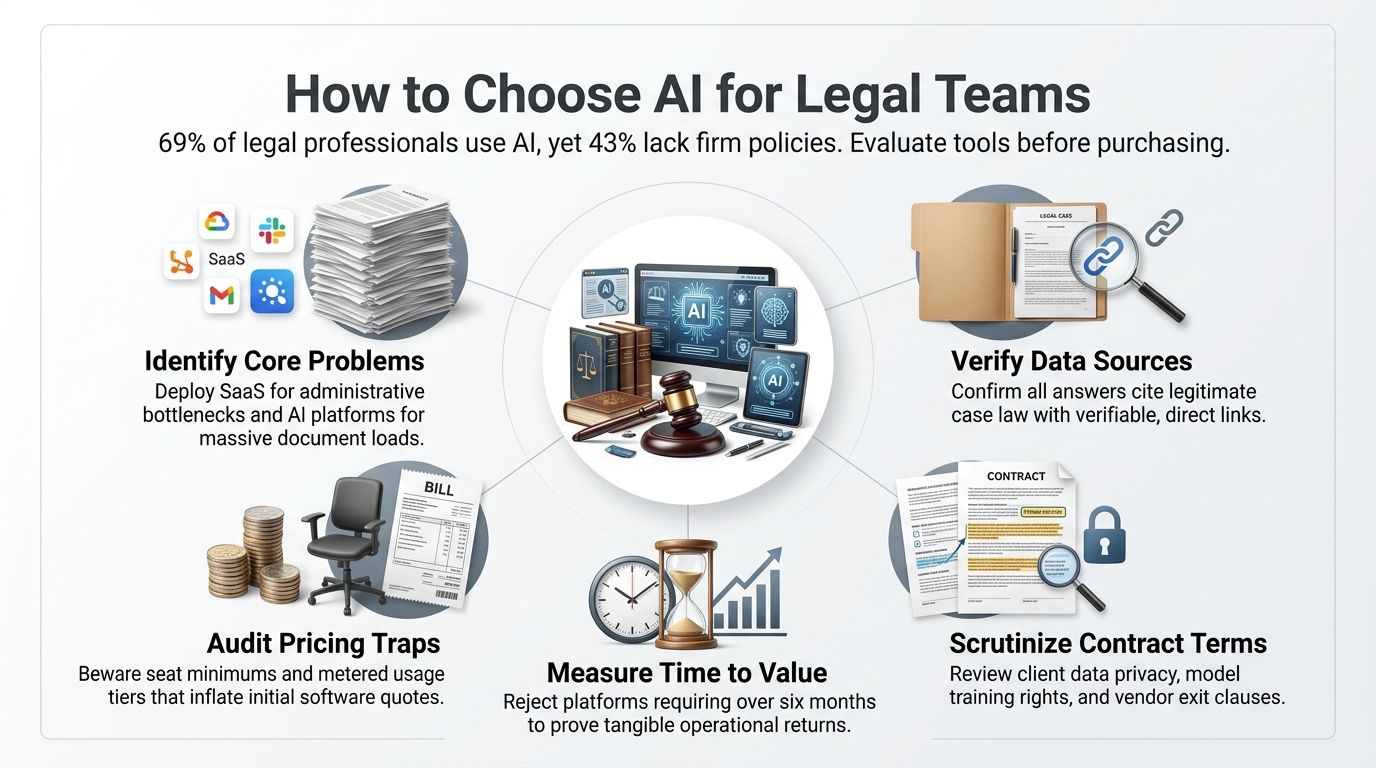
Most lawyers already use AI in some way. The 8am 2026 Legal Industry Report found that 69% of legal professionals use general AI tools for work, up from 31% the year before. Yet 43% said their firm has no AI policy and no plan to write one.
That gap is where the legal SaaS vs. AI-native legal platforms decision often goes wrong. Teams buy a tool before they know what job it should do. Use this checklist first:
- Name the pain: If deadlines, billing, or intake are the problem, a legal SaaS product with AI features is usually enough. If the problem is a huge pile of documents, an AI platform is worth a trial.
- Check the data source: Ask whether answers come from real case law and whether every citation links back to it.
- Read the contract closely: Look at data use, model training, and exit terms. This guide on legal considerations for SaaS agreements covers what to watch.
- Measure how fast you see results: A tool that takes six months to show value may never pay off. Learn how to judge time to value before you sign.
- Watch the fine print on price: Seat minimums and usage meters can make a cheap quote expensive.
Founders building legal tools have room too. Big platforms chase big law firms, which leaves small practice areas open. If you plan to build one, this guide on how to run a SaaS company as a solo founder is a good place to start.
Final Thoughts
The legal SaaS vs. AI-native legal platforms debate will not end with one side winning. Legal SaaS brings trusted data and stable systems. AI platforms bring speed and agents that can finish real work. Each is now copying the other.
For most teams, the smart next step is small. Write a simple AI policy, pick one painful task, and test one tool on it for 30 days. Check every citation it gives you. Then decide based on what you saw.