
The 2026 Nobel Prize in Physics was awarded to Francis Halzen for his decisive contributions to the IceCube Neutrino Observatory and the discovery of high-energy neutrinos from space. The Royal Swedish Academy of Sciences announced the award on October 6. Halzen, a physicist at the University of Wisconsin–Madison, is this year’s sole physics laureate.
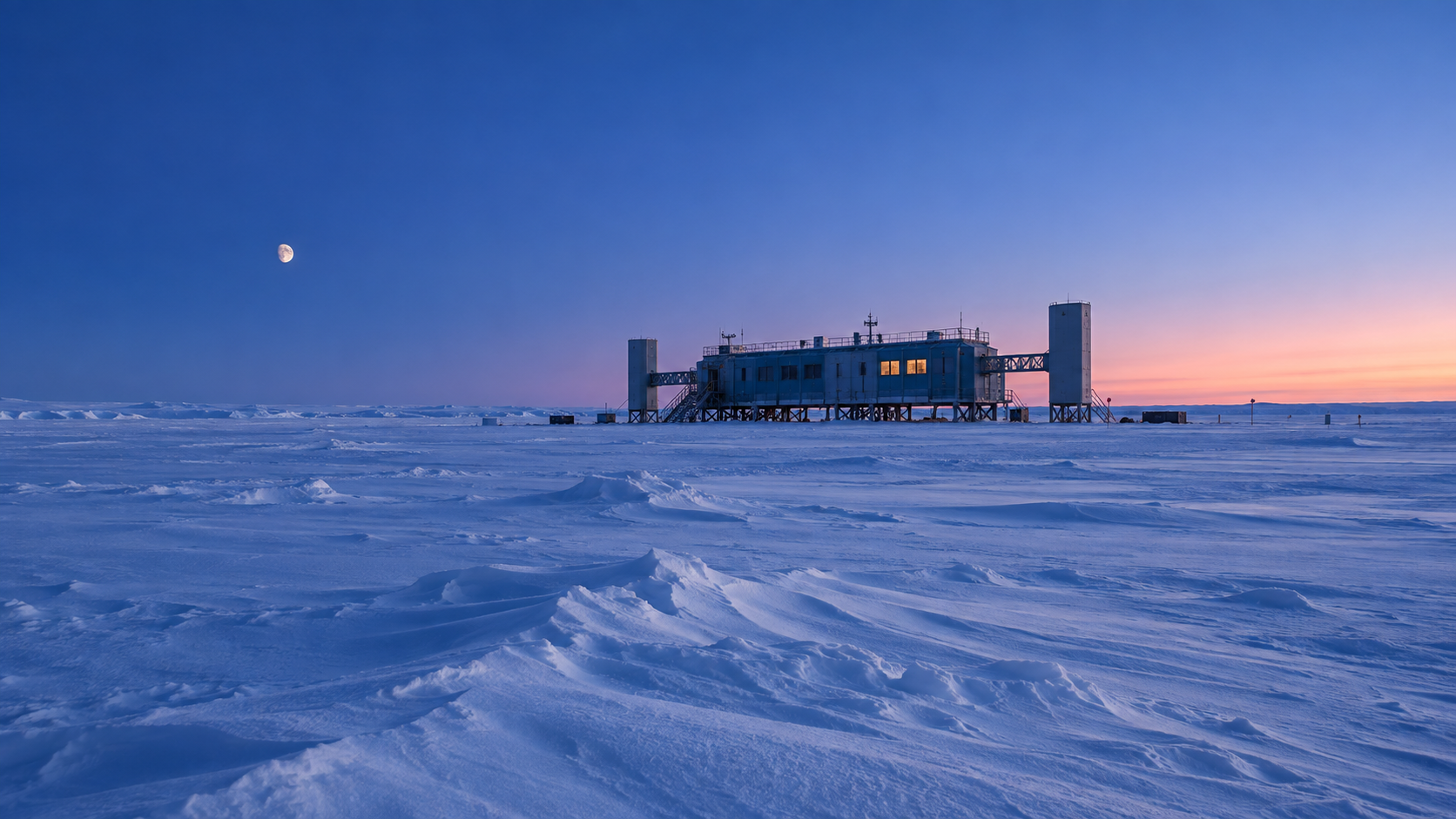
At the South Pole, IceCube uses a vast stretch of Antarctic ice as part of its detector. Thousands of sensors buried deep below the surface look for the faint signs left when an elusive particle called a neutrino interacts with matter. The particles IceCube studies can carry information from some of the most energetic places in the universe.
IceCube has answered a question that once seemed out of reach: could scientists detect a stream of these high-energy particles from the wider universe? Its findings have made the next question more urgent. Where are they coming from?
What the 2026 physics Nobel recognizes
The Nobel Committee credited Halzen for his leadership in creating IceCube and for the discovery of high-energy neutrinos of astrophysical origin. IceCube established that exceptionally energetic neutrinos are arriving from beyond our solar system. That gave researchers a new way to investigate the places where nature accelerates particles to extraordinary energies.
The distinction matters. Halzen did not discover neutrinos, and IceCube was not the first experiment to detect a neutrino from space. Earlier work had already found neutrinos from the Sun and from a nearby supernova. Other Nobel Prizes have recognized neutrino detection and the discovery that neutrinos change type as they travel. This award is about the high-energy cosmic population IceCube found and the observatory that made its study possible.
The prize carries 12 million Swedish kronor. Halzen is expected to receive his medal and diploma at the Nobel ceremony in Stockholm on December 10. The work behind the award began decades before this week’s announcement.
Why astronomers wanted to follow neutrinos
Astronomers have spent decades looking for better clues to the places that accelerate cosmic rays. Neutrinos promised one, provided anyone could detect enough of the right kind.
A particle that is difficult to stop
Neutrinos have no electric charge and very little mass. Enormous numbers pass through Earth, and through us, without any noticeable effect because they rarely interact with matter. That makes them frustrating to detect. It also makes them useful messengers.
Light can be blocked or absorbed by dense material. High-energy cosmic rays, mostly charged particles such as protons and atomic nuclei, can be diverted by magnetic fields during their journeys through space. A neutrino can often leave a crowded environment and travel a great distance largely undisturbed. If scientists can work out where it came from, they may learn something that light and cosmic rays alone cannot tell them.
Neutrinos are also produced in the Sun and in Earth’s atmosphere. IceCube’s Nobel-winning search focused on a much rarer, exceptionally energetic population. Separating those events from more familiar signals is part of the difficulty.
The question behind the experiment
For more than a century, scientists have studied cosmic rays without fully explaining where the most energetic ones are accelerated. In powerful environments, accelerated particles can collide with surrounding gas or radiation and ultimately produce neutrinos. Finding those neutrinos gives researchers another clue about where particle acceleration occurs.
A neutrino can offer a directional clue, but the precision varies from event to event. Establishing what produced it takes statistics, careful reconstruction and, often, observations from other telescopes.
How IceCube turned the South Pole into a detector
IceCube’s detector is buried below the South Pole, but the idea began long before the first sensors went into the ice. Halzen set out his vision in 1988. Tests through a predecessor project called AMANDA helped establish that deep ice could serve as a suitable detection medium. IceCube’s construction began in 2004. Its final sensor string was lowered into place in December 2010, and the completed instrument began its first full physics run in May 2011.
Those dates convey something important about the prize. This was not a single experiment carried out in one laboratory. Researchers first had to test an unconventional idea, develop the equipment, drill deep into Antarctic ice and keep a complex detector operating in one of the world’s most demanding locations.
The light IceCube actually sees
The observatory’s original array places 5,160 optical sensors on 86 strings, extending through roughly one cubic kilometre of ice. The sensors lie about 1.5 to 2.5 kilometres below the surface, where they can record faint light in the dark, relatively clear ice.
IceCube does not photograph a neutrino. On the rare occasion that one interacts with matter in or near the detector, the interaction can create fast-moving charged particles. Those particles produce a brief pattern of Cherenkov light. The sensors record which parts of the detector lit up and when; researchers use that pattern to estimate the incoming neutrino’s direction and energy.
The detector has to be enormous because the interactions are so rare. Size alone is not enough, though. Particles produced when cosmic rays strike Earth’s atmosphere create a flood of background events. Atmospheric neutrinos can also resemble the signals scientists are seeking. IceCube’s analyses must show that a result cannot reasonably be explained by that background.
The 2013 discovery that changed the question
The first decisive result concerned a population, rather than a named object in the sky. In 2013, the IceCube Collaboration reported 28 high-energy candidate events found in data collected over two years. Their combined properties were inconsistent with a purely atmospheric explanation. The data provided strong evidence for a population of neutrinos arriving from beyond the solar system, even though some events in the sample could still be atmospheric. An independent analysis of later data strengthened that finding.
The question shifted from whether IceCube could find such a cosmic signal to where it came from.
The result did not identify the birthplace of each event. Reconstructing a neutrino’s incoming direction involves uncertainty, and an individual event can be hard to separate from background. Finding sources would require more observations, better analysis, and help from telescopes looking for different kinds of signals.
From a cosmic signal to possible sources
Knowing that high-energy cosmic neutrinos reach Earth does not tell us which objects produce them. Over the following decade, IceCube began to narrow that gap, first through a well-timed alert and then through studies of events accumulated over years.
A clue from a distant blazar
In September 2017, IceCube sent an alert about a high-energy neutrino. Other observatories followed up and found that its direction and timing coincided with heightened gamma-ray activity from TXS 0506+056, a distant blazar powered by a supermassive black hole. Papers published in 2018 also reported an earlier excess of neutrino events from that direction in archived IceCube data.
Together, those findings made the blazar a persuasive candidate source. They also showed the value of multimessenger astronomy: a neutrino alert can prompt telescopes to look for light from the same part of the sky. The association is evidence for this source, not an explanation for every neutrino in IceCube’s broader sample.
An active galaxy closer to home
In 2022, IceCube reported evidence of high-energy neutrino emission from NGC 1068, also called Messier 77. It is an active galaxy roughly 47 million light-years away. Unlike a story built around a single alert, this finding drew on an excess of events accumulated over years.
The result is compelling because neutrinos can escape environments around an active galaxy’s central black hole that may be difficult to study using some kinds of light. Researchers have a new clue about activity in that region. They do not yet have a complete explanation of everything happening there.
A signal across the Milky Way
In 2023, the collaboration reported high-energy neutrino emission associated with the plane of our own galaxy. That finding broadened the picture again: IceCube’s neutrino sky includes a signal from the Milky Way as well as evidence associated with more distant galaxies.
It would be misleading to describe the result as a sharp photograph of individual cosmic accelerators. The analysis found a broader pattern of emission. Locating the objects responsible for every part of that pattern remains a different challenge.
What neutrinos add to astronomy
Each kind of observation reveals something different. Visible light, radio waves, X-rays, and gamma rays have helped astronomers study the universe for decades. Neutrinos add information carried by particles that can escape some dense regions and travel without being bent by magnetic fields. Together, those signals let researchers test more detailed ideas about the environments producing them.
To me, IceCube’s achievement is clearest in the question it changed. Researchers once needed to establish whether a detector in ice could find these rare cosmic neutrinos. Now they can ask which sources produce them, how those sources accelerate particles, and how much each type of object contributes to the signal reaching Earth.
The blazar association, the evidence from NGC 1068 and the Milky Way signal give them places to investigate. They do not yet provide a complete account of where the high-energy neutrinos come from.
Nobel Prize in Physics: One laureate and a much larger team
The Nobel Prize in Physics 2026 names Halzen alone. IceCube, however, is an international undertaking. Its collaboration now includes about 450 scientists at 58 institutions in 14 countries. Engineers, Antarctic crews, instrument builders and analysts have all been necessary to turn a proposal into a working observatory and scientific results.
Halzen has acknowledged that shared effort. He saw what Antarctic ice might make possible and helped lead the detector from proposal through construction and discovery. The people who built, calibrated and studied the instrument belong in the story too.
The decades of work behind the award span many careers, including years when the team could not know whether its hoped-for cosmic signal would appear.
What IceCube still needs to find
IceCube’s next phase is being built around the questions its first discoveries raised. Five new, more closely spaced strings were installed in 2026, adding more than 600 enhanced sensors and calibration instruments to the existing detector. The aim is to improve measurements, sharpen scientists’ understanding of how light travels through the ice and extend the observatory’s reach. The new equipment is being commissioned; the collaboration expects its first science data from the upgrade later in 2026.
A much larger project, IceCube-Gen2, is also being proposed. Its ambition reflects a practical limit of the current science: studying more sources with greater confidence requires more well-measured neutrino events. For now, Gen2 remains a proposal.
We now know high-energy neutrinos arrive from the wider universe. Evidence points to particular galaxies as sources, and the Milky Way produces a broader signal of its own. The sources responsible for most of the cosmic flux remain to be identified.
Halzen’s Nobel recognizes the work that made high-energy neutrino astronomy possible. IceCube turned Antarctic ice into an observatory for particles from violent cosmic environments. Its next task is to learn which engines sent them.