You have invested in new software, automated routine tasks, and trained your team. Now comes the question that matters: is it paying off? Calculating the ROI of digital transformation helps you put a financial value on those changes and compare it with what you spent.
But a faster workflow does not always mean lower costs, and a busy new platform does not prove better results. You need to know what improved, how much that improvement is worth, and whether the technology deserves the credit.
This guide walks you through the costs to include, the benefits to measure, and a practical way to calculate your return without relying on optimistic guesses.
What Is Digital Transformation ROI and Why Does It Matter
Digital transformation ROI is the measurable return a business gets from the money, time, and staff effort put into modernizing processes, systems, and customer experiences, expressed as a ratio or percentage against total program cost. It matters because digital transformation initiatives are expensive, span multiple years, and compete with other capital projects for the same budget, so leadership needs a consistent way to compare them.
Without a clear ROI model, digital transformation becomes a matter of opinion. One executive sees modernized systems and calls it a win. Another sees the invoice from the systems integrator and calls it a waste. A documented ROI calculation settles the argument with data instead of impressions.
Organizations that treat ROI as an afterthought tend to run into three problems:
- They cannot tell the board why a transformation program deserves more funding.
- They cannot tell which parts of the digital transformation journey are working and which parts are dead weight.
- They cannot defend the program when budgets tighten, because there is no business case left to defend.
How Do You Measure ROI on Digital Transformation Projects
You measure ROI on digital transformation projects by comparing a documented pre-transformation baseline against post-implementation results, over a fixed time window, using the standard ROI formula. Get the baseline wrong and every number that follows is wrong too.
The core calculation looks like this:
ROI = ((Net Benefit − Total Investment) / Total Investment) x 100
Net benefit includes cost savings, new revenue, and avoided costs. Total investment includes every dollar spent on technology, data infrastructure, integration, change management, and training during the measurement period.
A practical, board-ready model has three components:
- Current-state cost. Document cost per unit, error rates, and processing times before any change happens. This is your baseline and it should be locked before the project starts, not reconstructed afterward.
- Expected financial impact. Attribute a specific revenue lift or cost reduction to the transformation effort, and be explicit about what assumption drives that number. Vague claims like “improved efficiency” do not survive a finance review.
- Total program cost. Include technology licensing, data infrastructure, integration work, training, and the first year of run-and-maintain costs, not just the initial build.
Use a consistent time horizon, typically 12 to 36 months, so comparisons across departments and projects mean something. A process automation project measured over 12 months and a cloud migration measured over 36 months will produce ROI figures that are not actually comparable, even though both use the same formula.
What Metrics Should You Track for Digital Transformation ROI
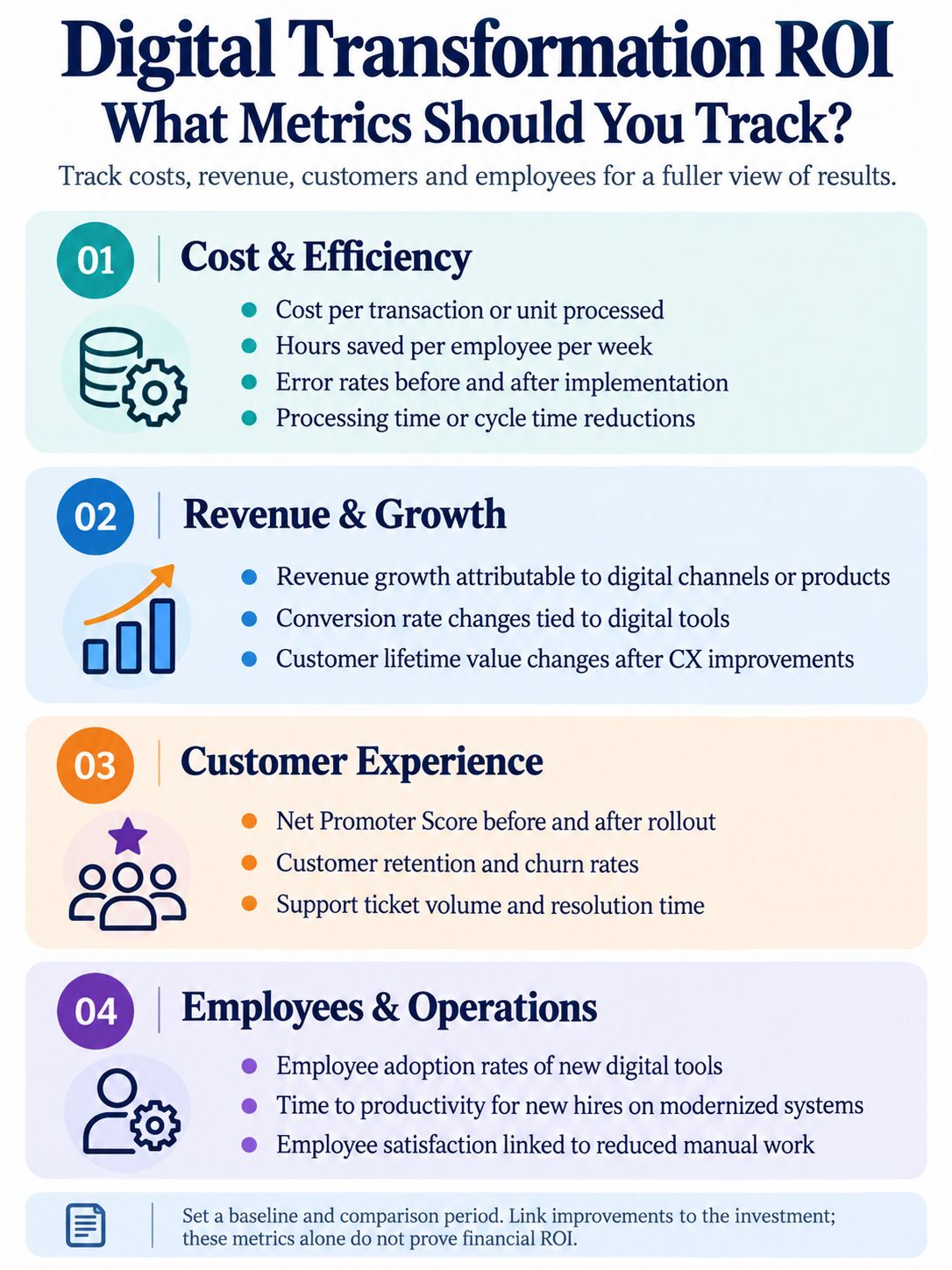
The metrics that matter most for digital transformation ROI fall into four groups: cost metrics, revenue metrics, customer metrics, and employee or operational metrics. Tracking all four prevents a narrow, misleading picture of success.
Cost and efficiency metrics:
- Cost per transaction or cost per unit processed
- Hours saved per employee per week through automation
- Error rates before and after implementation
- Processing time or cycle time reductions
Revenue and growth metrics:
- Revenue growth attributable to new digital channels or products
- Conversion rate changes tied to digital tools
- Customer lifetime value shifts after a customer experience transformation
Customer-facing metrics:
- Net promoter scores before and after rollout
- Customer retention and churn rates
- Support ticket volume and resolution time
Employee and organizational metrics:
- Employee adoption rates of new digital tools
- Time to productivity for new hires on modernized systems
- Employee satisfaction or engagement scores linked to reduced manual work
Digital Transformation ROI Calculator Tools and Solutions
A digital transformation ROI calculator works best when it combines a simple spreadsheet-based formula with purpose-built software for tracking automation, process data, and adoption rates over time. No single calculator fits every industry, so most organizations use a core ROI model plus specialized platforms for the type of transformation they are running.
At a basic level, an ROI calculator needs three inputs: baseline cost, projected benefit, and total investment. From there, specialized tools fill in the gaps that spreadsheets cannot handle well, such as live process data, document volumes, or RPA bot performance.
Enhance Your Business with AI
Artificial intelligence tools extend ROI tracking by analyzing process data in real time rather than waiting for quarterly reports. Businesses use AI for document classification, predictive maintenance, and customer service triage, each of which generates its own measurable cost and revenue signal.
Advance with Expert Consulting
Consulting support from a digital transformation specialist, such as BP3 Global Inc, helps organizations build a defensible ROI calculation instead of guessing at assumptions. Firms like BP3 Global typically bring process automation (RPA) expertise, data governance frameworks, and tested benchmarks from prior client engagements, which shortens the time it takes to get a credible business case approved.
Streamline Efficiency with Automation
Robotic process automation (RPA) platforms, including UiPath, Automation Anywhere, Power Automate, and Blue Prism, generate some of the clearest ROI data in digital transformation because bots log every transaction, error, and hour saved. A workload automation layer sitting on top of these RPA tools gives IT and finance teams a shared view of throughput and cost per transaction.
Refine Workflows with Process Optimization
Business process optimization work, sometimes paired with intelligent document processing (IDP), reduces manual touch points in high-volume workflows like claims processing, loan origination, or patient intake. BP3 Global’s Brazos Task Manager and Brazos Design System are examples of purpose-built tools for mapping, redesigning, and monitoring these workflows so that cost and time savings are visible as they happen, not estimated after the fact.
Update Systems through Application Modernization
Application and system modernization replaces legacy platforms that are expensive to maintain and hard to integrate with newer digital tools. Agentic Hub style platforms and an Agentic AI Compliance Monitor layer are newer additions to this category, letting organizations modernize core systems while keeping an audit trail for regulated industries.
Industries That Rely on These Solutions
Digital transformation ROI calculator approaches vary by sector, but the underlying formula stays constant. Industries with the heaviest adoption include:
- Banking, Finance & Insurance
- Government & Public Sector
- Pharma & Healthcare
- Telecom & IT
- Retail, Travel & Hospitality
- Professional Services
- Manufacturing, Construction & Design
How Long Does It Take to See ROI from Digital Transformation
Most digital transformation projects start showing measurable ROI between 6 and 18 months after go-live, with full three-year ROI figures used for board-level reporting. The timeline depends heavily on the type of transformation and the complexity of the systems involved.
- Process automation (RPA): Often shows cost savings within 3 to 6 months because bots start processing transactions immediately after deployment.
- Cloud migration: Typically takes 9 to 18 months to show net savings, since migration costs and parallel-running old systems delay the break-even point.
- Customer experience transformation: Usually takes 12 to 24 months, because revenue growth and customer lifetime value shifts take longer to show up in financial statements than cost reductions do.
What’s the Average ROI on Digital Transformation Investments
Average ROI on digital transformation investments varies by lever, but three-year figures commonly cited in 2026 guidance range from about 100 percent to 400 percent depending on the type of project. Generative AI initiatives reported in mid-2026 industry surveys show wide variation, with top performers reporting ROI well above average and many organizations still struggling to show any measurable return at all.
| Transformation lever | Typical 3-year ROI | Primary value driver |
|---|---|---|
| Cloud migration | 150 % to 250 % | Infrastructure cost reduction, reliability |
| Process automation (RPA) | 200 % to 400 % | Labor savings, error reduction |
| Customer experience transformation | 100 % to 300 % | Conversion, churn reduction, lifetime value |
How to Calculate Cost Savings from Digital Transformation
Cost savings from digital transformation are calculated by comparing documented pre-project costs against post-implementation costs for the same process, over the same volume of work. The formula is: Cost Savings = (Baseline Cost per Unit − New Cost per Unit) x Transaction Volume.
Follow this sequence:
- Establish the baseline. Record current cost per transaction, labor hours, and error-related rework costs before any change.
- Isolate the variable that changed. If automation, data tooling, and a new interface all launched at once, cost attribution gets messy. Where possible, stage rollouts so you can isolate what drove the savings.
- Apply volume. Multiply the per-unit savings by actual transaction volume over the measurement period, not a theoretical maximum.
- Subtract ongoing run costs. Software licensing, cloud hosting, and support staff time reduce the net savings figure, so include them.
- Report net savings, not gross savings. A process automation project that saves $40 per transaction but costs $15 per transaction to run nets $25, and that is the number that belongs in the ROI formula.
Digital Transformation ROI vs Traditional IT Investments
Digital transformation ROI differs from traditional IT investment ROI mainly in scope and measurement horizon: traditional IT ROI usually focuses on infrastructure cost avoidance, while digital transformation ROI spans process change, customer experience, and revenue growth across the business.
| Factor | Traditional IT investment | Digital transformation |
|---|---|---|
| Primary goal | Keep systems running, reduce downtime | Change how work gets done across the business |
| Main metrics | Uptime, maintenance cost, support tickets | Revenue growth, customer lifetime value, automation adoption |
| Time horizon | 1 to 3 years, often shorter | 2 to 5 years, with interim milestones |
| Owner | IT department | Cross-functional, often led by a CIO/CTO with business sponsors |
| Risk profile | Operational risk (downtime, security) | Operational plus organizational risk (adoption, change management) |
Treating a digital transformation program like a traditional IT upgrade is a frequent and costly mistake. A new ERP system judged only on uptime and support cost will look successful even if nobody in the business changed how they work, which means the real transformation value was never captured.
Common Mistakes When Calculating Digital Transformation ROI
The most common mistake in calculating digital transformation ROI is skipping the baseline, which makes every later comparison meaningless. Other recurring errors include ignoring run costs, double-counting benefits across departments, and setting an unrealistic time horizon.
- No baseline before launch. Teams try to reconstruct “before” numbers from memory months later, which finance teams rarely trust.
- Counting gross benefit instead of net benefit. Forgetting ongoing software, cloud, and support costs inflates ROI artificially.
- Attributing the same savings to two initiatives. If both a new CRM and a new automation tool claim credit for the same reduced support ticket volume, the combined ROI reported to the board is wrong.
- Using a measurement window too short for the lever. Judging a cloud migration after three months, before parallel-running costs end, produces a falsely negative ROI.
- Ignoring intangible benefits entirely. Treating only hard-dollar savings as “real” ROI undercounts programs that primarily improve employee experience or risk posture.
- No change management cost in the total investment figure. Training and adoption support is a real cost and belongs in the denominator.
Digital Transformation ROI for Small Businesses vs Enterprises
Small businesses and large enterprises use the same ROI formula for digital transformation, but differ sharply in investment size, risk tolerance, and the time they can wait for payback. A small business usually needs faster payback and lower total investment, while an enterprise can absorb a longer measurement window in exchange for scale benefits.
Small business considerations:
- Smaller total investment, often under six figures, so even modest dollar savings move the ROI percentage significantly.
- Faster decision cycles, which means pilots can scale or shut down within months.
- Limited internal data infrastructure, so off-the-shelf digital tools with built-in reporting often beat custom builds.
Enterprise considerations:
- Larger total investment across technology, data infrastructure, and change management, often spanning multiple business units.
- Longer measurement windows, typically 24 to 36 months, to reflect the scale of the rollout.
- Greater need for governance, since multiple departments may claim credit for overlapping benefits.
What If Your Digital Transformation Project Fails, How Do You Calculate ROI
A failed digital transformation project still produces an ROI figure, it is simply negative, and calculating it accurately is one of the most valuable exercises an organization can do. Use the same formula, document total sunk cost, and record whatever partial benefit was realized before the project stopped.
Steps for a failed or stalled project:
- Freeze the numbers. Total investment to date, including sunk technology and labor costs.
- Capture partial benefit. Even a failed rollout might have produced some automation, data clean-up, or process documentation with residual value.
- Calculate negative ROI honestly. ((Partial Benefit − Total Investment) / Total Investment) x 100 will produce a negative percentage, and that is the correct, useful result.
- Document root cause separately from the number. Was it a technology fit problem, a change management failure, or a flawed baseline? The number alone will not explain why.
- Feed the finding into future business cases. A documented negative ROI with a clear root cause protects the next transformation initiatives from repeating the same mistake, and often improves the credibility of future funding requests because it shows discipline rather than spin.
Digital Transformation ROI by Industry Benchmarks
Digital transformation ROI benchmarks vary by industry because transaction volume, regulatory burden, and labor cost differ significantly between sectors. Banking, Finance & Insurance and Telecom & IT tend to report some of the highest automation ROI due to high transaction volumes, while Government & Public Sector and Pharma & Healthcare often show longer payback periods because of compliance requirements and procurement cycles.
- Banking, Finance & Insurance: High-volume, repetitive transactions make RPA and document automation a strong fit, often landing at the upper end of the 200 percent to 400 percent three-year range.
- Government & Public Sector: Longer procurement and compliance cycles push ROI timelines out, but process automation still delivers strong labor savings over a multi-year horizon.
- Pharma & Healthcare: Data governance and regulatory documentation dominate the business case, so risk reduction benefits carry more weight alongside financial ROI.
- Retail, Travel & Hospitality: Customer experience transformation drives most of the ROI here, through improved conversion and customer lifetime value.
- Manufacturing, Construction & Design: Application and system modernization, paired with workload automation, tends to deliver steady but slower-building ROI tied to operational uptime.
Use published sector benchmarks as a starting comparison, then adjust for your own labor cost, transaction volume, and regulatory environment before presenting a number internally.
Final Thoughts
Calculating the ROI of digital transformation is not complicated math, but it does require discipline most organizations skip: a documented baseline, a defined time horizon, and an honest separation between financial, capability, and risk benefits. The formula itself, net benefit divided by total investment, takes seconds to apply. Getting trustworthy numbers into that formula is the real work.
Start with one project, not the entire transformation portfolio. Document current-state cost before anything changes. Pick four or five metrics that matter to your business, set a realistic measurement window, and track them consistently. Use the benchmarks in this guide as a sanity check, not a promise, and be ready to report a negative ROI honestly if that is what the data shows. Organizations that do this consistently build the credibility to fund the next phase of digital transformation, and the ones that skip it end up guessing, which is exactly the problem a good ROI calculation is supposed to solve.
Frequently Asked Questions
Why do 84% of companies fail at digital transformation?
Widely cited industry research puts digital transformation failure rates near 84 percent, usually because organizations skip a clear baseline, lack change management support, or never define what success looks like before starting. Poor executive alignment and unrealistic timelines also contribute, making the ROI impossible to measure or defend later.
Is 37% ROI good?
A 37 percent ROI is generally solid for a single-year digital transformation initiative, though it falls below the 100 percent to 400 percent three-year ranges typical for process automation or customer experience projects. Whether 37 percent is “good” depends on the time horizon, industry, and the cost of capital used for comparison.
What is the formula to calculate ROI?
The standard ROI formula is: ROI = ((Net Benefit − Total Investment) / Total Investment) x 100. Net benefit includes cost savings and revenue growth, while total investment includes technology, data infrastructure, integration, and training costs over the measurement period.
Is 4.5% a good ROI?
A 4.5 percent ROI is low for most digital transformation projects and would typically be considered underwhelming compared to benchmarks of 100 percent or higher over three years. It might be acceptable for a very low-risk, low-cost pilot, but it would not justify a large-scale transformation investment on its own.