When you buy a stock, you do not own it the second you click “buy.” The cash and the shares still have to change hands. That step is called settlement, and it can take a full day or more. Banks now look at blockchain for faster financial statements and quicker trades. The idea is simple. If each trade settles in minutes, the records behind a firm’s books are ready sooner too.
So, can blockchain make settlements faster and safer? In many cases, yes. Some big projects went live in 2026. But it is not a magic fix. This guide explains how settlement works, where blockchain helps, who uses it today, and what risks remain. If the basics are new to you, start with our guide on blockchain for beginners.
What Is a Financial Settlement?
Settlement is the final step of a trade. The buyer gets the asset. The seller gets the cash. Until both happen, the deal is not truly done.
Every settled trade also becomes a line in a company’s records. Those records feed its balance sheet and other reports. That is why the talk about blockchain for faster financial statements starts here. Fast, clean settlement leads to fast, clean books.
Settlement time is shown with a short code. “T” stands for the trade date. T+1 means the deal settles one business day later. T+2 means two business days later. T+0 means the same day.
Why Are Settlements Still Slow?
In May 2024, the United States, Canada, Mexico, and Argentina moved stock trades to T+1. The EU, the UK, and Switzerland plan to make the same move on October 11, 2027. That is progress. But one day is still a long wait when most of life runs online.
The delay comes from how the old system is built:
- Many middlemen. One trade can pass through brokers, custodians, clearing houses, and banks.
- Separate records. Each firm keeps its own ledger. They must compare notes at the end of the day. This is called reconciliation.
- Banking hours. Most payment systems close at night and on weekends.
- Slow payments abroad. Money sent to another country often hops through several partner banks.
Each step adds time, cost, and a chance for errors. Without blockchain for faster financial statements, firms often wait for every party to confirm before they can close their own books.
How Does Blockchain Speed Up Settlements?
A blockchain is a shared digital record. Every approved member sees the same version at the same time. This changes settlement in a few key ways.
First, there is one record instead of many. Firms no longer need to match their files at night. The ledger is already the same for everyone.
Second, smart contracts handle the rules. A smart contract is a small program that runs on the blockchain. It checks that the buyer has the cash and the seller has the asset. Then it completes the trade on its own.
Third, the swap happens at once. Experts call this “delivery versus payment” or atomic settlement. The cash and the asset move together, or neither one moves. No one is left waiting for the other side.
Blockchain also runs all day, every day. A trade on Sunday night can settle on Sunday night. Shared ledgers can shrink settlement from days to minutes or even seconds. This is a big reason blockchain for faster financial statements gets so much attention from banks.
How Does Blockchain Make Settlements Safer?
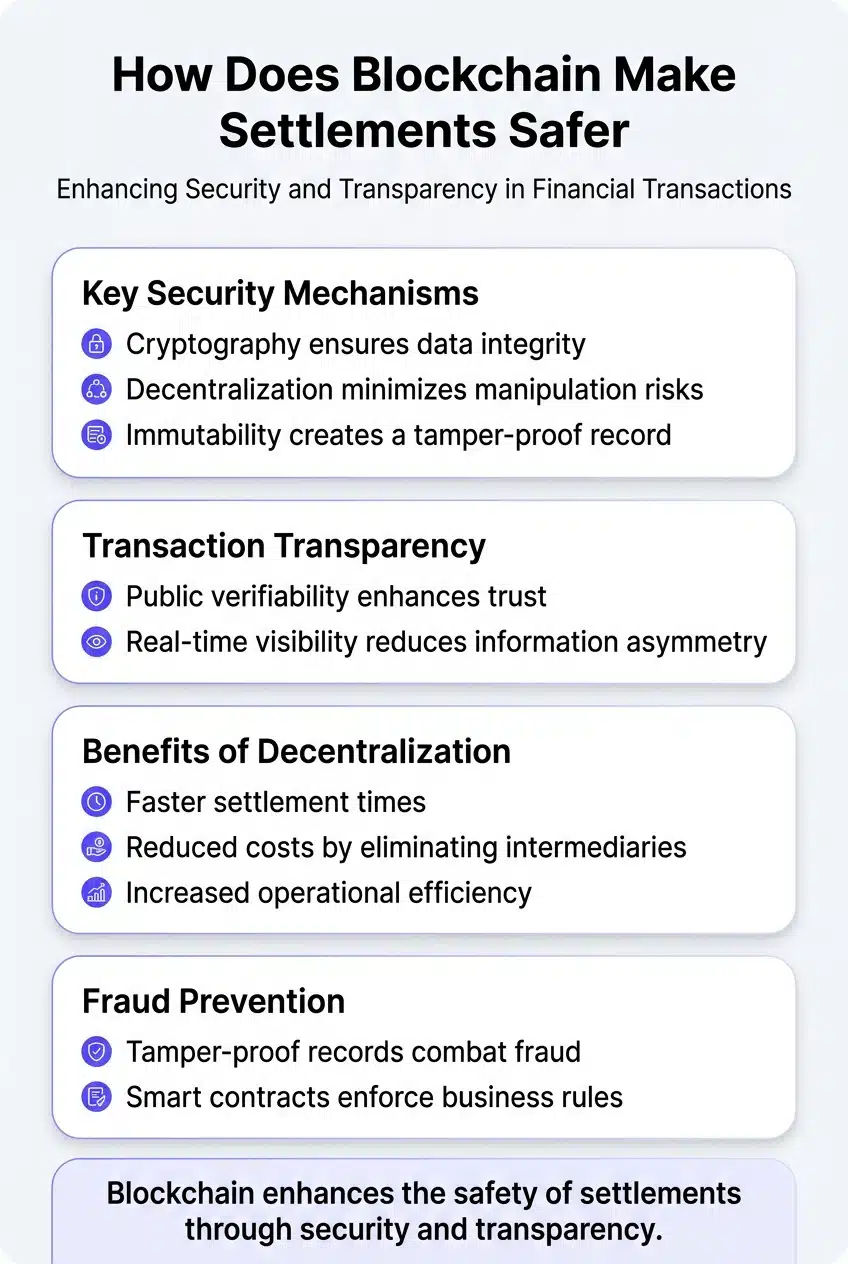
Speed is only half the story. Safety matters just as much.
- Less risk that one side fails. When a trade waits a day, the other party could fail to pay. Atomic settlement closes that gap.
- Records that are hard to change. Once data is added to the chain, editing it is very difficult. Fraud and hidden edits are easier to spot.
- A clear audit trail. Every step has a time stamp. Auditors can trace a trade from start to finish.
- Less cash locked up. Shorter settlement means firms keep less money aside as a safety buffer.
This is where blockchain for faster financial statements helps with accuracy, not just speed. The same shared record idea already helps other fields too. For example, blockchain in supply chain management lets companies track goods from factory to store.
One more point matters here. Most bank networks are “permissioned.” Only checked and approved members can join. That is very different from public crypto coins that anyone can use.
Who Is Using Blockchain for Settlements in 2026?
This is no longer just a lab test. Some of the biggest names in finance now use blockchain for faster financial statements and trade settlement in live markets.
DTCC
The DTCC handles US stock and bond trades after they happen. Its units processed securities deals worth $4.7 quadrillion in 2025. In December 2025, the SEC cleared its DTC unit to run a tokenization service for three years. On July 15, 2026, DTCC processed live tokenized trades with more than 30 firms. These included Treasury and stock trades that swapped cash and assets at the same time. The full service is set to launch in October 2026. For many Wall Street firms, blockchain for faster financial statements may soon be part of daily work.
JPMorgan Kinexys
JPMorgan renamed its blockchain unit Kinexys in November 2024. Its main tool, JPM Coin, turns bank deposits into digital tokens. These tokens can move 24/7 and settle in near real time. Kinexys now handles billions of dollars a day. In January 2026, the bank said it would bring JPM Coin to the Canton Network in phases during 2026. For business clients, this is blockchain for faster financial statements in action. Cash can move on a Saturday and show up in the books right away.
Swift
Swift links more than 11,000 banks and financial firms around the world. In September 2025, it announced a blockchain-based shared ledger. More than 40 institutions helped design it. By July 2026, the ledger was ready for first use, with 17 early banks running live tokenized deposit payments. One detail is important. The final bank to bank settlement still runs through existing payment systems for now. So Swift uses blockchain for faster financial statements and payment tracking, while the older rails still move the final funds.
What Are the Risks and Limits?
Blockchain for faster financial statements has real limits. Anyone following this space should know them.
- Code bugs and hacks. A flaw in a smart contract can be exploited. In February 2025, hackers stole about $1.5 billion in crypto from the Bybit exchange. Bank networks are more closed, but no system is fully safe.
- Scale. Big markets handle millions of trades a day. Some blockchains slow down under heavy use. Layer 2 solutions are one way builders try to fix this.
- Systems that do not connect. Many blockchains cannot talk to each other easily. Banks still need links between new ledgers and old ones.
- Rules still changing. Laws for tokenized assets differ by country. Many firms wait for clear rules before they fully switch.
- Less time to fix mistakes. Slow settlement gives staff time to catch errors. Instant settlement removes that window, so checks must happen before the trade.
- Privacy. Banks cannot show client data to everyone. That is why most use private networks with extra privacy tools.
What Does This Mean for Everyday People?
You may never touch a bank’s blockchain directly. But you could still feel the effects as banks adopt blockchain for faster financial statements and payments.
- Faster money transfers. Sending money abroad could take minutes instead of days.
- Quicker access to cash. When you sell stocks, your money may be ready sooner.
- Lower fees over time. Fewer middlemen can mean lower costs, though banks decide how much to pass on.
- Fewer payment delays. A bill you paid on time but that got stuck in transit can still cause trouble. Faster settlement lowers that risk. If late payments have already hurt you, our guide on how to repair credit score can help.
Frequently Asked Questions (FAQs)
Is blockchain settlement faster than T+1?
Yes. Blockchain can settle a trade in minutes or seconds, on any day of the week. That is why many experts see blockchain for faster financial statements as the path toward same-day (T+0) settlement.
Will blockchain replace banks?
No. Most live projects are run by banks and market firms. They use blockchain for faster financial statements and settlement, but they still hold the money and follow banking rules.
Is money safe on a bank blockchain?
Tokenized deposits stay inside the regulated banking system, so the usual bank rules still apply. This is one reason banks prefer this kind of blockchain for faster financial statements over public crypto networks.
Final Words
Blockchain can make financial settlements faster and safer. Live projects at DTCC, JPMorgan, and Swift show it works at a real scale. Trades can settle in minutes, records stay in sync, and both sides swap at the same time. Still, bugs, scale limits, and new rules mean the full shift will take years, not months. For banks, investors, and finance teams, blockchain for faster financial statements is moving from a bold idea to a daily tool, one market at a time.