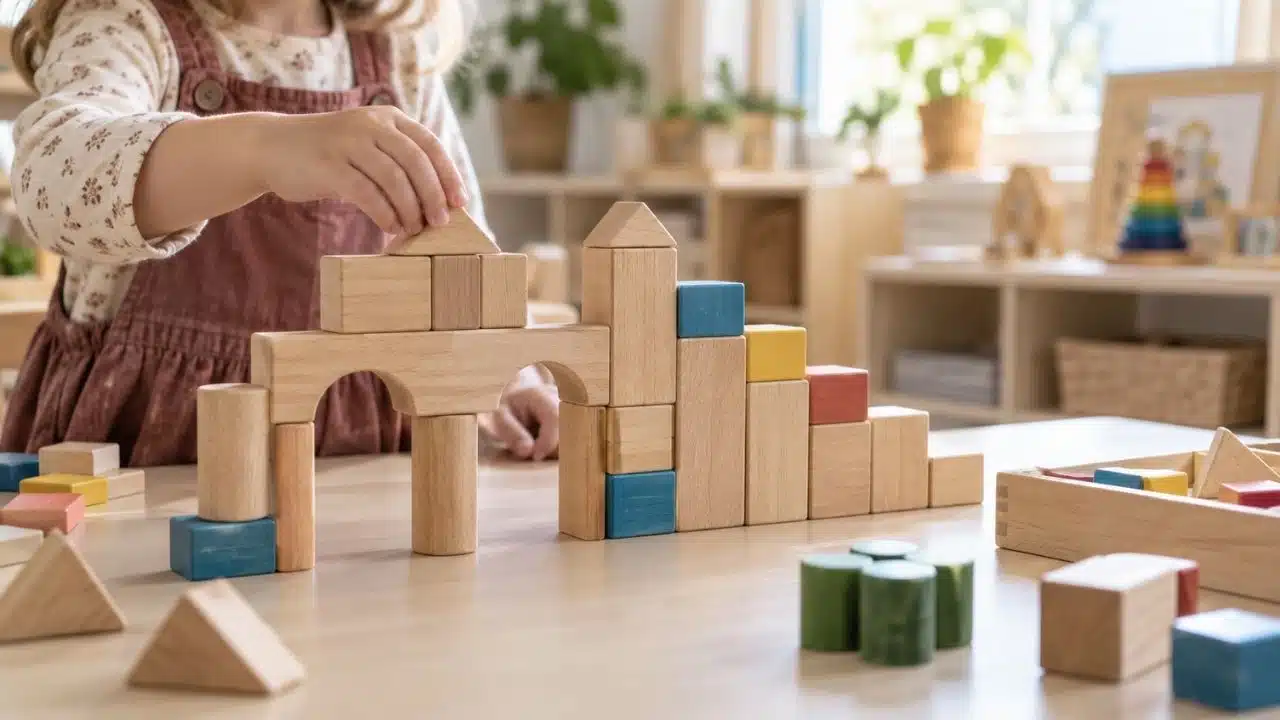
A child building a tower is doing more than stacking toys. The child must choose suitable pieces, compare their sizes, judge where each one belongs, and change the design when the tower leans or falls.
Those decisions help explain the connection between block play and math skills. Research has found that children’s performance on block-building and spatial-assembly tasks is associated with mathematical ability during the preschool years and, in some studies, with achievement later in school.
The word “predicts” needs careful handling. In developmental research, it means that an earlier measure is statistically related to a later result. It does not mean a preschool block structure can reveal a child’s academic future—or that giving a child more blocks will automatically produce higher mathematics scores.
The more useful finding is that construction play exercises several forms of thinking that mathematics also requires. Blocks allow children to explore space, shape, quantity, measurement, patterns, equivalence, and physical relationships without beginning with worksheets or formal symbols.
What the Research Actually Shows
A widely cited 2001 longitudinal study evaluated children’s block-play performance at age four and compared it with later mathematics outcomes. Those outcomes included standardized test results and school grades in the third, fifth, and seventh grades, followed by measures of mathematics participation and performance in high school.
Block-play performance was associated with a number of those later outcomes even after the researchers accounted statistically for IQ and gender. The study is one reason block play is often described as a predictor of later mathematics achievement.
It is not, however, proof of a simple cause-and-effect relationship. Children who produce more advanced block constructions may also differ in spatial ability, language development, attention, previous experience, home learning opportunities, or other characteristics related to school performance.
Research with younger children adds useful detail. A study of 102 three-year-olds assessed how accurately they reproduced structures using interlocking blocks. Their spatial-assembly performance was related to their concurrent early mathematics skills, even when researchers considered other relevant abilities. Because both were measured at roughly the same stage of development, the study showed a relationship rather than evidence that one caused the other.
A later longitudinal study followed children who completed block-building tasks at age three. Different features of their performance were associated with concurrent and later spatial skills, while the structural complexity of their buildings was associated with some later mathematical outcomes. The findings were not uniform across every task and measure—a reminder that “block ability” is not one single skill.
Taken together, the evidence supports a measured conclusion: block building can reveal and exercise forms of spatial thinking that are relevant to early mathematics. It should be treated as a worthwhile learning opportunity, not an informal intelligence test.
How Block Play and Math Skills Develop Together
Space becomes something children can manipulate
Spatial thinking involves understanding the positions of objects, the relationships between them, and how those relationships change when an object moves or rotates.
Consider a child copying a small block model. The child must inspect the original, select the right pieces, and reproduce an arrangement seen from a particular angle. A piece that appears correct may still need to be turned. If the structure does not match, the child has to locate and correct the difference.
This draws on spatial visualization and mental rotation—the ability to imagine how an object will look in another position. Mathematics later places similar demands on children when they interpret diagrams, compare geometric figures, use maps, or work with visual representations of number.
Young children do not need technical vocabulary for the activity to matter. They first experience the relationship physically: This piece does not fit here, but it fits after I turn it.
Geometry appears before formal lessons
Blocks make the properties of shapes visible and practical. A cube can rest steadily on several faces. A cylinder can stand upright but rolls on its curved side. A triangular prism may work as a roof but is usually unhelpful as the bottom of a tower.
As children build, they encounter:
- Flat and curved surfaces
- Corners and edges
- Two- and three-dimensional forms
- Symmetry
- Orientation
- Congruence
- Part-whole relationships
An adult can attach useful language to what the child is already doing:
“You turned the rectangle so the long side goes across the gap.”
“Both sides have the same shape.”
“That cylinder rolled because this side is curved.”
These comments are usually more valuable than quizzing the child on shape names. Vocabulary should sharpen observation, not take control of the play.
Counting has a reason
Block play gives counting an immediate purpose. A child may need four blocks for a wall, one block for each toy animal, or two more pieces to make both sides of a bridge equal.
When children touch or move each block while saying one number word, they practise one-to-one correspondence. When they understand that the last number said represents the total collection, they are using the cardinal principle.
Not every structure needs to become a counting exercise. Repeated demands to count can interrupt a child who is concentrating on balance or design. A well-timed question works better:
“How many blocks are holding up your bridge?”
If the child loses track, arranging the pieces in a row or touching each one once makes the counting problem easier to see.
Measurement begins without a ruler
Before children work with centimetres or inches, they can compare length, height, and width directly.
Two towers can be placed side by side. A road can be extended until it reaches the wall. Identical blocks can be laid end to end to measure a table. These experiences introduce the idea that measurement requires a unit to be repeated consistently.
Suppose a child says a road is “seven blocks long” but has used blocks of several different lengths. Rather than marking the answer wrong, an adult can ask whether the result would change if every measuring block were the same size. The inconsistency creates a genuine mathematical problem.
Children also encounter estimation. Before rebuilding a wall, ask how many blocks it might require. The estimate does not need to be correct. Comparing the prediction with the final quantity is the useful part.
Patterns can involve more than colour
A red-blue-red-blue line is a clear repeating pattern, but blocks support more demanding forms of pattern recognition.
A child might make:
- A cube-cylinder-cube-cylinder sequence
- Towers that increase from one block to four
- A group of two yellow blocks followed by one green block
- Matching structures on the left and right
- A border that alternates block direction
To extend the activity, leave the sequence unfinished and ask what belongs next. Asking the child to explain the choice provides more information than simply hearing the correct answer.
This type of reasoning contributes to children’s growing understanding of regularity and sequence, both of which become important in later mathematics.
Falling Structures Create Useful Problems
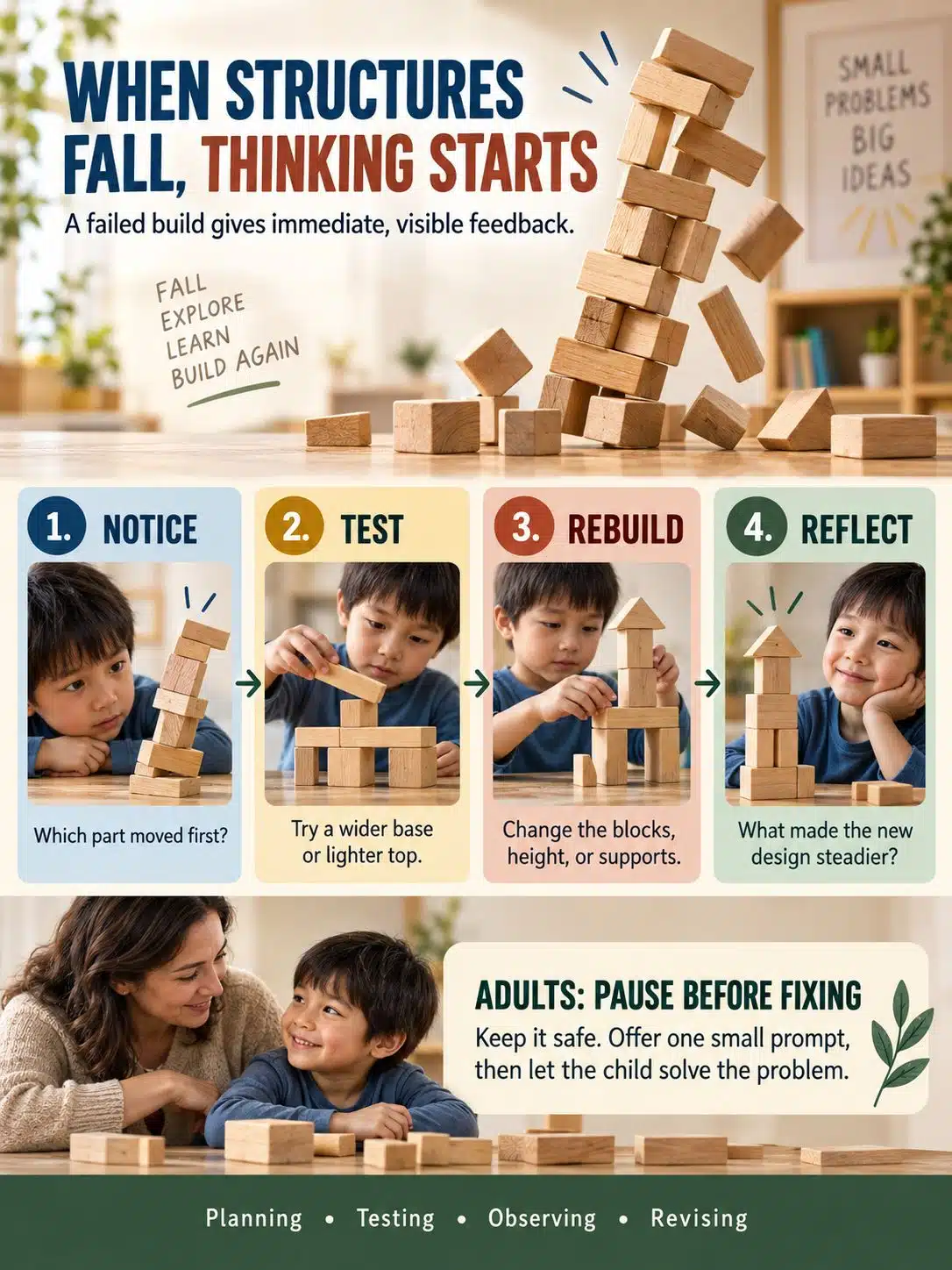
A block structure gives immediate, visible feedback. A narrow base cannot support certain designs. A long bridge may sag between widely spaced supports. A heavy top can make a tower unstable.
Children can respond by widening the base, changing the blocks, reducing the height, or moving the supports. They are planning, testing, observing, and revising.
These actions require attention and flexible problem-solving, although it would be too strong to claim that block play by itself improves executive function or guarantees greater persistence. The activity provides occasions to practise those behaviours.
Adults often remove the challenge by repairing the structure too quickly. Unless the child is becoming overwhelmed or the construction is unsafe, pause before stepping in. A small prompt—“Which part moved first?”—can help the child inspect the failure without supplying the solution.
Free Construction and Guided Play Serve Different Purposes
Unstructured block play gives children control over what they build and how long they pursue an idea. It supports experimentation, storytelling, and original planning. A cardboard box can become a garage; a line of blocks can become a river boundary; a tower can be rebuilt repeatedly for no reason beyond curiosity.
Guided play begins with a light suggestion or problem while preserving the child’s choices. An educator might provide a photograph of a bridge, place two toy animals on opposite sides of a gap, or ask children to make two towers the same height.
Neither approach needs to replace the other.
Free play leaves room for ideas that adults would not have planned. Guidance can direct attention toward a relationship the child might otherwise miss. Problems arise when guidance turns into step-by-step construction and the child becomes an assistant following the adult’s design.
Useful prompts include:
- “What could make the base steadier?”
- “Can you build the same height with different blocks?”
- “Which piece might fill that space?”
- “How could two toy cars fit under the bridge?”
- “What changed when you turned the block?”
- “Can you make the other side match?”
Ask one question and allow time for action. A stream of questions makes play feel like an assessment.
Match the Activity to the Child
Block play does not follow a fixed timetable. Age, motor coordination, prior opportunities, language, sensory preferences, and individual interests all affect what a child does.
Toddlers may explore before they construct
Toddlers commonly carry blocks, fill and empty containers, stack a few pieces, make rows, and knock structures down. These actions explore quantity, position, cause and effect, and physical properties.
Simple words are appropriate: in, out, on, under, beside, more, tall, and fall. Large, lightweight blocks are generally easier for young children to grasp and less likely to create a small-parts hazard.
Knocking down a tower is not failed play. It can be a deliberate experiment. In shared settings, provide a separate structure that can be demolished so one child’s investigation does not destroy another child’s work.
Preschoolers often begin to represent ideas
A row becomes a road. An enclosure becomes an animal pen. Two upright blocks supporting a horizontal piece become a bridge.
With experience, children may copy models, create symmetrical buildings, combine several structures into a town, or draw a plan before building. These constructions can bring counting, measurement, shape, and storytelling into the same activity.
Photographing an unfinished structure before cleanup can help a child return to the idea later. In a classroom, this is often more realistic than keeping a large construction standing indefinitely.
A Practical Activity: Same Height, Different Blocks
Build a short tower and invite the child to make another tower of the same height using different pieces. Do not demonstrate the solution.
A younger child may compare the towers visually or place them side by side. An older child may discover that two short blocks equal one longer block. If the towers are close but not equal, ask how the difference could be checked.
The activity brings together comparison, equivalence, unit size, and spatial planning.
It can be adjusted without turning it into a test:
- Start with “Which tower is taller?”
- Build two towers that are obviously different, then gradually make the comparison harder.
- Ask for the same height using exactly five blocks.
- Place the towers apart and invite the child to find a way to compare them.
- Ask whether a new design will be taller before it is built.
Listen to the child’s explanation. “It needs one more because it stops here” shows mathematical reasoning even when the language is informal.
Choosing Blocks: Simpler Is Often Better
Expensive themed sets are not necessary. The learning value lies in the relationships children can explore, not the branding.
A practical collection has enough pieces for sustained construction, repeated shapes for comparison and patterning, and components that can be combined in more than one way.
Different materials create different opportunities:
- Wooden unit blocks make size relationships and balance easy to observe.
- Interlocking bricks support stable, detailed models and repeated units.
- Foam blocks suit large-scale construction and are easier to move.
- Clean cardboard boxes can become walls, tunnels, buildings, or vehicles.
- Magnetic construction pieces can support shape composition, but only products with securely enclosed magnets should be considered.
Single-model kits can teach children to follow diagrams, but they offer less freedom once the intended model has been completed. For regular preschool play, a versatile open-ended set is usually the more useful purchase.
Safety Needs More Than an Age Label
Follow the manufacturer’s age and safety information, but also consider the child’s actual behaviour. A child who still places objects in the mouth should not have access to small blocks or loose construction parts, even if an older sibling uses them safely.
Inspect sets for:
- Cracks or sharp edges
- Splintering wood
- Peeling or damaged coatings
- Loose magnets
- Accessible button batteries
- Pieces that have broken into smaller parts
Small parts are a recognized choking hazard for children under three. High-powered magnets require particular caution: swallowing more than one can cause them to attract across internal tissue and lead to serious injury. Damaged magnetic toys should be removed immediately rather than repaired casually.
Safety rules and product standards vary by country. Families and schools should check local recall databases and current guidance from the relevant consumer-safety authority.
Do Not Use Block Skill to Label a Child
Some children build elaborate structures quickly. Others repeat simple arrangements or avoid construction activities.
That difference does not establish who is “good at math.” A child may have limited experience with blocks, difficulty manipulating small pieces, an uncertain understanding of the task, or little interest in that form of play. Visual, motor, sensory, or developmental differences may also affect performance.
Adapt the materials before reducing the intellectual challenge. Larger blocks can help children with fine-motor difficulties. A non-slip surface may make construction easier. High-contrast pieces and uncluttered work areas can support children with limited vision. A photograph or half-finished model can give a hesitant child a clearer starting point.
Mathematical and spatial thinking can also develop through puzzles, drawing, movement, containers, sand play, cooking, craft materials, and everyday household tasks. Blocks are useful, but they are not uniquely capable of producing these skills.
What Meaningful Progress Looks Like
A taller tower is only one possible sign of development. More revealing changes include a child:
- Planning before choosing pieces
- Turning a block after recognizing that it does not fit
- Comparing a construction with a model
- Using words about position, size, and shape
- Maintaining or extending a pattern
- Estimating how many pieces will be needed
- Explaining why a structure fell
- Trying a different solution after failure
- Coordinating a shared design with another child
Educators may document occasional examples to understand how a child approaches problems. Block play does not need constant scoring, however. Excessive assessment can replace exploration with performance.
Final Thoughts
The evidence connecting block play and math skills is credible but easy to overstate. Research shows meaningful associations among block building, spatial assembly, and mathematical performance. It does not show that blocks alone cause later academic success or that a preschool construction can predict an individual child’s future with certainty.
Their value is more immediate. Blocks make abstract relationships physical. Children can turn a shape, compare two lengths, count a group, repeat a unit, balance a structure, and see why a plan did not work.
Provide safe, open-ended materials and enough time to develop an idea. Use accurate spatial and mathematical language, but do not narrate every move. Offer a problem when the play needs extending, then return control to the child.
A modest box of blocks cannot promise higher grades. It can provide something developmentally valuable: repeated opportunities to think mathematically before mathematics becomes a page of symbols.