Whenever I look at subscription churn, I start with one question: did the customer choose to leave, or did a billing problem end the relationship? Involuntary churn is the second case. It happens when a subscription ends because a renewal payment could not be collected, even though the customer did not actively cancel.
A card may have expired, a bank may have declined the charge, or the account may have been short of funds for a few days. None of these events necessarily means the customer has stopped valuing the product.
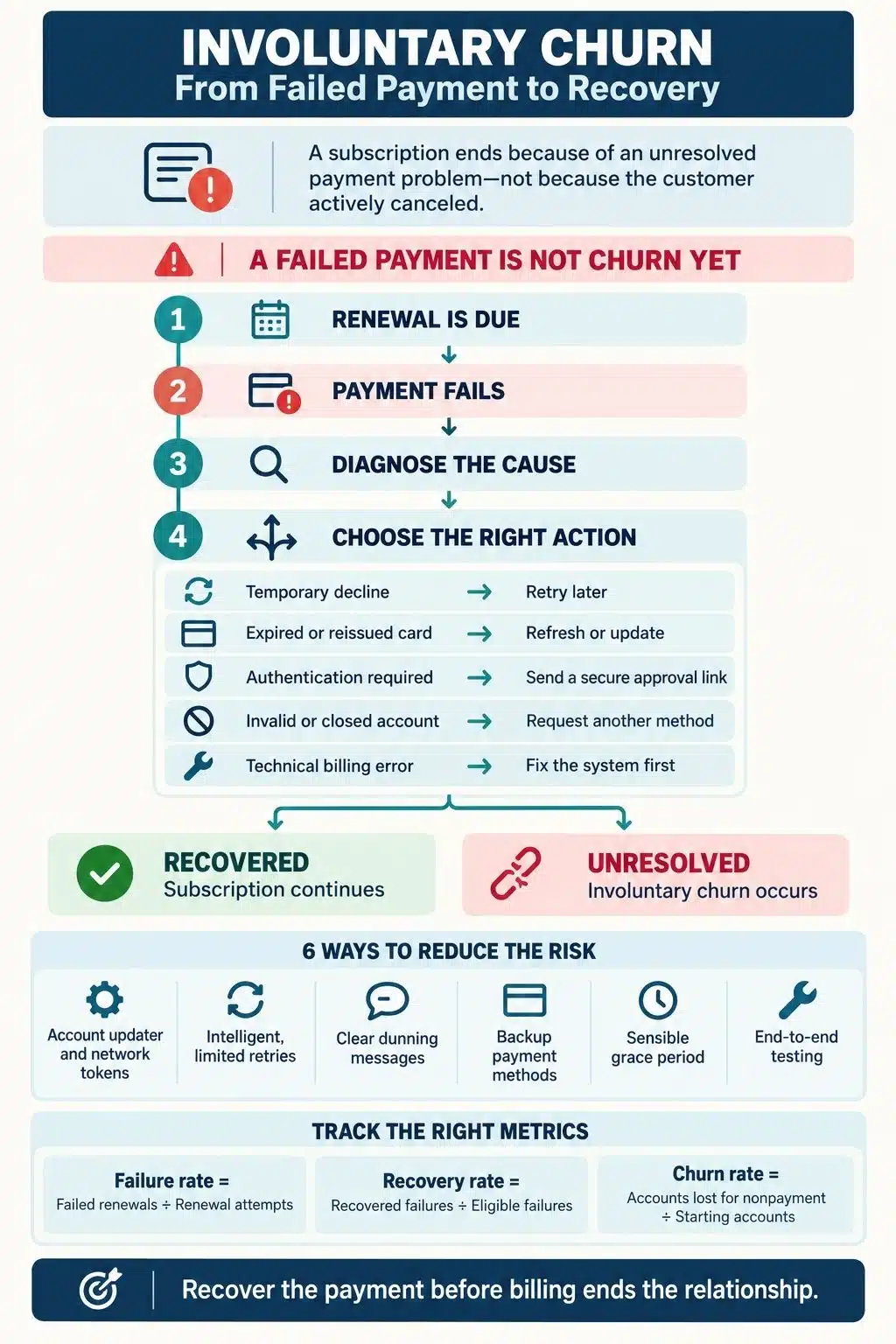
The distinction I find most useful is this: a failed payment is not yet involuntary churn. It is a recovery opportunity. Churn happens only when the payment remains unresolved and the subscription is ultimately ended for nonpayment.
Not every payment failure can be prevented, but many can be recovered before they cost the company a willing customer.
What Does Involuntary Churn Mean?
Involuntary churn, sometimes called accidental, delinquent, passive, or payment-failure churn, is the loss of a subscriber because of an unresolved payment or billing problem rather than a deliberate cancellation.
A typical case follows this sequence:
- The subscription reaches its renewal date.
- The saved payment method fails.
- Automatic retries and customer reminders do not recover the payment.
- The recovery or grace period ends.
- The business cancels or permanently closes the subscription.
The fifth step is the actual churn event. Until then, the account is better described as past due, delinquent, or in recovery.
Some customers intentionally let a payment fail instead of formally canceling. The billing system may still classify them as involuntary churn, but I would not treat that label as proof they wanted to stay. Payment data reveals what triggered the loss, not always the customer’s intent.
Involuntary Churn vs Voluntary Churn
Both forms of churn end with a lost customer, but they usually require different responses.
| Area | Voluntary churn | Involuntary churn |
| What happened | The customer deliberately canceled | The subscription ended after an unresolved payment problem |
| Common causes | Low usage, poor value, price, weak onboarding, changing needs | Expired cards, insufficient funds, issuer declines, authentication or billing errors |
| Main evidence | Cancellation activity, survey feedback, declining engagement | Payment events, decline responses, overdue invoices, failed recovery attempts |
| Best response | Improve the product, value, pricing, onboarding, or retention experience | Improve payment acceptance, retries, communication, and account recovery |
| Customer action | Usually required to cancel | Sometimes avoidable through automatic recovery |
Separating the two matters. If a company combines them in one number, a billing failure can look like a product problem. The opposite can happen too: better retries will not retain customers who no longer want the service.
Why Subscription Payments Fail
Payment failures do not all have the same cause. The right response depends on whether the problem is temporary, permanent, customer-related, or caused by the company’s own system.
Expired or Reissued Cards
Cards expire and may be replaced after loss, theft, suspected fraud, or routine reissuance. The customer’s new card may work normally while the subscription still holds outdated details.
Account-updater services and network tokens can refresh some eligible card information automatically. Coverage varies by bank, card, processor, and country, so customers still need an easy manual update option.
Insufficient Funds or Available Credit
The account may not have enough money or credit on the billing date. Because this can be temporary, a later retry may succeed without any customer action. Timing often matters more than repeatedly attempting the charge in a short period.
Issuer and Fraud-Prevention Declines
A bank may block a genuine renewal because the amount, location, transaction pattern, or fraud signals appear unusual. Businesses do not always receive a precise reason for the decision.
The customer may need to contact the bank or use another payment method. Repeatedly submitting the same declined charge is not always useful and can make the transaction appear riskier.
Incorrect, Closed, or Unusable Payment Details
An incorrect card number, expiration date, billing address, postal code, closed account, or revoked card can prevent collection. Retrying unchanged details will not solve the underlying problem. The customer usually needs to correct the information or provide another payment method.
Authentication Requirements
Some renewals require the customer to return and confirm the payment, such as through 3-D Secure. This can be especially relevant to off-session transactions in markets with strong customer-authentication requirements.
An automatic retry cannot complete an interactive authentication challenge. The customer needs a secure route back to the payment flow.
Technical or Billing-System Errors
Sometimes the failure belongs to the business rather than the customer. Processor outages, expired payment mandates, incorrect recurring-payment settings, disconnected merchant accounts, integration defects, or missed billing events can all interrupt collection.
These failures need internal alerts and investigation. Customers should not be told that their cards are the problem when the company’s own system caused the interruption.
Why Involuntary Churn Matters
The immediate loss is one unpaid invoice. The larger loss is the customer relationship and its potential future revenue. The company has already paid to acquire, onboard, and support that customer. An abrupt interruption can also damage trust and turn a recoverable billing problem into a deliberate cancellation.
Small monthly losses compound. If a fixed customer group loses 1% of its remaining accounts every month solely because of unresolved payment failures, about 88.6% of the original group remains after 12 months. That is an illustration, not an industry benchmark, but it shows why a small recurring leak deserves attention.
You may see claims that involuntary churn accounts for 20% to 40% of total churn. I would not use that range as a universal benchmark. Public estimates often come from billing providers, while actual results vary by price, market, customer type, payment method, and recovery setup. A company’s own mature data is more useful.
How to Prevent and Recover Involuntary Churn
The strongest approach combines prevention, automatic recovery, customer-assisted recovery, and a clear final account policy.
1. Separate Payment Failure From Completed Churn
Track these events independently:
- First-payment failures from new customers
- Renewal payments that fail on the first attempt
- Accounts currently inside the recovery window
- Payments recovered automatically
- Payments recovered after customer action
- Subscriptions ultimately lost for nonpayment
- Subscriptions canceled deliberately
This distinction shows where the real weakness lies. A high initial failure rate points toward payment acceptance. A low recovery rate may point toward retry logic, communication, or a difficult payment-update experience.
2. Keep Stored Payment Methods Current
Enable the account-updater and network-token features supported by the payment provider. These tools can refresh some changed card numbers and expiration dates without interrupting the customer.
Automation will not catch everything. Send an expiration notice when customer action is required, particularly before annual or high-value renewals. For business accounts, keep the billing contact current; a reminder cannot work if it goes to a former employee.
Recurring payments also need to be configured correctly. Obtain clear permission to store and reuse the payment method, identify recurring and off-session charges accurately, send complete billing information, and handle required authentication when the payment method is saved.
3. Match the Recovery Action to the Failure
A practical system should distinguish between at least four situations:
- Temporary decline: Retry later when the processor’s guidance permits it.
- Invalid or unusable payment method: Ask the customer for another method.
- Authentication required: Bring the customer back to approve the payment.
- Merchant or technical error: Correct the internal problem before trying again.
Do not send every failure through the same workflow. A retry may recover insufficient funds, but it will not repair an incorrect card number or complete an authentication challenge.
4. Use Intelligent, Limited Retries
Retries are useful for temporary failures. They should be timed and bounded rather than aggressive.
There is no universal retry count or perfect timetable. Payment methods behave differently, and processors or card networks may provide their own guidance. A monthly card subscription, an annual enterprise invoice, and a direct debit should not automatically share one schedule.
Stop retrying when the payment succeeds, the customer replaces the payment method, or the response indicates that another attempt is inappropriate. Make sure several billing tools are not retrying the same invoice independently.
5. Make Dunning Clear and Helpful
Dunning is the coordinated process of recovering overdue payments through retries, reminders, and account actions. The name sounds harsh; the customer experience should not be.
A good payment-failure message should tell the customer:
- Who sent the message
- Which subscription or invoice is affected
- What action is required
- Whether another attempt is planned
- When access may change
- How to get help
The main button should open a secure payment-update or authentication page directly. Do not bury the action inside a general account menu, and never ask customers to send card details by email.
Email should not be the only channel. An in-product notice can reach an active user who missed the email. High-value customers may need direct help from finance, support, or customer success.
All reminders must stop as soon as the payment is recovered. Continuing to send overdue notices after collecting the money quickly damages trust.
6. Offer Backup and Suitable Alternative Payments
Allow customers to add a backup payment method when the billing system supports it. For larger business accounts, bank debit, bank transfer, or invoicing may be more suitable than depending on one employee’s corporate card.
Alternative methods are not failure-proof. Bank debits can be returned, and some methods take longer to confirm. Choose options that fit the customer’s location, account value, and subscription model.
7. Use a Sensible Grace Period
Canceling access after one decline gives neither the system nor the customer much chance to resolve the problem. A controlled grace period allows retries and reminders to work before the relationship ends.
The right duration depends on billing frequency, account value, service cost, fraud exposure, and settlement time. A grace period need not mean unlimited usage. A SaaS business might restrict costly activity while preserving read-only access, administrator settings, or data exports.
Whatever policy you choose, make it clear. Customers should know when access will change, and normal service should return promptly after successful payment.
8. Escalate Important Business Accounts
Automation may not be enough when one failed renewal represents a large amount of recurring revenue.
Give high-value accounts a clear internal owner. The issue may be a missing purchase order, outdated billing contact, card limit, procurement delay, or expired bank mandate.
Account value can determine the level of review and support. It should not justify confusing or unfair treatment.
9. Test the Full Recovery Journey
Do not test only successful payments. Simulate temporary and permanent declines, authentication requests, payment updates, delayed bank responses, expired grace periods, duplicate billing events, and processor interruptions.
Then confirm that the invoice, subscription status, customer access, messages, analytics, and accounting records all reach the same correct outcome. Payment recovery is only reliable when every connected system agrees on what happened.
How to Measure Involuntary Churn Correctly
I would track customer loss, revenue loss, and payment recovery separately.
Customer involuntary churn rate
Accounts lost to unresolved payment failures during the period ÷ Active accounts at the start of the same period × 100
Involuntary MRR churn rate
MRR lost to unresolved payment failures during the month ÷ MRR at the start of that month × 100
Payment recovery rate
Failed renewal payments recovered ÷ Eligible failed renewals with completed recovery windows × 100
The first metric measures lost relationships. The second shows their effect on recurring revenue. The third evaluates how well the recovery process works.
Useful supporting metrics include:
- First-attempt renewal failure rate
- Recovery rate by invoice count and monetary value
- Median time from failure to recovery
- Recovery method, such as retry, card update, authentication, or manual help
- Retention of recovered accounts after 30, 60, or 90 days
Only compare failed payments that have had the same opportunity to recover. Mixing yesterday’s failures with invoices whose recovery windows have already ended makes current performance look artificially weak.
Here is a simple example. A monthly subscription company starts with 1,000 active accounts, all billed during the month. Thirty renewal payments fail initially. Twenty are recovered before the deadline, while ten subscriptions end for nonpayment.
- First-attempt renewal failure rate: 3%
- Payment recovery rate: 66.7%
- Customer involuntary churn rate: 1%
These figures answer different questions. Combining them into one number would hide whether the problem is payment acceptance, recovery performance, or actual customer loss.
Treat a Failed Payment as a Recovery Moment, Not a Goodbye
The operational trigger for involuntary churn usually appears in billing, but the customer’s intent may be more complicated. A good recovery system therefore does more than keep charging the same card.
It maintains payment credentials, interprets failures, retries only when appropriate, communicates clearly, gives customers a secure way to act, and allows reasonable time for recovery. It also knows when to stop and close the account fairly.
I would judge the entire process by one practical standard: does a temporary billing problem remain a minor interruption, or does it unnecessarily end a valuable customer relationship? When recovery is designed around that question, fewer willing customers are lost by accident.
Frequently Asked Questions on Involuntary Churn
1. Is involuntary churn the same as a failed payment?
No. A failed payment begins the recovery process. Involuntary churn happens only when the payment remains unresolved and the subscription ends.
2. What is a good involuntary churn rate for SaaS?
There is no dependable universal target. Compare similar plans, billing cycles, markets, customer segments, and payment methods. Your own trend over time is usually more useful than a broad industry average.
3. How many times should a failed subscription payment be retried?
There is no single correct number. Use the processor’s decline guidance and applicable network limits, then test a bounded schedule based on the payment method, billing frequency, customer segment, and reason for failure.
4. What is a dunning process?
Dunning is the coordinated sequence of retries, customer reminders, payment-update steps, and account changes used to recover an overdue subscription before the account is lost.
5. Can an automatic card updater prevent all involuntary churn?
No. It may prevent some failures caused by changed card numbers or expiration dates. It cannot solve insufficient funds, every issuer decline, required authentication, revoked authorization, or internal billing errors.