I used to think downloading the latest educational reading apps and queuing up audiobooks was the ultimate life hack. I could fold laundry while a soothing voice read a bestseller, or hand over a tablet to my nephew and watch him tap his way through a digital storybook. It felt incredibly efficient. We live in a world where technology promises to optimize everything, including how we consume words.
But lately, I’ve been going back to a much older, clunkier piece of technology: my own voice and benefits of reading aloud.
After noticing how easily my mind drifted during audiobooks, and how quickly digital stories turned into passive screen time, I started digging into what actually happens to our brains when we read out loud. What I found completely shifted my perspective. Despite all our shiny digital tools, the physical, messy, out-loud act of reading is scientifically undefeated.
Here is why I am putting the tablet away and speaking the words again.
The Magic of the “Production Effect”
Have you ever read a page silently, gotten to the bottom, and realized you have absolutely no idea what you just looked at? I know I have.
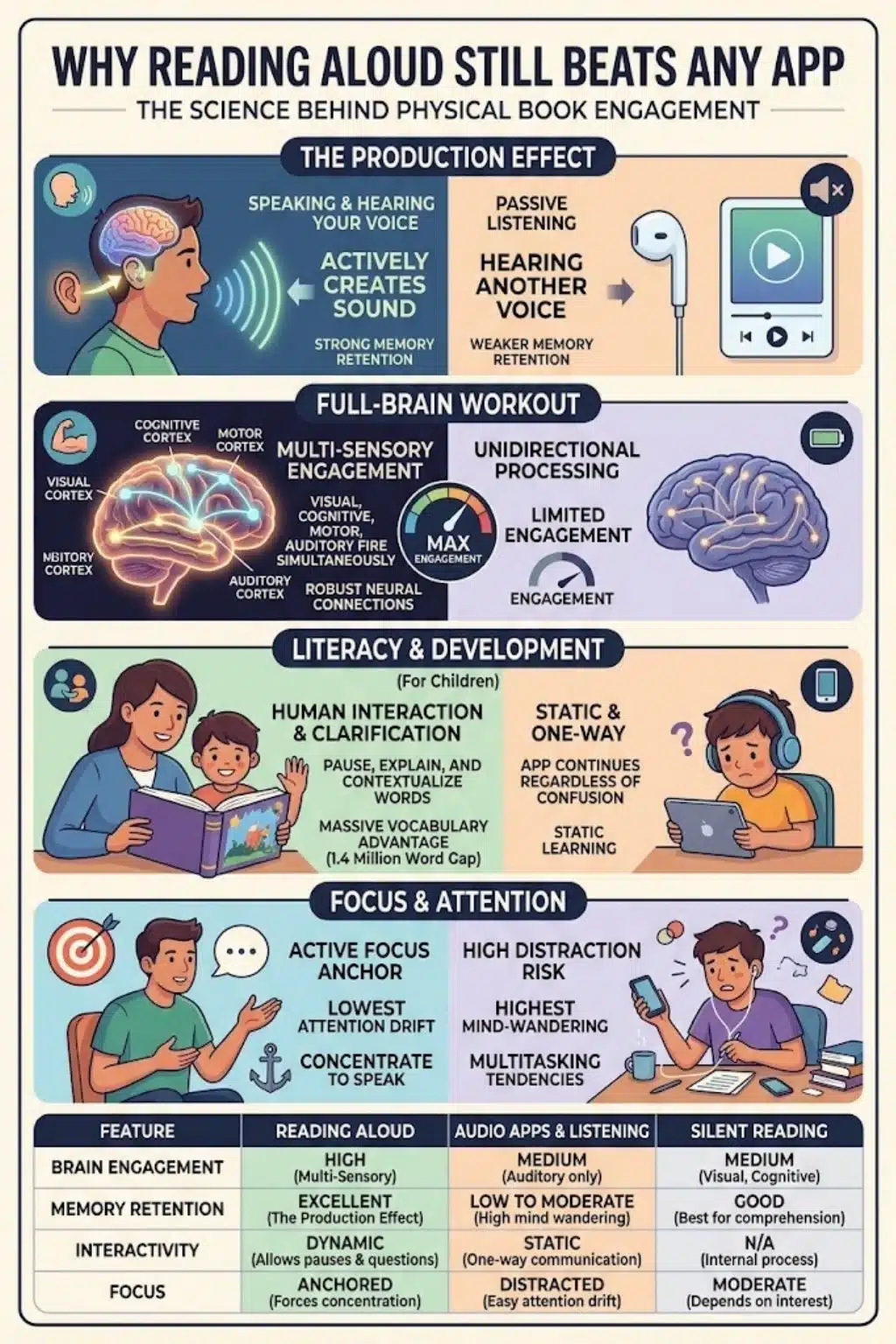
When we read silently or listen to an app, it is incredibly easy for our brains to go on autopilot. But when you read aloud, you trigger something cognitive psychologists call the production effect. Actively producing a word, using your mouth, tongue, and breath to physically say it, and then hearing your own voice speak it, makes that information highly distinct in your long-term memory.
By adding a physical action to the words, you give your brain an extra hook for active recall. It is the difference between watching someone ride a bike and actually pedaling it yourself. Now, when I need to remember an important email, a speech, or a complex new concept, I don’t just stare at the screen. I read it out loud to the empty room. It feels a little silly at first, but it works like magic.
A Full-Brain Workout
We often treat reading like it happens exclusively behind our eyes. But reading aloud is a full-body, multi-sensory workout for your brain.
When you hand a child an app that reads to them, the process is largely passive. The device does the heavy lifting. But neuroimaging shows that speaking words aloud forces the brain to fire on all cylinders. You are engaging your visual cortex to see the letters, your cognitive centers to process their meaning, your motor cortex to articulate the sounds, and your auditory system to hear the result.
An app simply cannot replicate that kind of rich neural activation. I’ve noticed that when I read aloud, the words carry an emotional weight and rhythm that I completely gloss over when I’m skim-reading in my head.
The 1.4 Million-Word Gap
If you are a parent, an aunt, an uncle, or just someone who cares about kids, this next part will make you want to grab a physical book immediately.
For years, I assumed that as long as kids were hearing words, whether from a cartoon, an interactive app, or a smart speaker, it all counted equally toward their literacy development. I was wrong. Research on child development has completely dismantled this idea. Studies show that children whose parents read five books a day to them enter kindergarten having heard roughly 1.4 million more words than kids who are never read to.
But it’s not just about the sheer volume of words; it’s about the delivery. An app doesn’t know when a child is confused. An audiobook doesn’t stop to ask, “Why do you think the bear did that?” or “Look at how big that tree is!” When we read aloud to kids, the pauses, the eye contact, and the side conversations are where the actual learning happens. A human voice provides the safety and context needed to understand complex ideas.
The Antidote to Mind-Wandering
Let’s be honest about audiobooks and digital apps: they are a multitasker’s dream. But that is exactly why they fail at keeping our attention.
When I listen to an audiobook, I am usually driving, doing dishes, or mindlessly scrolling. Studies on mind-wandering tested this exact scenario, comparing people reading silently, reading aloud, and listening to audio. Listening produced the highest rates of attention drifting. Reading aloud produced the absolute lowest.
You physically cannot mind-wander while reading out loud. If your focus breaks, your mouth stops moving. It forces you to stay anchored in the present moment. In a highly distracted world, reading aloud has accidentally become one of my favorite mindfulness practices.
Final Thought
There is absolutely a time and place for digital convenience. I am not deleting my audiobook apps anytime soon, and I know interactive learning games can be a lifesaver on a long flight.
But we can’t let convenience replace connection. Reading aloud, whether it is sounding out a beautiful paragraph to yourself, or putting on silly voices for a bedtime story, is a fundamentally human act. It builds stronger memories, wires the brain for deeper comprehension, and creates an environment of shared attention that no screen will ever match.
So tonight, try turning off the smart speaker. Pick up a real book, clear your throat, and let the words fill the room.
Frequently Asked Questions on Benefits of Reading Aloud
1. Is reading aloud just for kids, or do adults actually benefit too?
Adults benefit massively! While we mostly associate reading aloud with childhood bedtime stories, adults who read aloud experience better memory retention, sharpened focus, and a significant reduction in mind-wandering. It is an incredible tool for studying, memorizing speeches, or preserving long-term cognitive health.
2. Does listening to audiobooks count as reading?
Yes, but it engages the brain differently. Audiobooks are fantastic for consuming stories while multitasking, but because they are a passive medium, they lead to much higher rates of mind-wandering. If you want deep retention and active brain engagement, reading out loud is the superior method.
3. How long should I read aloud every day to see the benefits?
You don’t need to lose your voice to see results. For adults, reading aloud for just 10 to 15 minutes a day can drastically improve focus and memory recall. For children, aiming for a few short, engaging books a day makes a monumental difference in their vocabulary and literacy skills over time.
4. What if I feel awkward reading out loud to myself?
It definitely feels unnatural at first if you aren’t used to it! Start small. Try reading just your most important emails, a recipe you are following, or a beautiful quote you want to remember. Once you realize how much better you retain the information, the awkwardness fades quickly.
5. Can digital reading apps replace physical books if I read the screen out loud?
Reading aloud from a screen still gives you the “production effect” memory boost, which is great. However, physical books offer fewer distractions (no notifications popping up) and provide a tactile, spatial sense of where you are in the text, which naturally aids overall reading comprehension and reduces eye strain.