Organic vs paid social is often presented as a choice between patience and speed. Either you keep publishing organically and wait for momentum, or you pay for reach and expect faster results. That is the wrong comparison.
Organic social helps you understand your audience, develop stronger messages, earn credibility, and maintain customer relationships. Paid social gives those messages controlled distribution. It can reach selected audiences quickly, support a launch, and test whether an offer produces action beyond your existing community.
The real decision is not which channel wins. It is how much time, creative capacity, and money each one deserves at your current stage.
Organic and Paid Social Solve Different Problems
Organic social is strongest when people need time to become familiar with a brand. Educational posts, demonstrations, customer conversations, and informed opinions can answer questions that an advertisement cannot resolve in one impression.
It also gives potential customers somewhere to investigate the business. Someone who discovers you through an ad, recommendation, or search result may visit your social profile before deciding whether you appear credible.
Paid social services serve a different purpose. It allows you to choose an objective, define an audience, control timing, and direct people toward a specific action. That makes it useful for campaigns that need faster or more predictable distribution.
The distinction is simple:
- Organic social development develops trust, insight, community, and content.
- Paid social buys reach, speed, targeting, and testing opportunities.
Neither is effortless. Organic content requires research, production, publishing, moderation, and analysis. Paid social requires media spend, creative assets, tracking, campaign management, and continuous optimization.
Organic is not free, and paid is not guaranteed growth.
My Practical Starting Point Is 60% Organic and 40% Paid
For a business without reliable performance data, I would start by putting approximately 60% of its social effort into organic activity and 40% into paid activity.
The word “effort” matters here. It includes the time and resources used for strategy, content production, publishing, community management, advertising setup, optimization, and reporting. Media spend should be planned separately.
A company might devote more working hours to organic content while spending far more cash on advertising. Treating effort and ad budget as the same thing makes the split misleading.
The 60/40 starting point gives a brand enough room to learn what its audience responds to without postponing paid testing indefinitely. Organic activity can reveal useful topics, objections, and creative angles. A focused paid program can then test whether those ideas work with colder audiences.
The allocation should change as the evidence improves.
| Business situation | Organic effort | Paid effort | Why |
| New brand with unproven messaging | 70% | 30% | Learn what resonates before buying substantial reach |
| Brand with early content traction | 60% | 40% | Continue learning while testing amplification |
| Proven offer with reliable tracking | 40% | 60% | Scale a functioning acquisition system |
| Time-sensitive launch or promotion | 30% | 70% | Generate reach quickly for a limited period |
| B2B company with a long buying cycle | 65% | 35% | Support education, trust, and future demand |
| Community or retention objective | 75% | 25% | Prioritize conversation and customer relationships |
These are planning baselines, not universal benchmarks. A seasonal ecommerce campaign may move heavily toward paid for several weeks and then return to a more balanced allocation. A specialist B2B company may remain organic-heavy because its buyers require months of education and reassurance.
The split should follow the business situation, not a fashionable percentage.
Put More Effort Into Organic When You Are Still Learning
Organic deserves the larger share when the brand has not yet found a dependable message.
If positioning is unclear, aggressive ad spending can generate plenty of activity without producing much useful insight. People may click but fail to convert. A post may attract attention from an audience that would never buy. Low-cost leads may look impressive in an advertising dashboard and prove worthless when sales follows up.
Organic content gives you more room to explore what people care about and how they describe their problems. It is especially useful when the product requires explanation or trust plays a major role in the purchase.
I would lean further toward organic when:
- The target customer or positioning remains unclear
- The business has not found repeatable content themes
- Buyers need substantial education before acting
- Customer objections are not being addressed
- Comments, referrals, or direct conversations influence sales
- The paid team lacks a steady supply of fresh creative
- The company’s social profiles appear inactive or overly promotional
- Paid traffic reaches the website but rarely converts
Recommendation systems can show relevant organic posts to non-followers, so a small account can occasionally reach a much larger audience. That opportunity is real, but it is not predictable. Organic reach should be treated as something a brand can earn, not inventory it controls.
Increase Paid Effort Only When the Business Is Ready
Paid social becomes more valuable when the company has something worth scaling.
Before increasing spend, I would look for five things:
- A clear message: People can quickly understand the problem, offer, and reason to care.
- Enough creative variety: The team can test several genuinely different concepts rather than making minor variations of one ad.
- A suitable destination: The landing page continues the promise made in the ad and makes the next step easy.
- Reliable measurement: Conversion events work, leads can be traced into the CRM, and downstream quality is reviewed.
- Viable customer economics: The company knows what it can afford to pay for a lead or customer and can serve the additional demand profitably.
Paid activity deserves a larger share when organic content repeatedly attracts the intended audience, website visitors convert, lead quality is acceptable, and acquisition remains viable as spending rises.
It is also appropriate when timing matters. A product launch, event, seasonal offer, or limited promotion cannot depend entirely on unpredictable organic distribution.
However, a larger budget does not automatically create a better campaign. Small advertisers often divide their money among too many platforms, audiences, objectives, and ad sets. Each campaign then receives too little data to support a useful decision.
One focused test on the most relevant platform is usually more informative than several underfunded experiments.
Build One Organic-to-Paid System
Organic and paid social become inefficient when they operate as separate calendars with separate ideas. The stronger model is a continuous feedback loop.
Start With Real Audience Friction
Look at sales objections, reviews, customer-service conversations, search behavior, comments, and recurring questions. These sources are more valuable than copying whichever content format happens to be trending that week.
Turn those observations into different creative angles. The same problem might be addressed through a demonstration, comparison, common mistake, practical explanation, customer story, or informed opinion.
Evaluate the Quality of the Response
Likes alone tell you very little about commercial value. A stronger signal may be a thoughtful comment from someone in the target market, a saved tutorial, a qualified profile visit, a direct inquiry, or a smaller post that sends engaged visitors to the website.
Before moving an organic idea into paid testing, ask:
- Did it attract people resembling our intended customers?
- Did the audience understand the message?
- Were the comments relevant or merely reactive?
- Did it generate useful profile or website activity?
- Can the idea support a specific campaign objective?
A viral post is not automatically a useful advertisement. Entertainment, controversy, and broad advice can produce enormous engagement without creating purchase intent.
Adapt the Idea for Paid Distribution
Do not assume that placing money behind the original post is enough. A paid version may need a stronger opening, clearer proof, a more specific offer, or a different call to action.
The audience also changes. Organic followers, existing customers, and people who already recognize the brand behave differently from cold prospects. Prospecting and retargeting results should therefore be evaluated separately.
Return Paid Insights to Organic Content
Paid campaigns reveal which messages survive outside the existing community. Comments, objections, conversion patterns, and landing-page behavior can inform future posts, FAQs, sales material, and product communication.
Organic develops the message. Paid tests how far and how effectively that message can travel.
Let the Platform and Buying Journey Influence the Split
The same strategy will not work equally well on every platform.
For B2B brands using LinkedIn, informed posts from founders, executives, and subject-matter experts can build credibility over a long buying cycle. Paid distribution can extend those viewpoints to relevant roles, companies, or industries. An always-on organic presence still matters because not every buyer is ready to request a demonstration today.
TikTok is useful for discovering creative ideas because organic content can reach large numbers of non-followers. Promising brand or creator posts can then be adapted for paid distribution. The creative must still feel natural in the feed. Precise targeting cannot rescue an advertisement that feels completely out of place.
On Instagram and Facebook, organic activity supports social proof, customer relationships, and an active brand presence. Paid campaigns offer greater control over prospecting, retargeting, lead generation, and sales. Boosting a post is still advertising, although full campaign tools provide better control for serious testing.
YouTube can give useful videos a longer life through search and recommendations. Paid promotion may introduce a video to new viewers, but buying views should not be expected to improve its organic recommendation performance.
The practical approach is to choose one or two platforms that fit the audience, purchase journey, and team’s creative strengths. Publishing weak content everywhere does not create a broader strategy. It only multiplies the workload.
Measure Each Channel According to Its Job
Organic and paid social can support the same business objective without being judged by identical platform metrics.
| Objective | Useful organic indicators | Useful paid indicators | Business result to verify |
| Awareness | Relevant reach, non-follower reach, watch time, shares | Incremental reach, frequency, video completion | Branded search and direct traffic |
| Consideration | Saves, profile visits, useful comments, engaged sessions | Landing-page views, engaged visitors, retargeting growth | Sign-ups, return visits, product exploration |
| Lead generation | Relevant inquiries, direct messages, assisted leads | Cost per qualified lead, form completion, booked meetings | Accepted leads, pipeline, close rate |
| Sales | Assisted purchases and content-driven visits | Acquisition cost, conversion rate, marginal return | Revenue, profit, payback period |
| Retention | Customer responses, advocacy, user-generated content | Re-engagement and upsell cost | Repeat purchases, renewals, churn |
A high engagement rate can still come from the wrong audience. A low cost per lead can still produce people who never respond or do not fit the customer profile.
Follow the result beyond the first platform action. A click is not a sale, a completed form is not necessarily a qualified lead, and revenue is not the same as profit.
Expect Attribution to Be Imperfect
Advertising platforms, web analytics tools, and CRM reports rarely agree exactly. They may use different attribution windows, cookies, identity signals, and rules for assigning credit.
That does not make measurement useless. It means no single dashboard should be treated as the complete truth.
Use consistent UTM parameters on organic and paid links. Carry source and campaign information into the CRM where possible. Compare platform-reported conversions with lead quality, sales, revenue, and profit.
Larger advertisers may use holdout or lift testing to estimate how many results a campaign actually caused. Smaller businesses may not have enough volume for formal experiments, but they can still examine changes in branded search, direct traffic, geographic performance, and overall acquisition during campaign periods.
The goal is not perfect attribution. It is a more honest view of how the channels contribute.
Sometimes the Split Is Not the Problem
Poor social performance does not always mean the organic-to-paid ratio needs to change.
If people engage with posts but do not convert on the website, the offer or landing page may be weak. If paid campaigns produce leads that sales consistently rejects, the targeting, promise, or qualification process may be wrong. If neither channel can explain why someone should choose the product, the positioning needs attention.
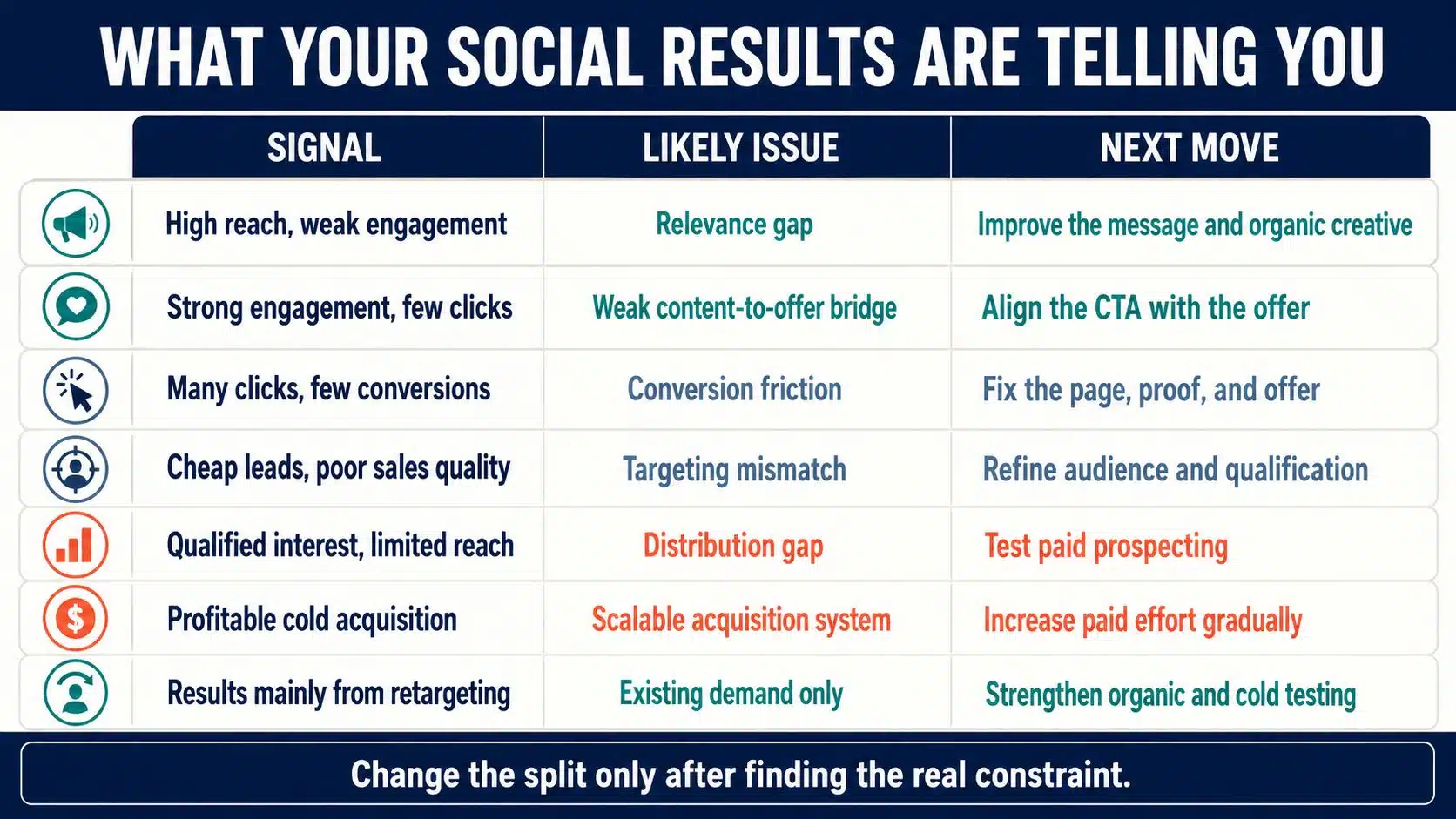
The pattern can help identify the likely problem:
- High reach, little engagement: The message or creative is probably not relevant enough.
- Strong engagement, few website visits: The content may be useful but disconnected from the offer.
- Plenty of clicks, few conversions: Check message consistency, page quality, proof, and conversion friction.
- Many leads, poor sales acceptance: Revisit targeting, qualification, and the promise made in the ad.
- Acceptable acquisition cost, weak profit: Examine margins, retention, and customer lifetime value.
- Results only from retargeting: The brand may be harvesting existing demand rather than creating new demand.
Social media can amplify a strong proposition and expose a weak one. It cannot permanently compensate for confusing positioning, poor product-market fit, or a broken buying experience.
Review the Split Using Evidence
A social allocation should be reviewed after a meaningful campaign cycle, when the business objective changes, or when performance begins to shift. Moving the percentage every few days creates noise rather than insight.
I would base the review on four questions:
- Are we reaching the people we actually want?
- Which messages and creative concepts attract meaningful attention?
- What happens after someone clicks, submits a form, or buys?
- Does performance remain viable as we increase effort or spending?
If organic activity is producing better audience insight and creative ideas, protect that investment. If paid campaigns are generating profitable new demand and the team can maintain creative quality, give them more room. If neither side produces a useful downstream result, investigate the offer and buying experience before changing the allocation.
Make the Allocation Follow the Evidence
I would begin with a dependable organic foundation, introduce focused paid tests, and move more effort toward advertising only when the message, creative, tracking, conversion path, and customer economics support it.
Even when paid campaigns perform well, organic activity still has a job. It maintains credibility, answers customer questions, develops new ideas, and supports people who are not ready to buy immediately.
A 60/40 split is a reasonable place to begin, but it should never become a permanent rule. The most effective organic vs paid social strategy is the one that keeps changing in response to audience quality, downstream results, acquisition costs, and current business goals.
Frequently Asked Questions on Organic vs Paid Social
Organic is usually the better foundation because it helps a small business understand its audience and establish credibility. Small, focused paid tests can then amplify strong messages or support a specific offer.
2. Is an 80/20 organic-to-paid split a good rule?
It can suit an early-stage or community-led brand, but it is not a universal standard. The right split depends on the objective, audience, buying cycle, creative capacity, tracking, and conversion performance.
3. Should I boost every organic post that performs well?
No. Promote content that attracts the right audience and supports a clear business objective. High engagement does not prove that a post can generate qualified leads or sales.
Run it long enough to collect meaningful results across the normal buying pattern. Avoid making major changes every day, because constant edits make performance harder to evaluate and can disrupt delivery.
Yes, especially for direct-response campaigns. However, potential customers may inspect the brand’s profile before acting. An inactive or unconvincing presence can reduce trust and leave the company with fewer ideas for future advertising.