
The AI industry is often discussed as if every major lab is running the same race. It is not. One group may be trying to build stronger general-purpose reasoning models, another may be studying what happens inside those models, while another is using AI to understand proteins, teach robots, or make powerful models practical on smaller hardware.
That distinction matters when comparing the leading AI research labs. A lab can be enormously influential without having the most popular chatbot, and the organization at the top of a model benchmark this month may not be the one producing the research with the longest scientific impact.
Our Selection Criteria
Rather than ranking organizations only by model performance or company valuation, I looked for sustained research influence and a recognizable technical identity.
The main filters were:
- Significant contributions to modern AI research or deployment
- Active research and model development in 2026
- Work that has influenced researchers, developers, or the wider AI industry
- A distinctive specialty rather than product popularity alone
- Evidence of meaningful work in areas such as reasoning, multimodal AI, safety, open models, scientific AI, robotics, or efficient computing
- Research outputs, models, datasets, code, or scientific tools that others can study or build upon
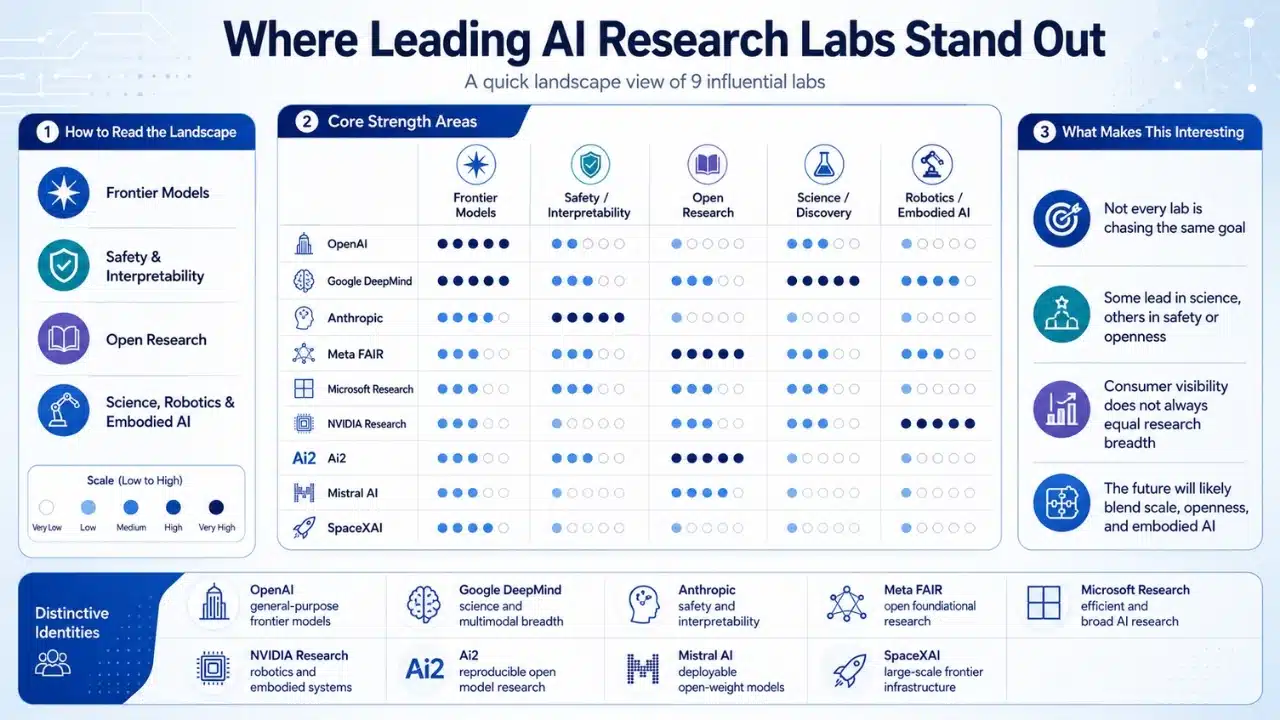
This is not a strict ranking from first to ninth. The labs are solving different problems, so declaring one universally “best” would hide more than it reveals.
Who This Is For
This guide is most useful for developers, students, researchers, technology professionals, founders, and general readers trying to understand who is actually pushing different parts of AI forward.
It is also useful if names such as OpenAI, DeepMind, Anthropic, FAIR, and Ai2 tend to blur together. Their research priorities are much more different than their shared “AI lab” label suggests.
9 Leading AI Research Labs Shaping AI Research
What makes these organizations interesting is not simply that they can train large models. Each has developed a recognizable area of strength that helps explain its influence on the broader field.
1. OpenAI: One of the Leading AI Research Labs for Frontier Models
OpenAI is best known for pushing general-purpose foundation models toward stronger reasoning, multimodal understanding, coding, tool use, and practical deployment. Its research agenda includes frontier models, reasoning, multimodal systems, and safe deployment as major areas of focus. The GPT family remains central to that work, with newer generations increasingly aimed at complex professional tasks involving research, coding, science, cybersecurity, and tools.
Best Known For:
- General-purpose GPT models and frontier reasoning
- Multimodal, voice, image, tool-use, and agentic AI research
Why We Chose It:
- It has played a major role in moving large language models into mainstream use.
- Its work spans text, images, audio, reasoning, coding, and more complex tool-assisted tasks.
- OpenAI remains one of the clearest examples of research being translated rapidly into widely deployed AI systems.
Things to Consider:
- Much of OpenAI’s most advanced work is delivered through proprietary models rather than fully open research artifacts.
- Product releases and scientific research increasingly overlap, so it is useful to distinguish the two.
2. Google DeepMind
Google DeepMind stands out because its research footprint extends well beyond conversational AI. Gemini anchors its general-purpose multimodal work, but the lab is also deeply involved in robotics, world models, mathematics, scientific reasoning, and AI-assisted biology.
Its AlphaFold work is particularly important. The system transformed protein-structure prediction, and Demis Hassabis and John Jumper were awarded part of the 2024 Nobel Prize in Chemistry for their work related to AlphaFold.
Best Known For:
- Gemini and advanced multimodal reasoning
- AlphaFold and AI for scientific discovery
Why We Chose It:
- DeepMind has repeatedly produced research with impact outside conventional software applications.
- AlphaFold has made predicted protein structures available at an enormous scale.
- Its research includes embodied AI and Gemini Robotics alongside general-purpose models.
- Earlier projects including AlphaGo, AlphaZero, and WaveNet influenced major directions in modern AI research.
Things to Consider:
- Google DeepMind works across so many fields that reducing it to “the Gemini lab” seriously understates its role.
- Some of its most important contributions are scientific rather than consumer-facing.
3. Anthropic
Anthropic has built its identity around capable frontier models combined with unusually deep work on AI safety and model behavior. Its research organization includes alignment, interpretability, frontier red teaming, economic research, and societal impacts.
At the same time, the Claude model family has become increasingly focused on coding, tool use, long-running agents, and professional knowledge work.
Best Known For:
- AI alignment and mechanistic interpretability
- Claude, coding agents, and long-horizon model behavior
Why We Chose It:
- Anthropic treats understanding model internals as a primary research problem rather than a secondary safety exercise.
- Its interpretability researchers continue studying internal structures and behavior emerging inside large language models.
- Constitutional approaches to shaping Claude’s behavior have become a distinctive part of Anthropic’s methodology.
- Its frontier red-team research addresses cybersecurity, biosecurity, autonomous systems, and other high-risk capabilities.
Things to Consider:
- Anthropic is no longer only a “safety lab.” Claude is also competing directly at the frontier of commercial model capability.
- Some of its safety research investigates uncertain and still-developing questions, so conclusions should not automatically be treated as settled science.
4. Meta Fundamental AI Research
Meta Fundamental AI Research, better known as FAIR, has been one of the strongest institutional supporters of open AI research. Its work has covered natural language processing, computer vision, speech, representation learning, embodied systems, and foundation models.
Meta’s Segment Anything research is a particularly clear example. The project evolved from image segmentation into more advanced systems capable of detecting, segmenting, and tracking objects in images and video.
Best Known For:
- Open research and reusable AI models
- Computer vision, particularly the Segment Anything family
Why We Chose It:
- FAIR has spent more than a decade publishing research and releasing technical artifacts to the wider community.
- The original LLaMA research helped accelerate the modern open-weight language-model ecosystem.
- Segment Anything established a highly reusable foundation-model approach to visual segmentation.
- FAIR’s research extends beyond generative chatbots into perception, embodiment, reasoning, speech, and other fundamental AI problems.
Things to Consider:
- Meta’s broader AI organization has evolved, so not every Meta model should automatically be described as a FAIR project.
- “Open” can mean different things across models, ranging from released weights to much more complete research transparency.
5. Microsoft Research
Microsoft Research is broader than a dedicated generative AI startup lab, which is part of why it deserves inclusion. Its AI work spans machine learning, language, computer vision, human-computer interaction, scientific computing, and efficient AI.
One especially influential recent direction has been the Phi family, which explores how smaller models can achieve surprisingly strong capabilities through carefully designed data and training methods.
Best Known For:
- Small language models and efficient AI
- Fundamental research across AI and computing
Why We Chose It:
- The Phi research challenged the assumption that capability improvements must always come primarily from increasing model size.
- Microsoft researchers demonstrated how data quality and synthetic training material could improve smaller models substantially.
- Its machine intelligence research emphasizes capability, trust, and efficiency.
- Unlike a single-product AI company, Microsoft Research can explore longer-term questions across multiple scientific disciplines.
Things to Consider:
- Microsoft Research should not be confused with every AI feature Microsoft ships commercially.
- Its most interesting research may sometimes receive less public attention than Copilot or Microsoft’s partnerships with frontier-model companies.
6. NVIDIA Research
NVIDIA is commonly viewed as the hardware company powering the AI boom, but NVIDIA Research has developed a substantial AI research program of its own. Its teams work on embodied intelligence, robot policies, efficient foundation models, perception, reasoning, and AI-scientist systems.
Its robotics groups investigate generalist embodied agents that can operate across simulated and physical environments.
Best Known For:
- Robotics and embodied AI
- Simulation, perception, and efficient foundation models
Why We Chose It:
- NVIDIA sits at an unusual intersection of AI algorithms, computing infrastructure, simulation, and robotics.
- Its robotics researchers study how machines can learn from human video, motion capture, and large-scale demonstrations.
- Its work combines multimodal models, robot learning, simulation, and foundation agents.
- That makes NVIDIA especially important as AI research moves from screens into physical environments.
Things to Consider:
- NVIDIA’s commercial hardware dominance can overshadow its research work.
- Its strengths are especially pronounced in embodied and compute-intensive AI rather than only conversational models.
7. Allen Institute for AI
The Allen Institute for AI, or Ai2, is one of the most important organizations to watch if research transparency matters to you. Its OLMo project goes significantly further than simply publishing downloadable model weights.
Ai2 releases training data, code, recipes, evaluations, and intermediate checkpoints. The lab is also developing Molmo, an open family of multimodal models focused on image and video understanding, pointing, tracking, and visual grounding.
Best Known For:
- Fully open language-model research
- OLMo and open multimodal models such as Molmo
Why We Chose It:
- OLMo gives outside researchers unusually deep visibility into how a modern language model is built.
- That makes it valuable for reproducibility, experimentation, education, and independent research.
- Molmo extends the same philosophy toward multimodal AI.
- Ai2 provides a useful counterweight to a frontier-model landscape increasingly dominated by closed systems.
Things to Consider:
- Ai2 does not have the same consumer reach or compute budget as the largest commercial labs.
- Its importance is better measured by research openness and reproducibility than chatbot market share.
8. Mistral AI
Mistral AI has become an important European AI lab by emphasizing efficient models, open weights, deployability, and greater control over where AI runs. Its model families include both smaller dense systems and larger models designed for reasoning, coding, multimodal tasks, and enterprise deployment.
Best Known For:
- Efficient and open-weight AI models
- European and sovereign AI infrastructure
Why We Chose It:
- Mistral has consistently challenged the idea that advanced models need to be available only through closed APIs.
- Its research spans reasoning, coding, OCR, speech, robotics, and other areas.
- Smaller and deployable models remain an important part of its technical identity.
- It is also positioning model choice and regional infrastructure as part of the broader AI-sovereignty discussion.
Things to Consider:
- Mistral offers both open and commercial systems, so describing the entire company as purely “open source” would be inaccurate.
- Its portfolio has expanded quickly, making its identity broader than the original Mistral 7B story.
9. SpaceXAI, Formerly xAI
xAI changed materially in 2026 when SpaceX acquired it, and the combined AI organization now presents itself as SpaceXAI. Its research and product development centers on the Grok family, large-scale training infrastructure, real-time information, reasoning, coding, voice, generative media, and increasingly autonomous agents.
Its newer systems also show how the organization is moving beyond conversational AI toward longer-running agentic work.
Best Known For:
- Grok and frontier-scale model training
- Extremely large AI compute infrastructure
Why We Chose It:
- The organization has scaled training infrastructure unusually aggressively through its Colossus systems.
- Its current work covers reasoning, code, voice, images, video, and agentic workflows.
- SpaceXAI describes its broader mission around using AI to accelerate scientific discovery.
- The combination of AI models, enormous compute capacity, and SpaceX infrastructure makes its long-term direction unusually distinctive.
Things to Consider:
- The organization is younger than most labs on this list and has gone through a major corporate restructuring.
- Its long-term scientific influence is therefore harder to judge than that of institutions with decades of published research.
A Quick Overview
The easiest way to understand these labs is by looking at the problem each one is unusually associated with rather than trying to force them into one performance ranking.
Overview Comparison
Here is the shortest way to see how their research identities differ.
| AI research lab | Especially known for | Research character |
|---|---|---|
| OpenAI | GPT, reasoning, multimodal frontier models | General-purpose frontier AI |
| Google DeepMind | Gemini, AlphaFold, robotics, AI for science | Broad scientific AI research |
| Anthropic | Claude, alignment, interpretability | Frontier AI with safety research |
| Meta FAIR | Segment Anything, open research | Open foundational AI research |
| Microsoft Research | Phi, efficient AI, machine intelligence | Broad fundamental research |
| NVIDIA Research | Robotics, simulation, embodied agents | Physical and embodied AI |
| Ai2 | OLMo, Molmo | Fully open and reproducible AI |
| Mistral AI | Efficient open-weight models | Deployable and sovereign AI |
| SpaceXAI | Grok, Colossus, large-scale agents | Frontier models and massive compute |
The comparison also shows why a simple “best lab” ranking would be misleading. DeepMind’s contribution to molecular biology, for example, is difficult to compare meaningfully with Anthropic’s interpretability work or NVIDIA’s embodied-agent research.
How to Evaluate Leading AI Research Labs for Yourself
A better question than “Which lab is winning?” is “What kind of progress am I trying to measure?”
The Selection Framework:
- Research impact: Look for work that changes what other researchers can do, not merely strong launch-day benchmark numbers.
- Distinctive contribution: Identify whether the lab has a recognizable technical specialty rather than copying whichever model category is fashionable.
- Openness and reproducibility: Consider whether outsiders can inspect the model, data, code, methodology, evaluations, or research papers.
- Real-world influence: Look at whether the research has affected science, software development, robotics, industry practices, or subsequent academic work.
The Final Checklist
Before treating any organization as a leading AI lab, ask:
- Has it produced original research rather than only commercial AI products?
- Is its work still active and relevant?
- Can I identify a clear technical contribution it is known for?
- Has its work influenced researchers or developers beyond the organization itself?
- Am I judging it by sustained impact rather than one model benchmark?
The Real AI Race Is Broader Than Chatbots
My main takeaway from comparing the leading AI research labs is that the most visible competition is only one layer of what is happening.
Frontier language models get the headlines because they are easy for millions of people to test. But protein prediction, mechanistic interpretability, small-model efficiency, open training stacks, robot learning, computer vision, and scientific reasoning may ultimately matter just as much. DeepMind’s AlphaFold is a useful reminder that an AI breakthrough does not need a chat interface to reshape an entire research field.
There is also an uncomfortable truth here. “Leading” increasingly reflects access to enormous quantities of compute, capital, data, and infrastructure. That concentration can accelerate progress, but it can also make frontier experimentation harder for universities and independent researchers. Work from organizations such as Ai2 therefore matters for a different reason: it keeps parts of the research process inspectable and reproducible.
I also expect the distinctions between these labs to blur. General-purpose models are moving into science, robots are gaining language-model reasoning, smaller models are becoming more capable, and AI safety research is becoming intertwined with deployment rather than existing as a separate discipline.
The interesting question over the next few years may therefore stop being which lab has the smartest chatbot. It may become which research philosophy, whether scale, openness, specialization, interpretability, efficiency, embodiment, or scientific discovery, produces the breakthroughs that endure.
Frequently Asked Questions (FAQs) About Leading AI Research Labs
What Are the World’s Leading AI Research Labs?
OpenAI, Google DeepMind, Anthropic, Meta FAIR, Microsoft Research, NVIDIA Research, Ai2, Mistral AI, and SpaceXAI are among the most influential organizations working across frontier AI research today. The answer depends on whether you prioritize language models, scientific AI, safety, open research, robotics, or another specialty.
Which AI Research Lab Is Best?
There is no defensible universal winner. Google DeepMind has exceptional scientific breadth, OpenAI and Anthropic are major frontier-model developers, Ai2 stands out for openness, and NVIDIA is particularly important in embodied AI and robotics.
Which AI Lab Is Best Known for AI Safety Research?
Anthropic is particularly associated with alignment, interpretability, red teaming, and research into model behavior. OpenAI, Google DeepMind, Meta, and other major labs also maintain their own safety research programs.
Which AI Research Lab Is the Most Open?
Ai2 is an especially strong candidate because OLMo provides model weights alongside training code, data, checkpoints, recipes, and evaluations. Meta and Mistral also release significant open or open-weight research, although openness differs across individual models.
Are Universities Still Important in AI Research?
Yes. Commercial labs dominate many frontier-model headlines because of the enormous computing resources required, but universities remain essential to foundational research, evaluation methods, theory, safety work, algorithms, and independent scrutiny. Many researchers at commercial labs also work closely with the academic research community.