When professionals attempt to double their output, they often try sweeping behavioral overhauls: completely clearing their schedules, adopting rigid morning routines, or adopting complex project management frameworks. These drastic changes rarely stick. Overwhelming shifts usually lead to burnout, resistance, and a swift return to default behaviors.
Sustainable performance improvements come from incremental changes. Adopting specific micro habits for productivity (actions that take less than two minutes to perform) lowers the psychological barrier to execution. Over time, these minor actions compound into significant operational efficiency, sharper focus, and reduced cognitive fatigue.
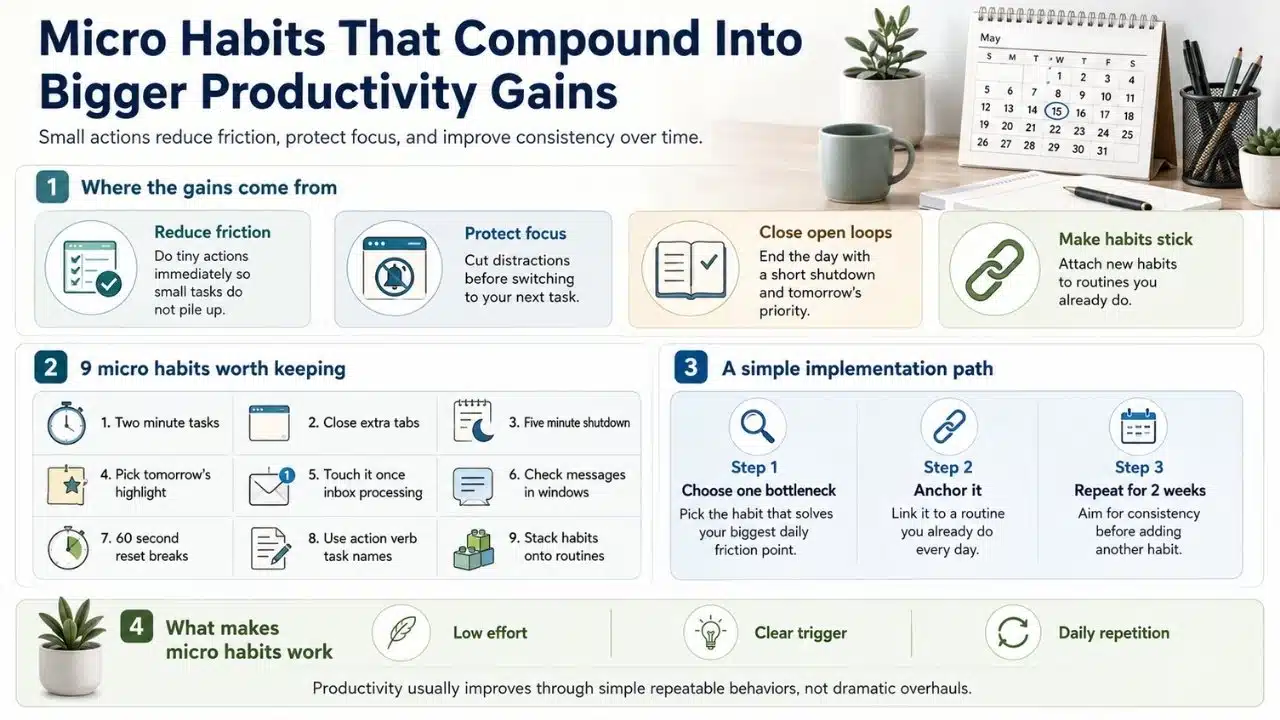
9 Essential Micro Habits for Productivity
Here are nine actionable micro habits designed to streamline your daily workflow.
1. Applying the Two-Minute Rule to Inbound Tasks
If an incoming item requires less than two minutes to execute, complete it immediately rather than deferring it to a to-do list.
Writing down a minor task, tracking it, and re-reading it later consumes more mental energy than simply finishing it on the spot. Brief responses, quick document approvals, or archiving processed files should be handled right away. Clearing small operational items immediately prevents administrative backlog from cluttering your daily schedule.
2. Closing Unused Browser Tabs Before Switching Contexts
Digital clutter creates visual noise that impairs attention span and cognitive bandwidth.
Before shifting from deep focus work to administrative tasks, take ten seconds to close every browser tab and application not needed for your next task. Maintaining only the active workspace on your monitor creates a clean environment, reducing open loop distractions and keeping your attention anchored to your primary objective.
3. Performing a Five-Minute Shutdown Routine
Transitioning directly from high-stress tasks to personal time without a clear offboarding step allows work anxiety to spill over into rest periods.
Reserve the final five minutes of your workday for a systematic shutdown routine:
-
Review completed items to acknowledge daily progress.
-
Transfer lingering action items onto tomorrow’s schedule.
-
Close all active program windows and clear physical workspace debris.
Establishing a clear boundary signals to your brain that the workday is complete, enabling better cognitive recovery overnight.
4. Selecting Your “Highlight Task” the Evening Before
Starting the morning without a clear priority leaves you vulnerable to reactive behavior, such as immediately diving into inbox management or low-impact requests.
At the end of each day, select a single “highlight task” for the following morning. This item should represent your highest-impact deliverable. When you start work the next day, begin execution on this target immediately before checking email or internal messaging channels.
5. Practicing “Touch-It-Once” Processing for Messages
Re-reading the same email or chat message multiple times without taking action creates unnecessary cognitive load.
When you open a message, commit to making an immediate decision:
-
Delete or Archive: Remove non-actionable items.
-
Delegate: Forward the item to the appropriate team member.
-
Respond: Complete short replies immediately.
-
Schedule: Add complex requests requiring deep work directly to your calendar or task manager.
Iterative processing ensures your inbox functions as a temporary transit zone rather than a permanent storage space.
6. Batching Communication Into Fixed Windows
Constant notifications create context switching, which can cost up to 20 minutes of focus recovery time per interruption.
Instead of keeping communication channels open all day, set two or three fixed times to check and respond to messages. Turning off push notifications outside these dedicated windows allows you to sustain deep focus on primary deliverables without persistent digital interruptions.
7. Taking 60-Second Micro-Breaks Between Focused Blocks
Continuous effort without rest degrades decision-making quality, increases error rates, and accelerates mental fatigue.
Incorporate one-minute transition breaks between major focus sessions. Stand up, stretch, look at an object 20 feet away, and take a deep breath. These brief physical resets break up physical tension, lower stress markers, and restore cognitive energy before you launch into your next task.
8. Framing Task Descriptions with Action Verbs
Vague items on a task list (such as “Marketing Plan” or “Budget”) create friction because your brain must determine the specific next step every time you read the line.
Rewrite task items using explicit, verb-led phrasing:
-
Replace “Marketing Plan” with “Draft initial outline for Q3 marketing plan.”
-
Replace “Budget” with “Export May expense report to CSV.”
Eliminating ambiguity reduces procrastination by clarifying the immediate action needed to make progress.
9. Stacking New Micro Habits onto Existing Anchor Routines
Introducing a new behavior into an unpredictable schedule often leads to inconsistency. Habit stacking solves this by linking a new habit to an established routine.
Structure new actions using the formula: “After I [Current Anchor Routine], I will [New Micro Habit].”
-
“After I pour my morning coffee, I will write down my single highlight task for the day.”
-
“After I finish my final call, I will execute my five-minute workspace reset.”
Leveraging established routines eliminates the need for extra willpower, helping new micro habits for productivity take root automatically.
What Most Productivity Advice Gets Wrong
Traditional productivity frameworks often urge users to adopt massive, rigid systems immediately. They emphasize perfect time-blocking, complex software setups, and strict daily schedules.
The flaw in this approach is that it relies heavily on high willpower. When stress increases or unexpected demands arise, complex systems quickly collapse under their own weight. Sustainable performance relies on low-friction execution. Building simple, low-effort habits ensures your workflow remains resilient, even during busy periods.
Micro-Habit Implementation Framework
Use this framework to systematically introduce new daily routines without overwhelming your workflow:
| Implementation Stage | Core Objective | Actionable Step |
| Phase 1: Selection | Target friction points | Pick one micro habit that addresses your largest current bottleneck. |
| Phase 2: Anchoring | Attach to routine | Link the habit to an existing daily trigger using habit stacking. |
| Phase 3: Automation | Consistency over intensity | Practice the habit daily for two weeks before introducing a second habit. |
Final Thoughts on Micro Habits for Productivity
High output is rarely the result of dramatic, sudden transformations. It is built through small, consistent operational choices that streamline focus and protect your time. By integrating targeted micro habits for productivity into your daily routine, you create a low-friction workflow that drives steady performance gains over time.
Frequently Asked Questions (FAQs) About Micro Habits for Productivity
How long does it take for a micro habit to become automatic?
Habit formation timelines vary depending on complexity and individual consistency. Simple micro habits (such as closing browser tabs or writing down a single priority) typically become automatic within two to three weeks of daily execution.
Can micro habits really replace major productivity systems?
Micro habits work best as the foundation of a productivity strategy, not as a complete replacement for fundamental planning tools. They complement project management software, calendars, and goal frameworks by lowering execution friction and improving daily adherence.
What should I do if I fail to maintain a new micro habit?
If a habit fails to take hold, scale back its scope. Reduce the effort required to execute the action, or attach it to a more reliable daily anchor routine. Consistency is far more important than intensity when forming sustainable behavioral patterns.