
Scrum is a lightweight framework that helps a small team solve a complex problem through short cycles of work, frequent inspection, and adaptation. It is not a complete project plan, a set of software tools, or a calendar filled with mandatory meetings.
That distinction matters because the visible parts of Scrum are easier to install than the changes beneath them. A workplace can schedule stand-ups and track velocity while priorities still come from several managers and feedback arrives too late to influence the product. It looks like Scrum on the calendar but behaves like traditional project control.
I do not think Scrum deserves automatic praise or automatic blame. Used well, it can expose bad assumptions early and help a team deliver something useful before investing too heavily in the wrong direction. Used mechanically, it adds meetings and new vocabulary to the same old control system.
In this guide scrum explained as it is currently defined and shows where the system tends to break.
What Is Scrum?
Scrum is designed for work where the right solution cannot be fully known in advance. A Scrum Team works toward a Product Goal in Sprints lasting one month or less. Each Sprint should produce at least one usable Increment, which the team and its stakeholders can inspect before deciding what happens next.
The framework rests on empiricism: decisions should be based on what is observed rather than what was assumed months ago. Its three pillars are transparency, inspection, and adaptation. Lean thinking adds a focus on essentials and reducing waste. Scrum’s five values, commitment, focus, openness, respect, and courage, support the honest conversations that this requires.
Scrum and Agile Are Related, but They Are Not the Same
Agile is a broader way of approaching uncertain work. The Manifesto for Agile Software Development emphasizes people, working results, customer collaboration, and responding to change. Scrum is one framework that can support those ideas; it is not a synonym for Agile.
A team can work in an agile way without Scrum, perhaps using Kanban, continuous delivery, Extreme Programming practices, or a workflow shaped for its context. The useful question is not, “Are we doing Agile correctly?” It is, “Does this way of working help us learn, deliver value, manage risk, and respond to evidence?”
Scrum’s Structure at a Glance
People often search for Scrum “roles” and “ceremonies.” The current guide uses accountabilities and events instead. The difference is not cosmetic. A job title describes a position; an accountability makes ownership clear. A ceremony can become a repeated routine; an event exists to create a specific opportunity to inspect and adapt.
| Part of Scrum | Official elements | What they provide |
| Three accountabilities | Product Owner, Scrum Master, Developers | Clear ownership of value, effectiveness, and delivery |
| Five events | Sprint, Sprint Planning, Daily Scrum, Sprint Review, Sprint Retrospective | A regular rhythm for planning, learning, and adjustment |
| Three artifacts | Product Backlog, Sprint Backlog, Increment | Transparency about the product, current plan, and completed value |
| Three commitments | Product Goal, Sprint Goal, Definition of Done | Direction, focus, and a shared quality threshold |
The 2020 revision removed the idea of a separate Development Team inside the Scrum Team. There is now one Scrum Team with three accountabilities. It also changed “self-organizing” to self-managing, added the Product Goal, and made the commitments more explicit. The official revision notes explain those changes directly.
The Three Scrum Accountabilities and What They Actually Own
These accountabilities are not a chain of command. They divide responsibility within one Scrum Team: the Product Owner steers value and direction, the Scrum Master helps the team and organization work more effectively, and the Developers turn goals into a usable result. The boundaries matter, but Scrum still depends on the three working together rather than passing work from one role to the next.
1. Product Owner: Value and Product Direction
The Product Owner is accountable for maximizing the value created by the Scrum Team. That includes developing and communicating the Product Goal, ordering Product Backlog items, and ensuring that the backlog is visible and understood.
The Product Owner may ask others to help with backlog work, but the accountability does not move. The Product Owner is one person, not a committee. If that person must collect requests from several departments but cannot decide which matters most, the backlog becomes a queue of political promises rather than a route toward a Product Goal.
The Product Owner owns value and ordering; the Developers own the plan for creating the Increment. Neither side benefits when specifications are simply passed across a boundary.
2. Scrum Master: Team and Organizational Effectiveness
The Scrum Master is accountable for establishing Scrum and improving the Scrum Team’s effectiveness. That includes coaching self-management, helping remove impediments, supporting the Product Owner, and working with the wider organization. It is more than booking meetings or updating a board.
A Scrum Master is not automatically the team’s manager. The Scrum Master should not assign everyone’s tasks, collect individual status reports, or decide whether someone has worked hard enough. Nor should the Scrum Master become a process police officer who protects a template while ignoring whether the product is improving.
Facilitating an event can be useful, but the team should not become unable to function when the Scrum Master is absent. That would be dependency, not self-management.
3. Developers: The Usable Increment
In Scrum, Developers means the people responsible for creating a usable Increment. It does not mean software programmers only. Depending on the product, the group may need design, engineering, testing, research, analysis, security, operations, writing, data, or other skills.
Developers create the Sprint Backlog, maintain quality through the Definition of Done, adapt their plan, and hold one another accountable. If the people needed to finish work sit in separate departmental queues, the team moves partial work rather than producing an Increment.
The Five Scrum Events and What Each Must Accomplish
All Scrum events happen within the Sprint. Their timeboxes are maximums, not meeting targets that must be filled.
| Event | Maximum for a one-month Sprint | Intended result |
| Sprint | One month | A usable Increment and progress toward the Product Goal |
| Sprint Planning | Eight hours | A Sprint Goal, selected work, and an initial delivery plan |
| Daily Scrum | 15 minutes | An adapted plan for the next day of work |
| Sprint Review | Four hours | Inspection of the outcome and an adapted direction |
| Sprint Retrospective | Three hours | Practical improvements to quality and effectiveness |
Shorter Sprints usually need shorter events.
1. The Sprint: A Container for Learning and Delivery
A Sprint is a fixed-length cycle of one month or less, with the next beginning immediately. The team works toward a Sprint Goal and creates a usable Increment. Quality cannot decrease, and changes must not endanger the goal, but scope can be clarified and renegotiated with the Product Owner.
This balance is often lost. Some organizations treat every selected backlog item as a personal promise. Others allow urgent requests to enter daily until the Sprint Goal means nothing. Scrum permits adaptation, but adaptation needs a stable objective.
Only the Product Owner can cancel a Sprint, and that should happen when its goal becomes obsolete, not simply because the work is harder than expected.
2. Sprint Planning: Decide Why, What, and How
Sprint Planning addresses three topics:
- Why is this Sprint valuable?
- What can be done during it?
- How will the chosen work get done?
The Scrum Team creates the Sprint Goal together. The Product Owner explains the most important backlog items, while the Developers select what they believe they can complete and form the plan.
Planning goes wrong when a manager arrives with a predetermined package of tickets and asks the team to “commit.” It also goes wrong when the meeting produces a full board but no coherent reason for the work. A useful Sprint Goal should guide trade-offs later. “Complete tickets 41 through 57” is a batch description, not a meaningful goal.
3. Daily Scrum: Replanning, Not Reporting
The Daily Scrum is a 15-minute event for Developers to inspect progress toward the Sprint Goal and adapt the Sprint Backlog.
The guide does not require each person to answer the familiar questions about yesterday, today, and blockers. That format can help, but it is optional.
The event becomes wasteful when every person reports to a manager while everyone else waits. The useful questions are: Is the Sprint Goal still reachable? What changed? Where is work stuck? What should we adjust?
The Developers choose the structure. The event exists for their planning.
4. Sprint Review: Feedback, Not Performance
The Sprint Review is a working session in which the team and relevant stakeholders inspect the outcome, discuss what changed, and consider what to do next.
Calling it a demo is convenient but incomplete. A demonstration may be part of the Review, yet the purpose is not to perform success for an audience. Honest evidence matters more than polished slides.
The Review is not a release gate either. A usable Increment can be delivered before the Sprint ends. Waiting for a ceremonial approval at the Review can delay value and weaken the feedback cycle Scrum is supposed to create.
5. Sprint Retrospective: Improvement That Changes Something
The Retrospective examines people, interactions, processes, tools, and the Definition of Done. It does not need a clever theme. It needs enough safety for honest discussion and enough authority to produce action. One completed improvement is more useful than a board full of forgotten observations.
The Three Scrum Artifacts and Their Commitments
Scrum artifacts are not administrative paperwork. They make essential information visible so people can inspect the same reality.
1. Product Backlog and Product Goal
The Product Backlog is the ordered, evolving source of work needed to improve the product. Its Product Goal describes the future state the Scrum Team is trying to reach. A list of 600 requests is not a strategy; without a clear goal, order often reflects whoever complained most recently.
Backlog refinement helps break down and clarify items so they may be selected in a future Sprint. It is an ongoing activity, not one of Scrum’s five formal events.
2. Sprint Backlog and Sprint Goal
The Sprint Backlog contains the Sprint Goal, the selected Product Backlog items, and an actionable delivery plan: why, what, and how. It belongs to the Developers and changes as they learn. The team can revise the route while protecting the objective.
A good Sprint Goal creates coherence. It gives several people a reason to collaborate instead of completing unrelated tickets under the same date range.
3. Increment and Definition of Done
An Increment is a usable step toward the Product Goal that meets the Definition of Done. Several may be created during one Sprint and delivered before the Review. The Definition of Done sets a shared quality threshold, which may cover testing, security, documentation, integration, accessibility, or operational readiness.
Work that does not meet the Definition of Done is not part of the Increment. This rule exposes a common fiction: a board can show every ticket in “Done” while testing, integration, documentation, and release work remain elsewhere. The labels look reassuring, but the product is not usable.
Where Scrum Goes Wrong
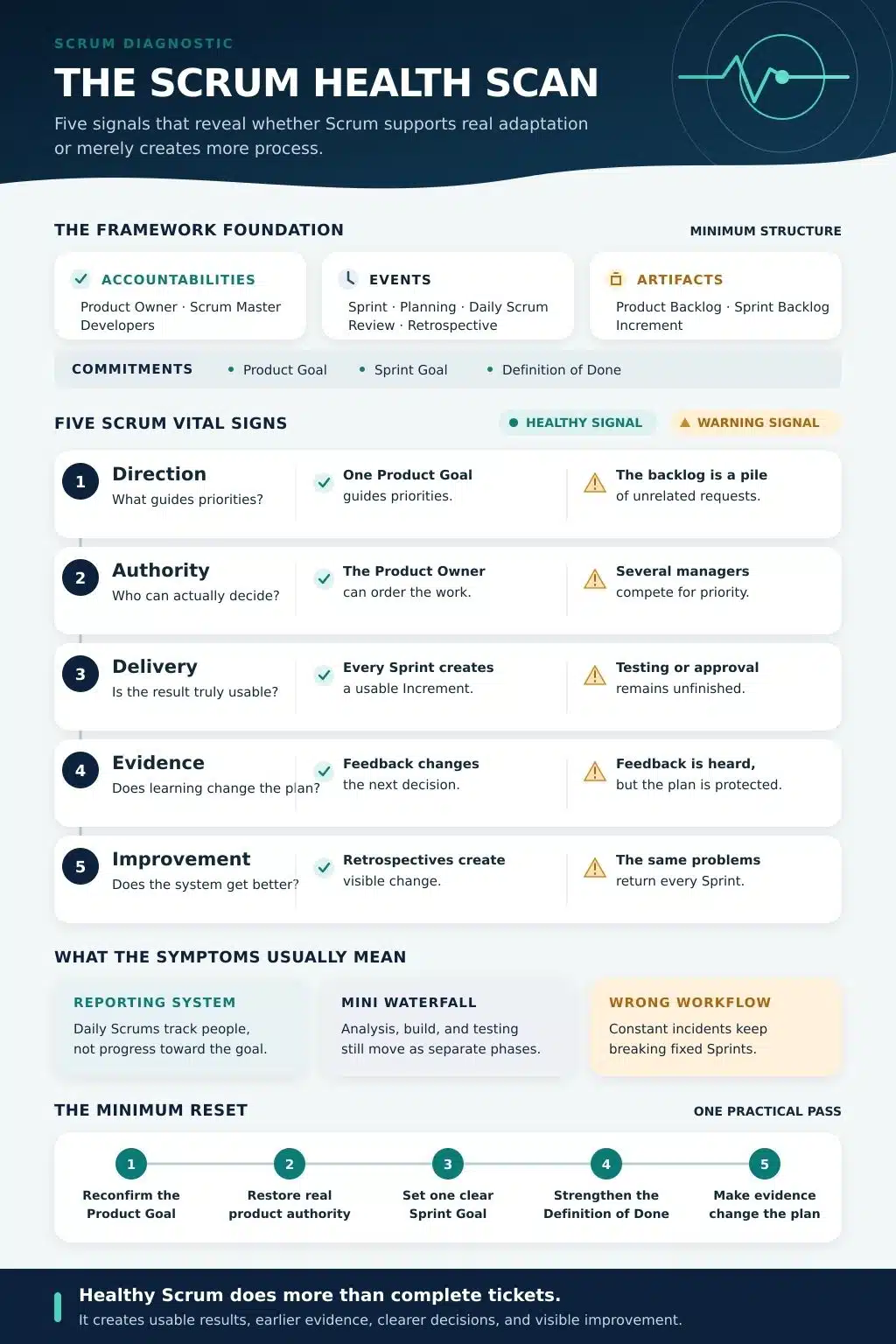
Scrum rarely goes wrong because someone forgot an agenda item. It breaks down when familiar organizational habits override the framework: authority remains elsewhere, uncertainty is punished, quality is deferred, or feedback is collected without changing a decision. These failures usually overlap, which is why repairing one meeting seldom fixes the wider system.
The Events Become a Reporting System
Scrum cannot help if evidence is allowed to appear but not to change anything. A Sprint Review may uncover weak demand, a technical risk, or a bad assumption. If the original plan remains protected because an executive promised it, inspection has become a performance rather than a source of learning.
The same problem shows up daily when every Developer reports yesterday’s activity to a manager. The Sprint Goal is barely mentioned, and blockers are taken “offline” without changing the plan. My test is simple: if the Daily Scrum helps management monitor people but does not help Developers decide what to do next, it has become a status meeting.
The Product Owner Has Responsibility Without Authority
One person carries the title, but several senior people control priority. The Product Owner becomes a backlog secretary who documents decisions made elsewhere.
This produces constant negotiation, unclear goals, and surprise work. A better backlog template will not solve it. The organization has to decide who can make product decisions and respect that authority in practice.
The Scrum Master Becomes a Traditional Manager
When Developers report their activity to the Scrum Master, wait for task assignments, or need permission to change the plan, the team is no longer self-managing.
The Scrum Master may be busy and highly organized, yet still preserve the team’s dependence on one coordinator. The more difficult responsibility is to help the team make its own decisions and tackle the organizational conditions that keep getting in the way.
The Sprint Turns Into a Ticket Deadline
Analysis fills the opening days. Development follows. Testing starts near the end. Integration and deployment happen later. The Sprint contains phases but never produces a usable Increment.
This becomes worse when every selected backlog item is treated as a personal promise. People hide uncertainty, work late, skip quality checks, or avoid admitting that the plan needs to change. The organization appears predictable, but the risk has merely moved into the product and the team.
The Sprint Goal is a commitment. The original list of selected items is a forecast that can be renegotiated as more is learned.
Story Points Become a Productivity Score
Once leaders reward rising velocity, point values tend to rise. Comparisons across teams are especially weak because each team estimates within its own context.
Higher velocity does not prove that customers received more value, quality improved, or delivery became faster. A team can produce more points while solving less.
Reviews and Retrospectives Become Theatre
In a weak Sprint Review, stakeholders arrive to watch, praise, and leave. Difficult trade-offs are avoided, real user evidence is absent, and no decision changes. A useful Review can include uncertain findings, market shifts, usage evidence, and problems the team has not yet solved. Its value lies in improving the next decision, not proving that everyone stayed busy.
Retrospectives become equally hollow when teams repeatedly identify slow approvals, unstable environments, overloaded specialists, or unclear ownership but cannot act on them. People eventually stop raising problems that the organization has shown no willingness to address.
Research on Agile adoption repeatedly points to management support, organizational culture, and team structure as material factors. That matters because a team-level meeting cannot repair an incentive or authority problem by itself.
“Done” Stops Meaning Usable
Quality work is moved outside the Sprint, exceptions become normal, and technical debt grows invisibly. “Done except for testing” is not done. Neither is “ready for release once three other teams approve it.”
A more credible Definition of Done may make output look slower at first because work that used to be hidden becomes visible. That is useful information, even when it is uncomfortable.
The Team Cannot Finish Work on Its Own
Every Increment depends on several external queues. Specialists are spread across too many teams. Managers assign work according to utilization rather than product goals.
Scrum can expose these dependencies, but its terminology cannot remove them. Leaders may need to change team design, decision rights, staffing, or approval paths before a usable Increment is possible within a Sprint.
Scrum Is Applied to Work That Does Not Fit It
Some teams receive unpredictable incidents, small service requests, and urgent support work throughout the day. Forcing that demand into Sprints may create artificial waiting and constant disruption.
Other work is stable and well understood. It may need disciplined flow and quality control more than a recurring product-learning cycle.
Scrum Should Expose Reality, Not Hide It
Scrum is valuable when it shortens the distance between an idea, a usable result, honest feedback, and a better decision. Its structure can reveal weak goals, overloaded teams, unresolved dependencies, poor quality, and false certainty before those problems become more expensive.
That exposure is uncomfortable. It is also why organizations often keep the events while weakening the accountabilities. Meetings are easier to install than product authority, cross-functional teams, transparent evidence, and genuine self-management.
My view is that Scrum should be judged by what it makes possible, not by whether every event appears on the calendar. If a team delivers usable value, learns quickly, improves its system, and can respond to evidence, the framework may be doing its job. If it produces status meetings, point targets, fixed scope, and unfinished work, the organization has not become agile. It has placed Agile vocabulary over its existing habits.
Frequently Asked Questions on Scrum
1. What are the three roles in Scrum?
The current Scrum Guide calls them accountabilities: Product Owner, Scrum Master, and Developers. The Product Owner is accountable for product value and backlog management, the Scrum Master for establishing Scrum and improving effectiveness, and the Developers for creating a usable Increment.
2. What are the five Scrum events?
The five events are the Sprint, Sprint Planning, Daily Scrum, Sprint Review, and Sprint Retrospective. The Sprint contains all the other events and lasts one month or less.
3. Is backlog refinement a Scrum event?
No. Product Backlog refinement is an ongoing activity in which items are broken down and clarified. Teams may schedule a recurring refinement session, but Scrum does not define it as a formal event or prescribe a timebox.
4. Does Scrum require story points or velocity?
No. Scrum requires Product Backlog items to be transparent enough for selection and says the Developers doing the work are responsible for sizing. It does not require story points, and velocity is not an official Scrum metric.
5. Why does Scrum fail in some organizations?
Scrum commonly breaks down when teams lack decision-making authority, Product Owners cannot control priority, managers assign work, events become status meetings, quality work sits outside the Definition of Done, or the organization refuses to adapt when evidence changes. It can also be a poor fit for highly interrupt-driven or predictable work.