
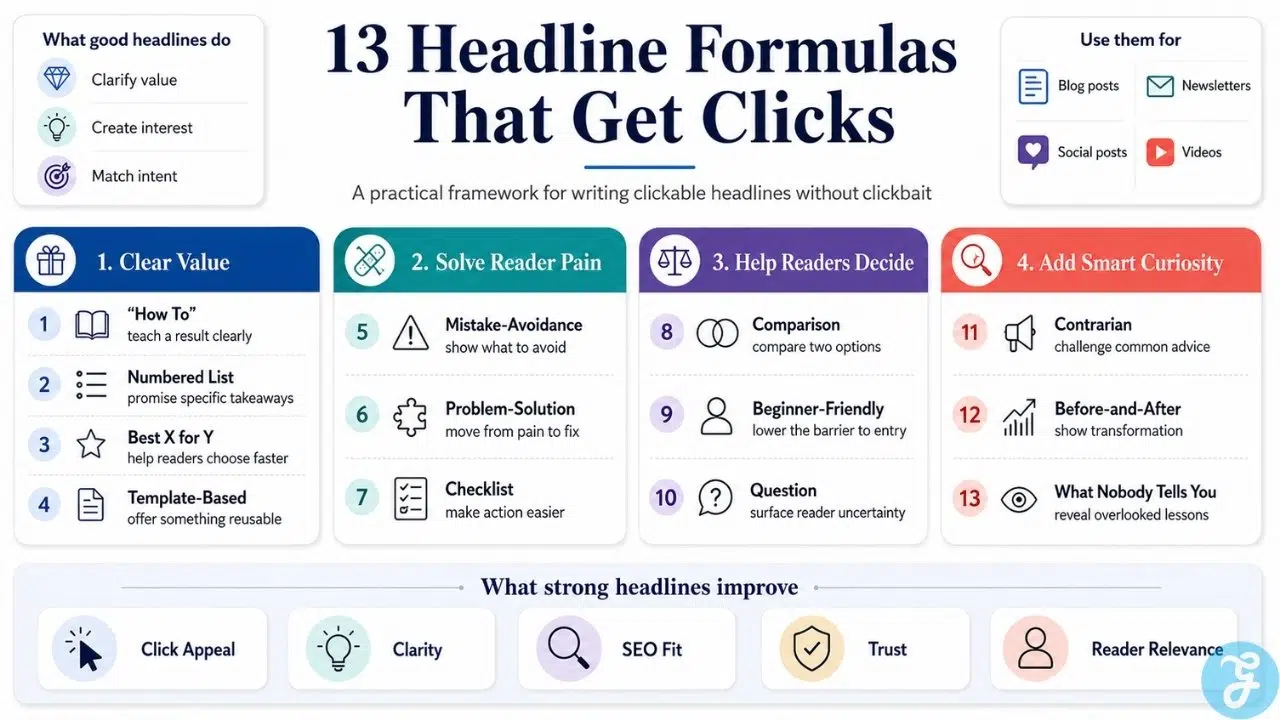
A headline has one job before anything else: make the right reader stop and care. That does not mean tricking people. It does not mean stuffing the title with drama, fake urgency, or “you won’t believe what happened next” energy. The best headline formulas work because they make the value clear quickly.
Good headlines tell readers what they will get, why it matters, and whether the content matches their problem. Great headlines do that with enough tension, specificity, or curiosity to earn the click without betraying the article.
That is the difference between clickable headlines and clickbait. One respects the reader. The other borrows attention and burns trust.
Our Selection Criteria
We selected these headline writing formulas based on usefulness, clarity, repeatability, and reader trust.
| Criteria | What We Looked For |
|---|---|
| Click appeal | Does the formula create a real reason to click? |
| Clarity | Can readers understand the promise quickly? |
| SEO fit | Can the headline include a keyword naturally? |
| Editorial trust | Does it avoid misleading curiosity or fake urgency? |
| Flexibility | Can it work for blogs, newsletters, YouTube, LinkedIn, landing pages, or guides? |
| Practical use | Can writers actually reuse the formula without sounding robotic? |
Who This Is For
These headline formulas are useful for bloggers, SEO writers, newsletter editors, publishers, content marketers, founders, YouTubers, social media managers, and anyone who needs stronger titles without turning every piece of content into bait.
They are especially useful if your current headlines feel too flat, too vague, too long, or too similar from one article to the next.
The Top 13 Headline Formulas That Get Clicks
Before using any formula, remember this rule: the headline should sell the article honestly. If the article cannot deliver what the headline promises, change the article or change the headline.
1. The “How to” Formula
The “How to” formula works because it promises practical help. Readers click because they want a process, not just an opinion.
This formula is especially strong for tutorials, guides, workflows, and problem-solving content. It also works well for search because people often look for direct instructions when they already know what they need.
Formula:
How to [achieve result] without [pain point]
Headline Templates:
- How to Write Better Headlines Without Sounding Clickbaity
- How to Grow a Newsletter Without Annoying Subscribers
- How to Build a Content Calendar Without Burning Out
Best Feature/For:
- Best for tutorials, guides, and educational content
- Great for SEO articles and evergreen content
Why We Chose It:
- Makes the reader benefit obvious
- Works across almost every niche
- Helps writers keep the article focused on a clear outcome
Things to consider:
- Avoid promising an easy fix if the process is genuinely hard
- Make sure the article actually explains the steps
2. The Numbered List Formula
Numbered headlines work because they make the content feel specific and scannable. A number tells the reader how much they are getting before they click.
This formula is useful for listicles, comparisons, examples, tools, tips, mistakes, and frameworks. It also helps reduce uncertainty because readers can quickly judge whether the content is worth their time.
Formula:
[number] [things] that [benefit or outcome]
Headline Templates:
- 13 Headline Formulas That Get Clicks
- 9 Email Content Tactics Publishers Should Use
- 11 SEO Mistakes That Quietly Hurt Rankings
Best Feature/For:
- Best for listicles and resource-style content
- Great for readers who want quick scanning and options
Why We Chose It:
- Sets clear expectations
- Makes content easier to package
- Works well for both SEO and social distribution
Things to consider:
- Do not add weak points just to hit a bigger number
- The number should match the depth of the article
3. The Mistake-Avoidance Formula
People are strongly motivated to avoid loss, embarrassment, wasted money, and wasted time. A mistake-based headline works because it signals risk.
This formula is powerful for expert content because it lets you teach through correction. It works best when the mistakes are specific, real, and costly enough for the audience to care.
Formula:
[number] [mistakes] that [negative consequence]
Headline Templates:
- 7 Headline Mistakes That Make Good Articles Easier to Ignore
- 10 Newsletter Mistakes That Kill Reader Trust
- 5 Content Strategy Mistakes That Waste Your Best Ideas
Best Feature/For:
- Best for warning-style educational content
- Great for expert blogs, B2B content, and practical guides
Why We Chose It:
- Creates urgency without fake drama
- Helps readers identify what they may be doing wrong
- Allows strong advice without sounding abstract
Things to consider:
- Do not shame the reader
- Explain the fix, not just the failure
4. The Problem-Solution Formula
This is one of the cleanest headline formulas because it starts where the reader already is: stuck with a problem.
The best version names the problem clearly and then points toward relief. It works for blogs, landing pages, email subject lines, product content, and service pages.
Formula:
Struggling with [problem]? Here’s how to [solution]
Headline Templates:
- Struggling With Low Opens? Here’s How to Fix Your Newsletter Headlines
- Losing Readers After the First Paragraph? Here’s How to Tighten Your Intro
- Getting Clicks but No Conversions? Here’s What to Check First
Best Feature/For:
- Best for direct pain-point content
- Great for audiences actively looking for help
Why We Chose It:
- Speaks to the reader’s real frustration
- Creates a clear bridge from pain to action
- Makes the article feel immediately relevant
Things to consider:
- Use only when the problem is specific
- Avoid vague problems like “not getting results” unless you define them clearly
5. The “Best X for Y” Formula
“Best” headlines work when readers are comparing options. The key is adding “for Y” so the headline feels specific instead of generic.
This formula is especially useful for tools, products, platforms, strategies, books, templates, courses, and services. It becomes stronger when the audience or use case is narrow.
Formula:
Best [thing] for [specific audience, use case, or goal]
Headline Templates:
- Best Headline Templates for SEO Writers
- Best Newsletter Tools for Small Publishers
- Best Content Optimization Tools for Growing Blogs
Best Feature/For:
- Best for comparison and recommendation content
- Great for affiliate, SaaS, and tool-focused articles
Why We Chose It:
- Matches buyer and research intent
- Helps readers choose faster
- Adds specificity to broad recommendation topics
Things to consider:
- Support recommendations with real selection criteria
- Do not call something “best” if you cannot explain why
6. The Comparison Formula
Comparison headlines work because readers often need help choosing between two options. The formula creates instant tension by placing alternatives side by side.
This works especially well when both options are familiar but the difference is confusing. The article should not just define both sides; it should help the reader decide.
Formula:
[Option A] vs [Option B]: Which is better for [goal]?
Headline Templates:
- Short Headlines vs Long Headlines: Which Gets Better Clicks?
- SEO Titles vs Social Headlines: What Should You Write First?
- Newsletters vs Social Media: Which Builds Stronger Reader Loyalty?
Best Feature/For:
- Best for decision-stage content
- Great for SaaS, marketing, business, education, and buyer guides
Why We Chose It:
- Makes the reader’s decision problem clear
- Creates natural structure for the article
- Attracts readers who are close to choosing
Things to consider:
- Do not fake a winner if the answer depends on context
- Include a “choose this if” section for practical value
7. The Beginner-Friendly Formula
Beginner headlines work because they remove intimidation. Many readers avoid content because it sounds too advanced, technical, or full of assumptions.
This formula makes the article feel safe to enter. It is especially useful for complex topics where readers need a clean starting point.
Formula:
[Topic] for Beginners: [simple outcome]
Headline Templates:
- Headline Formulas for Beginners: How to Write Titles People Notice
- SEO Writing for Beginners: How to Make Articles Easier to Find
- Newsletter Strategy for Beginners: How to Build a Useful Email Habit
Best Feature/For:
- Best for educational and entry-level content
- Great for complex topics with a wide beginner audience
Why We Chose It:
- Reduces friction for new readers
- Makes the content feel accessible
- Helps clarify the article’s difficulty level
Things to consider:
- Do not make the article too advanced after promising beginner help
- Explain terms simply without talking down to the reader
8. The Checklist Formula
Checklist headlines work because they promise completeness. Readers click because they want to know whether they missed something important.
This formula is strong for launches, audits, reviews, workflows, planning, publishing, and quality control. It also makes the article useful as a repeatable resource.
Formula:
The [topic] checklist for [goal or situation]
Headline Templates:
- The Headline Writing Checklist for More Clickable Headlines
- The Newsletter Launch Checklist for Publishers
- The Content Refresh Checklist for SEO Teams
Best Feature/For:
- Best for process-driven content
- Great for operational, editorial, and marketing workflows
Why We Chose It:
- Makes the article feel practical
- Encourages saves and repeat visits
- Helps readers complete a task with fewer mistakes
Things to consider:
- A checklist should be usable, not decorative
- Group items logically so readers can act on them
9. The Question Formula
Question headlines work when the question is already in the reader’s head. The best question headlines do not sound clever for the sake of it; they mirror real uncertainty.
This formula works well for opinion pieces, explainers, comparison articles, and myth-busting content. It can also perform well in newsletters because questions feel conversational.
Formula:
Is [thing] really [claim or concern]?
Headline Templates:
- Are Clickable Headlines Always Clickbait?
- Is Your Newsletter Subject Line Too Clever to Work?
- Do Headline Templates Make Writers Sound Generic?
Best Feature/For:
- Best for explainers and opinion-led content
- Great for topics with confusion, debate, or doubt
Why We Chose It:
- Creates curiosity naturally
- Helps frame the article around a reader concern
- Works well when the answer needs nuance
Things to consider:
- Do not ask a question the article barely answers
- Avoid obvious questions with obvious answers
10. The Contrarian Formula
Contrarian headlines get attention because they challenge what the audience already believes. They work when the argument is thoughtful, not just loud.
This formula is especially useful for op-eds, expert commentary, industry analysis, and thought leadership. The headline should make a clear claim, but the article must defend it with reasoning.
Formula:
Why [common belief] is wrong about [topic]
Headline Templates:
- Why Most Headline Advice Is Wrong About Clicks
- Why Short Headlines Are Not Always Better
- Why More Newsletter Subscribers Can Become a Publisher Problem
Best Feature/For:
- Best for opinion and expert analysis
- Great for industries full of lazy assumptions
Why We Chose It:
- Creates intellectual tension
- Signals a strong point of view
- Helps the article stand out from generic advice
Things to consider:
- Do not be contrarian just to sound bold
- Back the claim with clear logic and examples
11. The Before-and-After Formula
Before-and-after headlines work because they promise transformation. Readers want to know what changes when they apply the advice.
This formula is strong for case studies, tutorials, rewrites, optimization guides, and improvement-focused content. It becomes even stronger when the “after” result is specific.
Formula:
From [current state] to [better state]: How to [process]
Headline Templates:
- From Flat to Clickable: How to Rewrite Weak Headlines
- From Random Emails to Reader Habits: How Publishers Improve Newsletters
- From Thin Drafts to Strong Guides: How to Improve SEO Content
Best Feature/For:
- Best for transformation and improvement content
- Great for case studies, edits, and practical walkthroughs
Why We Chose It:
- Makes progress visible
- Gives the article a natural story arc
- Helps readers imagine the result
Things to consider:
- The article should show the transformation clearly
- Use examples so the promise does not feel abstract
12. The “What Nobody Tells You” Formula
This formula works because it suggests hidden practical knowledge. It can be powerful, but it also becomes clickbait quickly if abused.
Use it only when the article genuinely reveals overlooked trade-offs, uncomfortable truths, or lessons beginners usually miss. The best version feels useful, not conspiratorial.
Formula:
What nobody tells you about [topic]
Headline Templates:
- What Nobody Tells You About Writing Clickable Headlines
- What Nobody Tells You About Newsletter Growth
- What Nobody Tells You About SEO Content Briefs
Best Feature/For:
- Best for experience-based lessons
- Great for advanced guides, editorial commentary, and founder-led content
Why We Chose It:
- Creates curiosity without needing exaggeration
- Signals lessons beyond basic advice
- Works well when the content has hard-earned insight
Things to consider:
- Avoid using it for basic tips everyone already knows
- Deliver something genuinely specific or surprising
13. The Template-Based Formula
Template headlines work because they promise immediate usability. The reader expects something they can copy, adapt, or apply.
This formula is ideal for content about writing, planning, outreach, sales, emails, briefs, scripts, and workflows. It also works well when the article includes real examples, not just theory.
Formula:
[number] [templates] for [specific task or outcome]
Headline Templates:
- 21 Headline Templates for More Clickable Headlines
- 15 Newsletter Subject Line Templates for Publishers
- 12 Content Brief Templates for SEO Teams
Best Feature/For:
- Best for practical copy-and-use content
- Great for writers, marketers, founders, and busy teams
Why We Chose It:
- Gives readers immediate utility
- Makes the article easy to save and reuse
- Supports action, not just learning
Things to consider:
- Do not give templates without explaining when to use them
- Include examples so readers can adapt them properly
A Quick Overview
These headline formulas work best when you match the formula to the reader’s intent. A comparison headline fits a decision-making reader, while a checklist fits someone preparing to act. A contrarian headline works for thought leadership, but a beginner headline works better when the audience needs a clear entry point.
Overview Comparison
| Headline Formula | Best Use | Main Benefit | Best Fit |
| How to | Tutorials and guides | Clear practical value | SEO articles, guides |
| Numbered list | Tips, tools, examples | Scannable promise | Listicles, roundups |
| Mistake-avoidance | Warning content | Risk awareness | Expert advice |
| Problem-solution | Pain-point content | Immediate relevance | Blogs, landing pages |
| Best X for Y | Recommendations | Faster decisions | Tool and product lists |
| Comparison | Choice-based content | Decision support | Buyer guides, explainers |
| Beginner-friendly | Entry-level topics | Lower intimidation | Educational content |
| Checklist | Process content | Repeatable action | Launches, audits |
| Question | Uncertainty and debate | Natural curiosity | Explainers, newsletters |
| Contrarian | Opinion and analysis | Strong differentiation | Op-eds, thought leadership |
| Before-and-after | Improvement content | Visible transformation | Case studies, rewrites |
| What nobody tells you | Overlooked lessons | Curiosity and depth | Expert content |
| Template-based | Reusable assets | Immediate utility | Writing and workflow guides |
Our Top 3 Picks and Why
1. The “How to” Formula
This is the safest and most reliable option because it makes the value clear. It works especially well when the article teaches a process or solves a specific problem.
2. The Numbered List Formula
Numbered list headlines are easy to understand, easy to scan, and easy to package. They work well when the article offers several useful options, examples, tools, or tactics.
3. The Problem-Solution Formula
This formula is powerful because it starts with the reader’s pain. When the problem is specific, the headline feels personal without needing cheap urgency.
How to Choose the Right Headline Formula
The right formula depends on what the reader needs before clicking. Do they want a step-by-step process, a warning, a comparison, a shortcut, a beginner explanation, or a reusable template?
Do not choose the formula first and force the article into it. Start with the reader’s intent, then choose the headline structure that makes the promise clearest.
A simple selection framework:
- Pick How to when the article teaches a process.
- Pick Numbered list when the article offers multiple tips, tools, or examples.
- Pick Mistake-avoidance when the reader needs to avoid costly errors.
- Pick Comparison when the reader is choosing between options.
- Pick Checklist when the reader needs a repeatable workflow.
- Pick Question when the topic involves doubt or debate.
- Pick Template-based when the reader wants something reusable.
Final Checklist Before Publishing a Headline
Before you publish, ask:
- Does the headline make the article’s value clear?
- Is the promise honest and deliverable?
- Does it include the main keyword naturally if SEO matters?
- Is it specific enough to stand out from generic advice?
- Would the right reader understand it without extra context?
Clicks Are Earned Before the First Sentence
The best headline formulas do not manipulate readers. They help readers decide faster.
That is what a good headline should do. It should clarify the promise, create enough interest, and attract the right audience without misleading anyone. Clicks are valuable only if the reader feels the article delivered.
Use formulas as scaffolding, not as a substitute for judgment. The formula can open the door. The article still has to earn the room.
Frequently Asked Questions (FAQs) About Headline Formulas
What are headline formulas?
Headline formulas are repeatable headline structures that help writers communicate value clearly. They give you a starting point for writing titles, subject lines, article headings, video titles, and social post hooks.
Do headline templates actually work?
Headline templates work when they match the content and the audience’s intent. They fail when writers use them mechanically or make promises the article does not deliver.
What makes a headline clickable?
Clickable headlines are clear, specific, relevant, and interesting. They give the right reader a strong reason to click without relying on misleading curiosity or exaggeration.
Are headline formulas bad for SEO?
No. Headline formulas can support SEO when they include the topic naturally and accurately describe the content. The problem starts when headlines become vague, stuffed with keywords, or disconnected from the article.
How do I avoid clickbait headlines?
Avoid overpromising, hiding the real topic, using fake urgency, or creating curiosity the article cannot satisfy. A strong headline should attract attention and still feel honest after the reader clicks.