
There is a dangerous little sentence floating around SEO circles: “It’s already indexed, so it’s safer.” That sentence has sold a lot of bad links. Niche edits sound practical at first. A link is inserted into an existing article, usually on a website that already has age, topical relevance, traffic history, and authority metrics that look impressive in a report.
No waiting for a guest post. No new article to write. No long editorial process. Just a neat little backlink placed inside a page Google already knows. It does not look reckless. It looks efficient. It looks like a shortcut wearing a clean shirt and speaking in agency language. “Link insertion” sounds more professional than “paid backlink.” “Curated placement” sounds cleaner than “someone edited an old article because money changed hands.” “Niche relevance” sounds almost responsible until you ask the question that ruins the pitch:
Would this link have been added if nobody paid, traded, pressured, or brokered their way into the page? Most of the time, the honest answer is no. And when the answer is no, the risk starts.
The Niche Edits Feels Tempting Because SEO Is Impatient
Let’s be honest. I understand why SEOs fall for niche edits. Real link building is slow. Digital PR is unpredictable. Editorial mentions are hard to earn. Good journalists ignore weak pitches. Strong publishers reject thin stories. Clients want rankings now, not a calm lecture about brand authority and long-term trust.
So when a vendor promises a contextual link from an existing relevant article, it feels like the market has finally offered a practical answer.
The sales pitch is beautiful:
- The page already exists.
- Google has already crawled it.
- The article may already rank.
- The domain has authority metrics.
- The link sits inside the body content.
- The turnaround is fast.
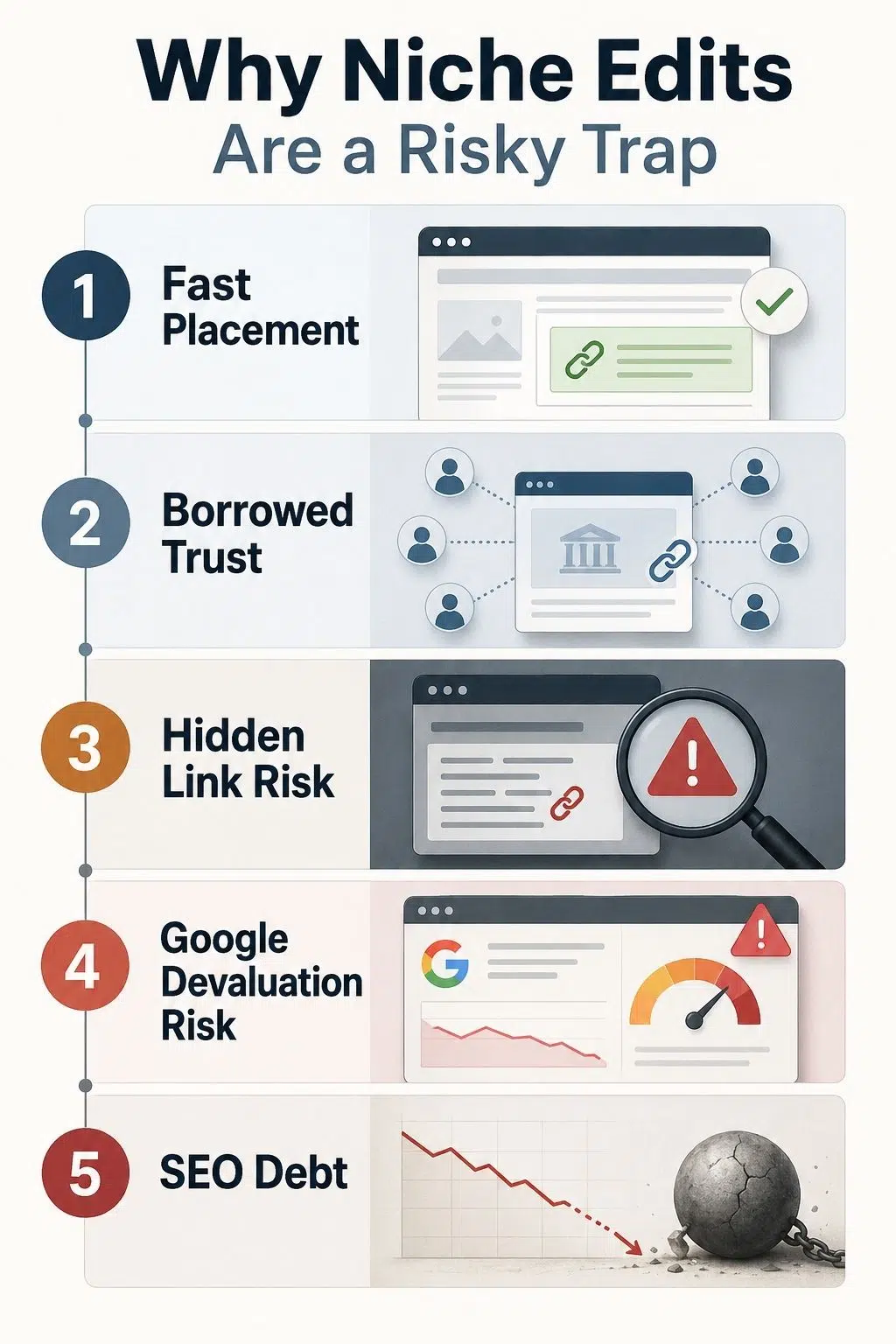
That is not just a pitch. It is a dopamine hit for anxious marketers. But speed is not the same as safety. An existing article is not the same as an earned editorial citation. A contextual paragraph is not automatically a trustworthy placement. A relevant page can still host an artificial link if the real purpose is to pass ranking value.
This is where many SEO teams make the wrong call. They treat age, relevance, and domain metrics as protection. But Google’s issue has never been only where a link sits. The issue is why the link exists.
The Real Niche Edit Dangers Start With Intent
The biggest mistake people make with niche edits is treating them as a placement problem.
They ask:
- Is the domain relevant?
- Does the page have traffic?
- Is the anchor text natural?
- Is the article indexed?
- Does the site look real?
Those are useful checks, but they are not enough. The better question is much simpler: did this link earn its place?
Suppose an old article is updated because a new source genuinely helps readers; that can be perfectly legitimate. Editors update content all the time. They replace outdated statistics, fix broken links, add better resources, cite new studies, and improve weak sections.
That is not the problem. The problem begins when the link is added, mainly because somebody bought access to the page. That is where niche edit dangers become obvious. Many niche edits are not editorial improvements. They are quite commercial insertions. The reader sees a normal article. Google sees a link inside the content. The buyer sees a ranking asset. But the real reason the link exists is hidden.
That hidden intent is the trap. A link that exists because it improves the article is an editorial reference. A link that exists because it was purchased to influence rankings is a liability.
The paragraph may look natural. The anchor may sound clean. The site may pass every surface-level metric check. None of that changes the basic problem. Artificial authority is still artificial authority.
Why Link Insertion Risk Is Bigger Than a Penalty
When SEOs talk about link insertion risk, they usually jump straight to penalties. That matters, of course. Google’s spam policies clearly target links created mainly to manipulate search rankings. Google also advises that paid placements should be qualified with attributes such as rel=” sponsored” or rel=”nofollow”. Search Console’s manual action documentation warns that unnatural, artificial, deceptive, or manipulative links can affect some or all of a site.
But the risk is not only a manual action. The bigger risk is dependency. When you buy niche edits, you attach your site’s growth to assets you do not control.
You do not control whether the publisher keeps the link, or whether the article later becomes stuffed with more paid outbound links, whether the site gets sold, expires, repurposed, hacked, or turned into an affiliate graveyard, or whether the same vendor sells placements to spam-heavy industries on the same network, or whether Google decides the link pattern is no longer worth counting.
That last one is brutal. Google’s own spam update guidance says that when link-spam systems neutralize spammy links, the ranking benefit those links previously generated can be lost and may not be regained. In plain English, the shortcut may stop working, and cleaning it up later may not restore the lift you enjoyed before.
That is SEO debt. And like all debt, it feels useful until the bill arrives.
Niche Edits Google Risk Is Not a Theory
Some SEOs still behave as if Google cannot understand paid link patterns unless the seller sends an invoice with “link scheme” written in the subject line. That is childish.
Google does not need to know every private payment to discount suspicious link patterns. Search systems can evaluate behavior at scale: sudden edits to old pages, unnatural outbound link growth, repeated commercial anchors, sites linking to unrelated money pages, networks of publishers selling placements, and articles that slowly become link farms while pretending to be editorial resources.
Will Google catch every paid niche edit? No. But “not caught yet” is not a strategy. It is gambling with a spreadsheet. The real issue with niche edits, Google’s risk is timing. The damage often comes late. A campaign may appear to work for months. Rankings improve. The agency sends a happy report. The client feels reassured. Everyone pretends the strategy is smart.
Then a spam system gets better. A site gets reviewed. A publisher sells too many placements. A link network becomes obvious. The benefit disappears. Now the same people who praised the shortcut start calling the traffic drop “volatility.” That word does a lot of unpaid labor in SEO.
Borrowed Authority Is Not Real Authority
Niche edits sell one fantasy above all others: that authority can be transferred without trust being earned. But real authority does not work like that.
If a respected publication links to your research because your data helps readers, that link carries meaning. It says your work contributed something. It says the publisher had a reason to cite you. It builds reputation outside the backlink itself.
A paid niche edit usually tries to capture the technical benefit of a citation without earning the editorial reason for that citation. That difference matters.
The SEO industry has spent years obsessing over domain metrics because numbers make messy human judgment feel simple. DR, DA, traffic estimates, referring domains, keyword counts – these can be useful diagnostic signals. But they are not proof of editorial trust.
A high-metric page can still host a bad link. A relevant article can still become polluted. A contextual placement can still be manipulative. A clean anchor can still be paid spam. A link is not good because a tool paints the domain green.
A link is good because it makes sense to the reader, survives scrutiny, and would still deserve to exist if Google disappeared tomorrow. Most paid niche edits fail that test.
The “Relevance” Argument Is Overused and Underexamined
Relevance is the most abused word in link building. A vendor will say, “Don’t worry, the site is niche relevant.” Then you open the page and find a link wedged into a sentence like a sofa blocking a hallway. Technically, the topic matches. Practically, the link feels off. That is because relevance is not just category matching.
A SaaS link inside a SaaS article can still be unnatural. A finance link inside a finance blog can still be manipulative. A health link inside a wellness article can still be reckless if the publisher has no medical credibility. A marketing link inside a marketing guide can still exist only because someone paid for it.
Relevance does not clean up bad intent. This is especially important now because search is moving deeper into trust evaluation, brand signals, author credibility, entity understanding, source quality, and content usefulness. Google’s systems are not simply counting blue links like loose coins on a table. They are trying to understand whether a source deserves visibility.
A niche edit may make you look connected for a while. It does not make you credible.
The Publisher Side of Niche Edits Is Just as Bad
There is another part of this conversation people avoid: niche edits can damage the publisher selling the placement, too. A publisher may think one paid insertion is harmless. One link in an old article. One quick revenue opportunity. No new content required. No major editorial lift.
Then one link becomes five. Five becomes twenty. Twenty becomes a business model. A helpful guide from 2021 slowly turns into a rented hallway for unrelated brands. A clean article starts carrying awkward commercial anchors. The publisher’s archive becomes inventory. The editorial standard becomes negotiable.
That is how decent sites decay. The damage is not always immediate. Readers may not notice every inserted link. But the site’s outbound link profile starts telling a different story. Articles that once served readers now serve buyers. And once a publisher teaches its archive to sell trust, every legitimate link on the site becomes a little harder to believe.
That is not only an SEO problem. It is an editorial problem.
Not Every Link Added Later Is Bad
This is where nuance matters. I am not arguing that every link added to an old article is dangerous. That would be lazy and inaccurate.
Content updates are normal. Good editors improve old articles. Writers add newer sources. Publishers replace broken links. Experts cite better research. Companies earn mentions after launching useful tools, original studies, strong guides, or genuinely helpful resources.
A link added after publication can be completely legitimate. The difference is editorial necessity.
A clean link insertion usually has these qualities:
- The link improves the reader’s understanding.
- The publisher can explain why it was added.
- The anchor text reads naturally.
- The linked page deserves the citation.
- The page is genuinely relevant, not just category-adjacent.
- There is no hidden payment for ranking value.
- If there is sponsorship or payment, the link is properly qualified.
A risky niche edit usually has different signals:
- The link exists mainly to influence rankings.
- The anchor text is commercially convenient.
- A vendor controls or brokers the placement.
- The publisher has a pattern of selling outbound links.
- The page has unrelated paid links added over time.
- The link would be embarrassing to explain to a client, journalist, or Google reviewer.
That last test is simple and powerful. If you cannot explain the link in daylight, you probably should not build it.

The Better Alternative Is Slower Because It Has to Be
The alternative to niche edits is not “do nothing.” The alternative is to build assets that deserve links. That means original research, industry data, expert commentary, sharp opinion pieces, practical tools, templates, visual explainers, comparison resources, public experiments, and guides that solve real problems better than what already ranks.
It also means digital PR that starts with a story, not an anchor-text target. There are safer ways to earn links when they are done properly:
Broken link replacement, where your page genuinely fixes a dead resource. Unlinked brand mention outreach where the mention already exists. Resource page inclusion where your asset clearly helps the audience. Expert contributions where your insight is the reason for the citation. Original data campaigns that journalists can actually use. Transparent partnerships where sponsorship is disclosed and links are qualified properly.
None of this is as fast as ordering ten niche edits from a vendor spreadsheet. That is the point. Real authority has friction. It takes editorial judgment. It requires a page worth citing. It asks whether your brand deserves to be referenced, not just whether someone can be paid to reference it.
The Real Problem Is Strategic Laziness
The harsh truth is that niche edits often appeal to teams that do not want to do the harder work of becoming link-worthy. That sounds blunt because it is. If your content has no original value, you need shortcuts. If your brand has no clear point of view, you need borrowed authority. If your campaign has no story, you need placement vendors. If your leadership only understands monthly link counts, you need something fast to show in a report.
Niche edits fit perfectly into that broken incentive system. They let agencies show deliverables. They let clients feel progress. They let SEO teams avoid the uncomfortable conversation that many websites are not being ignored because they lack backlinks. They are being ignored because they lack anything worth linking to.
That is the line nobody wants to put in a proposal. A weak page with purchased authority is still a weak page. A thin brand with link insertions is still a thin brand. A company with no editorial footprint cannot buy its way into genuine trust forever. Sooner or later, search catches up with the difference between being cited and being placed.
Build Links That Can Survive Being Explained
Niche edits are not risky because links are bad. Links still matter. Citations still matter. Discovery still matters. The web still runs on references.
Niche edits are risky because they often imitate the appearance of earned trust without doing the work that earns it. That is why the niche edits are so dangerous for brands. It does not feel like spam at first. It feels practical. It feels efficient. It feels like modern SEO.
Until the links get ignored, the publisher sells too many placements, the site gets reviewed, a spam update removes the benefit, and the client asks why the strategy cannot be explained without sounding shady. The future of SEO will not reward brands that hide weak authority inside old articles. It will reward brands that can prove why they deserve to be referenced.
So here is the cleanest rule I know: Build links you can defend in daylight.
If a link needs secrecy, clever wording, or plausible deniability to survive, it is not an asset. It is a liability wearing anchor text.