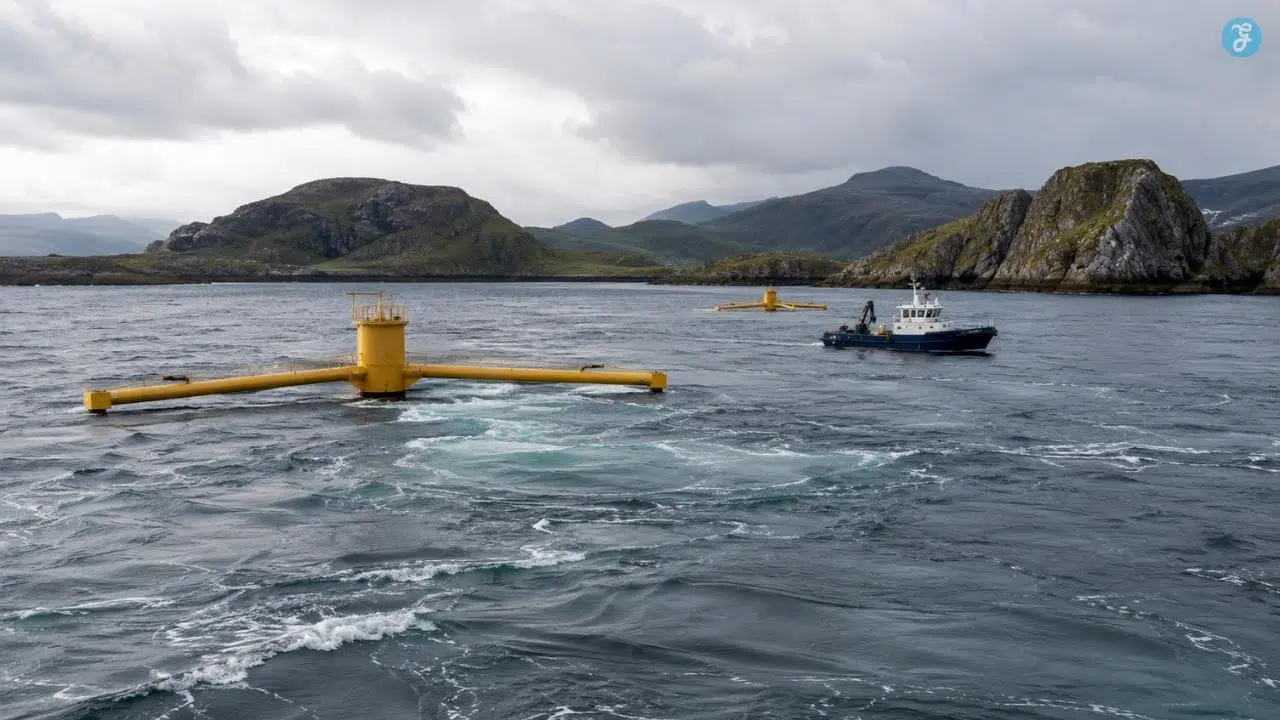
Scotland’s wave and tidal energy sector has never been an easy story. The promise is obvious. The country has powerful coastlines, serious offshore engineering knowledge, active test infrastructure, and a long history of marine energy experimentation. The challenge is just as obvious. Saltwater is brutal. Storms punish weak engineering. Offshore maintenance is expensive. Grid access can be slow. Investors usually want faster returns than marine energy can comfortably promise.
That is why the Scottish companies still pushing this sector forward deserve attention. This is not a list of ten identical startups building shiny ocean machines. That would be inaccurate. Scotland’s wave and tidal energy ecosystem includes technology startups, mature scaleups, specialist SMEs, engineering firms, subsea storage companies, and marine contractors. Some generate power. Some help deploy the systems. Some solve the less glamorous problems that make deployment safer, cheaper, and more realistic.
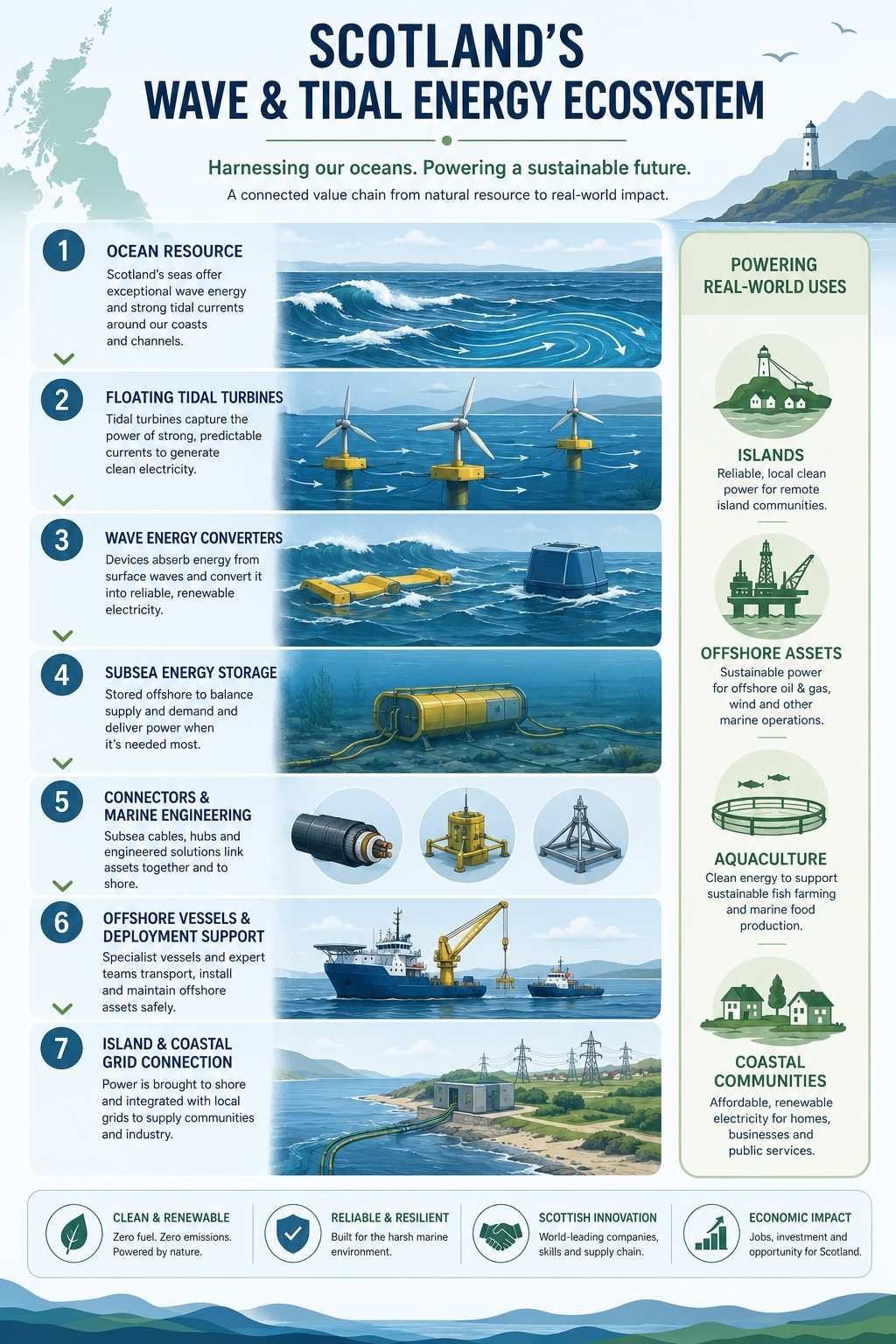
That distinction matters. Wave and tidal energy will not scale because one clever device survives a test. It will scale only when the whole chain improves: turbines, wave converters, moorings, connectors, batteries, vessels, installation methods, maintenance models, ports, local skills, and project finance.
So, this article looks at 10 Scottish wave and tidal energy companies that are helping move the sector from ambition toward practical deployment.
How I selected These Companies
This list was built around verified relevance, not hype. To be included, each company had to meet most or all of these criteria:
- It must be based in Scotland or have a clear Scottish operating base.
- It must be active and publicly verifiable.
- It must have a direct connection to wave energy, tidal energy, or marine-energy enabling technology.
- It must be a startup, scaleup, privately held SME, or specialist company rather than a generic multinational.
- It must contribute something practical to the sector, such as devices, storage, engineering, marine operations, deployment support, or testing infrastructure.
- Its role had to be specific enough to describe without inventing extra claims.
One important note: the word “shaping” is used deliberately. These companies are not all dominating the market in a conventional commercial sense. Marine energy is still an emerging sector. What they are doing is shaping the technology, supply chain, and deployment models that could decide whether wave and tidal energy become commercially useful.
1. Orbital Marine Power
Orbital Marine Power is one of Scotland’s most visible tidal energy companies.
The company is based in Orkney and Edinburgh and develops floating tidal stream turbine technology. Its best-known machine, the O2, has become one of the strongest symbols of Scotland’s tidal energy ambition. It is large, floating, towable, and designed to generate predictable power from tidal currents.
Orbital matters because it has moved beyond concept-stage storytelling. It has put serious hardware into real water, connected it to the grid, and continued working toward larger commercial tidal projects.
Business Snapshot
| Field | Details |
| Main technology | Floating tidal stream turbines |
| Scottish base | Orkney and Edinburgh |
| Strongest use case | Grid-connected tidal stream generation |
| Best suited for | Strong tidal sites, island energy systems, and coastal power projects |
| Sector role | One of Scotland’s most advanced tidal technology developers |
What the Company Actually Does
Orbital develops floating tidal turbines that can be towed into position. That design choice matters because offshore installation is one of the highest cost and risk points in tidal energy.
A floating system can simplify some parts of deployment, retrieval, and maintenance compared with systems that depend heavily on seabed foundations. The technology is built around predictable tidal currents, which is one of tidal power’s biggest advantages over other renewables. The tide may not run at full force every minute, but it can be forecast years in advance.
For Scotland, Orbital also matters as a supply-chain story. Large tidal systems create demand for marine engineering, fabrication, vessels, mooring systems, maintenance, ports, and local offshore skills.
Why It Belongs on This List
Orbital belongs here because it is one of the Scottish companies that has made tidal energy visible and tangible.
In a sector where many companies struggle to move beyond prototypes, Orbital has demonstrated real marine hardware in Scottish waters. Its work helps prove that tidal energy is not just a future possibility. It is a technology category being tested, refined, and connected to real grids.
Business Reality Check
Orbital should not be framed as a tiny early-stage startup. It is better described as a tidal technology scaleup.
The next challenge is not proving that the idea is interesting. The challenge is commercial scale. That means repeatable manufacturing, financeable projects, dependable operations, cost reduction, and enough site development to justify long-term growth.
Best Fit
Orbital Marine Power is best suited for grid-connected tidal-stream projects, island power systems, and coastal locations with strong predictable tidal currents.
2. Nova Innovation
Nova Innovation is another major Scottish name in tidal energy, especially because of its work in Shetland.
The company is known for subsea tidal turbines and for developing the Shetland Tidal Array. Unlike floating tidal systems, Nova’s turbines operate underwater. That gives the technology a different profile in terms of visibility, installation, maintenance, and site planning.
Nova has also broadened its business over time into wider marine energy and clean-energy services. That does not weaken its place on this list. It simply means the company should be described accurately.
Business Snapshot
| Field | Details |
| Main technology | Subsea tidal turbines and marine energy services |
| Scottish base | Edinburgh, with tidal projects in Shetland |
| Strongest use case | Tidal arrays for island and coastal power |
| Best suited for | Remote communities, coastal grids, and distributed marine energy |
| Sector role | One of Scotland’s best-known tidal energy developers |
What the Company Actually Does
Nova designs, builds, and operates tidal energy systems. Its Shetland work is particularly important because it helped demonstrate tidal power in a real island setting.
Subsea tidal turbines can reduce visual impact compared with surface-floating systems. That may matter for coastal communities, fishing areas, shipping routes, and sensitive marine landscapes.
The company has also worked around energy storage and electrification. That is useful because tidal power is predictable but cyclical. Storage, controls, and power-management systems can make tidal energy more practical for local use.
Why It Belongs on This List
Nova belongs here because it helped make Scottish tidal energy feel operational, not theoretical.
Its Shetland work gave the sector a real-world example of tidal turbines serving a local grid environment. In marine energy, that kind of operating experience is valuable. Many devices look good in diagrams. Far fewer perform in rough water for extended periods.
Nova’s wider clean-energy activity also reflects a business reality. Marine energy companies often need broader revenue and service models while the tidal market matures.
Business Reality Check
Nova should not be described as a pure tidal startup today. Its business is broader than that.
The safer description is this: Nova Innovation is a Scottish clean-energy company with strong tidal energy credentials and continuing relevance in marine renewables.
Best Fit
Nova Innovation is best suited for island, coastal, and distributed-energy projects where subsea tidal generation can support local power needs.
3. Mocean Energy
Mocean Energy is one of Scotland’s most interesting wave energy companies because it has taken a careful, staged path through a difficult sector.
Wave power is tough. The resource is attractive, but the operating environment is unforgiving. A wave energy converter has to capture useful motion while surviving storms, corrosion, fatigue, marine growth, and maintenance constraints.
Mocean’s technology uses a floating hinged raft design. Its earlier Blue X prototype helped demonstrate the company’s approach, while its larger Blue Horizon concept points toward more powerful offshore applications.
Business Snapshot
| Field | Details |
| Main technology | Floating wave energy converter |
| Scottish base | Edinburgh, Aberdeen, and Orkney presence |
| Strongest use case | Offshore power, subsea power, island energy, and future wave arrays |
| Best suited for | Marine users needing clean power from wave resources |
| Sector role | One of Scotland’s notable wave energy companies |
What the Company Actually Does
Mocean develops wave energy converters designed to turn wave motion into electricity. Its hinged raft concept moves with waves and converts that motion through a power take-off system.
The company has been involved in real-sea testing and offshore power demonstrations. That matters because wave energy cannot be proven through renderings alone. Eventually, the machine has to meet saltwater, weather, and maintenance realities.
Mocean is also interesting because it has focused on practical offshore markets, including subsea power. That may be a smarter route than trying to jump straight into large utility-scale wave farms.
Why It Belongs on This List
Mocean belongs here because it represents one of Scotland’s strongest current wave-energy development efforts.
The wave sector has seen plenty of failures. Scotland knows that history well. Mocean’s strength is that it has taken a disciplined approach, linking wave power to realistic early markets rather than overselling a giant commercial wave farm before the technology is ready.
Business Reality Check
Wave energy remains less mature than tidal stream energy. That is not a criticism of Mocean. It is simply the state of the sector.
The company still needs to keep proving reliability, survivability, cost, maintenance strategy, and buyer demand. For investors and partners, the key question is not whether wave energy is exciting. The key question is whether the device can produce useful power long enough, safely enough, and affordably enough.
Best Fit
Mocean Energy is best suited for offshore power, subsea applications, island energy, and staged wave-energy deployments.
4. AWS Ocean Energy
AWS Ocean Energy is another serious Scottish wave energy developer.
The company is best known for the Archimedes Waveswing, a submerged wave-power buoy. That design is different from many surface-floating wave devices. It is designed to sit below the sea surface and respond to pressure changes caused by passing waves.
That matters because storm survivability is one of wave energy’s biggest problems. A device that can avoid some of the worst surface loads has an obvious technical attraction, although the commercial challenge remains demanding.
Business Snapshot
| Field | Details |
| Main technology | Submerged wave-power buoy |
| Scottish base | Inverness / Highland |
| Strongest use case | Offshore, remote, and maritime wave-power applications |
| Best suited for | Sites where submerged wave conversion may offer survivability advantages |
| Sector role | Established Scottish wave energy developer |
What the Company Actually Does
AWS Ocean Energy develops the Archimedes Waveswing, a wave energy converter that reacts to pressure changes below the sea surface and converts motion into electricity.
The company has worked through staged development and real-sea demonstration pathways. That is important because wave energy technologies need years of technical learning before they can make credible commercial claims.
The submerged concept also addresses a core wave-energy question: how do you capture power from waves without leaving the device dangerously exposed to the harshest surface conditions?
Why It Belongs on This List
AWS belongs here because it represents a technically distinct Scottish wave energy pathway.
Not every wave energy converter needs to be a surface device. AWS’s approach gives the sector another design option and shows how Scotland’s wave energy ecosystem continues to test different engineering answers.
That variety is healthy. Wave energy is not mature enough for one design to claim victory.
Business Reality Check
AWS should still be described carefully. Its technology is promising, but wave energy remains a difficult market.
The company’s commercial future depends on whether the Waveswing can move from testing and demonstration into repeatable, financeable deployment. That requires technical performance, manufacturing confidence, maintenance planning, site access, and customer demand.
Best Fit
AWS Ocean Energy is best suited for offshore and remote applications where submerged wave energy conversion may offer operational and survivability benefits.
QED Naval sits in the tidal sector from a different angle: deployment, platform design, and marine engineering.
The company is associated with Subhub, a tidal platform designed to support turbine deployment, operation, and maintenance. That may sound less dramatic than a giant turbine, but it targets one of the sector’s biggest problems.
Tidal energy costs are not only about the turbine. They are also about how the turbine gets installed, retrieved, connected, inspected, repaired, and redeployed.
Business Snapshot
| Field | Details |
| Main technology | Tidal platform and marine engineering systems |
| Scottish link | Scottish marine energy company |
| Strongest use case | Tidal turbine deployment, integration, and maintenance |
| Best suited for | Tidal developers needing lower-risk deployment platforms |
| Sector role | Tidal engineering and platform specialist |
What the Company Actually Does
QED Naval develops marine technology for tidal energy, with a focus on making deployment and servicing more practical.
Its Subhub platform is designed to support tidal turbines through different stages of the asset life cycle, including transport, installation, operation, maintenance, and recovery. In tidal energy, those stages can be expensive and risky. Reducing vessel time and simplifying maintenance can improve project economics.
That makes QED Naval part of the sector’s cost-reduction story.
Why It Belongs on This List
QED belongs here because tidal energy needs more than better turbines.
If the supporting platform, installation method, and maintenance model are too expensive, a good turbine can still struggle commercially. QED is working on the deployment side of the problem, which is one of the less glamorous but highly important parts of the marine-energy value chain.
Business Reality Check
QED Naval is not a conventional electricity generator. It is not selling power to households.
It is better framed as a tidal technology and engineering company. Its commercial success depends on whether tidal developers, project owners, and supply-chain partners adopt platform-based approaches at scale.
Best Fit
QED Naval is best suited for tidal developers and project partners that need practical deployment, integration, and maintenance solutions.
6. Flex Marine Power
Flex Marine Power focuses on community-scale tidal energy.
That is an important market distinction. Not every tidal project needs to be a giant utility-scale array. Some coastal and island communities need smaller systems that can reduce diesel dependence, support microgrids, and strengthen local energy resilience.
Flex Marine Power is based near Glasgow and is developing tidal turbine technology designed to put tidal stream resources within reach of local communities.
Business Snapshot
| Field | Details |
| Main technology | Lower-cost tidal turbine system |
| Scottish base | Glasgow area |
| Strongest use case | Coastal communities and microgrids |
| Best suited for | Islands, remote sites, local energy systems, and smaller tidal resources |
| Sector role | Community-scale tidal energy startup |
What the Company Actually Does
Flex Marine Power develops tidal turbine technology for coastal power generation. Its model is built around local access to tidal stream resources rather than only large centralized projects.
That is commercially interesting because many remote or coastal users already deal with high energy costs, diesel logistics, and grid constraints. A smaller tidal system does not need to solve every national energy problem to be useful. It needs to be affordable, maintainable, and valuable to the local user.
Why It Belongs on This List
Flex belongs here because it gives Scottish tidal energy a community-scale pathway.
Large tidal arrays matter, but the sector also needs smaller options for islands, ports, aquaculture, and coastal microgrids. These markets may offer earlier adoption routes if the technology is reliable and cost-appropriate.
Flex’s approach is less about spectacle and more about local usefulness.
Business Reality Check
Community-scale tidal energy still faces tough economics.
Smaller systems must compete with solar, wind, batteries, diesel alternatives, grid upgrades, and hybrid systems. Flex’s success will depend on whether it can deliver dependable power at a cost that local users can justify.
Best Fit
Flex Marine Power is best suited for island communities, ports, aquaculture sites, coastal microgrids, and remote facilities with usable tidal-stream resources.
7. ZOEX
ZOEX is one of the newer Scottish wave energy companies on this list.
Based in Aberdeen, the company is developing a modular wave energy converter aimed at offshore and remote power markets. That is a practical early direction because remote marine users often rely on diesel generation, which is expensive, carbon-heavy, and difficult to manage offshore.
Instead of trying to power the national grid immediately, ZOEX is targeting users that already have a strong reason to look for alternatives.
Business Snapshot
| Field | Details |
| Main technology | Modular wave energy converter |
| Scottish base | Aberdeen |
| Strongest use case | Offshore and remote power |
| Best suited for | Aquaculture, ports, offshore wind support, remote marine infrastructure |
| Sector role | Early-stage wave energy startup |
What the Company Actually Does
ZOEX develops a modular wave energy converter for marine and offshore applications. Its system is positioned around cleaner power for remote users, including sectors where diesel generators are still common.
That use case makes sense. Wave energy does not need to compete with the cheapest grid electricity on day one. It can first compete with expensive, logistically difficult diesel power in marine environments.
The company is still early-stage compared with more mature Scottish marine energy names, but it brings a fresh startup route into the sector.
Why It Belongs on This List
ZOEX belongs here because it represents a newer generation of Scottish wave energy companies focused on practical niche markets.
Its strongest business logic is not “wave power will solve everything.” It is more grounded: remote marine users need cleaner, more resilient power, and wave energy may provide part of that solution if the technology proves reliable.
Business Reality Check
ZOEX is still young, so it should not be described as commercially proven at scale.
The company needs to keep proving reliability, survivability, unit economics, and real customer demand. That is normal for an early-stage wave energy business, but it should be stated clearly.
Best Fit
ZOEX is best suited for remote marine power users looking for alternatives to diesel generation in offshore, port, aquaculture, and coastal infrastructure settings.
8. Verlume
Verlume is not a wave or tidal turbine developer, but it belongs in this sector because marine energy needs storage and power management.
The Aberdeen-based company develops subsea energy storage and intelligent energy management systems. Its Halo system is designed to provide reliable underwater power delivery and can integrate with renewable power sources.
That matters because generating marine energy is only one part of the problem. The power also has to be stored, managed, delivered, and used.
Business Snapshot
| Field | Details |
| Main technology | Subsea battery storage and energy management |
| Scottish base | Aberdeen |
| Strongest use case | Offshore clean power and subsea infrastructure |
| Best suited for | Wave, tidal, offshore wind, aquaculture, subsea assets, and remote offshore systems |
| Sector role | Marine-energy storage and integration scaleup |
What the Company Actually Does
Verlume develops subsea battery and energy management systems for demanding offshore environments. Its technology can help smooth renewable power supply and deliver reliable energy to subsea equipment.
This is relevant to both wave and tidal energy. Tidal power is predictable but cyclical. Wave power is variable. Storage and intelligent energy management can make both more useful, especially for subsea equipment, offshore monitoring, and remote marine systems.
Verlume also has wider offshore applications, which may help the company stay commercially resilient while wave and tidal markets develop.
Why It Belongs on This List
Verlume belongs here because marine energy is a systems challenge.
A wave converter or tidal turbine may generate electricity, but that electricity still has to be integrated into a working power system. Without storage, controls, and reliable delivery, the value of marine renewable generation can be limited.
Verlume helps solve that downstream problem.
Business Reality Check
Verlume should not be described as a wave or tidal energy generator.
It is an enabling technology company for offshore power. Its role is especially important where marine renewables need to support subsea infrastructure, autonomous systems, remote offshore operations, or hybrid energy networks.
Best Fit
Verlume is best suited for offshore projects that need subsea energy storage, power smoothing, and integration with marine renewable energy systems.
9. Quoceant
Quoceant is one of those companies that shows why marine energy is built by specialists, not slogans.
The Edinburgh-based company works across offshore renewable engineering and technology development. In wave and tidal energy, it is especially relevant because of its work on connection systems, marine operations, and deployment challenges.
Connectors may not sound exciting. In marine energy, they can be decisive.
Business Snapshot
| Field | Details |
| Main focus | Offshore renewable engineering and connection systems |
| Scottish base | Edinburgh |
| Strongest use case | Wave and tidal device connection, deployment, and engineering support |
| Best suited for | Device developers, test centres, and offshore renewable projects |
| Sector role | Engineering innovation SME |
What the Company Actually Does
Quoceant provides engineering services and develops technology for offshore renewables. Its Q-Connect system is designed as a modular quick connection system for marine renewable devices.
The aim is to make mechanical and electrical connection safer, faster, and more practical. That is important because marine energy devices need to be connected to moorings, cables, and electrical infrastructure in difficult offshore conditions.
A better connection system can reduce vessel time, improve safety, and make testing and deployment easier.
Why It Belongs on This List
Quoceant belongs here because the wave and tidal sector needs engineering companies that solve specific deployment problems.
The company is part of Scotland’s knowledge-retention layer. Marine energy has had successes, failures, pivots, and hard lessons. Companies like Quoceant help carry that technical knowledge into newer projects and subsystems.
That matters because the sector cannot afford to relearn the same offshore lessons every decade.
Business Reality Check
Quoceant is not a power generator. Its value is often indirect.
But indirect does not mean minor. In marine energy, poor connectors, awkward deployment, and expensive offshore operations can damage project economics. Quoceant’s work addresses that practical reality.
Best Fit
Quoceant is best suited for wave and tidal developers, test centres, and offshore renewable projects needing specialist engineering and connection-system support.
10. Leask Marine
Leask Marine is an Orkney-based marine contractor, and it belongs on this list because Scotland’s wave and tidal sector would not function without companies like it.
Device developers usually get the attention. But someone has to tow, install, survey, maintain, recover, dive, fabricate, and support the machines in real water. That is where marine contractors become essential.
Leask Marine has worked around the Orkney marine renewables ecosystem for years and provides practical offshore support to wave and tidal projects.
Business Snapshot
| Field | Details |
| Main focus | Marine operations, vessel charter, diving, construction, and deployment support |
| Scottish base | Kirkwall, Orkney |
| Strongest use case | Wave and tidal device deployment and maintenance |
| Best suited for | Marine energy developers, test sites, and offshore renewable projects |
| Sector role | Marine renewables supply-chain SME |
What the Company Actually Does
Leask Marine provides vessel charter, commercial diving, marine construction, and operational support for offshore renewables.
This is not a background role. Marine energy testing and deployment are physical, weather-sensitive, and expensive. Devices must move from yards to ports to test sites. Moorings and cables must be handled. Weather windows are limited. Equipment must be recovered, inspected, repaired, and redeployed.
A capable local marine contractor can make deployment smoother and safer.
Why It Belongs on This List
Leask Marine belongs here because wave and tidal energy needs a serious local supply chain.
Technology developers cannot scale alone. They need vessels, skilled crews, divers, ports, fabrication support, local sea knowledge, and maintenance capacity. Orkney’s marine energy ecosystem would be weaker without companies that can actually work in those waters.
Leask represents the practical backbone of the sector.
Business Reality Check
Leask Marine is not a startup and not a device developer.
It is a specialist marine contractor. Its influence comes from enabling projects, not owning wave or tidal generation technology. But in a sector where offshore execution is so difficult, enabling companies deserve serious attention.
Best Fit
Leask Marine is best suited for wave and tidal developers that need marine operations support, vessel services, diving, installation, maintenance, and project logistics in Scottish waters.
Quick Overview of 10 Scottish Wave and Tidal Energy Companies
| Company | Main Focus | Scottish Base | Best Known For | Business Type |
| Orbital Marine Power | Floating tidal turbines | Orkney and Edinburgh | O2 floating tidal turbine | Tidal technology scaleup |
| Nova Innovation | Subsea tidal turbines and marine energy services | Edinburgh and Shetland projects | Shetland Tidal Array | Tidal energy developer |
| Mocean Energy | Wave energy converters and offshore power | Edinburgh, Aberdeen, Orkney | Blue X and Blue Horizon wave devices | Wave energy company |
| AWS Ocean Energy | Submerged wave-power buoy | Inverness / Highland | Archimedes Waveswing | Wave energy developer |
| QED Naval | Tidal platforms and marine engineering | Scotland | Subhub tidal platform | Tidal technology SME |
| Flex Marine Power | Community-scale tidal turbines | Glasgow area | Lower-cost tidal turbine for coastal communities | Tidal energy startup |
| ZOEX | Modular wave energy converter | Aberdeen | Wave power for offshore and remote users | Wave energy startup |
| Verlume | Subsea energy storage and management | Aberdeen | Halo subsea battery system | Marine-energy storage scaleup |
| Quoceant | Marine renewable engineering and connectors | Edinburgh | Q-Connect system | Engineering and innovation SME |
| Leask Marine | Marine operations and deployment support | Orkney | Wave and tidal installation support | Marine renewables supply-chain SME |
What These Scottish Wave and Tidal Energy Companies Reveal About the Sector
The biggest lesson from this list is simple: wave and tidal energy is not one industry.
Orbital, Nova, QED, and Flex Marine Power are tied most directly to tidal generation and deployment models. Mocean, AWS Ocean Energy, and ZOEX are working on wave energy from different technical angles. Verlume is solving subsea storage and power-management problems. Quoceant is tackling engineering and connection challenges. Leask Marine handles the marine-operations reality.
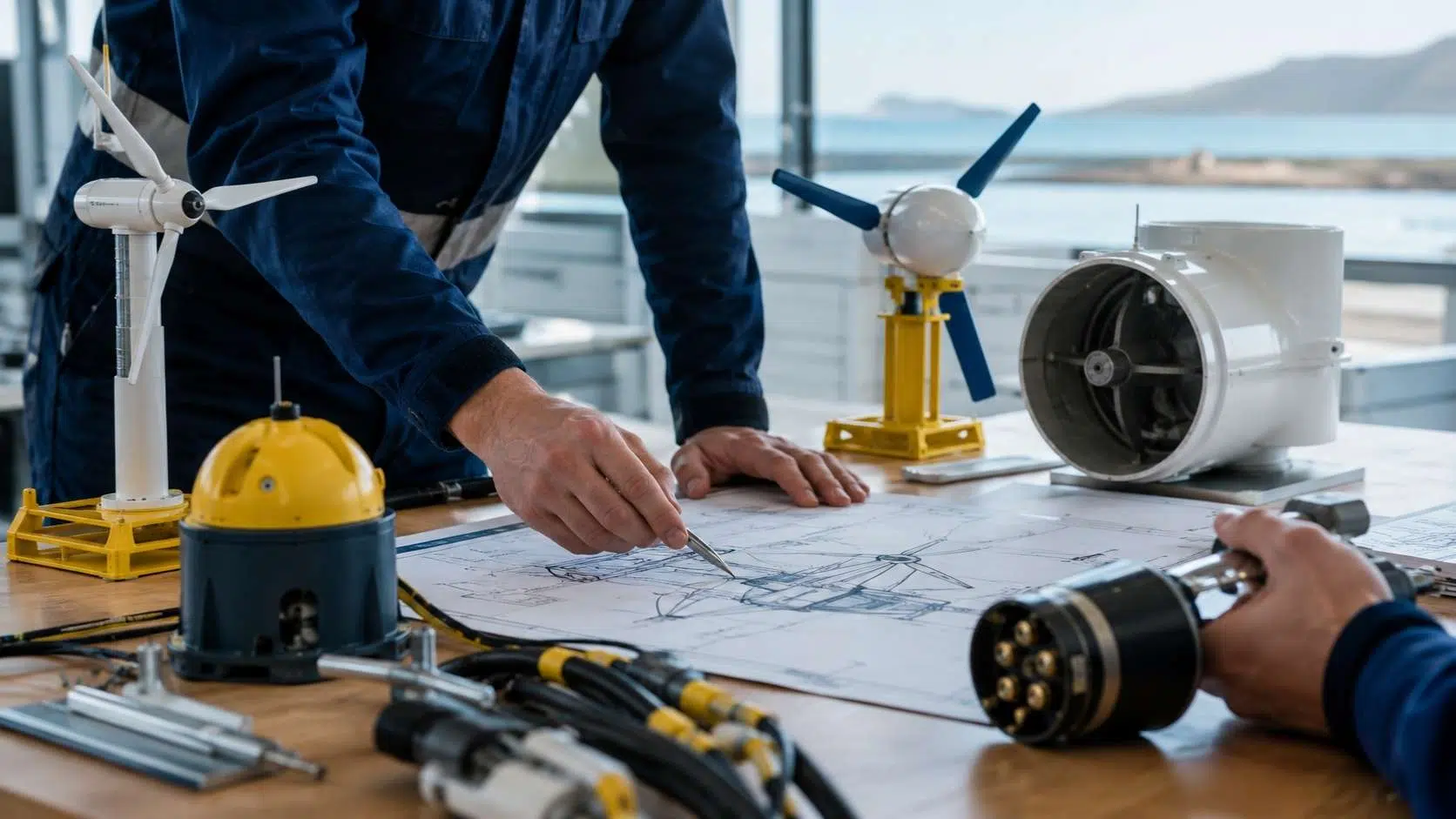
That mix is exactly what the sector needs. Marine energy will not scale through device developers alone. It needs local ports, specialist contractors, subsea storage, quick connectors, monitoring systems, environmental knowledge, manufacturing partners, consenting support, grid access, and patient capital.
Scotland’s strength is not only that it has strong waves and tides. It is that it has a long-learning ecosystem around them.
What Buyers, Investors, and Partners Should Check
Wave and tidal energy is promising, but it is not an easy sector. Before working with any company in this space, buyers and investors should ask hard questions:
- Has the technology been tested at sea, or only in controlled conditions?
- Is the system grid-connected, prototype-stage, or pre-commercial?
- What power rating has actually been demonstrated?
- How does the company handle maintenance, retrieval, and redeployment?
- What cost assumptions are behind the business model?
- Does the company depend mainly on public funding, private capital, or paying customers?
- Is the technology suited for utility-scale power, remote power, or offshore equipment?
- What environmental monitoring has been done?
- Does the company have credible marine operations partners?
- Can the system survive Scotland’s real sea conditions, not just the brochure version?
The last question matters most.
Marine energy has had plenty of beautiful renderings. The companies that matter are the ones that can keep machines, batteries, cables, and vessels working in saltwater, storms, and tight project budgets.
Business Opportunity in Scottish Wave and Tidal Energy
Scotland has a serious opportunity in wave and tidal energy, but it should not be oversold. Tidal energy is closer to commercial maturity because the resource is predictable, and several devices have already demonstrated real output. Wave energy still has a harder path because the resource is more chaotic, and device designs vary widely.
That does not make wave energy less important. It simply means wave companies need realistic early markets. Remote power, aquaculture, offshore monitoring, subsea equipment, ports, islands, and offshore wind support may be more practical starting points than giant wave farms.
The business opportunity is not just electricity generation. It also includes:
- Tidal and wave device manufacturing;
- Offshore engineering;
- Subsea power storage;
- Marine operations;
- Mooring and connector systems;
- Environmental monitoring;
- Test-site services;
- Maintenance and inspection;
- Island and coastal microgrid solutions;
- Exportable project knowledge.
That is why Scottish SMEs matter. Even if not every company becomes a global device manufacturer, many can still build valuable businesses around the marine-energy supply chain.
Wrapping Up
Scotland’s wave and tidal energy sector is not a neat success story. It is better described as a hard, technical, unfinished industry with real companies solving real problems.
Orbital Marine Power and Nova Innovation give Scotland strong tidal-energy credibility. Mocean Energy, AWS Ocean Energy, and ZOEX keep the wave-energy pipeline active. QED Naval and Flex Marine Power show that tidal energy still has room for new deployment models and community-scale thinking. Verlume, Quoceant, and Leask Marine prove that enabling technologies and supply-chain companies are just as important as the devices themselves.
The sector is not being shaped by hype alone anymore. It is being shaped by companies that understand the sea does not care about marketing.
That may be Scotland’s biggest advantage. Its wave and tidal energy companies have been forced to learn the hard way, in real water, with real machines, in one of the toughest renewable-energy environments in the world.
Frequently Asked Questions About Scottish Wave and Tidal Energy Companies
1. Why is Scotland important in wave and tidal energy?
Scotland has strong marine energy resources, offshore engineering expertise, and major testing infrastructure in Orkney. These factors have made it one of the important global locations for wave and tidal energy testing and development.
2. What is the difference between wave energy and tidal energy?
Wave energy captures the motion or pressure effects of ocean waves. Tidal energy captures water movement caused by tides, usually through underwater or floating turbines placed in strong tidal currents.
3. Are Scottish wave and tidal energy companies commercially mature?
Some are more mature than others. Tidal companies such as Orbital Marine Power and Nova Innovation have stronger real-world deployment records, while wave energy companies are generally still moving through testing, demonstration, and early commercialisation.
4. Why are supply-chain companies included in this list?
Wave and tidal energy cannot scale without marine operations, connectors, subsea storage, engineering support, and maintenance services. Companies like Verlume, Quoceant, and Leask Marine help solve those practical deployment problems.
5. Is tidal energy more advanced than wave energy?
In general, tidal stream energy is closer to commercial deployment because the resource is more predictable, and several devices have already demonstrated real output. Wave energy has major potential, but it faces tougher design and survivability challenges.
6. What should investors watch in this sector?
Investors should watch sea-tested performance, maintenance costs, grid connection, customer demand, project finance, environmental monitoring, supply-chain partnerships, and whether each company has a realistic path beyond prototypes.