If you have spent any time scrolling through TikTok or Instagram lately, you have probably noticed something. The wild days of digital marketing are over. In the UK, the government and independent watchdogs have tightened the screws. Posting an ad is no longer just about a cool filter and a catchy caption. It is about staying on the right side of the law. As we navigate through 2026, the UK social media advertising regulations have become some of the most sophisticated in the world. Whether you are a small business owner or a marketing pro, keeping up is a full-time job.
This guide breaks down exactly what you need to know to stay safe. We are moving past the jargon to look at how these rules actually work in the real world. From the way you label a “gifted” product to the massive fines for misleading environmental claims, the stakes have never been higher. If you want your brand to survive and thrive, understanding these regulations is the first step. Let’s dive into the ten essential facts that define the current landscape of British digital advertising.
1: The ASA and the CAP Code Form the Legal Bedrock
The Advertising Standards Authority (ASA) is the name you will hear most often. They are the UK’s independent regulator for advertising. While they are not a government department, they have real power. They enforce the CAP Code, which is essentially the rulebook for all non-broadcast marketing. This includes everything from a paid search result to a post on a brand’s own Instagram page. If the ASA finds you in breach, they can force you to pull an ad and name and shame you publicly. This system ensures that UK social media advertising regulations are followed by everyone from solo creators to global corporations.
Understanding the Advertising Standards Authority (ASA)
The ASA acts as the watchdog that keeps the industry honest. They review thousands of complaints every year, but they also use proactive technology to find hidden ads. Their influence extends across every digital platform, ensuring that no matter where an ad appears, it meets high standards. They operate on a self-regulatory model, but they are backed by the law through the CMA.
How the CAP Code applies to non-broadcast (digital) media?
The CAP Code is the set of rules that governs what you can and cannot say. It covers everything from making sure your price claims are accurate to ensuring you don’t offend anyone. In the digital space, the code is applied strictly to social media posts, even if they are not paid-for ads. If a post is designed to sell something, it falls under these rules.
| Feature | Description |
| Primary Regulator | Advertising Standards Authority (ASA) |
| Main Rulebook | The CAP Code (Non-broadcast) |
| Enforcement Power | Can demand ad removal and issue public censures |
| Scope | All digital marketing, including brand-owned social pages |
2: The New 2026 HFSS Advertising Ban is in Full Effect
If you sell food or drinks that are high in fat, sugar, or salt (HFSS), the game has changed. As of 2025 and 2026, the UK government introduced a total ban on paid-for online advertising for these products. This is part of a broader push to tackle childhood obesity. It means you can no longer pay to promote that less healthy burger or chocolate bar on a social media feed, regardless of who you are targeting. This is a massive shift in the advertising world and requires a complete rethink of digital strategy for food brands.
What is “Less Healthy” food and drink?
The government uses a nutrient profiling model to decide what counts as HFSS. It is not just about sweets; many pre-packaged meals and snacks fall under this umbrella. Brands have to be incredibly careful because even an accidental promotion of a restricted product can lead to significant legal trouble and a PR nightmare. This includes anything from high-sugar cereals to salty crisps.
There is a tiny bit of breathing room. Brands can still promote themselves generally, provided they do not show an HFSS product. For example, a fast-food chain can run an ad about its brand values or its sponsorship of a local team, but it cannot show a picture of a high-fat meal. Navigating this requires a very creative creative team to ensure the brand stays visible without breaking the rules.
| Regulation Aspect | Key Detail |
| Target Products | Foods high in fat, sugar, and salt (HFSS) |
| Online Restriction | Total ban on paid-for digital advertising |
| Brand Exemption | Allowed to promote the brand but not specific products |
| Purpose | To reduce childhood obesity and improve public health |
3: Influencer Disclosures Must Be Immediate and Prominent
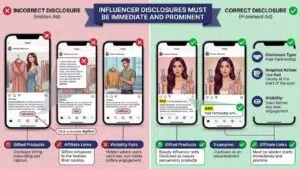
Influencer marketing is under the microscope like never before. The CMA and the ASA have made it very clear: if you are paid or given a gift to post something, it must be labeled as an ad. This is one of the most visible parts of the regulatory landscape. It is not enough to put #gifted or #affiliate at the bottom of a caption where nobody can see it. Following UK social media advertising regulations means being upfront with your audience before they even engage with your content.
The regulators hate hidden ads. They believe that a consumer should know they are being sold to before they even start reading or watching. If a user has to click see more to find out a post is an ad, the influencer has already broken the rules. The disclosure must be prominent, clear, and right at the start. Using the platform-provided tags is good, but adding a clear hashtag like #ad is still the gold standard for compliance.
Why “gifted” and “loaned” items count as commercial relationships?
Many creators think that if no money changed hands, it is not an ad. This is a dangerous mistake. If a brand sends a product for free, any post about that product is considered a commercial relationship. The same applies to loaning products or providing free services. The transparency rules are absolute and leaving them out can lead to your account being flagged.
| Disclosure Type | Required Action |
| Paid Partnership | Use #ad clearly at the start of the post |
| Gifted Products | Must be disclosed as an advertisement |
| Affiliate Links | Must be labeled so users know you earn a commission |
| Visibility | Disclosures must be seen before any user engagement |
4: The Online Safety Act (OSA) Places New Duties on Platforms
The Online Safety Act is a massive piece of legislation that reached its full power in 2026. While much of it is about protecting children from harmful content, it also places a duty of care on social media platforms regarding ads. Platforms like Meta, TikTok, and X are now legally required to prevent and remove fraudulent advertisements. This has a ripple effect on how legitimate brands are vetted and how their ads are displayed to the public.
The “Fraudulent Advertising” duty and what it means for legitimate brands
In the past, platforms often argued they were just the pipes and weren’t responsible for the water flowing through them. The Online Safety Act changed that. Now, if a scam ad for a fake investment or a counterfeit product stays up too long, the platform can face massive fines from Ofcom. This has led to much stricter verification for all advertisers, meaning you might need to provide more identity checks than before.
Priority offenses: From AI deepfakes to harmful content
The Act also addresses the use of AI in advertising. With deepfakes becoming more common, the regulations require platforms to be much more proactive in identifying and labeling AI-generated content. If your brand uses AI to create virtual influencers or synthetic voices, you have to be incredibly transparent to avoid being flagged as deceptive or harmful.
| Stakeholder | Responsibility Under the OSA |
| Platforms (Meta/TikTok) | Must proactively prevent and remove fraudulent ads |
| Ofcom | The regulator overseeing platform compliance |
| Advertisers | Must go through more rigorous identity verification |
| Consumers | Gain better protection against scams and deepfakes |
5: Greenwashing Now Carries Massive Financial Penalties
If you claim your product is eco-friendly or sustainable on social media, you better have the receipts. The Digital Markets, Competition and Consumers Act has given regulators the power to fine companies up to 10% of their global turnover for misleading environmental claims. This is a huge shift in the UK social media advertising regulations regarding corporate accountability. Brands can no longer hide behind vague terms or pretty pictures of nature if their business practices don’t match up.
The Digital Markets, Competition and Consumers Act (DMCCA) powers
This act has given the CMA some real teeth. Before, they had to go through long court processes to fine a company. Now, they can issue those fines directly. This means the time between a bad ad appearing and a massive fine being issued has shrunk significantly. It is designed to stop companies from using greenwashing as a cheap marketing tactic.
How the CMA can fine brands up to 10% of global turnover?
The 10% figure is not just a suggestion; it is a real possibility for major offenders. This level of fine can be devastating for even the largest companies. It applies to any business that targets UK consumers, regardless of where their headquarters are located. This makes environmental honesty a matter of survival for modern marketing departments.
| Claim Type | Requirement for Compliance |
| Environmental Claims | Must be substantiated with scientific evidence |
| Vague Terms | Avoid “eco-friendly” without specific context |
| Life Cycle | Must consider the impact from production to disposal |
| Penalties | Up to 10% of global annual turnover for breaches |
6: Financial Promotions and the Rise of “Finfluencer” Scrutiny
The Financial Conduct Authority (FCA) has been very busy in 2026. They are cracking down on what they call finfluencers—people who give financial advice on social media without being qualified. If you are promoting a credit card, a crypto platform, or even a get rich quick scheme, you are entering a world of very strict regulation. The FCA is monitoring social feeds 24/7 to catch people who are leading their followers into risky financial decisions.
The FCA’s 2026 global enforcement push
The FCA has teamed up with international regulators to track down illegal financial promotions that cross borders. They are using advanced data scraping tools to find accounts that are pushing unregistered crypto schemes. This isn’t just about deleting posts; it is about coordinated legal action against the people behind the accounts.
Why sharing a crypto tip could lead to a criminal record?
In the UK, promoting a financial product without authorization is a criminal offense. This means that a simple TikTok video about a new coin could actually land a creator in court. The law doesn’t care if you didn’t know the rules; the responsibility is on you to ensure your content is legal before you hit publish.
| Topic | FCA Regulation Requirement |
| Financial Advice | Must be provided by an authorized person |
| Crypto Promotions | Require mandatory, clear risk warnings |
| Finfluencers | Subject to criminal law if promoting illegally |
| Targeting | Ads must not target vulnerable or underage users |
7: Data Privacy and the UK GDPR/PECR Dual Layer
How you use data to target your ads is just as regulated as the content of the ads themselves. The UK GDPR and the Privacy and Electronic Communications Regulations (PECR) dictate how you can use custom audiences and tracking pixels. As third-party cookies fade away, the focus has shifted to how brands collect their own first-party data. You must be clear about what you are collecting and why you are collecting it.
You cannot just upload a list of customer emails to Facebook and start targeting them without their explicit consent. People have the right to know how their data is being used for advertising. Your privacy policy must be easy to find and written in plain English, not complicated legal speak. This ensures that the user remains in control of their digital footprint.
The “Cookie” rules in a post-third-party tracking world
With the death of the third-party cookie, many brands are looking for new ways to track users. However, the rules around consent remain the same. If you are using any technology to store information on a user’s device, you need their permission. This includes pixels, local storage, and even some types of fingerprinting.
| Data Element | Regulatory Rule |
| Custom Audiences | Requires explicit consent from the user |
| Tracking Pixels | Must be disclosed in the cookie policy |
| First-Party Data | The gold standard for compliant targeting in 2026 |
| Dark Patterns | Prohibited techniques to trick users into consent |
8: Age-Gating and Protecting Vulnerable Audiences

One of the biggest priorities for the UK social media advertising regulations is the protection of children and vulnerable people. This goes beyond just food. There are strict rules for alcohol, gambling, and even cosmetic surgery. You have to ensure that your ads are not seen by under-18s, and that they do not appeal to them in any way. This requires precise targeting and a deep understanding of the platform’s age-verification tools.
Alcohol, gambling, and cosmetic surgery restrictions
These categories are considered high-risk. Ads for alcohol cannot suggest that drinking makes you more popular or successful. Gambling ads must include information about responsible play. Cosmetic surgery ads are completely banned from being targeted at anyone under the age of 18. Each of these sectors has its own specific set of rules within the CAP Code.
New 2026 requirements for age-verification technology
As of 2026, the bar for age verification has been raised. It is no longer enough to just ask someone for their birthdate. Platforms are using AI to estimate ages based on behavior and, in some cases, requiring ID uploads. As an advertiser, you must use these advanced tools to prove that your restricted content is only reaching the intended adult audience.
| Restricted Category | Primary Regulation |
| Alcohol | Must not appeal to or target under-18s |
| Gambling | Strict rules against targeting vulnerable people |
| Cosmetic Surgery | Total ban on targeting minors |
| Vaping | Highly restricted, no flavor-based targeting for kids |
9: User-Generated Content (UGC) and Brand Responsibility
This is where many brands get caught out. If a customer tags you in a great video and you repost it to your official account, that video is now an ad. It doesn’t matter that you didn’t create it. By sharing it, you have adopted and incorporated it into your marketing, and it must now follow all the rules. This means you are responsible for any claims the customer makes in that video.
When does a customer’s post become your advertisement?
The moment you use a customer’s post for a commercial purpose, it changes status. This could be reposting it on your grid, using it in a paid ad campaign, or even putting it in your Instagram Story highlights. You need to ensure that the content is accurate and doesn’t break any ASA rules before you hit share.
The legal risks of reposting fan content without a “clear commercial” label
If a fan makes a health claim that isn’t true and you repost it, the ASA will hold you accountable. You also need to make sure that the reposted content is clearly labeled as an ad if there was any kind of incentive involved. This could be as simple as adding #ad to your repost if the original creator was given a discount code.
| Content Type | Brand Responsibility |
| Original Fan Post | Organic content (Brand is not responsible) |
| Reposted UGC | Becomes an ad (Brand is fully responsible) |
| Health Claims | Must be scientifically proven if used in an ad |
| Disclosure | Reposted content may require an #ad tag |
10: Enforcement is Swifter and More Public Than Ever
The way the ASA enforces the rules has moved into the future. They no longer rely solely on people writing letters of complaint. They now use an Active Ad Monitoring system that uses AI to scan thousands of social media posts every minute. This means they are catching breaches almost as soon as they happen. The time for hiding in the shadows is over, and brands must be ready for instant scrutiny.
The “Name and Shame” list of non-compliant creators
The ASA has a non-compliant influencer list on its website. If a creator repeatedly fails to label their ads, they are put on this list for everyone to see. The ASA even runs its own ads to tell people not to trust that influencer. This is a massive blow to a creator’s career and can make brands very nervous about working with them.
The AI used by the ASA is incredibly advanced. It can recognize brand logos, detect when a post sounds like an ad but isn’t labeled, and even flag when a restricted product is shown to the wrong audience. This technology allows the regulator to be everywhere at once, making it much harder to get away with sneaky marketing tactics.
| Enforcement Tool | How it Works |
| AI Monitoring | Scans social platforms for non-disclosure in real-time |
| Non-Compliant List | Publicly shames influencers who break rules |
| Ad Alerts | Tells platforms to remove specific illegal ads immediately |
| Consumer Reports | Fast-track online reporting system for the public |
Final Thoughts
Navigating the world of social media marketing in the UK is certainly a challenge. The rules are strict, the regulators are tech-savvy, and the fines are getting bigger. But here is the good news: these regulations are actually a great thing for honest brands. They level the playing field. When everyone has to follow the UK social media advertising regulations, the scammers and the greenwashers get filtered out, leaving more room for genuine businesses to connect with their customers.
The most important thing to remember is that transparency is your best friend. If you are ever in doubt, just be honest. Label your ads clearly, back up your claims with real data, and treat your audience’s data with respect. Compliance shouldn’t be a box you tick at the last minute; it should be baked into your creative process. If you stay educated and proactive, you can build a brand that people truly trust for years to come.
Frequently Asked Questions (FAQs) About UK Social Media Advertising Regulations
1. Do these rules apply to “Live Streams” on platforms like TikTok and Twitch?
Yes. Any commercial promotion that happens during a live stream must be clearly disclosed. Creators should verbally state that the content is an ad at regular intervals so that people joining the stream halfway through are still informed.
2. Can a brand be fined for what an influencer does on their private account?
If the influencer is talking about the brand’s product as part of a commercial agreement, the brand is legally responsible for the influencer’s compliance. This is why it is vital to have clear contracts that mandate proper labeling.
All promotions must be fair. You cannot claim a sale is for 24 hours only if you intend to extend it. You must also ensure that enough stock is available to meet the demand generated by the ad.
4. How do the rules handle “AI-generated” influencers who aren’t real people?
The ASA treats AI influencers just like human ones. If an AI character is promoting a product, it must be clear that it is an advertisement. Additionally, the brand should disclose that the character itself is AI-generated if there is any risk of misleading the public.
While not every post needs a legal review, having a compliance checklist based on the CAP Code is a smart move. For high-stakes campaigns or restricted products, getting a professional opinion can save you from massive fines.