Your API grows fast. Your servers start to slow down, and users complain about delays. You realize your API design cannot handle the traffic anymore. This problem hits many companies hard. They build APIs without thinking about growth. Then, when millions of requests come in, everything breaks. The whole system crashes, and you lose customers and money. I want to share a scary number with you. A recent study by Oxford Economics estimates that IT downtime costs US businesses an average of $9,000 every single minute.
That is a massive hit to any budget. APIs that scale well can handle ten times more traffic without falling apart. Companies that plan for growth from the start save thousands of dollars later. They keep customers happy and avoid late-night emergency fixes.
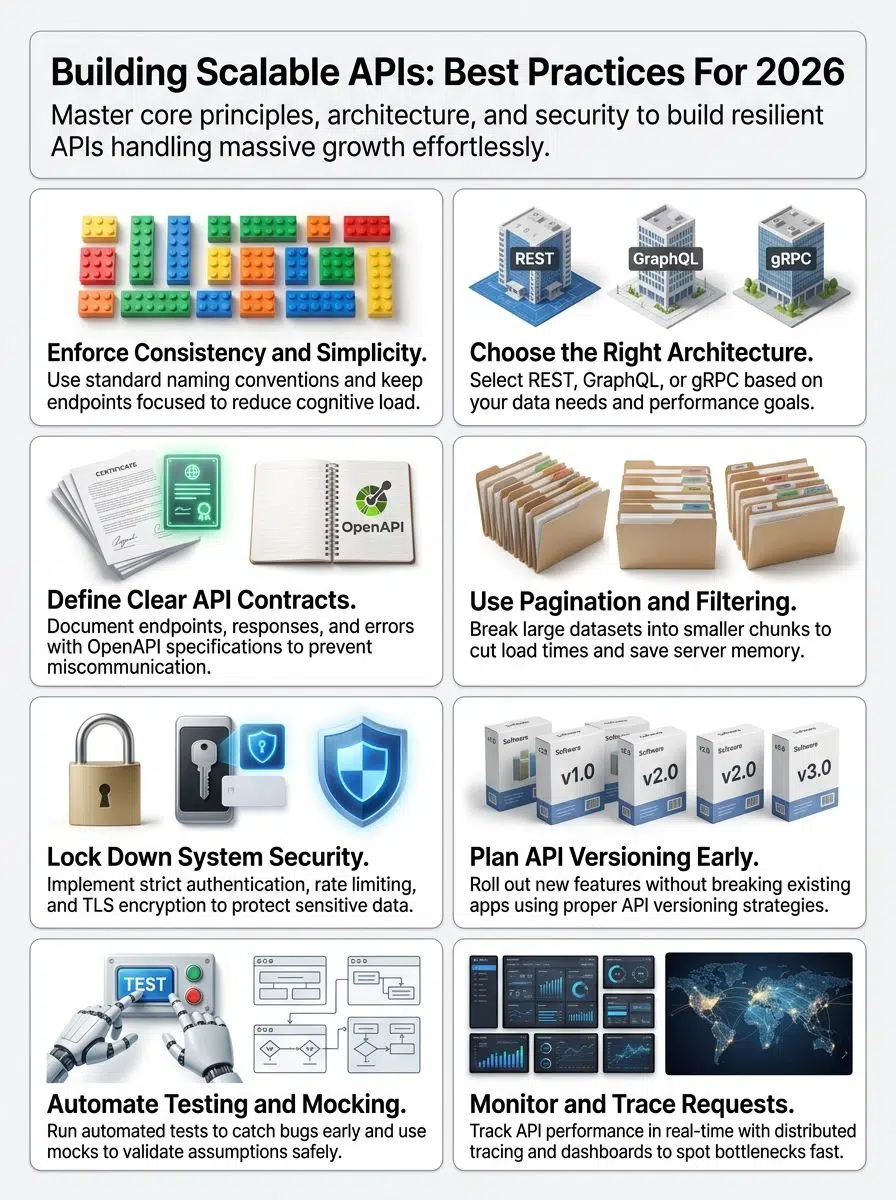
I am going to walk you through exactly how to design systems that grow with your business. I will share the core principles, the best architectural styles, and practical tips for security and testing.
Core Principles for Building Scalable API Design
Your API succeeds when it speaks a clear language. It needs to follow predictable patterns and hide the messy details from users. These four core ideas form the foundation of any API that can grow without breaking a sweat.
Consistency in naming conventions and response structures
Naming conventions act like a shared language between your code and other developers. When you stick to consistent patterns, teams spend less time decoding what each field means. For example, use snake_case for parameters or camelCase for JSON properties.
Consistency is the foundation upon which scalable systems are built. It reduces cognitive load and speeds up development.
A pro-tip I always share is to automate this process. Many teams in 2026 use an open-source linter called Spectral. You create a ruleset, and it automatically checks your code to ensure every endpoint matches your style guide.
- Standardize your date formats, using ISO 8601.
- Keep error messages structured the exact same way.
- Use automation tools to enforce rules before deployment.
Predictability through standard protocols and patterns
Your API works best when it follows standard protocols. Developers know exactly what to expect. REST, GraphQL, and gRPC all offer proven frameworks that teams understand quickly.
A 2026 Kong Inc. report found that over 83% of developers now use an API-first approach. Because so many people build this way, following expected patterns cuts confusion and speeds up integration.
Here is how predictability helps you scale:
- It makes caching strategies much easier to set up.
- It allows automated testing tools to run smoothly.
- It reduces the time developers spend reading documentation.
Abstraction of internal implementation details
Hide how your system works behind the scenes. Clients do not need to know about your database structure or server architecture. They just want clean endpoints that deliver data.
Think of it like a restaurant kitchen. Customers see the finished plate, not the chaos of the prep work. A great way to do this is by using the Backend for Frontend (BFF) pattern. This creates a specific API layer just for your user interface, keeping your core databases totally hidden.
- Never expose raw database error messages to the client.
- Use generic IDs instead of sequential database keys.
- Keep your data logic on the server, not in the app.
Simplicity and concise functionality
Simple is better than complex. Complex is better than complicated. – The Zen of Python
Keep your API functionality focused and lean. Bloated endpoints confuse developers and slow down performance. Build APIs that do one thing well.
A common mistake is returning massive data payloads. Experienced developers often aim to keep standard response payloads under 2KB. This simple restriction forces you to build concise, focused endpoints.
- Break large endpoints into smaller, focused actions.
- Remove outdated fields quickly to avoid clutter.
- Ask yourself if a feature is truly necessary before adding it.
Key Architectural Styles for API Development
You will find four main architectural styles that shape how APIs perform. Each one solves a different problem in your software architecture.
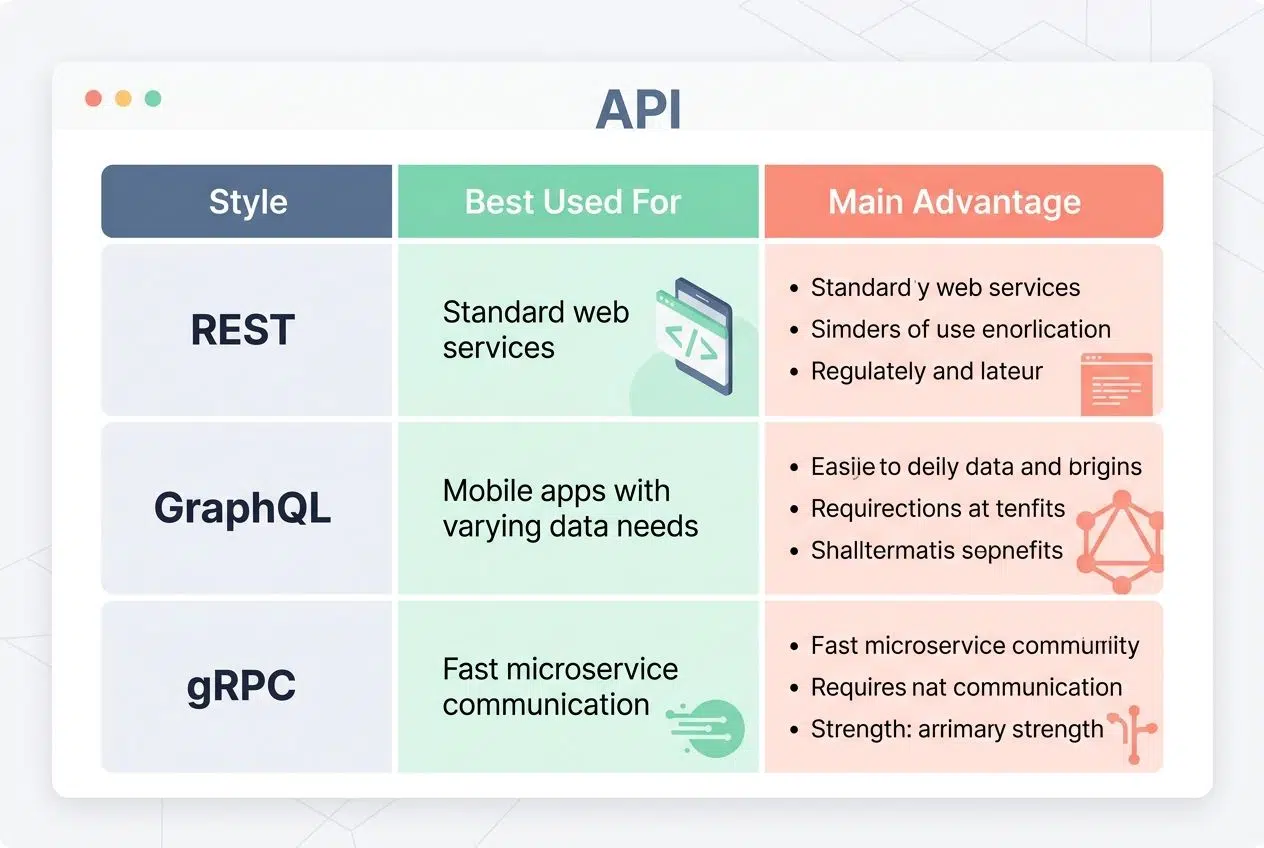
| Style | Best Used For | Main Advantage |
|---|---|---|
| REST | Standard web services | Easy to cache and widely understood |
| GraphQL | Mobile apps with varying data needs | Prevents over-fetching data |
| gRPC | Fast microservice communication | Incredibly small payload sizes |
REST (Representational State Transfer)
REST stands as the backbone of modern API design. It works by letting clients talk to servers using standard HTTP methods. You use GET to pull data, POST to send new information, PUT to update records, and DELETE to remove them.
Developers love REST because it follows predictable patterns. Most public APIs still use REST because it is incredibly easy to cache using standard web browsers and content delivery networks (CDNs).
- It treats everything in your database as an accessible resource.
- It makes load balancing very straightforward.
- It pairs perfectly with simple asynchronous processing using webhooks.
GraphQL for flexible data querying
GraphQL lets you ask for exactly what you need. You get nothing more and nothing less. Unlike REST APIs that return fixed data structures, GraphQL gives the client total control. If you only need a user’s name and email, you only request those two fields. This cuts down on wasted bandwidth and speeds up your mobile applications dramatically.
To scale GraphQL across multiple teams, many companies now use Apollo Federation. It lets you combine multiple small GraphQL APIs into one unified graph for the client.
- It reduces server round-trips by fetching related data at once.
- It makes resource modeling highly flexible.
- It pairs well with microservices and cloud integration.
gRPC for high-performance communication
gRPC is a modern framework designed for high-performance communication. It is built on HTTP/2, which moves data much faster than traditional REST APIs.
The secret is that it uses Protocol Buffers (Protobuf) instead of text-based JSON. Protobuf serializes data into binary, which often shrinks message sizes by up to 30%. This makes it the absolute best choice for internal microservices.
- It defines service contracts strictly upfront.
- It supports real-time streaming naturally.
- It uses tools like Buf to manage schemas easily.
Webhooks for asynchronous event-driven updates
Webhooks act like messengers that deliver real-time updates. Instead of a client asking your server for updates every five seconds, the server simply pushes a message when an event happens.
This approach cuts down unnecessary traffic and reduces server load. A great example of doing this right is Stripe. Their webhook system sets the industry standard by requiring cryptographic signing secrets, ensuring every message is verified and secure.
- They stop clients from polling your endpoints constantly.
- They spread heavy workloads out over time.
- They create fluid, responsive systems.
Best Practices for Designing Scalable APIs
You need to craft APIs that work like well-oiled machines. Smart design choices today prevent massive headaches tomorrow. Let’s look at the specific tactics you should use.
Define clear API contracts with specifications
API contracts form the blueprint of your scalable API design. They tell developers exactly what your API will do, how it will behave, and what data it will send back.
By 2026, the OpenAPI 3.1 specification will be the absolute standard. The biggest benefit of version 3.1 is that it fully aligns with JSON Schema Draft 2020-12. This means your documentation and your code validation use the exact same rules, eliminating a huge source of bugs.
- Contracts speed up development cycles.
- They allow teams to test against the API before they write any backend code.
- They make resource modeling crystal clear.
Use proper versioning strategies
API versioning keeps your system running smoothly as it grows. You must manage change without breaking the applications your clients already built.
A brilliant tactic is to use date-based versioning. Companies like Stripe use headers with dates like “2026-04-15”. This forces you to treat every API change as a permanent, documented event, rather than just bumping a “v1” to a “v2”.
- Keep old versions alive for clients who need time to upgrade.
- Separate versions to make load balancing easier.
- Plan your data strategies around multiple running versions.
Employ pagination and data filtering
Pagination breaks massive datasets into smaller, manageable chunks. If you return ten thousand records at once, your server will crash, and the user’s app will freeze.
Avoid simple offset pagination if you have a lot of data. Once a user scrolls past page 10,000, database queries become incredibly slow. Instead, use cursor-based pagination. The Relay GraphQL specification popularized this method, and it keeps database lookups fast, no matter how deep the user scrolls.
- It reduces memory usage on your servers.
- It speeds up response times significantly.
- Combine it with filtering to deliver hyper-focused data.
Implement error handling and meaningful responses
Your API will eventually experience errors. You must handle those failures gracefully. A vague error message leaves developers guessing and creates support tickets.
The best practice is to adopt the RFC 7807 standard, known as “Problem Details for HTTP APIs.” This standard dictates a specific JSON structure for errors, including a type URI, a title, and specific detail fields.
Standardized error handling builds developer trust faster than almost any other feature. When they know how to fix a problem, they stay happy.
Support partial responses for optimized performance
Partial responses let your API send back only the data that clients actually request. Think of it like ordering a burger without the pickles. You get exactly what you want.
In REST APIs, you can implement this by allowing a query parameter like ?fields=name, email. The server intercepts this and strips out the heavy, unwanted data before sending the response over the network.
- It cuts down on bandwidth costs.
- Smaller responses cache much more effectively.
- Your servers process lighter, faster payloads.
Use HATEOAS for resource discoverability
HATEOAS stands for Hypermedia As The Engine Of Application State. It works like a GPS for your API. Your API responses include direct links to related resources.
A common way to format this is using HAL (Hypertext Application Language). HAL standardizes how you include these navigation links in your JSON responses, making it incredibly easy for clients to build automated crawlers.
- Clients discover actions without reading separate documentation.
- You reduce tight coupling between the client and server.
- You can change backend URLs without breaking frontend apps.
Security Considerations for APIs
Your API stands as a prime target for attackers. You need to lock down authentication, rate limiting, and encryption right from the start. Let’s cover the essentials to keep your data safe.
Authentication verifies who a user is, while authorization determines what they can actually do. You need both to build a secure system.
You must pay attention to the 2023 OWASP API Security Top 10 list. The number one threat is API1:2023 Broken Object Level Authorization (BOLA). This happens when a user changes an ID in a URL and accesses someone else’s private data. You must explicitly check permissions on every single database lookup to prevent this.
- Use OAuth 2.0 or JWT tokens for secure logins.
- Set clear permission levels for different user roles.
- Never trust client-provided IDs without verifying ownership.
Use rate limiting and throttling to prevent abuse
Your API faces constant pressure from aggressive scrapers and bad actors. Rate limiting acts like a bouncer at a club, controlling how many requests hit your servers per minute.
The new OWASP list highlights API4:2023 Unrestricted Resource Consumption as a major threat. To fight this, you need to pick the right limiting algorithm.
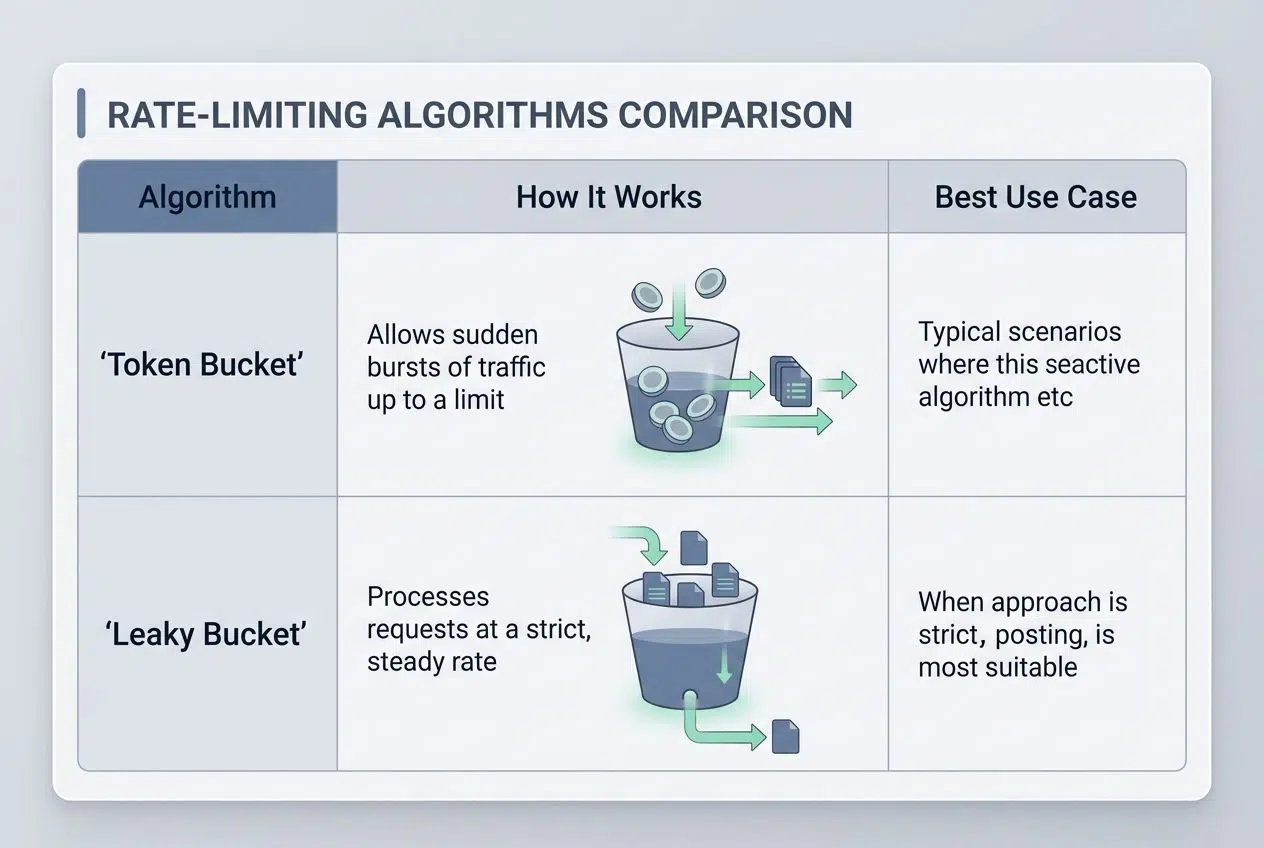
| Algorithm | How It Works | Best Use Case |
|---|---|---|
| Token Bucket | Allows sudden bursts of traffic up to a limit | Standard public APIs |
| Leaky Bucket | Processes requests at a strict, steady rate | Heavy background processing |
Enable data encryption for secure communication
Data encryption acts as your first line of defense. Unencrypted data sits exposed on the network, like leaving your front door wide open.
In 2026, you should enforce TLS 1.3 on all API endpoints without exception. This scrambles messages so only the intended receiver can read them. Older versions of TLS have known vulnerabilities, so force your load balancers to reject them entirely.
- It protects login credentials and payment information.
- It builds trust with your users.
- It meets legal compliance requirements for health and finance data.
Monitor API usage for security threats
Your API logs tell a story. Monitoring API usage patterns helps you catch suspicious activity before it turns into a massive data breach.
You should route your traffic through a Web Application Firewall (WAF), like Cloudflare or AWS WAF. These tools automatically flag unusual IP addresses, block known malicious bots, and alert your team when traffic spikes beyond normal levels.
- Look closely at failed authentication attempts.
- Track which resources get accessed the most.
- Use asynchronous processing to analyze logs without slowing down the API.
Effective Versioning Strategies
Your API will grow over time. You keep users happy when you handle changes without breaking their mobile apps or websites.
Different versioning methods let you roll out updates smoothly. You pick the approach that fits your system best, and your developers sleep better at night.
URI versioning
URI versioning puts the version number right into the web address itself. For example, your endpoint looks like api.company.com/v1/users.
This approach makes the version crystal clear to anyone looking at the URL. Developers see exactly which version they are calling, eliminating any confusion during integration.
- It makes load-balancing routing incredibly easy.
- It allows you to test new features safely.
- The downside is that URLs change when you upgrade.
Query string versioning
Instead of embedding the version into the path, you append it as a parameter. Your API call looks like GET /users?version=2.
This approach keeps your base URL clean and stable. Clients can switch versions by simply modifying one small query parameter, making the transition very painless.
- It keeps your core infrastructure routing simple.
- Caching strategies are easier to manage.
- It works great when supporting many versions at once.
Header-based versioning
Header-based versioning puts the information inside HTTP headers. Your API clients send a custom header to dictate the version.
A perfect example of this is GitHub. Their API requires clients to send an X-GitHub-Api-Version header with a specific date. This keeps your URLs totally clean and focused entirely on resource modeling.
- Endpoints stay focused on the data, not the version.
- Clients switch versions without rewriting URLs.
- It requires clearer documentation for new developers.
Media type versioning
Media type versioning works like content negotiation. Clients send a specific Accept header, like application/vnd.company.v2+json, and your server responds accordingly. This strategy shines when you want to maintain backward compatibility while rolling out new data shapes. Your team can support multiple data strategies without creating separate physical endpoints for each version.
- It fits perfectly into advanced microservices.
- Performance optimization improves with fewer duplicated routes.
- It keeps your API design incredibly elegant.
Testing and Mocking in API Design
Testing your APIs catches problems before they reach your users. Mocking lets you validate your ideas without waiting for real databases to spin up. These practices keep your code reliable as your traffic scales up.
Importance of API testing for scalability
API testing catches performance issues and security gaps early. Scalability means your API must handle more users and more data without crashing.
For load testing, many engineering teams now rely on k6 by Grafana. It lets you write performance tests in JavaScript, simulating thousands of concurrent users to see exactly when and where your API breaks.
- It shows you exactly where performance bottlenecks live.
- It gives your team confidence during traffic spikes.
- It measures realistic response times and error rates.
Use of mocks for validating assumptions
Testing alone cannot catch everything before launch. Mocks step in to validate how different parts of your system communicate.
If you wait for the frontend team to finish before testing the backend, you waste weeks. Tools like WireMock let you build fake versions of external services. You test your API against these stand-ins instantly.
- Mocks help you test weird edge cases safely.
- They let teams work in parallel without waiting.
- They make testing high-traffic situations much cheaper.
Automated testing for regression prevention
Automated testing catches bugs the second a developer makes a mistake. Your team runs tests automatically after each code change to prevent old problems from returning.
You should tie your automated test suites directly into your CI/CD pipeline using tools like GitHub Actions. Every time someone commits code, the server runs the tests. If a test fails, the code cannot be merged.
- It acts as a permanent safety net for API development.
- It ensures new caching strategies actually work.
- It validates that performance optimizations do not break data models.
Tools and Technologies for Scalable API Development
The right tools make building scalable APIs much faster. You want to pick technologies that fit your team’s skills perfectly.

OpenAPI Specification for documentation
The OpenAPI Specification gives your API a clear, readable blueprint. This standard format describes your endpoints, parameters, and authentication methods in one place.
Once you write the specification, you can use Swagger UI. This tool reads your OpenAPI file and instantly generates a beautiful, interactive website where developers can read about and test your API right in their browser.
- It keeps your code and documentation perfectly in sync.
- It forces you to think through resource modeling early.
- It ensures consistent API design across your whole company.
Postman for API testing and collaboration
Postman is a powerhouse for teams building APIs. It offers a single platform where developers can test, document, and collaborate.
A fantastic workflow is to build test collections in Postman, and then run them from your command line using the Newman CLI tool. This bridges the gap between manual testing and automated deployment pipelines beautifully.
- It handles complex authentication methods easily.
- It tracks performance metrics to spot bottlenecks.
- It allows teams to leave comments and share workspaces.
gRPC tools for advanced communication needs
When you need extreme speed between internal services, gRPC tools deliver. Because gRPC uses binary serialization, it processes messages incredibly fast.
Managing gRPC files can be tricky, which is why developers use the Buf CLI. Buf enforces linting rules on your Protobuf files and manages breaking changes automatically, saving teams hours of debugging time.
- These tools lower latency and reduce bandwidth usage.
- They make load balancing across microservices simpler.
- They provide clear error codes for fast troubleshooting.
Common API Design Patterns
Different approaches shape how you build APIs. Picking the right pattern makes all the difference in your project’s success.
Inside-out API design
Inside-out API design starts with your internal databases and works outward. You build the API based on what your backend already does.
For example, you might directly expose your PostgreSQL database tables as API endpoints. This approach is incredibly fast to build because developers just leverage existing infrastructure.
- It skips long planning phases.
- It works well for internal admin dashboards.
- The downside is that it often confuses external users.
Outside-in API design
Outside-in design flips the script entirely. You start by thinking about what your users actually need, not what your database looks like.
You map out the exact user journey first. Then, you design endpoints that deliver exactly that data. Finally, you figure out how to wire the database up to make it work. This puts the customer experience first.
- It drives much better API adoption.
- It makes integration feel natural and intuitive.
- It forces you to create efficient data flows.
Agile API design
Agile API design takes the user-first approach and makes it faster. Instead of waiting six months to launch, teams work in short, two-week sprints. You build a small piece of the API, give it to a beta tester, get feedback, and improve it immediately. This prevents you from building a perfect product that nobody actually wants to use.
- It prioritizes resource modeling early in the project.
- It allows you to pivot your versioning strategies safely.
- It builds scalability into the foundation step by step.
Monitoring and Optimization of APIs
Your API might perform well today, but tomorrow’s traffic spike might tell a different story. You need real-time visibility to spot problems before your users complain.
Implement distributed tracing for debugging
Distributed tracing acts like a GPS map for your API requests. It tracks a single request as it bounces between dozens of different microservices.
The industry standard for this is OpenTelemetry. By implementing OpenTelemetry, you attach a unique ID to a request. You can then see exactly which microservice caused a five-second delay, eliminating all the guesswork.
- It records timestamps at every single stop.
- It reveals where caching strategies are failing.
- It makes debugging microservices much less painful.
Monitor API performance using dashboards
Dashboards give you a clear view of your system’s health in real time. You can track response times, error rates, and traffic patterns.
According to a New Relic report, high-impact IT outages cost businesses an annual average of $76 million USD. Using strong dashboard tools like Datadog or New Relic cuts your risk drastically by alerting you the second a metric drops.
- They help you identify slow endpoints immediately.
- They show you exactly where load balancing is needed.
- They track historical data to guide future architecture choices.
Analyze usage patterns to optimize resources
Your API usage patterns reveal exactly what your customers value. By tracking these metrics, you can discover unused features and find hidden bottlenecks.
A smart tactic is to stop looking at average response times and start looking at your P99 latency. The P99 metric shows you the experience of your slowest 1% of users. Fixing the P99 issues often uncovers deep architectural flaws that you can fix to speed up the whole system.
- It helps you scale your infrastructure smarter, not just bigger.
- It reduces cloud hosting costs by identifying wasted resources.
- It proves exactly what data gets requested the most.
Wrapping Up
Scalable APIs form the foundation of modern software. Mastering their design shapes how applications will perform for years to come. Building scalable APIs requires continuous attention to detail. You need to focus on security best practices, performance optimization, and clean resource modeling from day one.
By implementing proper authentication, smart rate limiting, and reliable versioning strategies, you protect your data and your users. When you add in strong monitoring tools, you can catch problems early and keep your systems running smoothly.
If you stick to these principles and measure your results, you will succeed at Building Scalable APIs: Best Practices For 2026.
Frequently Asked Questions (FAQs) on API Design
1. What makes an API scalable in 2026?
A scalable API uses caching solutions like Redis to speed up responses, keeps endpoints simple and focused, and distributes work across multiple servers. This architecture means your system handles growth smoothly. Even if your user base triples overnight, your app stays fast and responsive.
2. How do I keep my APIs secure as they grow?
Use OAuth 2.0 for authentication and always encrypt connections with HTTPS. Set role-based permissions and run regular security audits to catch weak spots early.
3. Why is versioning important for building robust APIs?
Versioning lets you roll out improvements without breaking existing apps that depend on your service. It’s like updating your product while maintaining backward compatibility for current users.
Test early and often using tools like k6 to simulate heavy traffic and spot bottlenecks before launch. Monitor performance continuously so you’re never surprised when real users flood in.