

Have you ever looked at an old black-and-white photo of a great-grandparent and wondered if their story could change your future? Maybe you’ve heard family legends about a village in Sicily or a hometown in Cork, but you never realized those memories might be worth more than just sentimental value.
It sounds almost too good to be true, doesn’t it? The idea that you could become a citizen of a country you’ve never lived in, simply because of who your ancestors were.
But here is the reality: For thousands of Americans, this isn’t just a daydream. It is a legal right known as Citizenship by Descent. Whether you want a backup plan, a way to retire in Europe, or just a deeper connection to your roots, your bloodline might be the key to a second passport.
So, grab a cup of coffee, and let’s go through it together. I’m going to walk you through the exact steps, the hidden rules, and the new 2026 updates you need to know to claim what is rightfully yours.
What is Citizenship by Descent?
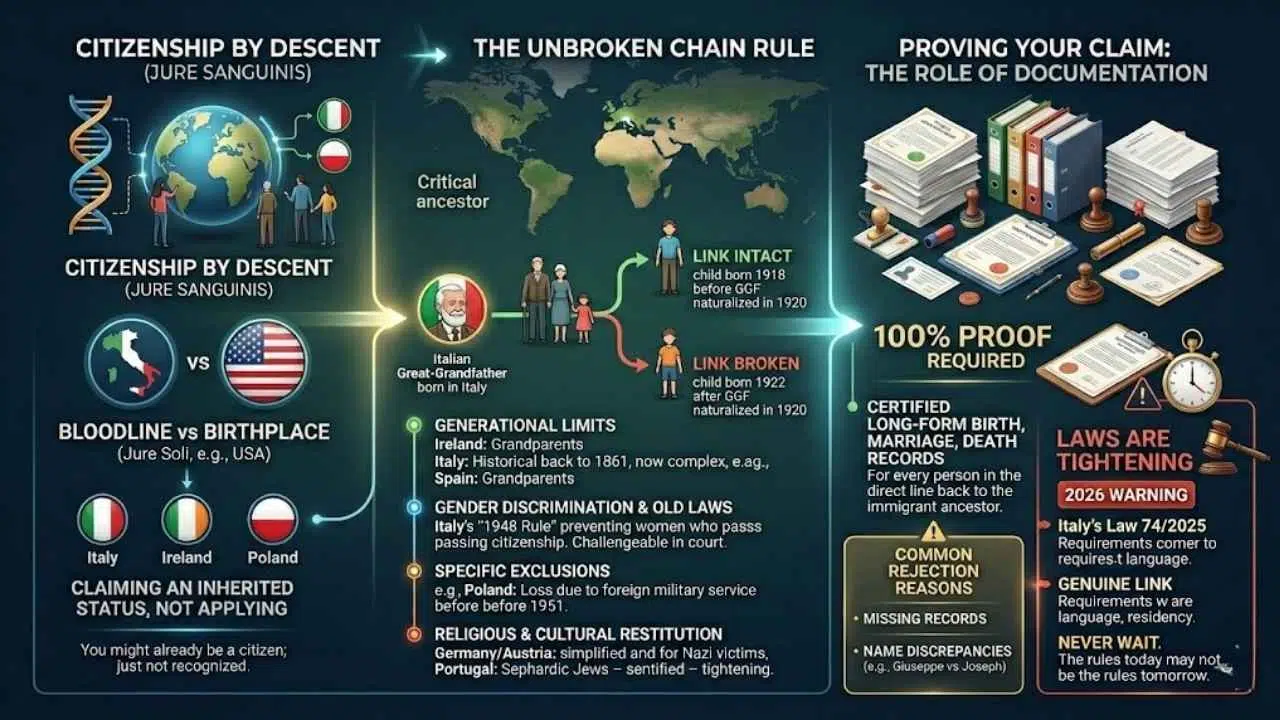
Citizenship by descent is a legal principle that allows you to claim citizenship based on your bloodline rather than your birthplace. In legal terms, this is often called Jure Sanguinis (Latin for “right of blood”).
While the United States follows Jure Soli (right of the soil)—meaning if you are born here, you are a citizen—many other nations prioritize heritage. This means that in the eyes of countries like Italy, Ireland, or Poland, you might already be a citizen; you just haven’t been recognized yet.
This isn’t about “applying” for naturalization in the traditional sense. You don’t need to have lived there for years, and in many cases, you don’t even need to speak the language initially. You are essentially asking the government to acknowledge a status you inherited at birth.
Currently, over 50 countries offer some form of this pathway. However, the window of opportunity changes. As we saw with major legal shifts in 2025, countries can—and do—change their rules overnight. Understanding the specific “transmission” laws of your ancestor’s home country is the first step to unlocking these rights.
Who Qualifies for Citizenship by Descent?
Many people dream of holding a European passport, but assuming you qualify can be tricky. The rules are rarely as simple as “my grandfather was born there.”
Your eligibility usually depends on an “unbroken chain” of citizenship. This means your ancestor must have still been a citizen of their home country at the time their child (your parent or grandparent) was born. If they naturalized as a U.S. citizen before having children, the chain might be broken.
Eligibility Criteria & Common Tests
To gain citizenship by descent, you generally need to prove that you fit into a specific legal window. Here are the most common factors that determine if you are in or out:
- The “Unbroken Chain” Rule: This is the most critical check. For example, if your Italian great-grandfather became a U.S. citizen in 1920, but your grandfather was born in 1918, the chain is intact. If your grandfather was born in 1922, the chain is broken, and you likely do not qualify.
- Generational Limits: Ireland allows you to go back to a grandparent (or great-grandparent if registered early). Italy historically had no generational limit (tracing back to 1861), though new laws in 2025 have complicated this. Spain typically stops at grandparents.
- Gender Discrimination in Old Laws: Many countries used to allow only fathers to pass on citizenship. For instance, Italy had a “1948 Rule” where women couldn’t pass citizenship to children born before January 1, 1948. While this can now be challenged successfully in court, it requires a specific legal process.
- Specific Exclusion Lists: Some countries maintain registers of ancestors who lost citizenship. In Poland, men who served in a foreign military (like the U.S. Army) before 1951 often lost their citizenship automatically, which disqualifies their descendants today unless they fall under specific “Allied Forces” exceptions.
- Religious & Cultural Restitution: Countries like Germany (under StAG 5 and Article 116) and Austria offer simplified pathways for descendants of victims of the Nazi regime who were stripped of their rights. Similarly, Portugal had a pathway for Sephardic Jews, though this has tightened significantly as of 2024.
The “2026 Warning”: Be aware that laws are tightening. In May 2025, Italy introduced “Law 74/2025,” aiming to restrict citizenship for those without a “genuine link” (like language or residency) to the country. While courts are currently debating this, it serves as a reminder: never wait if you think you are eligible. The rules today may not be the rules tomorrow.
The Role of Documentation
You cannot just claim these rights verbally; you must prove them on paper. This is often the hardest part of the process. You will need certified, long-form copies of birth, marriage, and death records for every person in your direct line back to the immigrant ancestor.
Documentation gaps—like a missing marriage license or a name spelled “Giuseppe” on one form and “Joseph” on another—are the most common reasons for rejection. Governments want 100% proof that the person in your family tree is exactly who you say they are.
Benefits of Citizenship by Descent
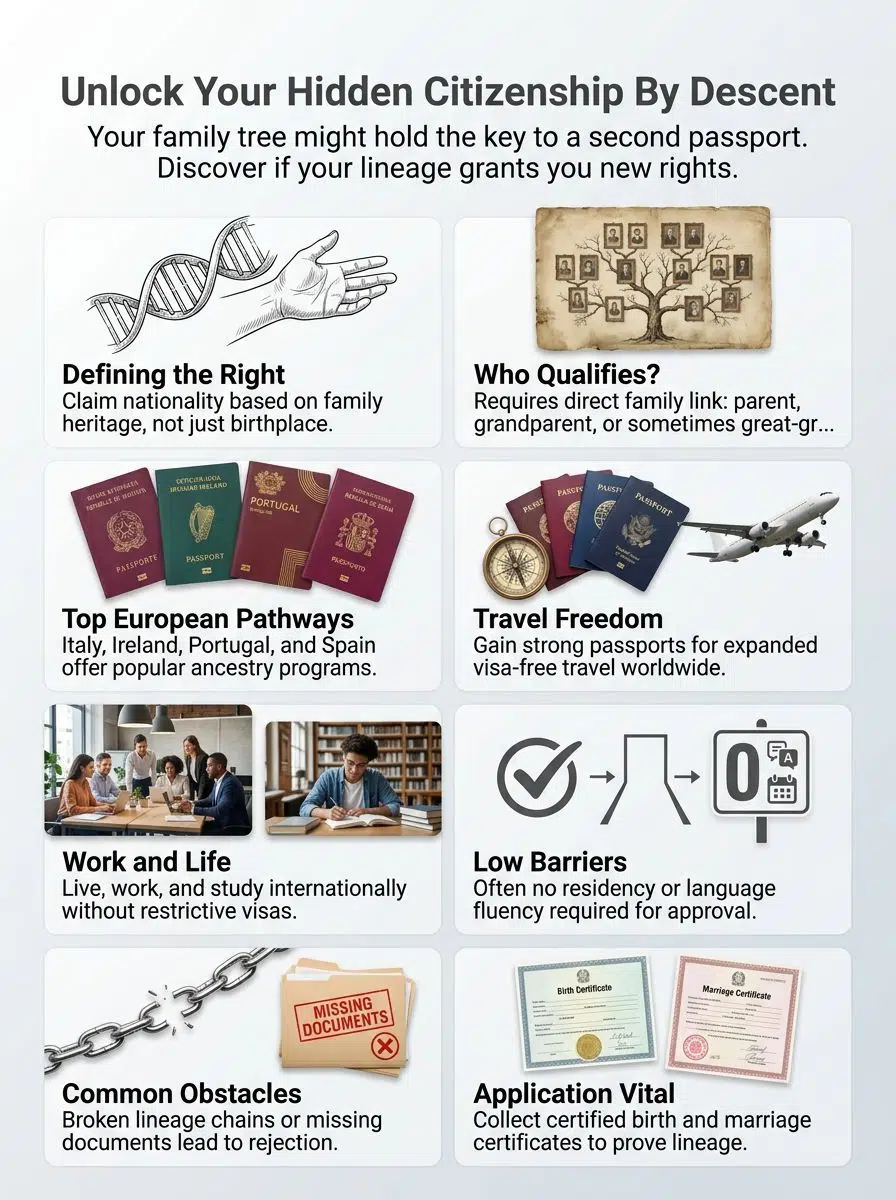
Why go through the hassle of digging up 100-year-old birth certificates? Because a second passport is one of the most powerful assets you can own.
Access to Dual or Multiple Citizenships
A common myth is that you must give up your U.S. passport to get another one. This is rarely true. The United States allows dual citizenship, as do countries like Italy, Ireland, the UK, and Australia.
This path is also significantly cheaper than “Golden Visa” programs, where you essentially buy residency by investing €500,000 or more in real estate. Citizenship by descent typically costs only the administrative fees (often under $1,000 total for DIY cases), making it the most affordable way to gain dual status.
Expanded Travel Freedom
A second passport is a master key for global travel. If you secure a passport from an European Union (EU) country, you gain the right to live, work, and retire in any of the 27 EU member states—not just the one that gave you the passport.
For example, with an Irish passport, you could live in Paris, work in Berlin, or retire in Tuscany without needing a visa. It also protects you from travel restrictions. If one country closes its borders or changes visa rules for Americans, you have a backup option.
No Residency or Language Requirements (Usually)
Unlike becoming a citizen through marriage or naturalization, descent-based claims often skip the hardest hurdles:
- No Move Required: You can apply from your local consulate in the U.S. (e.g., in Boston, Chicago, or Los Angeles) and get your passport without ever moving to the country.
- No Language Tests: For countries like Ireland and Poland, you do not need to speak the language to become a citizen. (Note: Some countries, like Croatia and recently Portugal, have introduced or are debating language requirements, so always check the latest statutes).
- Immediate Benefits: Once recognized, you have the same rights as someone born there. This includes access to subsidized healthcare and education rates for your children in Europe.
Countries Offering Citizenship by Descent
Rules differ wildly across the globe. While dozens of nations offer this, here is a breakdown of the most popular programs and their specific quirks as of 2026.
Comparison of Popular Programs
| Country | Generational Limit | Key Requirement / “Gotcha” | Est. Processing Time |
|---|---|---|---|
| Ireland | Grandparents (Standard) | Great-grandparents only if parent registered before your birth. | 9-12 months (Foreign Births Register) |
| Italy | None (Historically) | Active Legal Flux: 2025 laws may require a “genuine link” (language/residency). 1948 Rule applies to maternal lines. | 2-4 years (Consulates) / 1-2 years (Courts) |
| Poland | None (Theoretically) | Military Paradox: Ancestor lost citizenship if they served in foreign military before 1951 (unless Allied Forces). | 1-2 years |
| Germany | Varies | StAG 5: Restitution for those discriminated against by gender or Nazi laws. Very strong program. | 1-2 years |
| Portugal | Grandparents | New 2024 Rules: Sephardic route now requires 3 years of residency. Language test often required for others. | 2+ years |
European Countries
Europe is the hotspot for these programs because of the massive wave of emigration in the 19th and 20th centuries.
- Italy: Famous for having no generational limit, meaning you could theoretically claim from a great-great-grandfather born after 1861. However, the “1948 Rule” means if your line goes through a woman who gave birth before 1948, you must hire a lawyer and sue in Italian court (a process that is actually often faster than the consulate route!).
- Ireland: One of the most straightforward processes. If your grandparent was born on the island of Ireland, you are eligible. You simply apply to the Foreign Births Register (FBR). Once approved, you are an Irish citizen.
- Hungary & Lithuania: Both have strong programs for descendants of those who left before the fall of communism, often allowing claims back to great-grandparents.
- Spain: Historically strict, but the “Grandchildren Law” (Ley de Nietos) opened a temporary window for many descendants. You should check if this window is still open, as it often has sunset clauses.
Non-European Countries
Don’t ignore the rest of the world. Many other nations have generous policies.
- Israel: The Law of Return allows Jews, children of Jews, and grandchildren of Jews to immigrate and become citizens.
- Mexico: If you have a Mexican parent, you are considered a Mexican national. This is increasingly popular for Americans seeking a lower cost of living south of the border.
- Ghana: Through the “Year of Return” initiative, Ghana has been welcoming members of the African diaspora, though this is often a form of permanent residency that leads to citizenship rather than automatic recognition.
- Philippines: If you were born to at least one Filipino parent, you are a citizen by birth, even if born in the U.S. This “dual allegiance” status is widely recognized.
Challenges and Limitations of Citizenship by Descent
It can feel like a wild goose chase, hunting down old birth records or family papers. The road is bumpy, and knowing the potholes ahead can save you months of frustration.
Missing or Inconsistent Documentation
This is the number one dealbreaker. If your great-grandfather’s birth certificate says “Paolo” but his marriage license says “Paul,” the Italian government might reject it. You often need to amend these records in the U.S. courts or find supporting evidence like baptismal records.
Pro Tip: If you cannot find a naturalization record, you might need a “Certificate of Non-Existence” (CONE) from USCIS. This proves your ancestor never became a U.S. citizen, which is often the “golden ticket” for eligibility. Be warned: USCIS processing for this can take many months.
Maternal vs. Paternal Lineage Rules
We touched on Italy’s 1948 rule, but other countries have similar quirks. In the past, many nations believed citizenship only passed through the father. While most have updated these laws to be gender-neutral, they aren’t always retroactive.
For example, if you are claiming UK citizenship through a mother born before 1983, the process is different than if you are claiming through a father. Always check if the law distinguishes between the “maternal line” and the “paternal line” for your ancestor’s specific birth year.
Long Application Processing Times
Patience is not just a virtue here; it’s a requirement. Post-pandemic backlogs have hit consulates hard.
- Italian Consulates in cities like Miami or Los Angeles sometimes have appointment wait times of 3 to 4 years.
- Irish FBR applications are currently averaging about 9 months.
- USCIS Genealogy Requests (to get old US records) can take over a year.
Many people find that hiring a specialist service to retrieve documents can shave months off the timeline, simply because they know exactly which archive to call.
Step-by-Step Guide to Applying for Citizenship by Descent
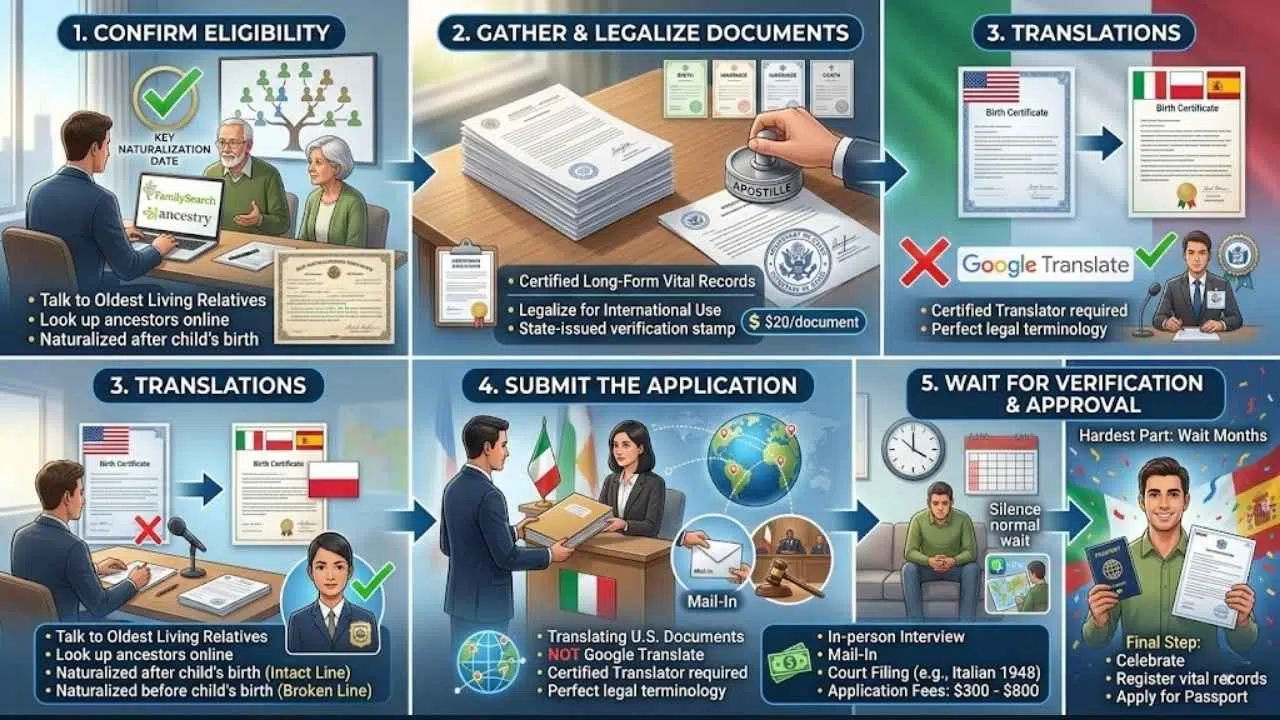
Claiming a passport through your roots can feel like following a treasure map—there are steps, and each one matters. Curious how to turn your family tree into a new citizenship? Here is the playbook.
Step 1: Confirm Eligibility
Before spending a dime, do the free research. Talk to your oldest living relatives. Look up your ancestors on sites like FamilySearch or Ancestry.com.
Specifically, look for the date of naturalization. If your ancestor became a U.S. citizen after the next person in line was born, you likely have a case. If they became a citizen before the birth, the line is likely broken.
Step 2: Gather and Legalize Documents
You will need “certified long-form” copies of every vital record (birth, marriage, death) from your ancestor down to you. But just having the paper isn’t enough.
For international use, documents usually need an Apostille. This is a special cover page issued by the Secretary of State (for U.S. documents) that verifies the signature on the document is real. It typically costs around $20 per document, depending on the state. Without this stamp, a foreign government will look at your U.S. birth certificate as just a piece of paper.
Step 3: Translations
If you are applying to Italy, Poland, or Spain, your U.S. documents must be translated into their language. You cannot just use Google Translate. You almost always need a “certified translator” or a professional recognized by the consulate to ensure the legal terminology is perfect.
Step 4: Submit the Application
Once you have your “packet” (the stack of apostilled, translated documents), you submit it. This might be an in-person interview at a consulate, a mail-in application (like for Ireland), or a court case filing (for complex Italian 1948 cases).
Prepare for a fee. While not expensive compared to investment visas, application fees generally range from $300 to $800 depending on the country and current exchange rates.
Step 5: Wait for Verification and Approval
This is the hardest part. You might not hear anything for months. Do not panic; silence is usually normal. Use this time to learn a bit of the language or plan your first trip as a citizen.
When the approval finally comes, it is a moment to celebrate. You will typically be invited to register your vital records with the country and then apply for your passport.
Final Thoughts
Tracing your roots might lead you to a passport you never knew was yours. It’s a journey that connects you to your history in a tangible way, offering freedoms and options that most people only dream of.
While the paperwork can be tedious and the wait times long, the payoff is a lifetime of benefits for you, your children, and generations to come. It saves money compared to other immigration routes and opens doors to living, working, and traveling across entire continents.
If this topic piques your interest, check government sites or trusted ancestry research services for more details before starting your journey. So go ahead—dust off those old family photos; buried in that stack might be the key that changes where you belong!






















