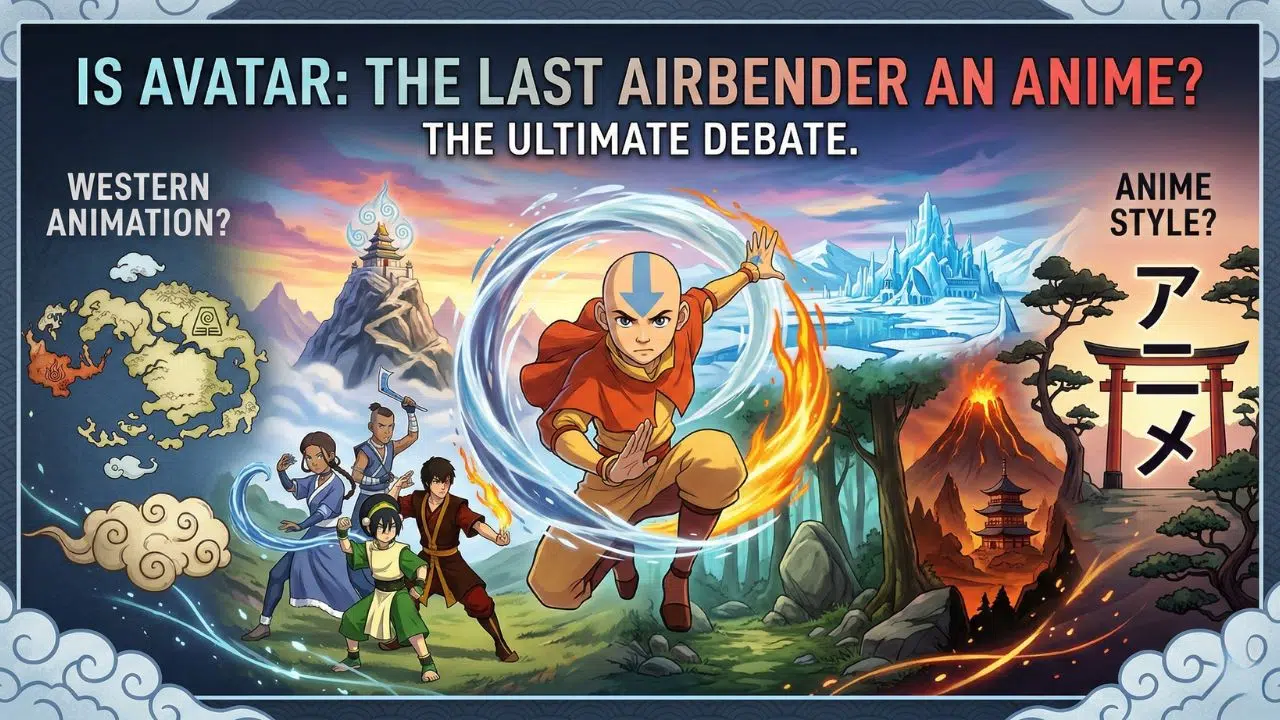
You have probably asked yourself the big question. Is Avatar: The Last Airbender an anime? You are definitely not the only one wondering about this. Many fans get puzzled when friends start arguing about cartoon labels. Some call it an anime because of the way it looks and feels. Others say cartoons made in America are just cartoons, no matter how much they look like Japanese animation.
Here is a quick fact. Avatar: The Last Airbender was made by Nickelodeon Animation Studio in the United States, but its art style is heavily inspired by Japanese anime and Asian culture.
I am going to walk you through the exact details, and I think you will be surprised by what we find. So, grab a cup of coffee, and let’s go through it together.
What Does “Anime” Really Mean?
Anime means “animation” in Japanese. Outside Japan, it usually points strictly to animation made in Japan or using a certain style. Shows like Naruto, Pokémon, and Sailor Moon set the bar for what people call anime today.
Where Does the Term “Anime” Come From?
The word “anime” comes directly from Japan. In the Japanese language, it simply means any kind of animation, including shows from the United States or Europe. For example, people in Tokyo might call SpongeBob SquarePants an anime right alongside Studio Ghibli’s Spirited Away.
Outside Japan, most fans use the word only when talking about animated works made in Japan. Scholars and critics point out that cultural context shapes how words work across different places. A “cartoon” can mean something entirely different to kids in New York than it does to kids in Osaka.
Over time, the meaning split based on where you live. Now, folks debate online about what counts as real anime. To give you an idea of how strict the Western definition is, the Merriam-Webster dictionary officially added the word “anime” to American English in 1985. They define it specifically as a style of animation originating in Japan. That strict geographic rule makes the Avatar debate so huge.
What Are the Defining Features of Anime Style and Genre?
Big eyes, sharp lines, and bright colors often set anime apart from other types of cartoons. Characters might have wild hair or wear bold costumes. Scenes use exciting camera angles to make fights look incredibly dynamic.
If you want to spot classic anime style, look for these specific traits:
- Expressive Faces: Huge sweat drops, popping veins, and massive eyes show intense emotion.
- Dynamic Action: Fight choreography uses speed lines and dramatic pauses.
- Deep Storytelling: Villains get deep backstories instead of just simple, evil motives.
- Epic Music: Orchestral scores turn sad scenes into unforgettable moments.
Most anime stories focus on coming-of-age journeys or battles between good and evil. Fights draw inspiration from martial arts like kung fu or northern Shaolin styles. This is very common in many shounen series packed with action scenes and slick fight choreography. Shows like “Baccano!” and “Castlevania” show how this unique style reaches far past Japan.
Why Do People Think Avatar: The Last Airbender Is Anime?
Many folks easily spot the anime inspiration in Aang’s eyes, the epic fight scenes, and the emotional stories. You can see hints of Studio Ghibli, vibrant action like Naruto, and extensive world-building that echoes Japanese cartoons. This makes people wonder if it fits the label.

How Does Avatar’s Art Style Compare to Japanese Anime?
Avatar: The Last Airbender looks exactly like Japanese anime. The creators, Bryan Konietzko and Michael Dante DiMartino, aimed for that specific aesthetic. The animation features big eyes, sharp lines, and dramatic faces just like you see in popular anime series.
Earth Kingdom buildings copy old Chinese art styles. Meanwhile, Fire Nation designs use beautiful patterns from South Asian cultures. Artists used many traditional anime tricks too, such as speed lines during fights or exaggerated emotional reactions.
To get that authentic look, Nickelodeon outsourced parts of the show to animators in South Korea. Studios like JM Animation, MOI Animation, and DR Movie worked on Avatar. These exact same Korean studios also animate massive Japanese anime hits. This shared production talent brought an extra layer of that true anime feel, making the mix-up completely understandable.
In What Ways is Avatar’s Storytelling Similar to Anime?

Aang’s journey feels exactly like a coming-of-age story found in many shounen anime. Each season builds around clear arcs, such as the hunt for Sozin’s Comet in season 3. Villains have serious depth. Zuko and Azula both show real growth and intense internal struggles.
Stories use humor and heart together, mixing heavy drama with funny bits from Sokka or Appa’s daily antics. The episodes also heavily rely on familiar anime pacing.
| Classic Anime Trope | How Avatar Uses It |
|---|---|
| The Beach Episode | Zuko, Azula, Ty Lee, and Mai visit Ember Island to show new, vulnerable sides of themselves. |
| The Recap Episode | “The Ember Island Players” uses a comedic play to help fans catch up on big moments before the finale. |
| The Wise Mentor | Uncle Iroh teaches profound lessons about change and destiny while drinking tea. |
Characters take huge steps forward over time. Katara’s path is filled with tough choices and deep feelings. This mirrors the best heroes in top animated television series from Japan.
What Sets Avatar Apart from Traditional Anime?
Avatar: The Last Airbender was created by two Americans with help from Nickelodeon Animation Studio. Its story pulls rich ideas from Chinese culture, Taoism, and Buddhism. But the show was not made in Japan like most anime.
Where was Avatar Produced and Who Created It?
Nickelodeon Animation Studio in the United States produced The Last Airbender. Michael Dante DiMartino and Bryan Konietzko, both American creators, came up with the story and the characters.
They did not work with any Japanese company or studio. The show aired on Nickelodeon, which is a major American channel for kids and families. This production was entirely separate from anime made in Japan.
Even so, Avatar took massive influence from Asian culture and anime style. Its sequel series, The Legend of Korra, followed the same path with Western showrunners leading the way. Many fans call it one of the greatest animated series created outside of East Asia. Still, its production roots stay firmly planted in American television history.
How Do Cultural Influences and Themes Differ From Anime?
The Earth Kingdom in Avatar draws from Chinese culture, not Japanese culture like most anime. You can spot this clearly in the architecture, clothes, and even the food shown throughout Book 2.
The creators brought in a real martial arts expert named Sifu Kisu to make the action authentic. He carefully mapped different real-world styles to each element in the show.
- Waterbending: Based on the fluid, healing movements of Tai Chi.
- Earthbending: Relies on the strong, rooted stances of Hung Gar.
- Firebending: Utilizes the fast, aggressive kicks of Northern Shaolin.
- Airbending: Uses the circular, evasive footwork of Ba Gua.
Writers mixed cultures instead of focusing on Japanese ways alone. Katara and Sokka’s Water Tribe pulls ideas from Inuit people and other indigenous groups outside Asia. Story themes feel Western at times. Friendships grow through humor and open talk about feelings, which is handled differently in classic Japanese shows like Dragon Ball Z.
Can Avatar Be Considered an “Honorary Anime”?
Many fans think Nickelodeon’s Avatar: The Last Airbender should sit at the anime table, right beside shows like Naruto and Fullmetal Alchemist. Some argue fiercely for it, while others say its Western roots make it stand apart. It sits alone, just like Appa in a herd of flying bison.
What Reasons Support Calling Avatar Honorary Anime?
Fans often call Avatar an honorary anime. This cartoon has many traits that connect it directly to Japanese animation, even though it was produced in the United States.
- The art style resembles classic anime shows with big eyes, sharp lines, and detailed expressions on characters like Toph Beifong.
- Storytelling feels deep, layered, and highly emotional. It explores themes like friendship, good versus evil, and personal growth.
- Action sequences are incredibly fast-paced and creative. The waterbending fights feel exactly like battles in popular anime series from Japan.
- Writers use tropes common in anime stories. Mentor figures like Uncle Iroh remind viewers of shows like Naruto.
- Many fans say watching Avatar acted as a gateway to Japanese anime for kids across America.
- Voice acting brings intense drama and humor, a key piece borrowed from traditional Japanese cartoons.
- The creators have shared how their ideas were heavily influenced by anime classics they loved growing up.
- Even Appa is inspired by creatures found in Asian folklore, combining ideas from China with common anime monster designs.
- Themes blend Eastern culture with Western storytelling. This makes it similar to many Netflix anime series we see today.
- Fans launched massive debates online after the live-action version dropped in 2024 as Avatar: The Last Airbender (2024 TV series). People felt strong connections to both the new cast and the original animation style.
“I grew up watching both Dragon Ball Z at my cousin’s house and reruns of The Last Airbender on weekends. Honestly, sometimes it felt hard to tell which was which when friends argued about what counted as real anime.”
What are the Arguments Against Labeling It As Anime?
While many people use the label loosely, purists and experts disagree. This comes down to hard facts about how and where the show was manufactured.
- “Anime” specifically means animation made in Japan for Japanese audiences, by Japanese creators.
- Avatar was produced by Nickelodeon Animation Studio in the United States, not in Tokyo.
- The main creators are American, not Japanese people working within the Japanese anime industry.
- If you check MyAnimeList, the largest anime database online, you will find a strict rule. They completely ban Avatar from their site because it was not produced in Japan. This strict geographic rule is the strongest argument against the label.
- For industry experts, origin is key. Just as only sparkling wine from Champagne can be called “champagne,” only Japanese animation fits the word anime.
- The story and themes are influenced by Asian culture, but Western shows often borrow ideas without changing their genre.
- Works like Castlevania and even The Last Airbender (film) face the exact same debate because they share a style with anime but were made in Western countries.
- M. Night Shyamalan’s live-action adaptation is also seen as completely separate from true anime productions due to its Hollywood roots.
Final Words
So, Avatar: The Last Airbender is a cartoon made in America, but it looks and feels like anime.
We learned that anime typically means cartoons from Japan, featuring special art and deep stories. This is very much like what you see with Katara and Appa on their wild journey.
Some folks call it an honorary anime because of its Japanese-inspired style. Others keep the label strictly for shows spoken in Japanese or made by Japanese artists.
Looking at these facts helps clear up why the debate continues online today.
Maybe next time you watch Aang save the day or check out the live-action series on Netflix, ask yourself if labels matter as much as a truly great story does. Want to learn more about how stories connect cultures? Check out forums that discuss East Asian animation influences, and you might just find your next favorite show!
Is Avatar the Last Airbender an Anime: FAQs
1. Is Avatar: The Last Airbender considered an anime or just a kids show?
While many fans call it anime because of its beautiful art style, it is actually an American cartoon created by Michael Dante DiMartino and Bryan Konietzko for Nickelodeon in 2005. It breaks the mold of a standard kids show by tackling mature themes, but since it was produced in the US, it does not fit the strict geographical definition of anime.
2. Why do some fans say Avatar is anime-inspired?
You can see huge Japanese animation influences in how characters like Katara (Avatar: The Last Airbender) and the flying bison Appa (Avatar: The Last Airbender) show exaggerated facial expressions like giant sweat drops. The creators specifically looked to famous Japanese works like Studio Ghibli films to shape this unique, anime-inspired visual style.
3. Did the live-action series or the 2009 film change how we view Avatar’s status as anime?
Live action remakes like the recent Netflix live-action series, and certainly the completely unrelated Avatar (2009 film), did nothing to change the fact that this beloved franchise is a Western cartoon rather than a true anime.
4. Does speaking Japanese or using words used in Japanese make something an anime?
Having characters speaking japanese or throwing around a lot of japanese cultural references does not automatically give a show anime status in the United States. The term strictly refers to animation produced directly in Japan, regardless of any slang or phrases used in japanese media.
5. What makes Avatar’s third season stand out compared to other shows called “anime”?
The highly acclaimed third season wraps up the story with the kind of intense emotional depth you would normally expect to read in a massive fantasy Novel. This final chapter secured a perfect 100 percent rating on Rotten Tomatoes because it treats its audience with incredible respect.