Feeling when you’re stuck on a boss fight for an hour, dying repeatedly, and then suddenly, on the tenth try, the enemy seems just a little bit slower? You might have convinced yourself you finally “got good,” but there is often something else happening behind the scenes. This is the hidden hand of game design at work. It’s a system that silently tweaks the rules to keep you from quitting.
I’ve spent years analyzing how developers keep us hooked, and the data is clear: they don’t want you to be bored, but they also don’t want you to rage-quit.
So, let’s break down exactly how these systems track your behavior, the fine line between helpful assistance and psychological manipulation, and why the industry is currently fighting over the ethics of this technology.
What is Dynamic Difficulty Adjustment (DDA)?
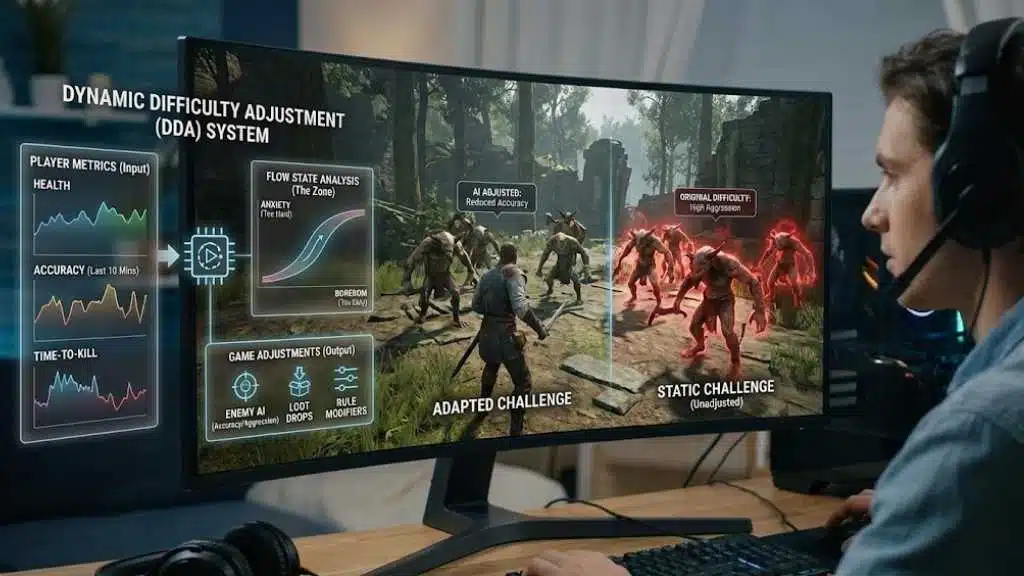
Dynamic Difficulty Adjustment, or DDA, is a design technique where a video game automatically modifies its rules, behaviors, or stats in real-time based on the player’s ability. Instead of a single “Normal” difficulty that stays the same for everyone, the game becomes a living system that reacts to you.
Definition and Purpose of DDA
At its core, DDA is about keeping you in the “zone.” Psychologists call this the state of Flow—a concept popularized by Mihaly Csikszentmihalyi—where a task is difficult enough to be engaging but not so hard that it causes anxiety. DDA systems monitor metrics like your health, accuracy, and time-to-kill to ensure you stay in this narrow channel of optimal engagement.
Designers use this because static difficulty is risky. A fixed challenge might bore a veteran player while crushing a newcomer. By adapting the game on the fly, studios can sell the same product to millions of people with vastly different skill levels and ensure they all finish the story.
How DDA Works in Video Games
Modern DDA has moved far beyond simple “rubber banding” (where a racing game slows down the lead car). Today, games use sophisticated algorithms and even Reinforcement Learning (AI) to profile you. Here is what is happening under the hood:
- The Input: The game tracks specific variables, such as how many times you’ve died in the last 10 minutes, your ammunition reserves, or your input reaction time.
- The Analysis: An internal manager compares your stats against an “ideal” performance curve. If you are deviating too far (performing too poorly or too well), it flags the need for a change.
- The Adjustment: The game alters variables. In a shooter, enemies might become less accurate. In an RPG, loot drops might become more generous.
For example, in many modern stealth games, if you are detected repeatedly, the AI guards may become slightly “dumber,” taking longer to notice you or forgetting your location faster. You feel like a master spy, but the game is actually quietly holding the door open for you.
The Appeal of Dynamic Difficulty Adjustment
When done correctly, DDA is invisible magic. It creates the illusion that you are always succeeding by the skin of your teeth, which is a powerful emotional hook.
Enhancing player Engagement
The primary goal for any studio is retention. If you stop playing, you stop buying DLC or microtransactions. Data from industry studies suggests that adaptive difficulty can increase player retention significantly—some reports cite uplifts of over 30% in session length for casual players. By smoothing out difficulty spikes, developers ensure you see more of the content they spent millions creating.
Reducing frustration and Maintaining Flow
We have all played games that felt unfair. DDA acts as a safety net for these moments. If a player fails a specific jump five times, a smart system might subtly extend the landing platform or increase the character’s jump height by 5%. This prevents the “rage-quit” moment. The player feels relief and satisfaction at overcoming the obstacle, unaware that the obstacle itself was lowered.
Personalizing the Gaming Experience
Think of DDA as a personalized Dungeon Master. Instead of forcing you to choose between “Easy,” “Medium,” or “Hard” at the start—before you even know how the game plays—the system learns your preferences. If you love exploration but are bad at combat, the game can quietly lower enemy health while keeping puzzles complex. This creates a unique experience where the game feels “right” for you, even if your friend is playing a mathematically different version of the same title.
Ethical Concerns Surrounding DDA
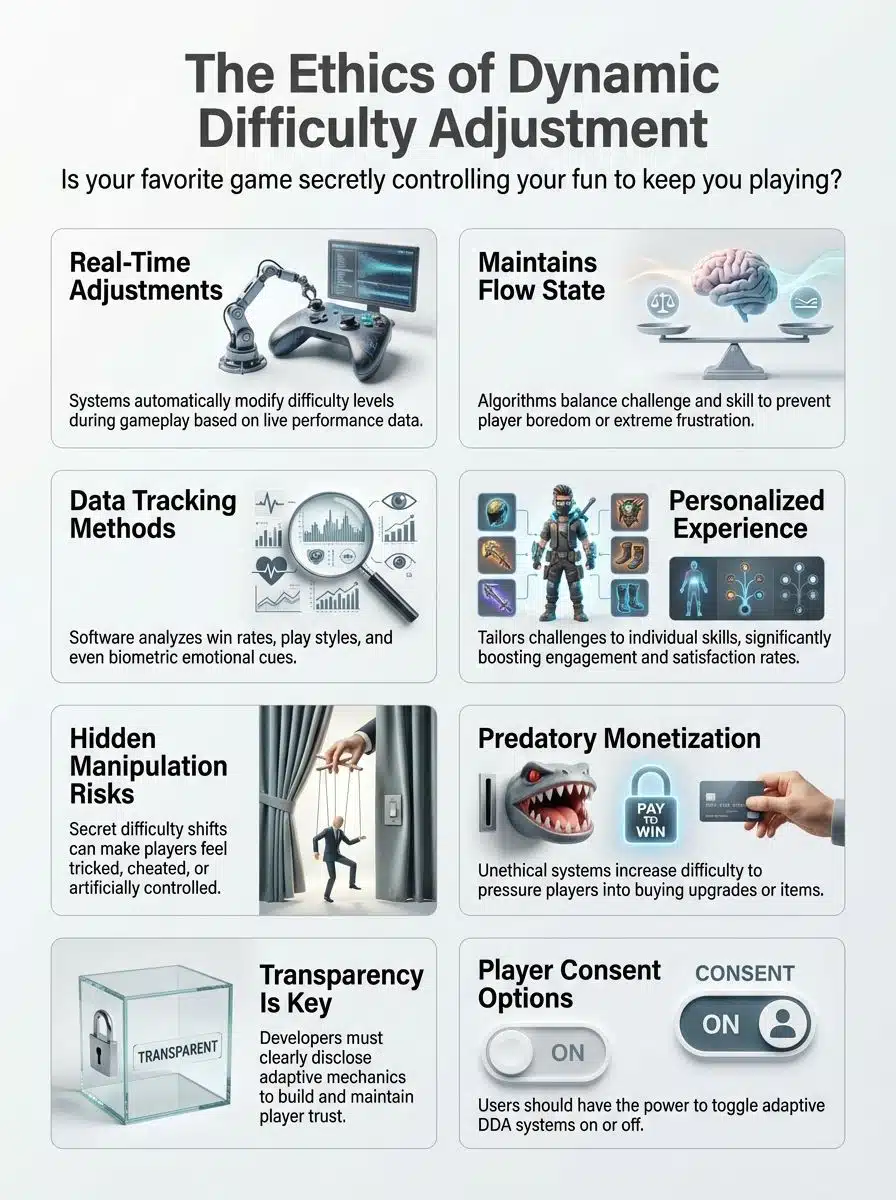
This is where the conversation shifts from “helpful design” to “psychological manipulation.” If a game changes the rules without telling you, is your victory actually real? And worse, are these systems being used to help you have fun, or to empty your wallet?
The Potential for Player manipulation
The biggest ethical issue is the lack of consent. When you defeat a boss in a game like Elden Ring (which largely avoids DDA), you know you mastered the mechanics. In a game with heavy DDA, you can never be sure if you won because you improved, or because the algorithm took pity on you. This uncertainty can devalue the sense of achievement, which is the primary reason many people play games in the first place.
Exploiting Behavioral Patterns for Monetization
The dark side of DDA is EOMM (Engagement Optimized Matchmaking). This is a controversial concept where a game might intentionally match you against impossible odds to make you lose, followed by an easy match to make you win. The goal is to create a “yo-yo” effect of frustration and relief that keeps you addicted, similar to a slot machine.
“In 2017, Activision was granted US Patent 20170259177A1, which described a system that could match players to influence microtransactions. For example, the system could match a junior player against an expert who owns a powerful premium weapon. The junior player gets crushed, sees the weapon’s power, and is psychologically primed to buy it.”
While Activision has stated this specific system wasn’t implemented in Call of Duty, the existence of the patent proves that the industry is actively researching how to weaponize difficulty to drive sales.
Types of Dynamic Difficulty Adjustment
Not all adaptive systems are the same. They range from simple math tweaks to complex emotional AI.
| Type | How It Works | Common Example |
|---|---|---|
| Performance-Based | Adjusts stats based on wins/losses or accuracy. | Resident Evil 4 (Game Rank) |
| Probabilistic | Tweaks the % chance of success behind the scenes. | XCOM (Hidden hit bonuses) |
| Emotion-Based | Uses biometrics or input patterns to detect stress. | Experimental Horror Games |
| AI Director | Controls pacing, spawns, and items to create drama. | Left 4 Dead |
Performance-based Systems
This is the most common form. If you clear a room quickly and take no damage, the game notes this high performance. In response, it might spawn an extra enemy in the next room or upgrade the enemy type from “Soldier” to “Heavy Gunner.” Conversely, if you use three health packs in one fight, the game will ensure the next crate you break contains extra healing items.
Emotion-based Systems
This is the cutting edge. While mass-market games don’t usually hook up to heart monitors yet, they infer emotion from your inputs. “Button mashing” can indicate panic. Erratic camera movements can indicate confusion. The system reads these digital body language cues to adjust the atmosphere—perhaps dimming the lights or triggering a scary sound effect when it calculates you are most vulnerable.
Hybrid Approaches
Most AAA games use a mix. They track your raw performance stats (kills, deaths) but cross-reference them with pacing data. The goal is to create a “drama curve.” Even if you are playing perfectly, the system might force a quiet moment to let you breathe, ensuring the next action sequence feels more intense by comparison.
Case Studies of DDA in Popular Games
To understand the real impact of these systems, we need to look at the games that defined them—both the heroes and the villains of the conversation.
Examples of Successful and Ethical Applications
Some games use DDA so effectively that players love it, even when they know it exists.
- Resident Evil 4 (The Hidden Rank): This is the textbook example. The game internally ranks you on a scale of 1 to 10. You might start at Rank 5. Play well, and you hit Rank 8—enemies become aggressive and dodge your shots. Get hit, and you drop to Rank 3—enemies slow down. It’s brilliant because it keeps the tension high without feeling unfair.
- Left 4 Dead (The AI Director): This system doesn’t just change stats; it changes the drama. The “Director” tracks the survivors’ “stress levels.” If the team has been fighting a horde for too long, the Director forces the zombies to retreat, giving the players a moment of silence to heal and reload before the next wave.
- Mario Kart (Rubber Banding): A classic example where players in last place get powerful items (Blue Shells, Bullet Bills) while the leader gets weak items (Bananas). It keeps the race tight and exciting for everyone.
Controversial Implementations and Backlash
The conversation turns negative when transparency is lost.
- EA Sports FC (formerly FIFA): For years, players have alleged that “scripting” or “momentum” exists—a hidden system that makes your players sluggish if you are winning 2-0, to give the opponent a chance to catch up. EA has faced lawsuits over this. While a 2021 lawsuit was dismissed after EA provided technical data to plaintiffs showing no DDA was used in Ultimate Team modes, the community perception persists because the game feels manipulated.
- Call of Duty (SBMM vs. EOMM): Players debate endlessly whether the matchmaking is based on Skill (fairness) or Engagement (addiction). The fear is that the game is “rigging” matches to ensure you have a 50% win rate, preventing you from ever truly dominating.
The Role of Transparency and Player Consent

The solution to these ethical problems is simple: honesty. Players generally accept help if they ask for it, but they hate being tricked.
Informing Players about DDA Mechanisms
The industry is slowly moving toward “Assist Modes” rather than hidden DDA. Celeste is the gold standard here. Instead of secretly making jumps easier if you die, the game offers a clear “Assist Mode” menu. You can toggle specific cheats like “Infinite Stamina” or “Slow Game Speed.”
This respects the player’s intelligence. It says, “This game is hard. If you want to change the rules, here are the tools to do it.” It puts the control back in your hands, transforming DDA from a hidden manipulator into a user-controlled accessibility tool.
Allowing Players to Opt in or Out
The future of ethical DDA is the toggle. Games like The Last of Us Part II and God of War Ragnarok allow granular difficulty customization. You can set “Enemy Health” to Hard but “Parry Timing” to Easy. This allows players to curate their own challenge without an algorithm guessing what they want.
The Future of DDA and Ethical Gaming Practices
As AI advances, DDA will move from simple stat-tweaking to full-blown content generation.
Balancing Innovation with Player Trust
We are approaching an era of Generative Agents—AI characters that can improvise dialogue and change the story based on your mood. Imagine an RPG where the villain realizes you are bored with combat and decides to try and bribe you instead of fighting. This could be revolutionary, but it requires immense trust. Players need to know that the AI is acting to make the story better, not to artificially prolong the game to boost engagement metrics.
The Need for Industry Standards
Right now, it is the Wild West. There are no regulations requiring companies to disclose if they are using EOMM or bot-matches to inflate your ego. As these systems become more capable of influencing human behavior, we may need industry-wide labeling—similar to “nutrition facts”—that tells you exactly how the game’s matchmaking and difficulty algorithms operate before you press start.
Final Thoughts
Dynamic difficulty adjustment is a tool, and like any tool, it can be used to build or to break. When used responsibly, like in Left 4 Dead or Resident Evil 4, it creates unforgettable experiences that feel perfectly paced. It keeps us in the flow and helps us conquer challenges we thought were impossible.
But when it is hidden, fueled by profit-driven patents, and designed to manipulate retention rather than joy, it crosses an ethical line. As players, our best defense is to stay informed. Check the accessibility settings, read the developer blogs, and understand that sometimes, that lucky break you just got wasn’t luck at all—it was the game deciding you needed a win.