
The global energy landscape is undergoing an unprecedented transformation. For the first time in history, investment in renewable energy has surpassed fossil fuel spending, reaching over $1.8 trillion in 2024 alone. This shift isn’t just about reducing carbon emissions; it represents a fundamental reimagining of how we produce, store, and distribute power across the planet.
This comprehensive guide explores 10 revolutionary green tech innovations that are actively changing the future of energy. Each technology represents a critical piece of the puzzle in our transition away from fossil fuels. You’ll discover how these innovations work, their current development status, real-world applications, and the timeline for mainstream adoption.
Whether you’re a business leader planning sustainability strategies, a policymaker shaping energy regulations, or simply someone interested in our technological future, understanding these innovations is essential for navigating the energy transition ahead.
Let’s dive into the cutting-edge technologies that are revolutionizing how humanity powers itself, technologies that could determine whether we successfully address the climate crisis and build a truly sustainable energy system for generations to come.
Revolutionary Green Tech Innovations
The convergence of scientific breakthroughs, manufacturing advances, and policy support has unleashed a wave of green tech innovations that are fundamentally reshaping the energy landscape. These aren’t incremental improvements; they’re revolutionary technologies that challenge decades-old assumptions about clean energy. What makes these innovations truly revolutionary?
Each one addresses a critical barrier that has historically limited renewable energy adoption. Nuclear fusion promises unlimited baseload power. Perovskite solar cells slash costs while boosting efficiency. Green hydrogen decarbonizes hard-to-electrify sectors. Advanced storage solves renewable intermittency.
These revolutionary green tech innovations offer a credible pathway to net-zero emissions by 2050. The question is no longer whether these technologies work; pilot projects have proven viability. The question is how quickly we can scale them globally.
1. Nuclear Fusion Power Plants
Nuclear fusion represents the holy grail of clean energy, the same process that powers the sun and stars. Unlike nuclear fission, which splits heavy atoms and produces radioactive waste, fusion combines light atomic nuclei (typically isotopes of hydrogen called deuterium and tritium) to create heavier elements, releasing enormous amounts of energy in the process.
The key advantages are staggering: fusion produces no greenhouse gases, generates no long-lived radioactive waste, cannot experience runaway reactions like fission reactors, and uses fuel that is virtually inexhaustible. A single gram of fusion fuel contains the energy equivalent of nearly 8 tons of oil.
The challenge has always been achieving the extreme temperatures (over 100 million degrees Celsius) and pressures needed to force atomic nuclei together while containing this stellar-hot plasma.
Recent Breakthroughs in Fusion Technology
December 2022 marked a historic milestone when the National Ignition Facility in California achieved fusion ignition—producing more energy from fusion than the lasers put into the reaction. This breakthrough, repeated and improved upon in subsequent experiments, proved that fusion energy gain is physically achievable, not just theoretically possible.
The ITER (International Thermonuclear Experimental Reactor) project in France, representing a collaboration of 35 nations, continues assembly with operations expected in the late 2020s. ITER aims to produce 500 megawatts of fusion power from just 50 megawatts of input, a tenfold energy gain that would demonstrate commercial viability.
Meanwhile, private fusion companies are accelerating progress. Commonwealth Fusion Systems has developed high-temperature superconducting magnets that enable smaller, more powerful tokamak reactors.
TAE Technologies is pursuing an alternative approach using boron fuel, which produces no neutron radiation. These companies are targeting commercial fusion power plants by the early 2030s, decades ahead of traditional projections.
Commercial Viability and Timeline
The fusion industry has attracted over $6 billion in private investment, signaling growing confidence in commercial viability. Multiple companies now project that their first commercial reactors will begin operation between 2030 and 2035.
The UK government has committed to building the world’s first commercial fusion power station, STEP (Spherical Tokamak for Energy Production), targeting the early 2040s.
Current cost projections suggest fusion electricity could compete with renewable sources once scaled, though initial plants will be expensive demonstrators. The levelized cost of energy (LCOE) is expected to fall below $100 per megawatt-hour as technology matures and production scales up.
Impact on Global Energy Systems
Fusion power could revolutionize energy systems by providing 24/7 baseload power without carbon emissions or air pollution. Unlike solar and wind, fusion doesn’t depend on weather or time of day. A single fusion plant could power millions of homes using just a few kilograms of fuel daily.
If successfully commercialized, fusion could enable energy abundance, support desalination for water-scarce regions, power carbon capture facilities, and potentially enable hydrogen production at unprecedented scales. The technology represents a genuine pathway to unlimited clean energy, the ultimate solution to energy scarcity and climate change combined.
2. Perovskite Solar Cells
Perovskite solar cells represent one of the most exciting developments in photovoltaic technology. Named after the crystal structure they share with the mineral perovskite, these cells use a family of materials with the chemical formula ABX₃, typically methylammonium lead halides.
What makes them revolutionary is their ability to convert sunlight to electricity with efficiencies rivaling or exceeding traditional silicon while being dramatically cheaper and easier to manufacture.
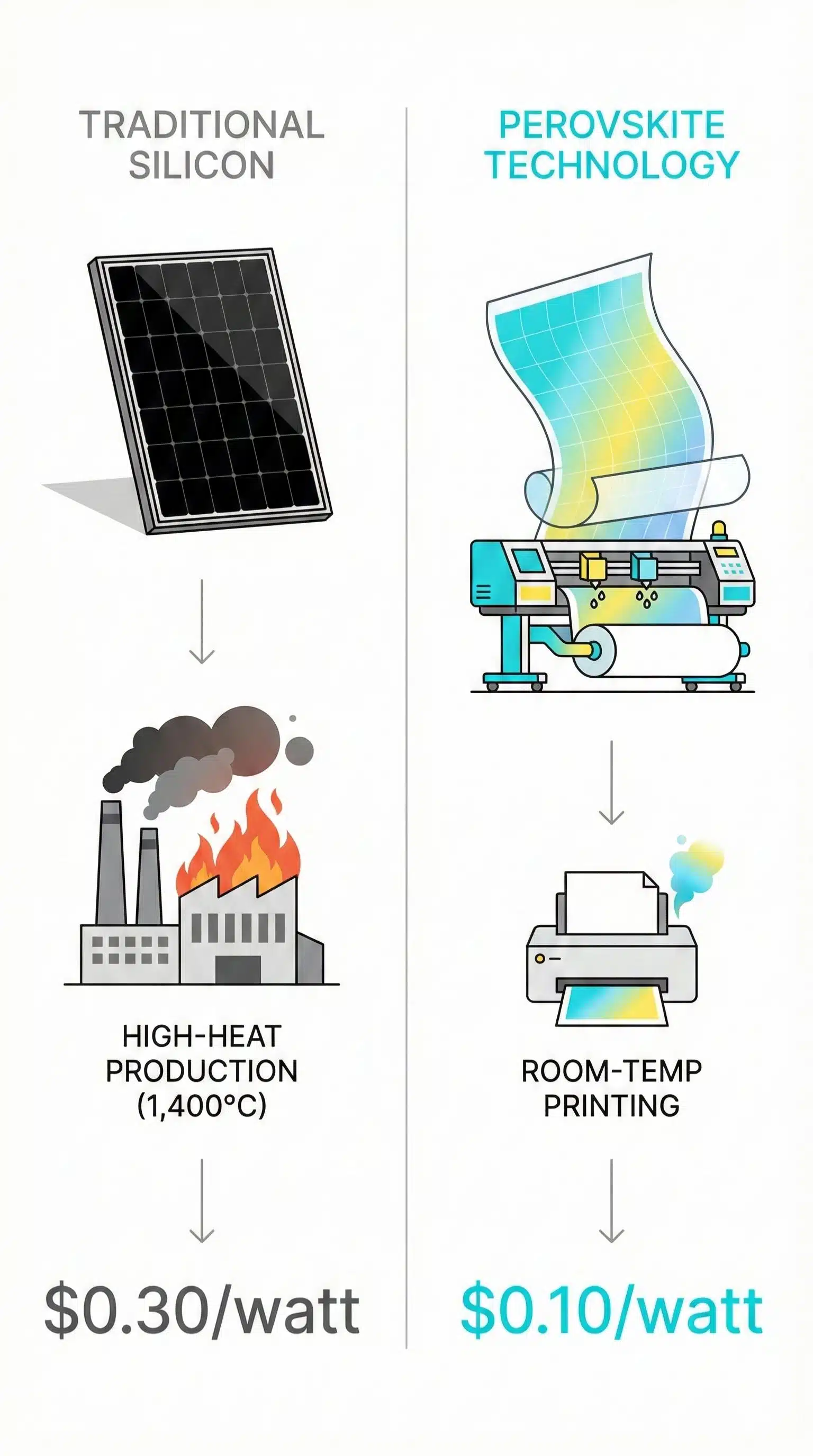
Unlike silicon solar cells, which require energy-intensive production at temperatures above 1,400°C, perovskite cells can be manufactured at room temperature using simple solution-processing techniques similar to inkjet printing. This means solar panels could potentially be printed on flexible substrates, opening up applications impossible with rigid silicon panels.
Efficiency Gains and Cost Reductions
In just over a decade, perovskite solar cell efficiency has skyrocketed from 3.8% in 2009 to over 26% for single-junction cells and exceeded 33% for tandem cells that layer perovskite with silicon. This represents the fastest efficiency improvement of any solar technology in history. For context, most commercial silicon panels operate at 18-22% efficiency.
The theoretical efficiency limit for perovskite-silicon tandem cells reaches approximately 43%, compared to 29% for silicon alone. This means significantly more power generation from the same surface area, critical for space-constrained installations like rooftops. Manufacturing costs could eventually drop to $0.10 per watt, compared to $0.20-0.30 for silicon, potentially halving solar panel prices.
Flexible and Versatile Applications
Perovskite’s flexibility unlocks entirely new solar applications. Imagine building-integrated photovoltaics (BIPV) where windows, facades, and roofing materials generate electricity while maintaining aesthetic appeal. Semi-transparent perovskite cells could cover skyscraper windows, turning entire buildings into vertical power plants without sacrificing natural light.
The technology enables solar cells on curved surfaces, wearable electronics with self-charging capabilities, and portable solar chargers that fold like paper. Vehicle manufacturers are exploring perovskite coatings for electric cars that could extend range by generating supplementary power. The material’s light weight also makes it ideal for aerospace applications and remote installations where shipping costs matter.
Commercialization Status
The primary challenge holding back perovskite commercialization has been stability and durability. Early cells degraded rapidly when exposed to moisture, oxygen, heat, and UV light.
However, intensive research has yielded remarkable progress. Modern encapsulated perovskite cells now demonstrate operational lifetimes exceeding 25 years under accelerated testing, matching silicon’s commercial lifespan.
Several companies, including Oxford PV, Swift Solar, and Saule Technologies, have begun pilot production and expect commercial products by 2026-2027. The technology is poised to capture significant market share, particularly in tandem configurations that boost silicon panel output by 20-30% with minimal additional cost.
3. Green Hydrogen Production Technology
Hydrogen is the most abundant element in the universe and burns cleanly, producing only water vapor as exhaust. However, not all hydrogen is created equal from an environmental perspective.
Today, 95% of hydrogen comes from fossil fuels through a process called steam methane reforming, producing ‘gray hydrogen’ that generates significant CO₂ emissions, approximately 830 million tons annually, equivalent to the combined emissions of the UK and Indonesia.
‘Blue hydrogen’ uses the same fossil fuel process but captures and stores the CO₂ emissions underground. While better than gray hydrogen, it still relies on extracting natural gas and achieves only 70-90% carbon capture. ‘Green hydrogen,’ by contrast, is produced through electrolysis, splitting water molecules using electricity from renewable sources like solar and wind. This process creates truly zero-emission hydrogen, completing the clean energy circle.
Electrolysis Innovations and Efficiency
Electrolysis technology has evolved significantly. Proton Exchange Membrane (PEM) electrolyzers offer fast response times and high current densities, making them ideal for pairing with variable renewable energy. They can ramp production up or down in seconds, functioning as a form of energy storage that consumes excess solar and wind power when generation exceeds demand.
Alkaline electrolyzers, the mature technology, provide lower capital costs and longer lifespans exceeding 60,000 hours. Solid Oxide Electrolysis Cells (SOEC) operate at high temperatures (700-900°C), achieving efficiencies above 90% by using waste heat. Some SOEC systems can reach efficiencies of 95%, meaning nearly all input electricity converts to hydrogen energy.
Recent innovations include anion exchange membrane (AEM) electrolyzers that combine PEM’s flexibility with alkaline’s low cost by eliminating expensive materials like platinum and iridium. These advances are driving electrolyzer costs down from $1,000 per kilowatt in 2020 toward targets of $300-500 per kilowatt by 2030.
Industrial Applications and Use Cases
Green hydrogen addresses one of decarbonization’s toughest challenges: heavy industry. Steel production, responsible for 7% of global CO₂ emissions, can replace coal-based blast furnaces with hydrogen-based direct reduction.
SSAB, a Swedish steelmaker, has already produced the world’s first fossil-free steel using green hydrogen. Cement production, chemical manufacturing, and oil refining, all hard-to-electrify sectors, can substitute hydrogen for natural gas and coal.
Transportation represents another massive opportunity. While batteries suit passenger cars, hydrogen fuel cells offer advantages for long-haul trucking, shipping, and aviation, where weight and refueling time matter.
Hydrogen-powered trains already operate commercially in Germany, and major shipping companies are developing hydrogen-fueled cargo vessels. Airbus is developing hydrogen-powered aircraft targeting commercial service by 2035.
Infrastructure Development
The hydrogen economy requires massive infrastructure investment. Pipelines, storage facilities, refueling stations, and port terminals must be built or retrofitted. Existing natural gas pipelines can transport hydrogen blends up to 20% concentration without modification; dedicated hydrogen pipelines require different materials but can leverage existing rights-of-way.
Global hydrogen infrastructure investment reached $75 billion in 2024, with governments committing an additional $280 billion through 2030. The EU’s European Hydrogen Backbone project plans 40,000 km of hydrogen pipelines by 2040.
As production scales and infrastructure develops, green hydrogen costs are projected to fall from $3-6 per kilogram today to $1-2 per kilogram by 2030, achieving cost parity with fossil fuel alternatives and unlocking massive decarbonization potential.
4. Advanced Energy Storage Systems
While lithium-ion batteries revolutionized portable electronics and electric vehicles, they face fundamental limitations for grid-scale energy storage. Limited lithium and cobalt resources, fire risks from thermal runaway, degradation after 1,000-3,000 charge cycles, and high costs for long-duration storage (beyond 4 hours) constrain deployment.
The renewable energy transition demands storage solutions that can hold power for days or weeks to smooth out seasonal variations and extended periods of low wind and sun.
Next-generation battery chemistries are addressing these limitations. Sodium-ion batteries use abundant, inexpensive sodium instead of lithium, potentially reducing battery costs by 30-40%.
Although offering lower energy density than lithium-ion, sodium-ion excels for stationary storage where weight doesn’t matter. China’s CATL began mass production of sodium-ion batteries in 2023, with energy density reaching 160 Wh/kg and projected improvements to 200 Wh/kg.
Solid-State Battery Technology
Solid-state batteries replace the flammable liquid electrolyte in conventional lithium-ion cells with a solid electrolyte, typically ceramic or polymer. This breakthrough offers multiple advantages: 50-100% higher energy density, near-elimination of fire risk, faster charging (potentially 80% in 10 minutes), and longer lifespans exceeding 5,000 cycles. The solid electrolyte also enables lithium metal anodes, which store significantly more energy than graphite anodes.
Major automakers are racing to commercialize solid-state technology. Toyota announced plans for solid-state battery vehicles by 2027-2028, claiming a 900-mile range and 10-minute charging.
QuantumScape, backed by Volkswagen, has demonstrated solid-state cells that retain 95% capacity after 1,000 cycles. Samsung has developed silver-carbon composite anodes for solid-state batteries, achieving a 500-mile range.
While manufacturing challenges remain, particularly achieving stable solid-liquid interfaces and scaling production, solid-state batteries could transform electric vehicles and premium energy storage within the next 5-7 years.
Flow Batteries for Grid-Scale Storage
Flow batteries offer unique advantages for long-duration storage. Unlike conventional batteries, where energy capacity and power output are coupled, flow batteries separate these functions. Energy is stored in liquid electrolytes held in external tanks, while power is generated in a central stack.
Need more storage capacity? Simply add bigger tanks. This design enables duration-independent costs, scaling from 4 hours to 12 hours of storage adds minimal expense.
Vanadium redox flow batteries (VRFB) currently dominate the market, offering 20+ year lifespans and unlimited cycling without degradation. China has installed gigawatt-scale VRFB systems, with the world’s largest 800 MWh facility in Dalian providing 8 hours of storage.
However, vanadium’s cost remains a barrier. Zinc-based flow batteries from companies like Eos Energy offer cheaper alternatives using abundant zinc, targeting $100 per kWh costs, competitive with lithium-ion for long-duration applications.
Gravity and Thermal Storage Solutions
Mechanical storage systems provide low-cost, long-duration alternatives using simple physics. Energy Vault’s gravity storage system uses cranes and motors to stack 35-ton concrete blocks in tower formations. When energy is needed, blocks descend, driving generators. The system achieves 80-85% round-trip efficiency with 10-20 hour discharge durations and a 35-year lifespan with minimal degradation. Gravitricity develops similar concepts using abandoned mine shafts to raise and lower weights.
Thermal energy storage heats materials like molten salt, sand, or rocks to 500-1,000°C using excess electricity, then releases heat to generate steam for turbines when needed. These systems can store energy for days or weeks at a fraction of battery costs—potentially $2-10 per kWh compared to $100-200 for lithium-ion. Malta Inc. combines both approaches in a ‘pumped heat’ system that stores energy as both hot and cold molten salt. As renewable penetration increases, these long-duration, low-cost storage technologies become essential for grid stability and resilience.
5. Offshore Floating Wind Farms
Traditional offshore wind farms use fixed-bottom foundations, monopiles or jackets driven into the seabed. While effective, this approach limits deployment to relatively shallow waters, typically under 60 meters deep. This constraint excludes vast ocean areas with exceptional wind resources.
Approximately 80% of offshore wind potential lies in waters deeper than 60 meters, particularly along coastlines with steep continental shelves like the US West Coast, the Mediterranean, and much of Asia.
Floating wind turbines solve this limitation by mounting turbines on floating platforms anchored to the seafloor with mooring lines, similar to offshore oil platforms. This innovation unlocks deepwater locations where winds blow stronger and more consistently than shallow coastal waters. Capacity factors, the percentage of maximum output actually generated, can exceed 60% at prime deepwater sites compared to 40-50% for onshore wind and 45-55% for shallow offshore wind.
Engineering Innovations in Deep-Water Deployment
Several platform designs have emerged, each with distinct advantages. Semi-submersible platforms use three or four columns connected by pontoons, offering stability and easier assembly in sheltered waters before towing to the site. Spar buoy platforms feature a deep-draft cylinder weighted at the bottom, providing excellent stability in rough seas.
Tension leg platforms use vertical tethers, minimizing platform motion but requiring more complex installation. Barge platforms offer the simplest, cheapest design for moderate conditions.
Modern floating turbines reach 15 MW capacity, twice the power of typical onshore turbines, with rotor diameters exceeding 230 meters. Advanced control systems adjust blade pitch and yaw to counteract platform motion, maintaining optimal power generation despite waves.
New mooring technologies using synthetic ropes instead of chains reduce costs and environmental impact. Serial production techniques from shipbuilding are being adapted to manufacture platforms at scale, with targets of 50+ platforms annually per facility by 2030.
Global Projects and Installations
Norway’s Hywind Scotland, operational since 2017, demonstrated floating wind’s commercial viability with capacity factors exceeding 56%. The 88 MW project weathered Hurricane Ali in 2018 without damage, proving durability in harsh conditions.
Hywind Tampen, an 88 MW floating array powering offshore oil platforms, began operation in 2023, the first offshore installation powering industrial facilities.
The UK awarded contracts for floating wind developments totaling 5 GW by 2030. France’s first commercial-scale floating wind farm, a 250 MW project off Brittany, is under development.
The US Bureau of Ocean Energy Management identified two floating wind lease areas off California with potential for 4.6 GW, enough to power 1.5 million homes. South Korea is committed to 6 GW of floating wind by 2030 to power industrial zones. China installed its first deep-water floating turbine in 2021 and announced plans for multi-gigawatt floating farms in the South China Sea.
Economic and Environmental Benefits
Current floating wind costs range from $100 to $150 per MWh, compared to $40 to $80 for fixed offshore wind. However, costs are falling rapidly as technology matures and supply chains develop. Industry projections target $60-80 per MWh by 2030, competitive with fixed offshore wind and new natural gas plants. The International Energy Agency forecasts floating wind could provide 15% of global electricity by 2050 if deployment accelerates.
Environmental benefits include minimal seabed disturbance compared to fixed foundations, deployment far from shore, reducing visual impact and conflicts with shipping lanes, and potential for hybrid systems combining floating wind with wave energy or aquaculture.
Marine ecosystems may actually benefit as floating platforms create artificial reef habitats. The technology’s ability to access the strongest, most consistent winds while minimizing environmental conflicts positions floating offshore wind as a cornerstone of renewable energy expansion, particularly for island nations and countries with limited shallow offshore areas.
6. AI-Optimized Smart Grids
Traditional electrical grids operate on centralized, one-way power flows: large power plants generate electricity that flows through transmission lines to distribution networks and finally to consumers. This 20th-century infrastructure struggles with 21st-century challenges, integrating intermittent renewables, managing distributed generation from millions of rooftop solar panels, coordinating electric vehicle charging, and responding to increasingly dynamic demand patterns.
Artificial intelligence transforms dumb grids into intelligent networks that continuously optimize themselves. Machine learning algorithms process vast datasets from smart meters, weather forecasts, generation sources, and consumption patterns to predict and balance supply and demand in real-time.
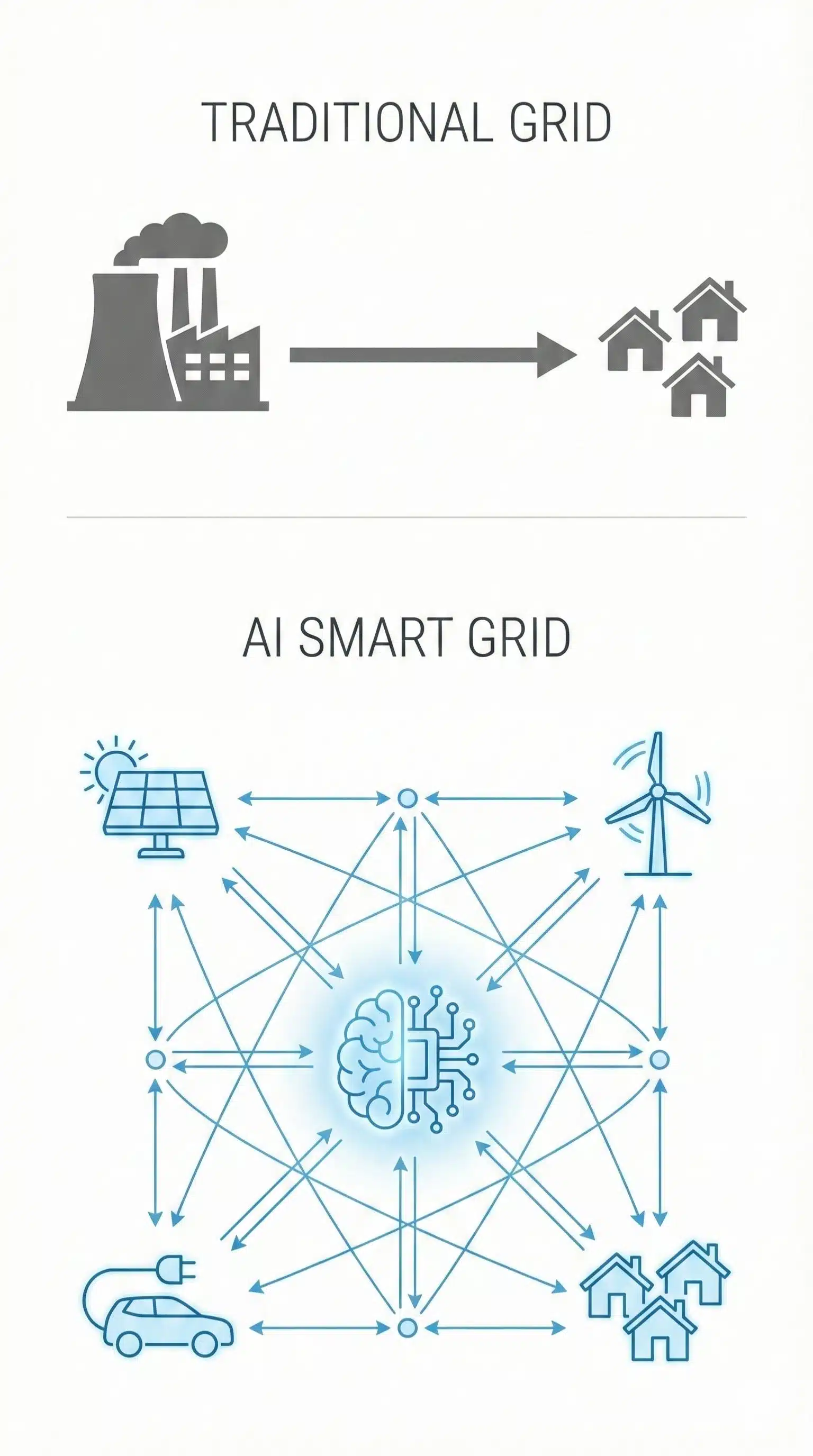
Rather than maintaining expensive reserve capacity to handle peak demand, AI systems can orchestrate millions of distributed resources, shifting EV charging to off-peak hours, adjusting building climate control, and coordinating battery storage to flatten demand curves and maximize renewable utilization.
Predictive Load Balancing and Demand Response
AI excels at forecasting. Neural networks trained on historical data predict electricity demand hours or days in advance with accuracy exceeding 95%, accounting for weather, day of week, holidays, events, and behavioral patterns.
Google’s DeepMind AI reduced the energy used for cooling its data centers by 40% through predictive optimization. National Grid in the UK uses AI to forecast demand and renewable generation, reducing forecast errors by 30% and cutting carbon emissions by millions of tons annually.
Demand response leverages AI to shift electricity consumption in time. When renewable generation spikes on a sunny, windy day, AI systems can signal smart appliances, industrial processes, and EV chargers to increase consumption, absorbing surplus power.
During peak demand or low renewable output, the system reduces consumption by pre-cooling buildings, delaying non-essential industrial processes, or adjusting lighting. This creates a ‘virtual power plant’, millions of distributed resources coordinated to balance the grid without building additional generation.
Integration of Distributed Energy Resources
The modern grid increasingly resembles the internet, decentralized with two-way flows. Rooftop solar panels, home batteries, electric vehicles, and small wind turbines transform consumers into ‘prosumers’ who both consume and generate electricity. Managing millions of these distributed energy resources (DERs) manually is impossible; AI makes it feasible.
AI platforms aggregate DERs into virtual power plants. Tesla’s Autobidder software coordinates thousands of Powerwall batteries to provide grid services in Australia and California, earning money for owners while stabilizing the grid. In Germany, Next Kraftwerke connects over 10,000 DERs, solar, wind, batteries, and flexible industrial loads into Europe’s largest virtual power plant, optimizing their operation to maximize revenue and grid stability.
Real-Time Optimization Benefits
AI enables self-healing grids that detect and respond to failures in milliseconds. When a fault occurs, AI systems instantly reroute power through alternative paths, isolate the problem, and restore service, often before customers notice an outage.
During California’s wildfire seasons, AI-powered grids can proactively de-energize high-risk lines during dangerous wind conditions while minimizing impact on customers.
The economic benefits are substantial: AI optimization reduces grid operating costs by 10-30%, decreases the need for expensive ‘peaker’ power plants, enables higher renewable penetration without reliability issues, and defers costly infrastructure upgrades by squeezing more capacity from existing systems.
As grids worldwide upgrade with smart sensors, advanced metering, and AI platforms, we’re witnessing the transformation from passive electricity distribution to active, intelligent energy ecosystems that self-optimize for efficiency, reliability, and sustainability.
7. Carbon Capture and Utilization (CCU) Technology
While reducing emissions is essential, atmospheric CO₂ levels have already reached 425 parts per million, well above the 350 ppm scientists consider safe. Removing existing carbon dioxide from the atmosphere through Direct Air Capture (DAC) offers a way to reverse past emissions and achieve net-negative carbon footprints. DAC facilities use chemical processes to extract CO₂ from ambient air, which contains only 0.04% carbon dioxide, far lower than concentrated sources like power plant exhaust.
Two main approaches dominate DAC technology. Liquid solvent systems pass air through chemical solutions (typically hydroxide or amine compounds) that selectively bind CO₂. Heating the solution releases concentrated CO₂ for storage or use.
Solid sorbent systems use porous materials that absorb CO₂ from air, then release it when heated or subjected to a vacuum. Climeworks, a Swiss company, operates the world’s largest DAC facility in Iceland, Orca, which captures 4,000 tons of CO₂ annually using solid sorbent technology powered entirely by geothermal energy.
Carbon Engineering, backed by Bill Gates and Occidental Petroleum, is developing a liquid solvent DAC plant in Texas targeting 1 million tons annual capacity, equivalent to removing 200,000 cars from the road.
Their process uses renewable energy and waste heat, achieving costs projected below $100 per ton by 2030. Innovations include advanced materials that reduce energy requirements by 50%, modular designs enabling faster deployment, and integration with renewable energy to minimize the carbon footprint of operations.
Carbon-to-Fuel Conversion
Rather than simply storing captured carbon, CCU technologies convert CO₂ into valuable products, creating economic incentives for carbon removal. Several pathways show promise. Synthetic fuels combine captured CO₂ with green hydrogen to produce ‘e-fuels’, drop-in replacements for gasoline, diesel, and jet fuel. Porsche is building an e-fuel production facility in Chile, targeting 550 million liters annually by 2026, producing carbon-neutral gasoline for classic cars and motorsports.
Building materials represent another major opportunity. CarbonCure injects captured CO₂ into concrete during mixing, where it mineralizes into calcium carbonate, permanently sequestering carbon while improving concrete strength. Over 500 concrete plants worldwide use the technology, sequestering 500,000 tons of CO₂ annually. CarbonBuilt goes further, creating carbon-negative concrete that stores more CO₂ than is emitted during production.
Covestro produces polyols for plastics using CO₂ as a raw material, demonstrating that carbon can replace petroleum feedstocks. Other applications include carbonated beverages, greenhouse agriculture (where CO₂ enhances plant growth), and methanol production for chemicals and fuels.
Industrial Point-Source Capture
Capturing CO₂ from concentrated industrial sources, power plants, cement factories, steel mills, is more economical than direct air capture because exhaust streams contain 10-30% CO₂. Post-combustion capture uses chemical solvents to scrub CO₂ from flue gas. Boundary Dam in Canada and Petra Nova in Texas demonstrated commercial-scale power plant capture, though high costs challenged viability.
Next-generation capture technologies are dramatically reducing expenses. NET Power’s supercritical CO₂ cycle combusts natural gas in pure oxygen, producing CO₂ and water that separate naturally, eliminating expensive chemical capture. The process achieves 97% carbon capture with no energy penalty and generates additional revenue by selling the CO₂ for industrial use or enhanced oil recovery.
Economic Models and Carbon Credits
Carbon capture economics depend heavily on policy support and carbon pricing. The US Inflation Reduction Act expanded 45Q tax credits to $180 per ton for permanent storage and $130 per ton for utilization, potentially making DAC profitable. The EU’s carbon price has exceeded €90 per ton, creating strong incentives for capture.
Companies like Microsoft, Stripe, and Shopify are purchasing carbon removal credits, creating demand that supports CCU development. Current DAC costs range from $250 to $600 per ton but are projected to fall to $100-150 per ton by 2030 with scale.
Point-source capture costs $50-100 per ton for power plants and $30-60 for industrial facilities. As costs decline and carbon prices rise, carbon capture could become a major industry.
The IEA projects we’ll need to capture 7.6 billion tons of CO₂ annually by 2050 to meet climate goals, representing a market potentially worth hundreds of billions of dollars. CCU bridges the gap between fossil fuel phase-out and full decarbonization, addressing hard-to-eliminate emissions while buying time for a complete energy transition.
8. Advanced Geothermal Systems (Enhanced Geothermal Systems—EGS)
Traditional geothermal power exploits naturally occurring hydrothermal reservoirs—rare geological formations where heat, rock permeability, and water coexist. This limits conventional geothermal to volcanic regions and tectonic boundaries, representing less than 2% of Earth’s land area.
Enhanced Geothermal Systems (EGS) remove this geographical constraint by creating artificial reservoirs anywhere hot rock exists at drillable depths.
EGS technology drills 3-5 kilometers deep into hot crystalline rock, then injects high-pressure water to create fractures, a process similar to hydraulic fracturing in oil and gas. These fractures form a network of pathways that increase rock permeability.
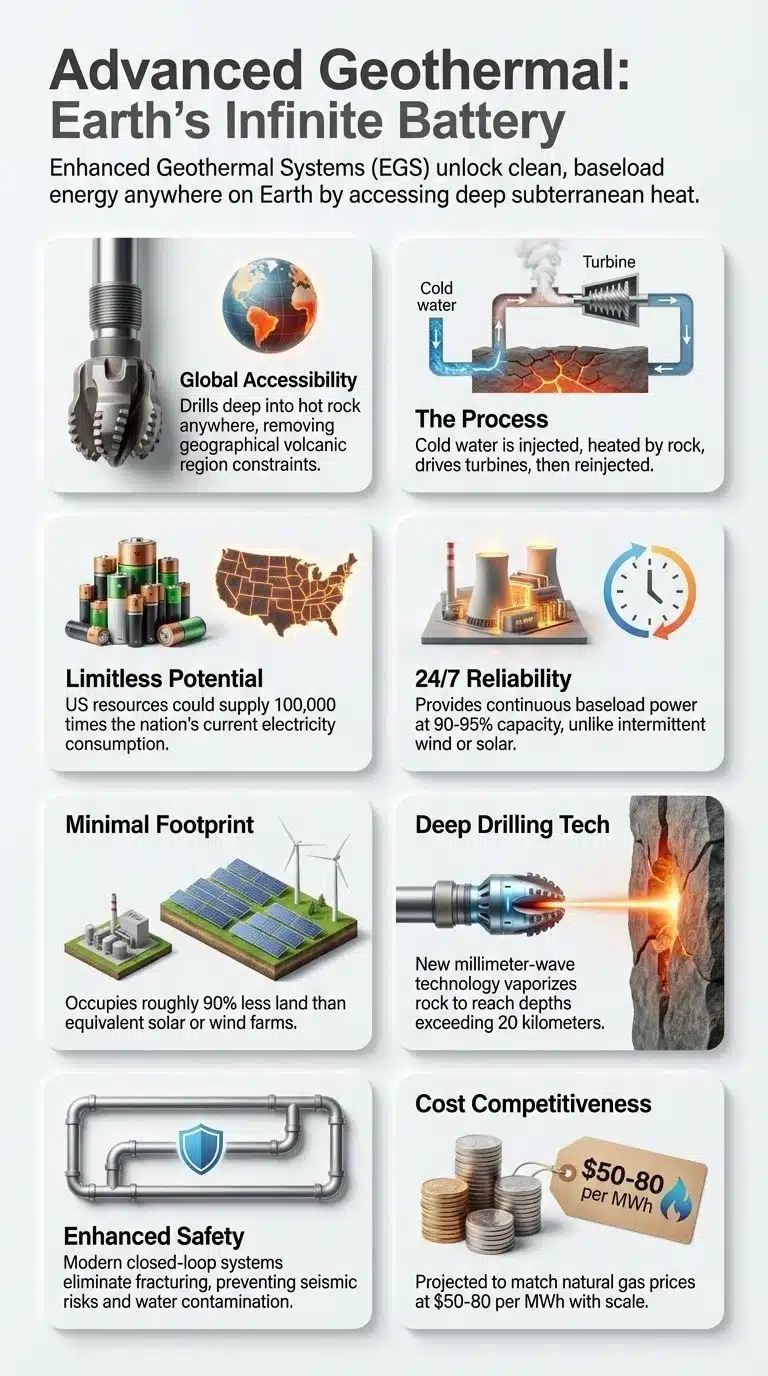
Water is then circulated through the heated rock: injection wells send cold water down, the fractured rock heats it to 150-220°C, and production wells bring hot water or steam to the surface to drive turbines. After power generation, the cooled water is reinjected, creating a closed loop that can operate for decades.
Expanding Geothermal Beyond Volcanic Regions
Earth’s internal heat is effectively limitless from a human timescale perspective. Every continent has hot rock at accessible depths. EGS can provide baseload power in Texas, Massachusetts, Germany, and China, locations previously unsuited for geothermal. MIT estimates US EGS resources could supply 100,000 times America’s current electricity consumption. The US Department of Energy calculates that exploiting just 2% of EGS potential in the US could power the entire country.
Unlike solar and wind, geothermal provides continuous baseload power, operating 24/7 at 90-95% capacity factors regardless of weather. This makes it perfect for complementing intermittent renewables. Additionally, EGS plants have tiny land footprints compared to solar and wind farms. A 100 MW geothermal plant might occupy just 1-4 square kilometers compared to 30-50 square kilometers for equivalent solar capacity.
Drilling and Stimulation Innovations
EGS drilling leverages decades of oil and gas drilling technology evolution. Modern directional drilling allows multiple wells from a single pad, reducing surface impact. Rotary steerable systems enable precise well placement. Improvements in drill bit materials and mud systems reduce costs and drilling times.
Companies like Quaise Energy are developing millimeter-wave drilling that vaporizes rock using high-frequency electromagnetic waves, potentially reaching depths of 10-20 kilometers where temperatures exceed 400°C, accessing even greater energy resources.
Hydraulic stimulation techniques have advanced significantly since early EGS attempts. Instead of creating large fracture networks that can induce seismicity, modern approaches use low-flow, high-precision stimulation to enhance existing natural fractures. Microseismic monitoring tracks fracture growth in real-time, allowing operators to optimize injection parameters and avoid triggering problematic earthquakes.
Closed-loop systems being developed by Eavor eliminate fracturing entirely, drilling two wells connected by a horizontal section kilometers underground, circulating fluid through the closed loop without contacting natural rock formations. This approach eliminates seismic risks and groundwater concerns.
24/7 Baseload Clean Energy
EGS offers what renewable energy systems desperately need: firm, dispatchable baseload power. While solar and wind require backup from batteries or gas plants, geothermal simply runs continuously. This makes it ideal for replacing retiring coal and nuclear plants, providing grid stability as renewable penetration increases.
Fervo Energy demonstrated the first commercial-scale EGS project in Nevada in 2023, achieving 3.5 MW production with plans to scale to 400 MW by 2028. The project achieved flow rates and temperatures exceeding expectations, proving commercial viability. Google partnered with Fervo to develop the first geothermal energy system specifically designed to power data centers 24/7.
Initial costs for EGS range from $100 to $150 per MWh but are projected to fall to $50-80 per MWh with scale and experience, competitive with combined-cycle natural gas. As drilling costs decline and technology matures, EGS could provide 8% of global electricity by 2050, according to IRENA projections. The technology represents clean energy’s ‘baseload battery’—storing heat in Earth’s crust for billions of years, ready to provide stable, carbon-free power whenever needed.
9. Tidal and Wave Energy Harvesters
Earth’s oceans contain enormous energy. Waves, driven by wind, continuously cross ocean surfaces. Tides, pulled by gravitational forces of the moon and sun, raise and lower sea levels twice daily with astronomical precision. Ocean currents flow like underwater rivers. Together, these represent a theoretical global resource exceeding 80,000 terawatt-hours annually, roughly four times current global electricity consumption.
Unlike solar and wind, ocean energy offers unique advantages. Tidal energy is perfectly predictable—we can calculate tidal patterns decades in advance with complete accuracy. Wave energy is far more energy-dense than wind; waves contain about 1,000 times more energy per square meter than air.
Coastal regions, home to 40% of the global population, have direct access to these resources. Yet ocean energy remains underdeveloped compared to other renewables, representing less than 1% of renewable energy investment.
Innovative Turbine and Generator Designs
Tidal stream generators function like underwater wind turbines, capturing kinetic energy from tidal currents. Horizontal-axis turbines resemble three-bladed wind turbines optimized for water’s higher density. Vertical-axis turbines use a Darrieus or Gorlov design that operates regardless of current direction—important since tides reverse twice daily. Orbital Marine’s O2, the world’s most powerful tidal turbine at 2 MW, uses two 20-meter rotors mounted on a floating platform. The design allows easy access for maintenance and can be towed to port for repairs.
Tidal barrages operate like hydroelectric dams built across estuaries, generating power as tides flow in and out through turbines. France’s La Rance tidal power station has operated since 1966, producing 240 MW. However, barrages’ environmental impact on estuaries limits their deployment. Modern tidal lagoon designs create artificial enclosed areas offshore, reducing environmental concerns while generating substantial power. Swansea Bay in Wales proposed a 320 MW tidal lagoon that would power 155,000 homes.
Wave energy converters come in numerous configurations. Point absorbers are floating buoys that bob with waves, converting vertical motion to electricity through hydraulic systems or linear generators. Ocean Power Technologies’ PowerBuoy systems provide power for remote ocean monitoring. Attenuators are long floating structures aligned with wave direction; they flex as waves pass, pumping hydraulic fluid through generators.
Pelamis Wave Power developed 150-meter snake-like machines that produced 750 kW. Oscillating water columns trap air above water in a chamber; waves raise and lower water levels, forcing air through turbines. This technology powers the Basque Country’s Mutriku breakwater power station.
Pilot Projects and Commercial Deployments
Scotland’s MeyGen project in the Pentland Firth represents the world’s largest tidal stream array. Phase 1A installed four 1.5 MW turbines that have generated over 50 GWh since 2018, demonstrating reliability exceeding 90%. Planned expansions could reach 398 MW, enough for 175,000 homes. The site experiences some of Earth’s strongest tidal currents, with speeds exceeding 5 meters per second.
Nova Scotia’s Bay of Fundy, with the highest tides in the world (16+ meter tidal range), hosts multiple tidal energy demonstrations. Sustainable Marine Energy deployed a 280 kW floating tidal energy platform, PLAT-I, that successfully generated power for two years. Cape Sharp Tidal installed 2 MW turbines, though harsh conditions challenged operations, highlighting the engineering challenges of ocean energy.
Wave energy faces greater technical challenges but is advancing. CorPower Ocean’s wave energy converters achieved 5,000 operational hours in Atlantic testing, demonstrating survivability in harsh conditions. CalWave Power Technologies deployed their x1 wave energy converter off San Diego, generating power and transmitting it to shore via subsea cable. Ocean Energy Europe estimates 100 GW of ocean energy capacity could be installed by 2050, primarily tidal stream and wave systems.
Predictability Advantages Over Other Renewables
Tidal energy’s ultimate advantage is perfect predictability. Unlike wind and solar forecasts that become less accurate beyond a few days, tidal predictions remain precise for centuries. This predictability simplifies grid integration—operators know exactly when tidal generation will peak and trough, enabling perfect scheduling of complementary resources.
Wave energy, while less predictable than tides, still offers 2-3 day accurate forecasts, better than wind. The energy density of water (800 times denser than air) means smaller devices generate substantial power. A 15-meter-diameter tidal turbine produces as much as a 60-meter-diameter wind turbine. Current costs remain high, $200-300 per MWh for tidal and $250-400 for wave, but costs are declining 15-20% annually as technology matures.
By 2030, tidal energy could reach $100-150 per MWh, competitive with offshore wind. For island nations and coastal cities, ocean energy offers local, predictable, and ultimately abundant renewable power, a blue complement to green solar and wind that could power humanity’s coasts for millennia.
10. Transparent Solar Windows and Building-Integrated Photovoltaics
Buildings consume approximately 40% of global energy, yet their vast surface areas—windows, facades, and roofs—remain largely unharvested solar resources. Building-integrated photovoltaics (BIPV) transforms architectural surfaces into power generators, fundamentally changing how we think about energy and construction.
Rather than adding solar panels as afterthoughts, BIPV integrates electricity generation directly into building materials, creating structures that produce a substantial portion of their own energy needs.
The opportunity is staggering. Office buildings in major cities have hundreds of thousands of square meters of glass facades. Residential towers multiply this by dozens of buildings per city block. If even a fraction of this glass generated electricity, urban energy dynamics would transform. Buildings could shift from pure consumers to net producers during sunny hours, feeding excess power back to the grid. This distributed generation would reduce transmission losses, enhance grid resilience, and dramatically decrease the land area needed for solar farms.
Transparent Solar Cell Technology
Creating transparent solar cells required a breakthrough in photovoltaic physics. Conventional solar cells absorb visible light, the same wavelengths humans see, making them opaque. Transparent photovoltaics instead harvest ultraviolet and infrared light, wavelengths invisible to humans that pass through ordinary glass unused. By selectively absorbing these invisible wavelengths while transmitting visible light, the technology creates windows that appear transparent while generating electricity.
Transparent luminescent solar concentrators represent the most promising approach. Organic molecules embedded in glass or plastic absorb UV and near-infrared light, then re-emit it at specific infrared wavelengths. This emitted light travels through the material to edge-mounted solar cells, which convert it to electricity. Because the conversion happens at the edges, the window surface remains clear. Researchers at Michigan State University achieved 10% efficiency with near-perfect transparency, sufficient for commercial viability.
Alternative approaches use ultra-thin metal layers or organic photovoltaic materials that selectively transmit visible light while converting UV and IR wavelengths. These achieve higher efficiencies (15-20%) but with some tinting—acceptable for commercial buildings where slight tinting reduces cooling costs. Some products offer variable transparency, adjusting from clear to tinted based on sunlight intensity, simultaneously optimizing power generation and indoor comfort.
Energy-Generating Glass and Facades
Ubiquitous Energy commercialized transparent solar under the brand UE Power. Their windows achieve 10% transparency with 8-10% power conversion efficiency. Installation in the first commercial building occurred in 2023, a Michigan office building using transparent solar windows that generate 30% of the building’s lighting energy while maintaining the architectural aesthetic. The windows look like standard high-performance glass, with no visible difference to occupants.
ClearVue developed solar glass incorporating nano-sized particles that redirect UV and IR light to edge-mounted solar cells. Their products maintain 70-90% visible transparency while generating 30-40 watts per square meter.
Australian buildings use ClearVue panels in atriums and facades, demonstrating structural integration. Physee developed PowerWindow—floor-to-ceiling windows with integrated micro-solar cells coating the glass. Installed in several European office buildings, these windows generate power while reducing glare and heat gain, decreasing air conditioning requirements by 25-30%.
Beyond windows, BIPV extends to roof tiles, facade panels, and shading devices. Tesla’s Solar Roof tiles integrate solar cells into glass roof tiles that mimic traditional roofing materials. SunStyle manufactures solar roof tiles nearly indistinguishable from conventional clay tiles, maintaining architectural heritage while generating power. These products achieve 150-200 watts per square meter, lower than traditional panels but acceptable when aesthetics matter.
Urban Energy Independence
The cumulative impact of BIPV could reshape urban energy systems. A study of New York City calculated that BIPV covering just 30% of building facades and roofs could generate 15% of the city’s electricity needs. In less dense cities with more sunshine, this percentage increases to 30-40%.
Combined with rooftop solar, battery storage, and energy efficiency improvements, many buildings could achieve net-zero energy consumption—producing as much energy as they consume annually.
Retrofit potential is enormous. Most glass facades are replaced every 20-30 years. As transparent solar reaches cost parity with high-performance windows, expected by 2027-2030, upgrades become economically attractive. New construction offers even greater opportunities, as integrated systems reduce both energy and construction costs compared to adding conventional solar panels separately. Current pricing for transparent solar windows runs $100-150 per square meter premium over standard high-performance glass—a 20-40% increase.
However, energy generation offsets this within 10-15 years. As production scales, costs will decline toward parity with conventional glazing. The vision is compelling: cities where buildings harvest energy from their own surfaces, dramatically reducing strain on centralized power systems while creating architecturally beautiful, energy-generating structures that prove sustainability and aesthetics need not conflict.
Final Words
The energy revolution is underway. These 10 green tech innovations, nuclear fusion, perovskite solar cells, green hydrogen, advanced energy storage, floating offshore wind, AI-optimized grids, carbon capture and utilization, enhanced geothermal systems, tidal and wave energy, and transparent solar windows, represent the vanguard of our transition to a sustainable energy future.
Each technology addresses different aspects of the energy puzzle: baseload power, intermittent generation, energy storage, grid optimization, hard-to-electrify sectors, and urban integration.
The timeline for mainstream adoption varies by technology. Some, like perovskite solar and enhanced energy storage, could achieve significant market penetration within 3-5 years. Others, including floating offshore wind and green hydrogen, are scaling rapidly, with commercial deployment accelerating through the late 2020s. Nuclear fusion and advanced geothermal target commercial viability in the 2030s. Carbon capture, tidal energy, and transparent solar require continued cost reductions but show clear pathways to competitiveness.
The urgency cannot be overstated. Climate change is accelerating. 2024 marked the warmest year on record, with consequences ranging from intensifying storms to crop failures to ecosystem collapse. Every fraction of a degree of warming we prevent translates directly to reduced human suffering and economic damage. These technologies provide the tools; deploying them at the necessary scale and speed requires unprecedented cooperation among governments, businesses, and civil society.