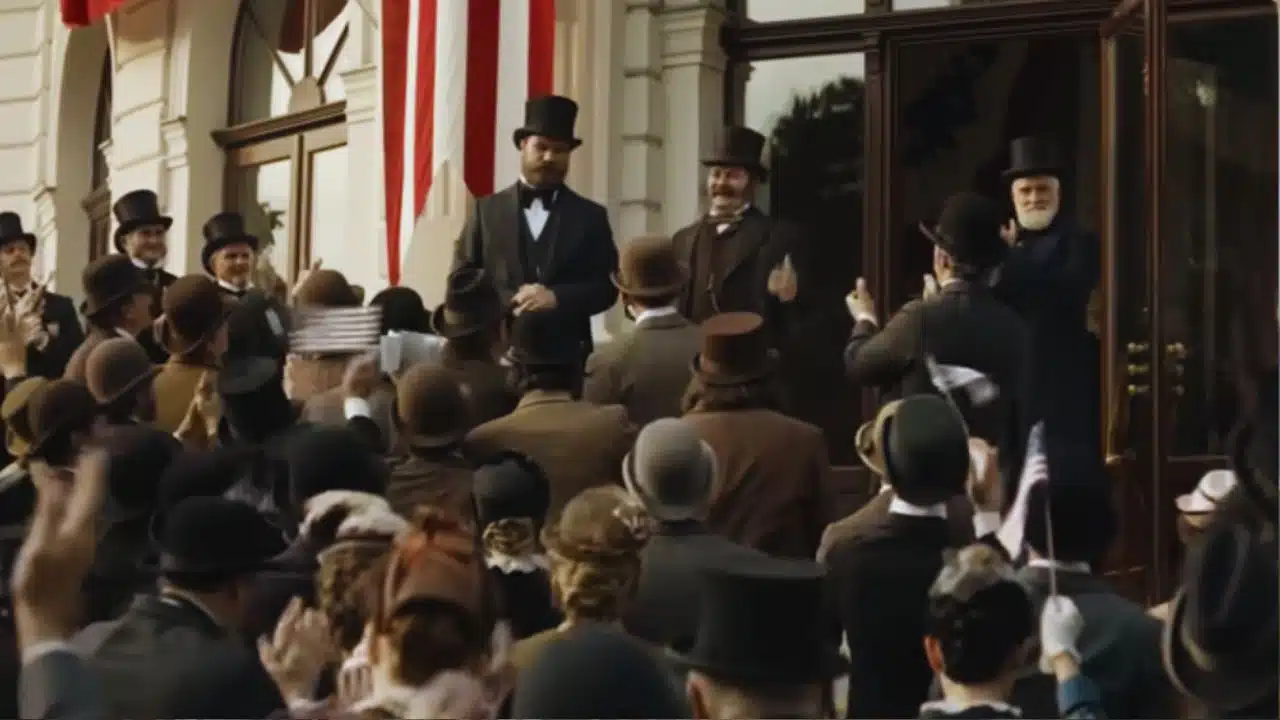
Netflix’s new limited series Death by Lightning isn’t your typical political drama — it’s a four-episode dive into the chaotic, tragic, and nearly unbelievable history behind the assassination of President James A. Garfield in 1881. Starring Michael Shannon as the humble yet visionary Garfield and Matthew Macfadyen as the erratic assassin Charles J. Guiteau, the show captures a chapter of American history that’s often forgotten. And yet, it’s a chapter full of corruption, madness, tragedy, and a stunning failure of medical science.
The show’s creator, Mike Makowsky, made one thing clear: very little needed to be fabricated. “These situations are insane and so unfathomable by today’s standards,” he said. From the political rot of the patronage system to Guiteau’s delusional campaign for a government job to the president’s agonizing, preventable death, the story writes itself — and it’s almost entirely true.
Makowsky based the series on Destiny of the Republic, a meticulously researched 2011 book by historian Candice Millard. Both the book and the show unearth a political moment that feels absurd by today’s standards, but was all too real. Even though Death by Lightning makes room for dramatization, most of what viewers will see is grounded in real events, real people, and a very real tragedy.
James A. Garfield: The Tragic President America Forgot
In the show, Garfield is portrayed as thoughtful and morally grounded — a man who viewed politics as public service rather than personal power. While the series doesn’t dive too deeply into his flaws, Garfield was not without them. In real life, historians have noted that he had a close — possibly romantic — relationship with Kate Sprague, the wife of another politician, Roscoe Conkling, Garfield’s staunch rival. Though the show hints at past marital strains with Lucretia Garfield (played by Betty Gilpin), it omits this subplot for narrative clarity. Makowsky explained this choice, saying, “It was so far in his past that we didn’t want to bog the story down with flashbacks.”
Still, Garfield’s own words — “You of all people know that I’m the furthest thing from a great man” — reflect an internal conflict. He recognized his own imperfections, yet rose to the presidency in a time of deep political fracture. What makes his story more haunting is how vulnerable he was. In the 1880s, there was no Secret Service assigned to protect the president. In fact, the idea of presidential security was still so foreign that Garfield himself once said, “Assassination could be no more guarded against than death by lightning.”
That eerie quote became the title of the series — and it wasn’t just poetic. Garfield truly believed that he didn’t need a protective detail, even though Abraham Lincoln had been assassinated only 16 years earlier. His belief in the dignity of the office and in the public’s better nature left him tragically exposed. Garfield welcomed citizens to meet him directly — his White House had open “office hours” — and it was during one of these open moments that Charles Guiteau began his long obsession with the president.
Charles J. Guiteau: The Delusional Assassin No One Took Seriously
Charles Guiteau wasn’t just any would-be assassin. He was a failed preacher, a con man, and an emotionally unstable man who believed God had chosen him to change the course of American politics. When Garfield won the presidency, Guiteau convinced himself that he was the reason. Despite doing little more than handing out a few speeches on Garfield’s behalf, Guiteau believed he deserved a top diplomatic post — specifically, to be the U.S. Ambassador to France.
When he didn’t get the job, his behavior grew more erratic. He repeatedly approached White House staffers, hung around Republican campaign offices, and even tried to meet Vice President Chester A. Arthur. The series invents a scene in which Guiteau and Arthur go on a drunken escapade to a women’s boxing match — a purely fictional touch. “When you’ve got Matthew Macfadyen and Nick Offerman, how do you not write that scene?” Makowsky admitted with a laugh.
But while that moment is fictional, Guiteau’s obsession with power — and his belief that killing Garfield would elevate Arthur to hero status — was terrifyingly real. He saw the assassination as a righteous act that would restore the nation’s political order. And because presidents at the time moved freely among the public, he had no difficulty approaching Garfield in a train station on July 2, 1881, and shooting him at close range.
Guiteau was arrested soon after and later tried for murder. His courtroom performance was bizarre — ranting about divine intervention, writing poems, and even attempting to claim credit for Garfield’s eventual death as part of “God’s plan.” While there’s no official psychiatric consensus, modern historians generally agree he was likely mentally ill. After his conviction, Guiteau was executed by hanging in 1882. His body was dissected by doctors, and his brain was removed and preserved as a specimen — yes, that actually happened. Makowsky even visited the preserved brain during research, noting that it’s kept at a military medical facility in Maryland and is rarely shown to the public.
A Fatal Infection, Not a Fatal Bullet: How Garfield Actually Died
One of the most disturbing truths of Death by Lightning is that Garfield likely would have survived — if not for his doctors. The bullet didn’t hit any vital organs, and Garfield lived for 80 days after being shot. But this was before germ theory was accepted in mainstream medicine. His doctors repeatedly probed his wound with unwashed fingers and unsanitized tools, even using a rudimentary metal detector (which failed due to a mattress’s metal springs) in a failed attempt to locate the bullet.
The resulting infection — what we now know as sepsis — spread throughout his body. Garfield was in excruciating pain and lost over 80 pounds during his convalescence. He eventually died not from the bullet, but from the medical response to it. The series shows this in harrowing detail, emphasizing the limited knowledge of the time. Although we can’t say with 100% certainty whether it was a specific doctor’s hands or a contaminated instrument, it’s widely accepted that Garfield’s death was caused more by misguided treatment than by the assassin’s bullet.
This grim reality adds to the emotional weight of the series. Garfield didn’t die instantly. He suffered for months, in plain sight of a nation unsure of how to help. His wife Lucretia stood by him the entire time. And when he finally passed away, the country not only lost a promising leader, but also began to grapple with its outdated medical and political systems. His death helped spark the eventual passage of the Pendleton Civil Service Reform Act, which aimed to dismantle the spoils system that had corrupted government appointments.
Death by Lightning Is Stranger Than Fiction — Because It’s True
At its core, Death by Lightning is not just a story about a president’s assassination. It’s a story about a turning point in American democracy. It highlights the absurdity of a system where mentally unstable individuals could approach the president without barrier. It exposes the failures of a medical establishment that resisted science. And it asks a simple question: what happens when a nation refuses to modernize until tragedy forces its hand?
Mike Makowsky and his team have crafted a story that feels both absurd and authentic — because much of it is. With stellar performances and a focus on historical fidelity, the show succeeds in its goal of getting people curious about forgotten chapters of history. It’s a reminder that sometimes the strangest, most dramatic, and most heartbreaking stories don’t come from fiction at all — they come from real life.
So when viewers watch assassins lurking in public, vice presidents dragged into drunken misadventures, or doctors digging into wounds without gloves — they’re not just seeing drama. They’re seeing echoes of a very real and very chaotic moment in America’s past. Death by Lightning doesn’t need to exaggerate the truth. The truth is shocking enough.
The Information is Collected from USA Today and AOL.