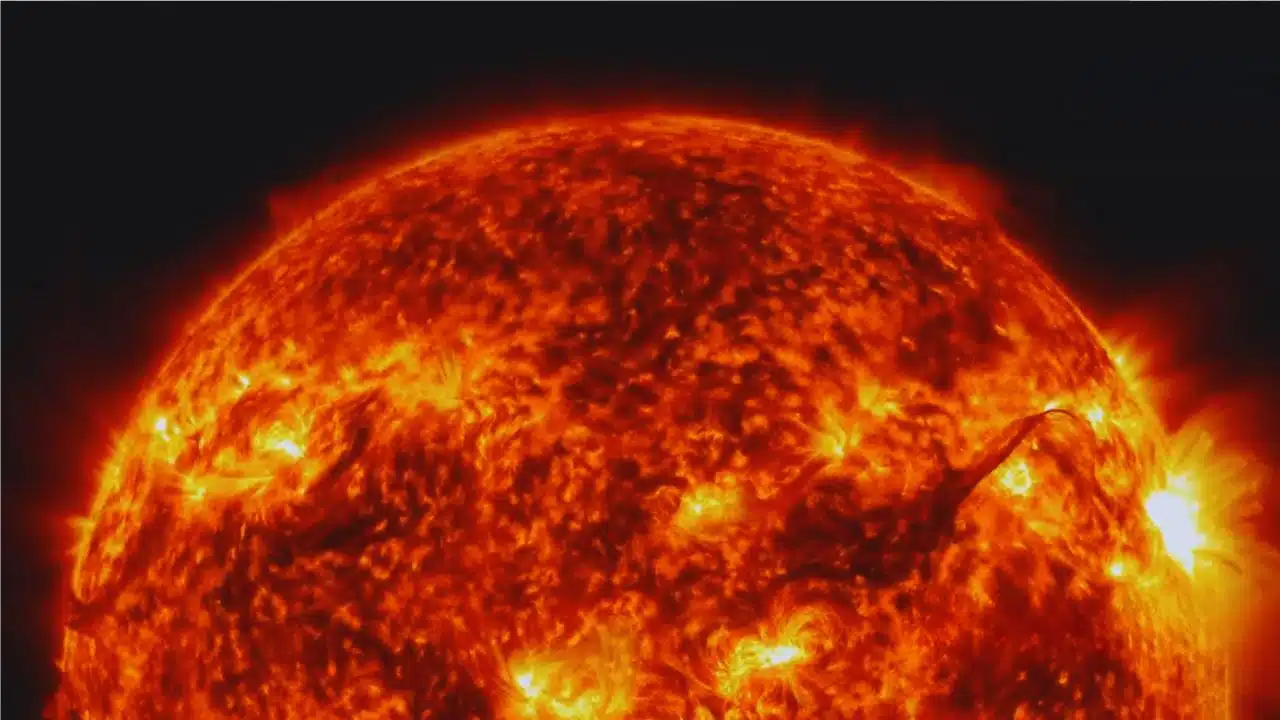
For the first time in human history, scientists have captured a clear and direct view of the Sun’s polar regions—areas that had remained a mystery for centuries. This milestone has been achieved through the European Space Agency’s Solar Orbiter mission, developed in collaboration with NASA. The spacecraft’s unique, tilted orbit allowed it to peer above the solar equator and observe the Sun’s poles head-on, something no previous mission had managed.
Until now, every solar mission—from SOHO to the Parker Solar Probe—had orbited roughly within the same plane as the planets, known as the ecliptic. This alignment limited our perspective to the Sun’s equatorial regions, leaving its poles shrouded in mystery. Yet, those poles are vital to understanding the Sun’s complex magnetic behavior. The magnetic field of the Sun governs everything from sunspots and flares to the powerful solar winds that can affect satellites and power grids on Earth.
With Solar Orbiter’s new vantage point, researchers have not only captured the first-ever images of the polar regions but also mapped the behavior of the Sun’s magnetic field in these elusive areas. What they found was far more dynamic than anyone had expected. The discovery is reshaping what scientists know about the solar magnetic cycle—an 11-year rhythm of activity that dictates how the Sun’s energy radiates through the solar system.
For the first time, astronomers have been able to measure how plasma and magnetic structures behave near the poles. These regions are now seen as the “engines” that power the Sun’s global magnetic circulation, driving the rise and fall of solar activity. In this new window into the Sun, researchers found that magnetic and plasma motions near the poles are not slow or stagnant, as once thought—they are astonishingly active.
How Solar Orbiter Changed the View of the Sun
The Solar Orbiter’s orbit was gradually adjusted over the past few years until it reached a tilted position relative to the plane of the Solar System. This change was crucial because it provided a line of sight toward the Sun’s poles. From this vantage point, the spacecraft’s advanced instruments could finally study how plasma, light, and magnetic fields interact in those regions.
Among the most significant tools on board were the Extreme Ultraviolet Imager (EUI) and the Polarimetric and Helioseismic Imager (PHI). Together, they allowed scientists to visualize structures called supergranules—massive cells of boiling plasma on the solar surface that are two to three times larger than Earth itself. Each of these supergranules acts like a conveyor belt, carrying plasma and magnetic fields across the surface. When they cluster and flow, they create a web of magnetic connections known as the Sun’s magnetic network.
By carefully tracking these supergranules at the poles, scientists were able to calculate how fast magnetic fields and plasma are moving in that region. Before these observations, researchers assumed that the plasma drifted toward the poles much more slowly than it did near the equator. However, the new data shattered that belief. The Solar Orbiter revealed that the plasma was moving northward and southward at speeds of 10 to 20 meters per second—almost as fast as at lower solar latitudes.
This rapid movement of plasma across the polar surface was unexpected. It means that the magnetic “conveyor belt” of the Sun—responsible for carrying magnetic flux from the equator to the poles—might be far more efficient and faster than previous models suggested. That discovery has enormous implications for understanding how the Sun’s magnetic field regenerates and flips every 11 years.
The findings also confirmed that the polar supergranules act as natural tracers, helping scientists visualize how the solar magnetic field circulates globally. As Lakshmi Pradeep Chitta, a research group leader at the Max Planck Institute for Solar System Research and the study’s lead author, noted, these giant plasma cells make the polar component of the Sun’s magnetic circulation visible for the first time. What was once theoretical is now directly observed—an extraordinary leap in solar physics.
The revelation is crucial because the Sun’s magnetic field does not simply rotate in place—it breathes and evolves. Magnetic energy generated deep inside the Sun moves outward, shaping everything from solar flares to coronal mass ejections. These events can affect communications, GPS, satellites, and even power systems on Earth. Understanding the polar magnetic field, therefore, means improving our ability to forecast space weather and protect our technological infrastructure.
What the Discovery Means for the Future
The implications of this breakthrough go beyond the scientific excitement of seeing the Sun’s poles for the first time. The discovery offers an entirely new understanding of how the Sun’s magnetic field evolves and interacts with its surface plasma. For decades, solar scientists have tried to model how the Sun’s internal flows connect its equatorial and polar regions, but without direct data from the poles, every model contained large uncertainties.
Now, with Solar Orbiter’s data, researchers can begin refining those models with real observations. The discovery that the magnetic flow at the poles is faster than expected challenges long-standing theories about how the Sun’s magnetic field reverses every 11 years. This reversal, known as the solar cycle, is what drives periods of high and low solar activity—times when sunspots, flares, and solar storms are either frequent or scarce. The new findings may indicate that the processes behind the cycle are more synchronized and dynamic than previously believed.
If the polar circulation truly moves faster, the solar cycle itself might progress differently—possibly affecting the timing and intensity of solar maxima, the peaks of magnetic activity when the Sun’s energy output and radiation storms are at their highest. Such insights will help scientists make more accurate predictions about when the next solar maximum will occur and how strong it will be.
The discovery also has a direct impact on space weather forecasting. The poles influence how the Sun’s magnetic field opens up into interplanetary space, shaping the solar wind that constantly streams toward Earth. By understanding how plasma moves at the poles, scientists can better predict fluctuations in that solar wind—information that is crucial for space agencies, power companies, and satellite operators.
As Solar Orbiter continues its mission, its orbit will gradually tilt even further out of the ecliptic plane, giving even clearer and more comprehensive views of both poles. In the coming years, this will allow scientists to monitor how the Sun’s magnetic field changes over time, capturing the moment when the poles flip polarity—an event that occurs roughly every 11 years.
While the current findings have answered many long-standing questions, they have also opened new ones. How exactly does the Sun’s deep interior feed energy into these polar flows? What mechanisms control the speed of plasma movement across different latitudes? And how do these processes influence the buildup of solar storms that affect Earth?
The new results mark only the beginning of a long and fascinating era of discovery. For centuries, the poles of the Sun were invisible, leaving a crucial gap in our understanding of how our star functions. Now, with this first-ever direct view, humanity is finally seeing the missing piece of the solar puzzle. The Sun’s poles are no longer silent or unknown—they are alive, dynamic, and more complex than we ever imagined.
This breakthrough not only redefines our understanding of the Sun but also strengthens our ability to anticipate and adapt to the cosmic forces that shape life on Earth. As the Solar Orbiter continues its journey, each new observation promises to bring us closer to unlocking the full secrets of the star that sustains us all.
The Information is collected from MoneyControl and MSN.