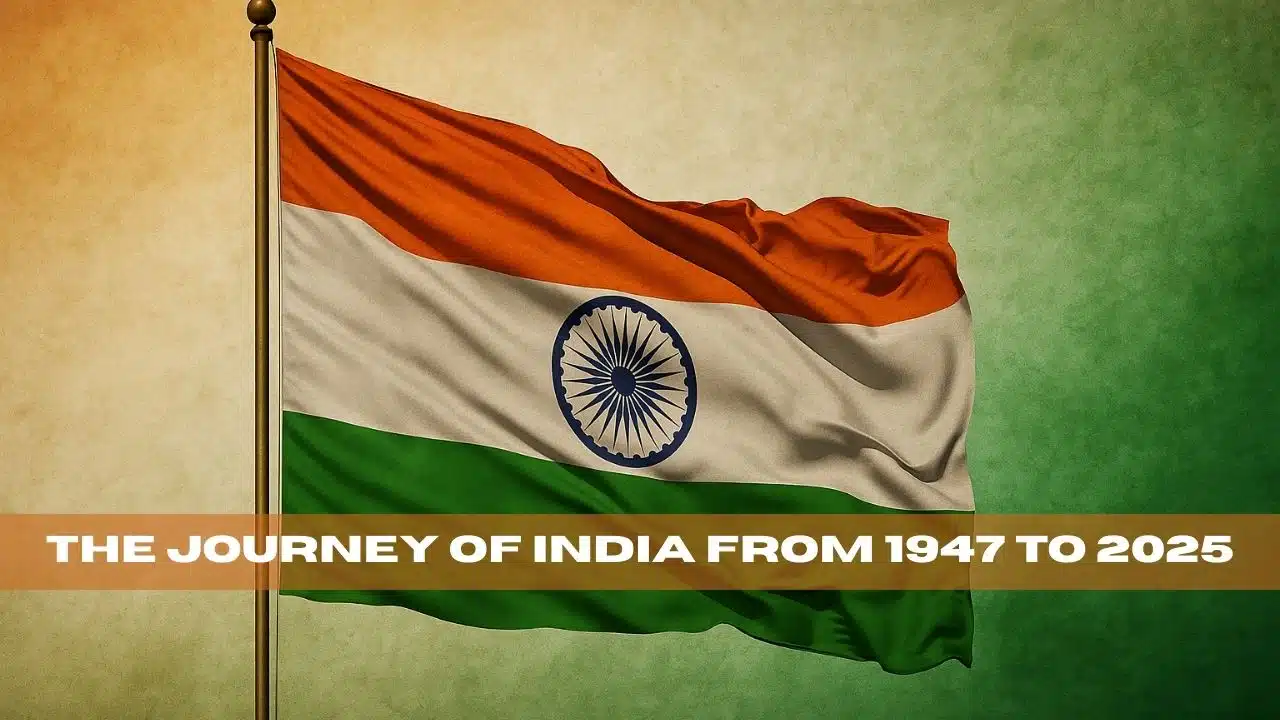
On 15 August 1947, the tricolor flag rose over a free India for the first time, marking the end of nearly two centuries of British colonial rule. The moment was emotional, hard-earned, and filled with hope. But independence was just the beginning of a new journey—one that would demand resilience, unity, and vision.
From the struggles of partition to becoming a global economic power, India’s 79-year journey tells the story of a nation that refused to give up despite challenges. This is the story of how India transformed from a newly independent state to one of the world’s most influential democracies.
The Dawn of Independence: 1947
When India finally broke free from British rule, joy was mixed with deep sorrow. The Partition of India led to the creation of Pakistan and the displacement of millions. Communal violence left scars that still echo in history. Yet, amid the turmoil, Jawaharlal Nehru’s “Tryst with Destiny” speech set a tone of hope and responsibility for the new nation.
Building the Foundations of a New Nation
In the early years, India focused on creating strong democratic foundations. The Constitution of India, adopted on 26 January 1950, became the guiding document for the Republic. Parliamentary democracy, an independent judiciary, and universal adult suffrage ensured that every citizen had a voice.
Early Years: Challenges and Nation-Building (1947–1965)
One of the first big tasks was uniting more than 500 princely states. Sardar Vallabhbhai Patel, India’s first Deputy Prime Minister, played a crucial role in persuading and integrating these states into the Indian Union—laying the groundwork for national unity.
Economic and Social Policies
India’s early leaders prioritized Five-Year Plans to strengthen agriculture, industry, and infrastructure. Focus was also placed on education and public health, though resources were limited. The Green Revolution was still years away, but seeds of agricultural reform were being sown.
Tests of Resilience: Wars and Emergencies (1965–1980s)
India faced its first major external challenges with the Indo-China War of 1962 and the Indo-Pak War of 1965. The victory in the 1971 Bangladesh Liberation War against Pakistan, which led to the creation of Bangladesh, was a defining moment for India’s military and diplomatic standing.
Internal Political Turmoil
The mid-1970s brought a political crisis with the Emergency (1975–77), a period of suspended civil liberties and press censorship. This chapter tested the strength of Indian democracy, but the return to free elections reaffirmed the people’s faith in their system.
Liberalization and Globalization (1990s)
By the early 1990s, India faced an economic crisis. Under Prime Minister P.V. Narasimha Rao and Finance Minister Dr. Manmohan Singh, the government introduced sweeping liberalization policies. Barriers to trade were reduced, foreign investment was encouraged, and the private sector flourished.
India on the Global Stage
In 1998, India conducted nuclear tests at Pokhran, declaring itself a nuclear power. This boosted its strategic position, even as it worked to strengthen diplomatic ties worldwide.
The New Millennium: Growth and Transformation (2000–2014)
India became known as the IT capital of the world, with cities like Bengaluru and Hyderabad driving the global outsourcing boom. Mobile phones and internet access began transforming everyday life.
Social Development and Challenges
Education initiatives like Sarva Shiksha Abhiyan expanded school access, while rural development programs targeted poverty reduction. Yet, income inequality, corruption, and social unrest continued to pose challenges.
India in the 21st Century: 2014 to 2025
Recent years have seen ambitious projects such as Digital India, Startup India, and Smart Cities Mission. The expansion of expressways, metro systems, and high-speed rail networks has improved connectivity and boosted the economy.
Global Influence
India has hosted major events like the G20 Summit, increased its presence in global climate talks, and strengthened defense partnerships. It is now considered a key player in shaping world policies.
Social and Political Landscape
Women’s empowerment programs, youth-led startups, and increased voter participation have energized democracy. At the same time, debates over free speech, diversity, and political polarization continue to shape the nation’s discourse.
India’s Key Achievements Over 79 Years
-
Democracy’s survival in a nation of 1.4 billion people.
-
Economic growth from agriculture-based to a diversified economy.
-
Advancements in space research (ISRO’s Mars Orbiter Mission and Chandrayaan missions).
-
Global cultural influence through cinema, literature, and sports.
-
Military modernization and disaster relief capabilities.
India’s Challenges Ahead
Despite its successes, India still faces hurdles:
-
Poverty and unemployment, especially in rural areas.
-
Climate change impacts, including floods and droughts.
-
Urban overcrowding and infrastructure strain.
-
Maintaining unity in a culturally and linguistically diverse nation.
Vision 2047: India at 100
As India looks toward its centenary of independence, the goals are clear:
-
Becoming a fully developed nation with high living standards.
-
Leading in green technology and sustainable development.
-
Ensuring quality education and healthcare for all.
-
Strengthening democratic values and inclusivity.
Takeaways
From the joy of independence in 1947 to the challenges and triumphs of 2025, India’s 79-year journey is a story of determination, resilience, and hope.
The road ahead may be filled with challenges, but the spirit that won freedom continues to guide the nation toward its future. As India marches toward 2047, its centenary, the dream remains the same: a prosperous, united, and just India for generations to come.