The United Kingdom is undergoing a striking transformation in its climate, with rising temperatures, altered rainfall patterns, and an increase in extreme weather events. According to the latest State of the UK Climate report released by the Met Office, the country’s climate has changed significantly in just a few decades, largely due to human activities driving global warming.
The report presents compelling evidence that the UK’s climate today is distinctly different from the past. The frequency of extremely hot days has grown, while cold nights—once typical of British winters—have become increasingly rare. These shifts are not isolated anomalies but part of a broader trend, tied directly to the rising concentration of greenhouse gases in the atmosphere.
2024 Sets Multiple Climate Records
The year 2024 stood out as one of the most climate-volatile years in the UK’s meteorological record. February was the second warmest since national records began in 1884. May and the entire spring season both became the warmest on record. December and winter overall ranked as the fifth warmest.
Notably, 2024 was also the fourth warmest year in the UK’s long-term temperature records. These record-setting conditions are not just statistical footnotes—they are further proof that the UK is warming steadily. Data from 2025 suggests the trend has continued, with even more extreme weather conditions emerging early in the year.
A series of prolonged heatwaves hit various parts of the UK in summer 2025, including traditionally cooler regions like Wales, Northern Ireland, and Scotland. Southern England saw particularly high temperatures. These heatwaves aren’t just more frequent—they’re more intense, longer-lasting, and widespread.
Water Restrictions and Drought Are Spreading
June 2025 became England’s warmest June on record, triggering water supply concerns across several regions. Yorkshire was the first to enforce a hosepipe ban after enduring extremely dry conditions.
Earlier in the year, England experienced its driest and sunniest spring in over 130 years. By June, both Yorkshire and the northwest of England had been officially declared to be in drought by the Environment Agency. Additional regions are expected to be added to the drought list in the coming weeks when the National Drought Group holds its next meeting.
These water shortages highlight the increasingly fragile nature of the UK’s water infrastructure and resources under a warming climate.
Long-Term Warming Trends Confirmed by Decades of Data
The UK’s warming trend is not based on short-term anomalies. According to long-term climate records, the country is warming at an average rate of approximately 0.25°C per decade. Between 2015 and 2024, the average temperature in the UK was 1.24°C higher than it was between 1961 and 1990.
Supporting this finding is the Central England Temperature (CET) dataset—the world’s longest-running continuous temperature record. It dates back to 1659 and is maintained by the Met Office. The CET shows that the last three decades have experienced unprecedented warming, surpassing anything recorded in over 300 years of temperature observations.
This data proves that the warming is neither subtle nor temporary—it is rapid and persistent.
Decline in Cold Weather: Fewer Frosts, Warmer Winters
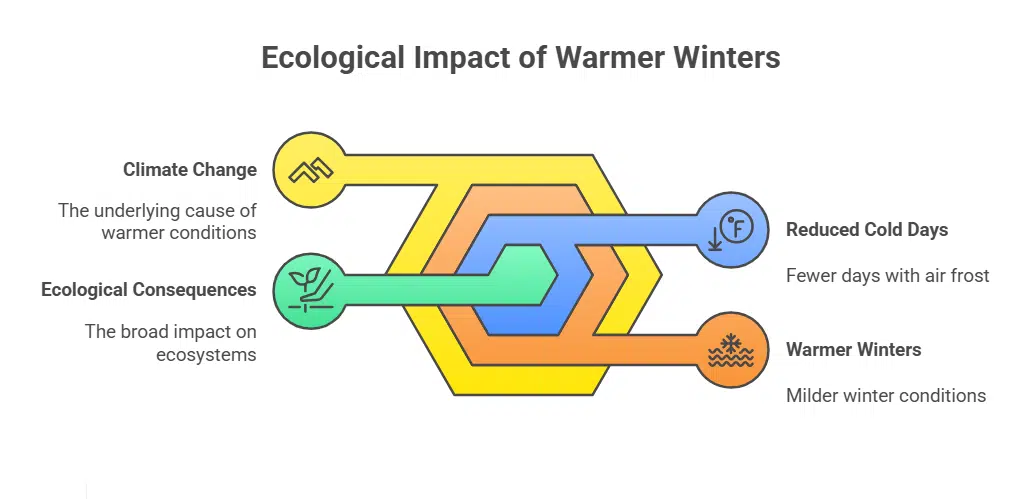
The shift toward warmer conditions has reduced the number of cold days in the UK. The last decade recorded 14 fewer days with air frost compared to the long-term average between 1931 and 1990.
This means winters are becoming significantly milder. Air frost, which once signaled the arrival of winter, is now far less common. While this might sound appealing to some, the ecological consequences are considerable. Many plant and animal species rely on cold winter conditions to regulate life cycles, hibernation, and reproduction.
Rainfall Increasing, Especially in Winter
Although temperature records often make headlines, changes in rainfall are just as important—and just as alarming. The Met Office reports that rainfall from October to March between 2015 and 2024 was 16% higher than in the period 1961–1990.
This rise in precipitation, especially during the winter months, increases the risk of flooding, landslides, and waterlogged soil. The UK’s maritime location between the Atlantic Ocean and continental Europe contributes to its weather variability, but climate change is amplifying this variability in dangerous ways.
2023–2024 Winter: Wettest in Over 250 Years
The combination of prolonged storms and heavy rainfall between October 2023 and March 2024 made this the wettest six-month winter period in over two and a half centuries.
Several storms, named and tracked by the Met Office, caused extensive damage. Some of the worst-hit areas included eastern Scotland, Derbyshire, Nottinghamshire, and the West Midlands. In these areas, rainfall exceeded three to four times the normal average for September.
Severe flooding disrupted daily life. In Stratford-upon-Avon, the Royal Shakespeare Company was forced to cancel performances due to floodwaters entering the theater. In Tenbury Wells, Worcestershire, a wall collapsed when a local brook overflowed and flooded the town center.
These events highlight how even culturally significant institutions and town centers are now vulnerable to recurring extreme weather events.
UK Sea Levels Rising Faster Than Global Average
For the first time, the Met Office report confirms that sea levels around the UK are rising faster than the global average. This increase compounds the already serious flood risk, particularly in low-lying coastal regions.
As seas continue to rise, storm surges become more destructive. Historical precedent shows that the UK is susceptible to such events. The catastrophic North Sea flood of 1953, which killed over 300 people in England and over 1,800 in the Netherlands, serves as a grim reminder.
Climate scientists at the National Oceanography Centre warn that another severe storm surge is a matter of “when,” not “if.”
Nature Under Pressure: Climate Disrupts Ecosystems
The natural world in the UK is struggling to keep pace with the rapidly changing climate. The Nature’s Calendar project, which tracks seasonal changes in flora and fauna, reports that spring in 2024 arrived earlier than usual for most species observed.
Twelve out of 13 recorded spring events, including the first sightings of frogspawn and the nesting of blackbirds, occurred ahead of the long-term average. This trend disrupts delicate ecological balances.
Animals like dormice and hedgehogs are at particular risk. These mammals depend on seasonal cues for feeding and hibernation. When fruit and nuts ripen early during hot summers, fewer are available in autumn—precisely when these animals need to build fat reserves for winter survival.
UK Forests Under Climate Stress
Woodlands are also experiencing the effects of climate stress. At the Alice Holt Forest Research Centre, scientists are studying how native and non-native trees respond to the UK’s changing climate.
Many native tree species are not coping well. Signs of stress include smaller leaves, reduced growth, thinning canopies, and in some extreme cases, tree death after drought events.
However, not all species are failing. Coastal redwoods from California, the tallest trees on Earth, have shown promise. These trees have been trialed in the UK for over 60 years and appear to tolerate the hotter, wetter conditions more successfully than many native species.
This research suggests that new tree species may need to be introduced to maintain the health and biodiversity of UK forests.
Urgent Need for Adaptation
The cumulative data shows that climate change is already reshaping the UK’s weather, ecosystems, and infrastructure. The Met Office stresses the urgent need for national adaptation strategies.
Investments in flood defenses, sustainable water management, and heat-resilient urban planning are no longer optional—they are essential. The UK must also prepare its agriculture, public health systems, and natural conservation programs to meet the demands of a hotter, wetter, and more extreme future.
By planning ahead and acting decisively, the UK can reduce the worst impacts of climate change and protect both its people and natural heritage.