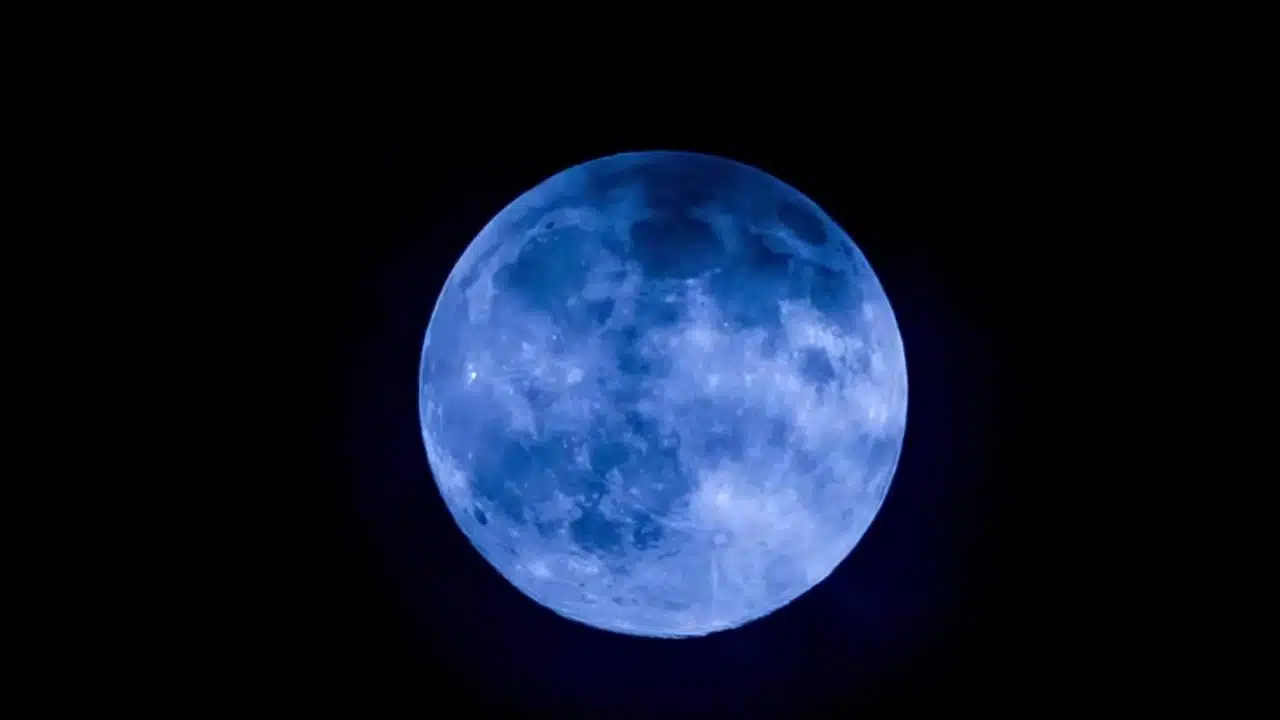
The month of August kicked off with a brilliant supermoon illuminating the night sky, and it’s set to conclude in a similar fashion with another stunning supermoon gracing our view in the coming week.
Adding to the celestial spectacle, the ringed jewel of our solar system, Saturn, will make its closest and most luminous appearance of the entire year, positioned near the moon.
The full moon will reach its peak at 9:36 p.m. ET on the evening of August 30th, but its full appearance will continue through the morning of Friday, as indicated by NASA.
As the sun sets on Wednesday, around 8:42 p.m. ET, the radiant gleam of Saturn will emerge roughly 5 degrees to the upper right of the moon. As the night progresses, Saturn will seemingly trace a clockwise path around the moon, as described by NASA. At their closest proximity, the two will appear separated by a distance roughly equivalent to four full moons, a perspective shared by EarthSky.
Saturn achieved opposition on August 27th, signifying the moment when Earth passed between the sun and the distant planet. This special occurrence places Saturn at its nearest point to Earth within its orbital journey, consequently granting us a clear and captivating view of it in our night sky.
Both of August’s full moons can be classified as supermoons, as per EarthSky. Supermoon is a term that can have slightly different definitions, but it generally refers to a full moon that comes closer to Earth in its orbit, making it appear larger and more luminous in the night sky. During this occurrence, the moon will be situated at a distance of 222,043 miles (357,344 kilometers) from Earth, which is around 18,000 miles (28,968 kilometers) closer than its average distance.
Some astronomers suggest that a supermoon happens when the moon is within 90% of its perigee, the closest point in its orbit to Earth.
This supermoon’s influence might have an impact on Hurricane Idalia, predicted to hit land on Wednesday morning, by causing stronger tides and potentially worsening the storm surge. The proximity of this supermoon to Earth will intensify its gravitational pull on the oceans.
According to Jamie Rhome, Deputy Director of the National Hurricane Center, it could elevate high tide by about a foot.
The second full moon within a single month is also known as a blue moon, which is where the saying “once in a blue moon” comes from, though the moon itself won’t actually appear blue.
Ordinarily, a full moon occurs approximately every 29 days, while most of our calendar months last either 30 or 31 days. This mismatch leads to a blue moon happening about every 2.5 years, with the most recent one taking place in August 2021.
Interestingly, the second full moon in August coincides with the Hindu festival of Raksha Bandhan, a celebration of the special bond between siblings, particularly brothers and sisters.
Supermoons and Full Moons
On September 29, 2023, the fourth and last supermoon of the year will rise.
The Farmers’ Almanac lists the full moons that will still happen in 2023:
- Harvest moon is on September 29
- Hunter’s moon is on October 28
- Beaver moon is on November 27
- Cold moon on December 26
Both Lunar and Solar Eclipses
People throughout North, Central, and South America are in for a treat as they’ll get to witness an annular solar eclipse. This celestial event occurs when the moon positions itself between the sun and Earth, reaching its farthest point from our planet. As a result, the moon will appear smaller than the sun, surrounded by a radiant halo.
To safely observe this phenomenon without harming their eyes, viewers are advised to wear specialized eclipse glasses.
On October 28, a partial lunar eclipse is also on the celestial agenda. During this event, only a section of the moon will drift into Earth’s shadow, as the alignment of the sun, Earth, and moon won’t be complete. This partial eclipse will be observable from Europe, Asia, Australia, parts of North America, and a substantial portion of South Africa.
Meteor Showers
The upcoming meteor showers for the rest of the year will be best seen during the late evening until dawn in places with minimal light pollution. These are the peak dates for the events.
- Orionids: 20 and 21 October
- November 4 and 5: Southern Taurids
- 11 and 12 November: Northern Taurids
- November 17 and 18: Leonids
- 13 and 14 December: Geminids
- Ursids: Dec. 21 and 22