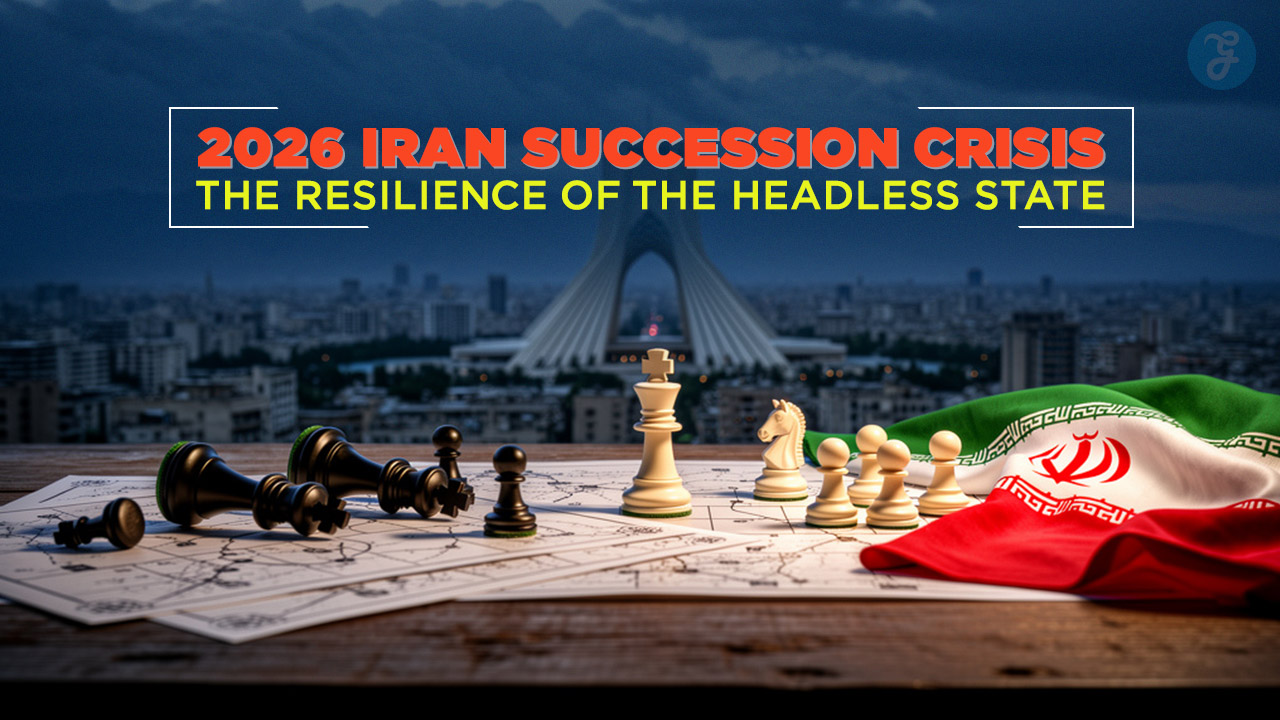
The ruins of the leadership compound in northern Tehran still smoulder. Yet the administrative gears of the country have not ceased their grinding. Planners in Washington and Tel Aviv envisioned a neat transition toward regime change. They underestimated the resilience of a system built for existential pressure. The current 2026 Iran Succession Crisis is less a vacuum of power and more a redistribution of it. Tehran moved with clinical speed. It prioritised institutional continuity over the survival of any single individual. This ensures the clerical and military apparatus remains upright even as its head is severed.
This brings us to a strange paradox. A decapitated leadership in most modern states signals a definitive defeat. For Iran it acted as a tripwire for a sophisticated and decentralised defence mechanism. This is not a state of retreat. It is a state of metamorphosis. By activating a “Mosaic Defence” protocol the regime ensures that provincial commanders and local councils maintain the capacity to govern. They can strike back without central oversight. The survival of the system is now the ultimate metric of success. It renders traditional Western definitions of military victory obsolete.
The Decapitation Strike and the Vacuum
The precision of the strikes on 28 February was meant to be a finality. According to reports from the IISS and News on Air the losses are staggering. Defence Minister General Aziz Nasirzadeh and General Abdol Rahim Mousavi perished alongside the Supreme Leader, Ayatollah Ali Khamenei. The command structure of the IRGC was severely hit in a single night. In any other nation this would lead to the total dissolution of the state. In Tehran it led to a quiet and grim transition. The appointment of General Ahmad Vahidi as the new Commander-in-Chief signals that while the head was severed the body remains functional. The streets stayed empty but the bureaus stayed open.
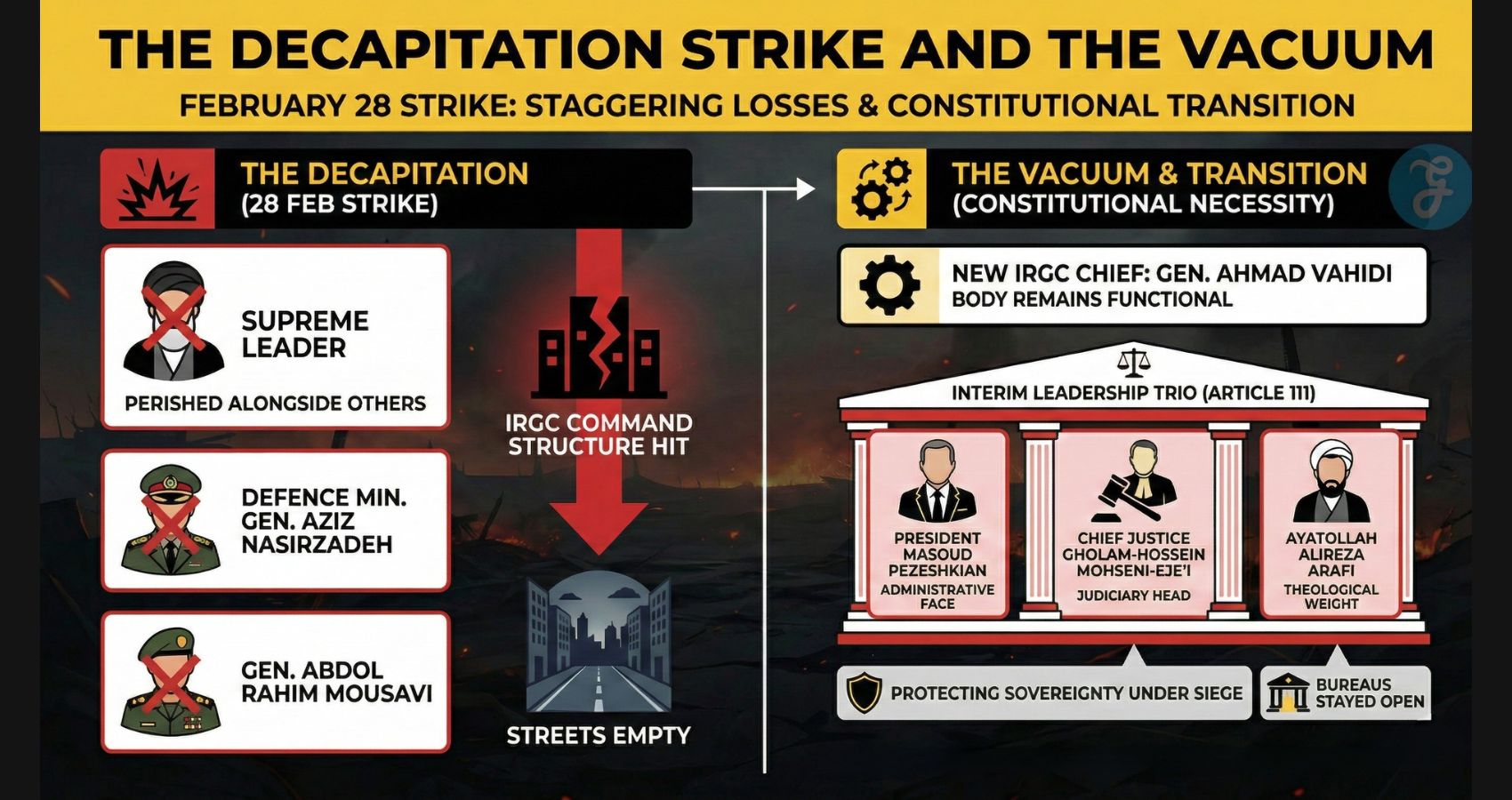 A leadership trio emerged within hours to steady the ship. President Masoud Pezeshkian now stands alongside Gholam-Hossein Mohseni-Eje’i, the Head of the Judiciary, and Ayatollah Alireza Arafi. This interim council is not a sign of weakness. It is a constitutional necessity. Under Article 111 this council preserves the dignity of the nation while the fires still burn. Arafi brings a theological weight that reassures the faithful. Pezeshkian provides the administrative face for a public in shock. They are not just holding power. They are protecting the sovereignty of a country under siege.
Stability over Succession: The Constitutional Fail-Safe
Many observers wondered how such a transition happened with such speed. Analysis from Georgetown University suggests the Assembly of Experts, the 88-member body of clerics responsible for selecting the head of state, was never caught off guard. They likely maintained a shadow successor list for years. This was a fail-safe against the exact type of aggression witnessed this week. The state did not have to scramble for a plan because the plan was already etched into the constitutional fabric. They chose stability over the chaos of a public succession battle.
This resilience is deeply human. It reflects a collective refusal to let the country fall into a power vacuum. While foreign missiles targeted the buildings the internal logic of the state held firm. The 2026 Iran Succession Crisis has revealed a regime that values its institutional life over any individual figure. For the ordinary Iranian this rapid transition provides a small measure of predictability in a world that has suddenly turned violent. The head may be gone but the heart of the administration continues to beat.
Military Doctrine: The “Mosaic Defence”
The missiles did not stop the machine. Despite the silence from the central command offices the Iranian military response remains potent. This is the “Mosaic Defence” in action, a doctrine that the Scandinavian Journal of Military Studies identifies as the ultimate evolution of Iran’s long-standing “Passive Defence” (Padafand-e Gheyr-e Amel). Established in IRGC manuals decades ago, this strategy is built for a world where the capital is lost. It treats the nation not as a single body, but as a resilient collection of independent, self-sustaining cells. Each part can survive and strike even when the centre is dark.
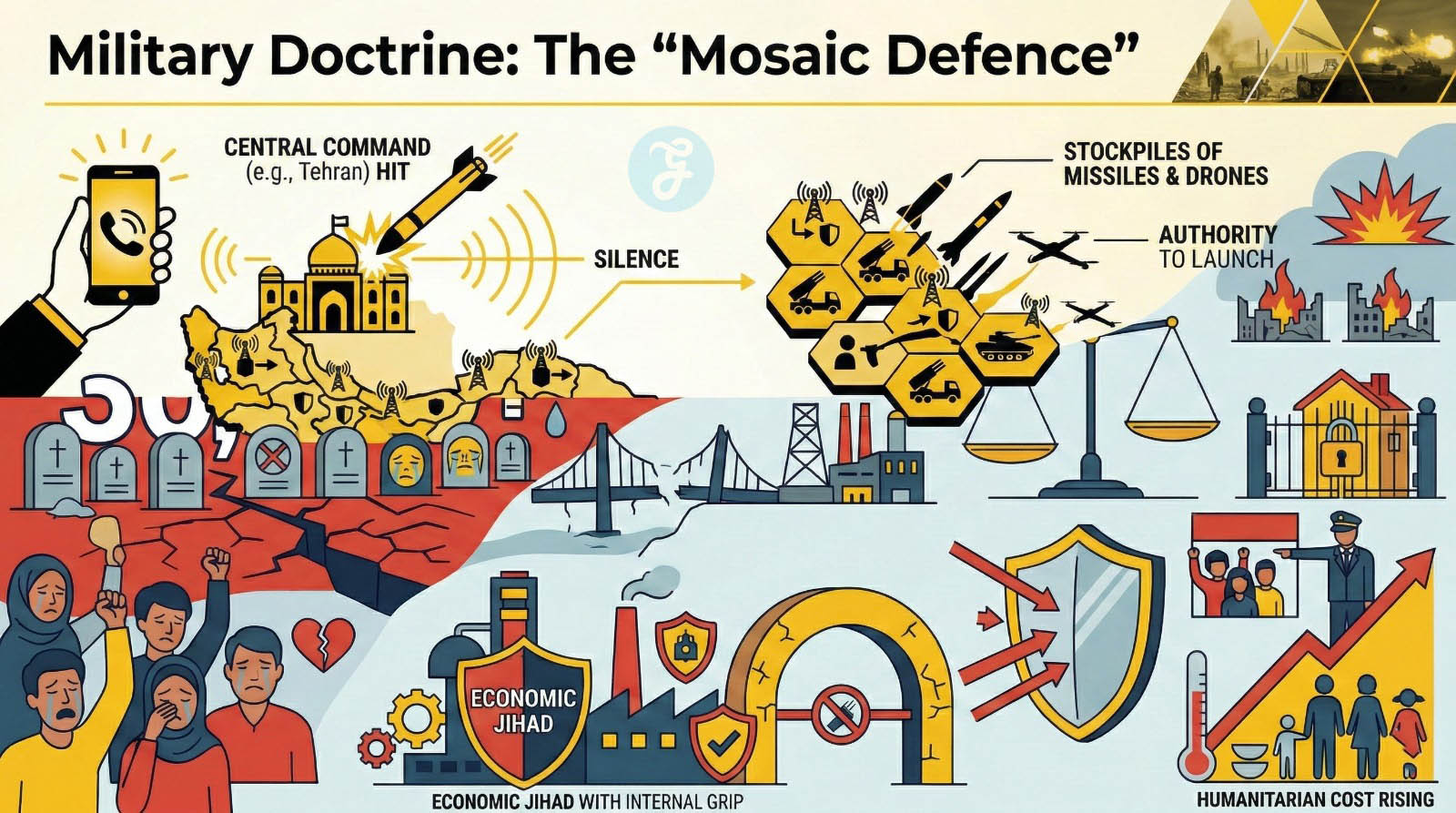 Iran has divided its territory into 31 distinct provinces. Each one possesses its own autonomous command structures. Local units of the Revolutionary Guard do not need a phone call from Tehran to act. They have their own stockpiles of missiles and drones. They have their own authority to launch. This decentralisation means that a strike on the leadership does not paralyse the rank and file. It turns the entire country into a lethal and self-managed grid.
The scale of the aggression has been massive. Reports suggest that over 2,000 strikes have hit Iranian soil. Yet the strategy of “survival through attrition” remains the priority. Iran knows it cannot win a traditional air war against such firepower. It focuses instead on making any ground move a nightmare. They aim to raise the cost of intervention until it becomes unbearable for the West. Every local cell is ready to turn its province into a fortress of asymmetric denial.
The Ghost in the Machine: Digital Defiance
The struggle for the Iranian soul now plays out in the silent wires of the deep web. As physical command centres fell the digital resistance took over. Internet monitor Netblocks reported a near total blackout on 1 March 2026. Connectivity dropped to just one percent. Yet pro-Iran hacking groups stayed online. They launched a digital counter-offensive against Western and Gulf infrastructure. This is the ghost in the machine. It proves the regime prepared for a world where its leaders are dead but its code remains active.
These digital cells operate exactly like the physical Mosaic units. They do not wait for a central nod. Over 60 hacktivist groups are currently engaged in what they call a digital jihad. They have targeted energy grids in Saudi Arabia and financial hubs in London. This adds a layer of invisible risk to the 2026 Iran Succession Crisis. Even if the missiles stop the cyber war could last for years. It is a form of asymmetric sabotage. It ensures the West pays a price for every piece of digital or physical infrastructure disabled in Tehran.
The Domestic Cauldron: Protests vs Patriotism
Inside the country, the mood is thick with a different kind of tension. The 2026 Iran Succession Crisis unfolds against a backdrop of deep internal scars. The protests of 2025 and early 2026 were brutal. Classified documents leaked to Iran International and corroborated by multiple monitors suggest that over 30,000 people lost their lives in the streets during the mid-January crackdowns alone. This high-end estimate captures the sheer scale of the internal fracture. The grief of the public is real and heavy. The newly formed Interim Leadership Council must govern a population that is simultaneously mourning its children and fearing foreign invasion.
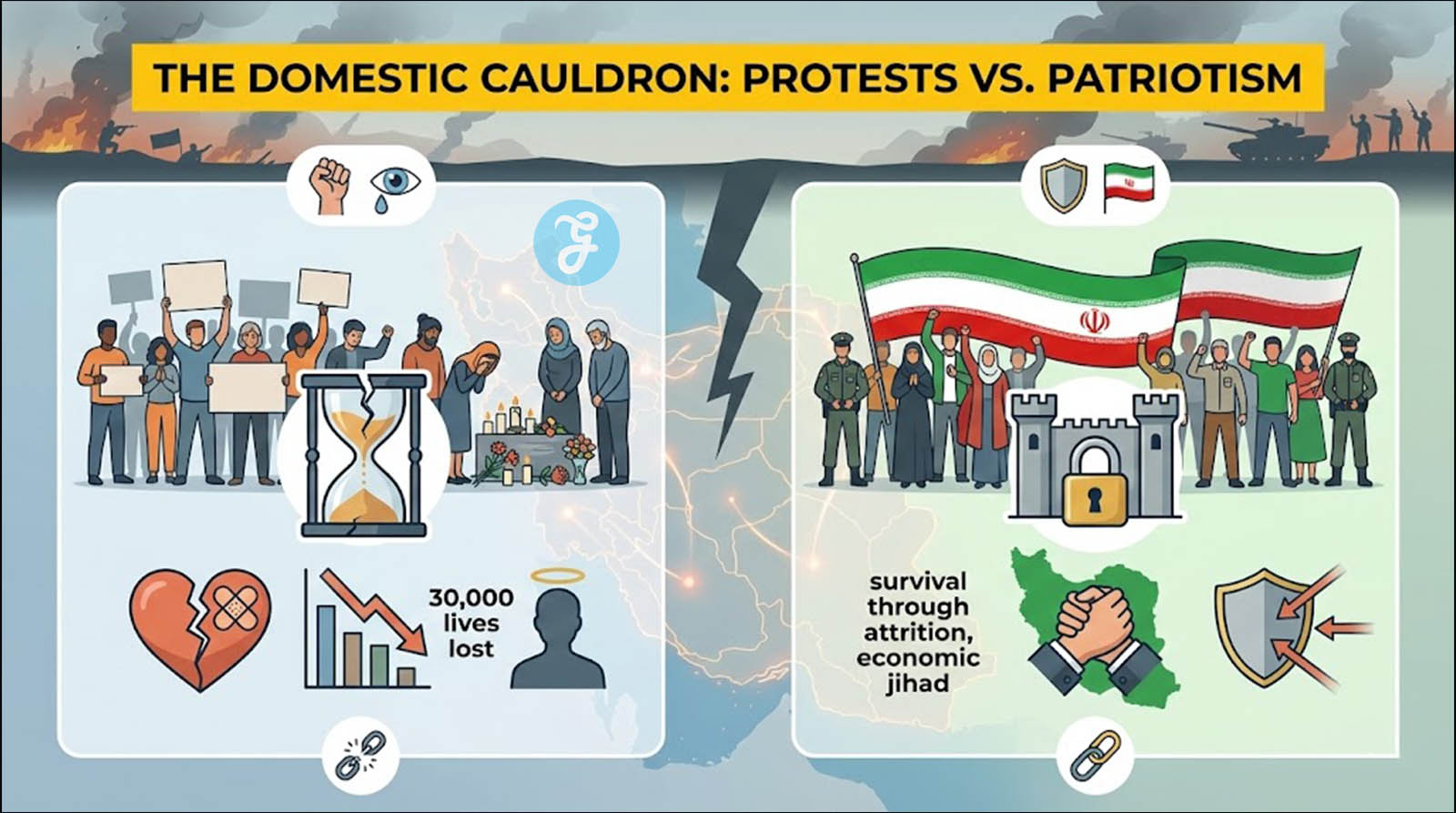 There is a strange and fragile atmosphere in the middle-class districts. Some may feel a quiet sense of relief at the end of the previous era, yet many more are gripped by a “security-first” mindset. They have seen what happens when nations in the region crumble into total chaos. The fear of becoming the next Syria or Libya often outweighs the immediate desire for political change. Many are choosing the familiar weight of the state over the terrifying unknown of a power vacuum.
Infrastructure is failing under the weight of the blockade and the recent air strikes. The regime has branded its response an “economic jihad,” using the external war to justify a tighter grip at home. Observers have noted how the “survival of the state” is being used as a shield against any internal dissent. It is a survival trap: the more the country is pressured from the outside, the easier it becomes for the state to frame every protest as an act of treason. The humanitarian cost continues to rise as the focus remains fixed on the preservation of the system.
Regional Fallout: The Fraying Axis
The fire in Tehran has not stayed within its borders. It has raced across the region and scorched the very foundations of the so-called Axis of Resistance. The most visible collapse is in Syria. House of Commons reports verified that the Assad administration collapsed in December 2025. The February strikes served as the final blow to the remnants of that alliance. This was more than a political end. It was a strategic severance. The land bridge that once carried Iranian weapons and influence into the Levant is now permanently broken. Hezbollah finds itself cut off from its primary supply lines.
A striking paradox has emerged in the rhetoric from Tehran. In an interview Foreign Minister Abbas Araghchi insisted that Iran “stands alone.” He claimed the nation needs no help in its self-defence. Yet even as he spoke Hezbollah and the Houthis were escalating their own survival wars. They are not fighting as puppets of a central command but as independent actors trying to preserve their own existence. The “unity of the arenas” has been replaced by a fragmented struggle for local relevance.
The retaliation against Western interests has been wide and violent. Verified strikes have hit US military installations across the Gulf. Bases in Qatar and Bahrain have come under fire from drone and missile barrages. Even the UAE has reported attacks on its capital markets and airports. This is the regional cost of the 2026 Iran Succession Crisis. The conflict is no longer a surgical strike on a leadership compound. It is a messy and multi-directional war that threatens every oasis of stability in the Middle East.
Geopolitics of the Strait: Survival as Global Sabotage
Tehran is now using the world’s economy as its primary shield. The regime has initiated an effective closure of the Strait of Hormuz. This is not a formal blockade but a credible threat of violence against any commercial transit. The impact was instant. As contextualized by the Columbia University Center on Global Energy Policy, oil prices have jumped $10 per barrel since the start of the year, punctuated by a sudden 10% overnight spike. Global markets are reeling.
The most dramatic shock came from Doha. QatarEnergy has suspended all liquefied natural gas (LNG) production following strikes on its industrial facilities at Ras Laffan. This decision has sent Dutch TTF gas prices soaring to record highs, effectively doubling in value within a single trading session as a fifth of the global supply vanished from the ticker. All of it must pass through the narrow neck of the Strait. By making the waterway a war zone, Iran is effectively sabotaging the energy security of the entire planet.
This economic sabotage has a clear diplomatic goal. Iran is leveraging the global pain to pressure the big buyers in Asia. Both Beijing and New Delhi are seeing their energy bills explode. Tehran expects these capitals to use their weight in Washington to demand an immediate ceasefire. The 2026 Iran Succession Crisis is being used to hold the world’s manufacturing hubs hostage. It is a survival strategy that treats global economic stability as a bargaining chip.
Unity in the Shadow of the Spire
The strikes have achieved something the old leadership often struggled to reach. They have fused national identity with the instinct for preservation. Even those who once stood in vocal opposition to the state now find themselves in a complex and painful union with it. The sight of foreign missiles over Tehran has a way of silencing internal feuds. For many Iranians the 2026 Iran Succession Crisis is no longer a debate about the merits of the clergy. It is a struggle for the very existence of their soil. People are queuing for blood donations and organising local aid networks with a quiet and grim solidarity. They are not merely resisting a foreign power. They are protecting their neighbours. This is a grassroots survivalism that the West failed to calculate. It is a human wall built of grief and defiance.
The Birth of the Fragmented State
The old Islamic Republic ended on the night of 28 February. What replaces it is something far more militarised and significantly more unpredictable. We are no longer dealing with a state led by a single charismatic cleric. We are facing a sprawling and armed network of provincial commanders who have nothing left to lose. This is a structural pivot from clerical oversight to a praetorian junta. It has stripped away the civilian pretences of the government. It has left only the cold logic of the security apparatus.
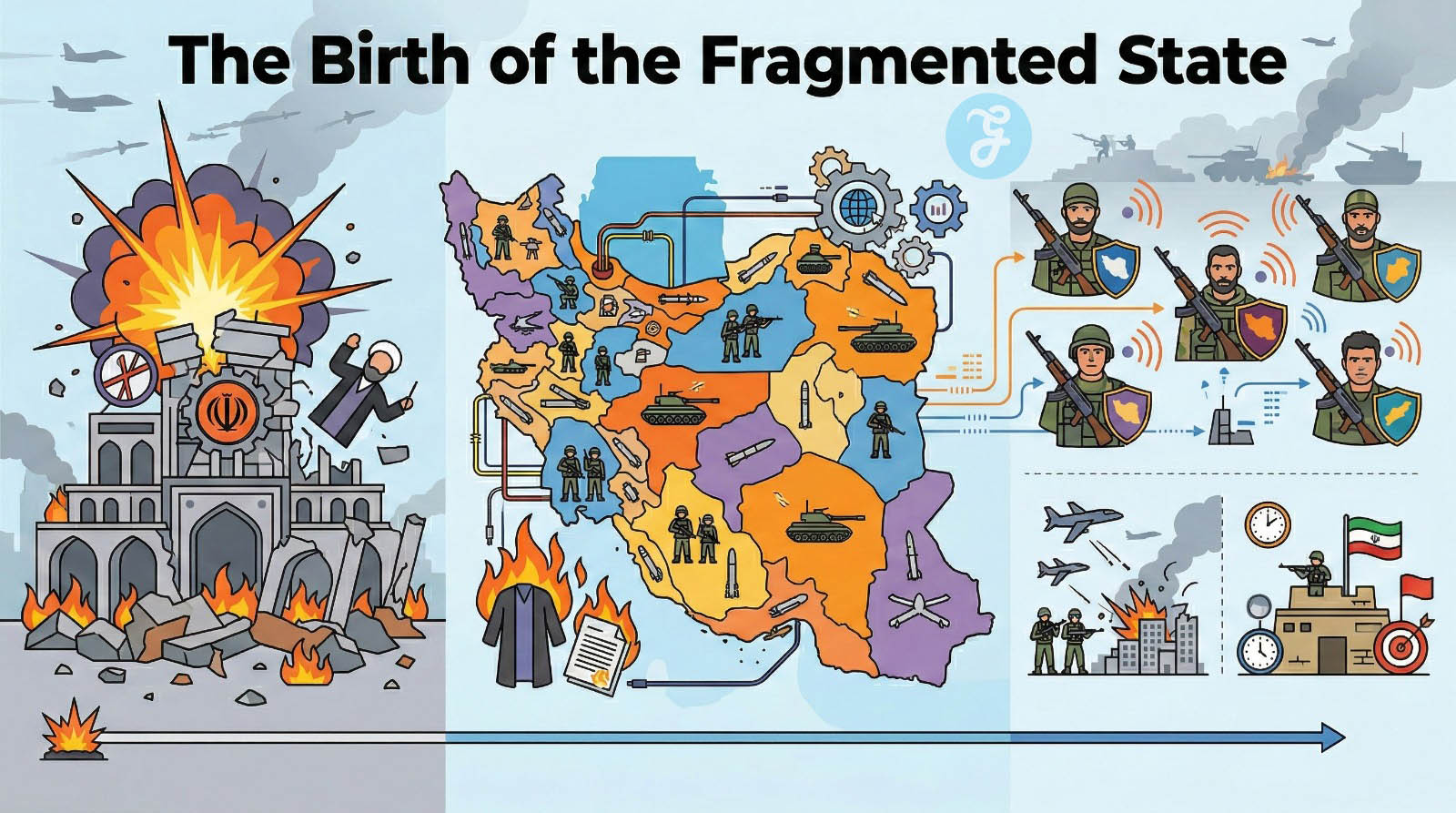 Western capitals often measure success through the lens of regime change or total defeat. These are the wrong metrics for the 2026 Iran Succession Crisis. For the interim council in Tehran victory is not defined by the conquest of territory. It is not defined by the destruction of the enemy. Victory is simply the act of existing. If the state remains a functioning and armed entity on 1 April 2026 they will claim a win. They have survived a decapitation strike that would have toppled almost any other modern government. The survival of this decentralised command structure suggests that the initial objectives of Operation Epic Fury may have underestimated the resilience of a state already conditioned for asymmetrical survival.
Beyond the Horizon: A Victory That Looks Like Catastrophe
The question for global diplomacy is no longer about who leads in Tehran. The individual names on the council matter less than the system they represent. The real challenge is whether the region can survive the “Mosaic” of the Iranian response. This decentralised and violent defiance threatens to pull every neighbour into a permanent state of war.
We are witnessing the birth of a new and fractured order. It is an order where the survival of the state is bought at the cost of regional peace. The world must now decide if it can live with the consequences of a victory that looks exactly like a catastrophe.
Disclaimer: Editorialge maintains a steadfast commitment to responsible reporting on the evolving conflicts in West Asia involving Israel, Iran, U.S., Gulf nations and non-state actors like Hezbollah, Hamas, Houthis, Islamic State, and others. In an environment where digital disinformation is widespread, we cannot independently verify every social media post or claim involving national and non-state actors. Our priority remains factual accuracy and the exercise of extreme caution when documenting all regional media.