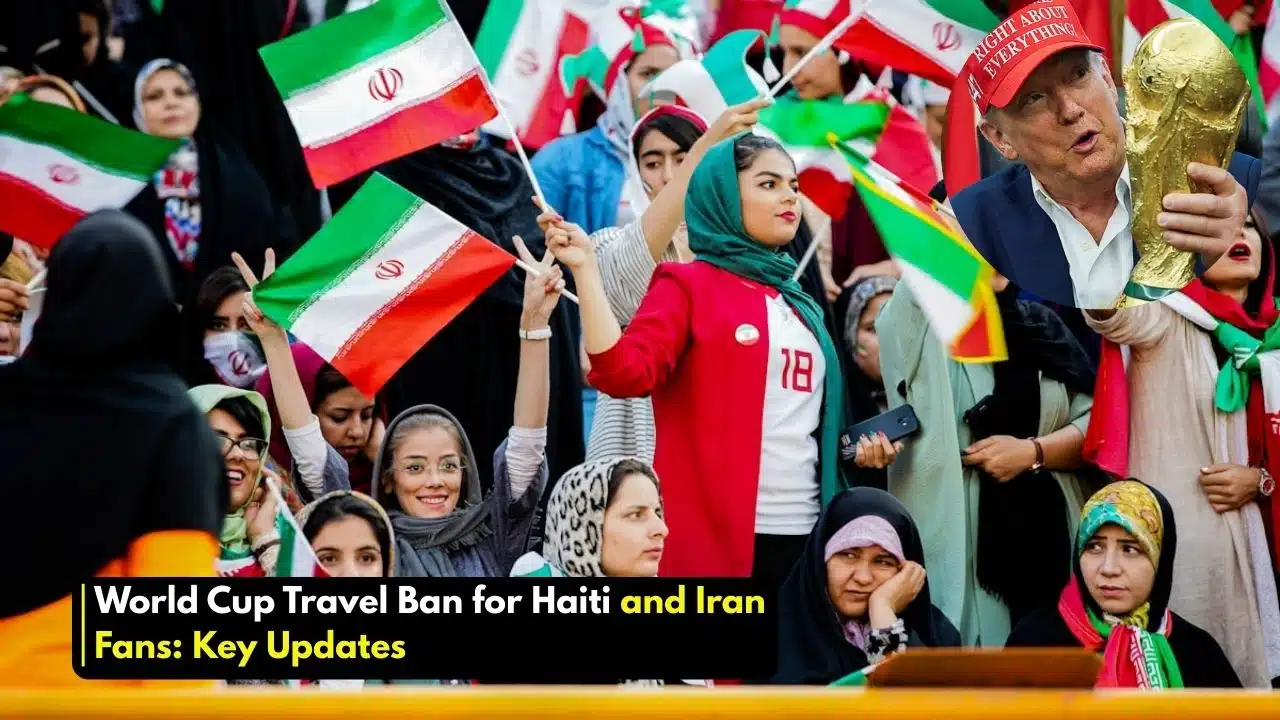
As the excitement for the upcoming FIFA World Cup 2026 continues to swell across continents, a new geopolitical wrinkle threatens to cloud the spirit of international unity the tournament represents. Recent travel restrictions from certain nations, notably Haiti and Iran, have ignited controversy after warnings that thousands of fans may be barred from attending matches in host cities across North America.
For soccer fans who see the World Cup as the ultimate celebration of sport beyond borders, the issue is not merely a matter of logistics—it symbolizes a deeper clash between global politics and the world’s most beloved game.
Football and Politics Collide
The World Cup has always stood as more than an athletic spectacle. It has historically served as a soft-power arena where nations compete for pride, recognition, and identity. Yet with tensions rising between governments, 2026 could become one of the most politically charged tournaments of the modern era.
In recent months, the **joint hosts—United States, Canada, and Mexico—**have engaged in discussions over renewed travel security policies, citing rising migration pressures and national security concerns. As part of these evolving measures, citizens from countries facing political instability or sanctions—including Haiti and Iran—have faced stricter visa scrutiny.
While not explicitly labeled as “bans,” these policies effectively restrict travel by limiting visa approvals or elongating bureaucratic processes to the point of impossibility.
According to initial reports from Haitian and Iranian media, dozens of supporters’ groups have already had their group visa applications rejected or delayed beyond practical timelines.
FIFA’s Diplomatic Balancing Act
The situation places FIFA in a precarious position. The federation prides itself on promoting values of inclusion and global solidarity, yet its limited jurisdiction over sovereign visa policies makes intervention complex.
A senior FIFA official, speaking anonymously to Editorial GE, expressed concern that politics could overshadow the tournament’s inclusive image.
“Football brings people together, but when governments introduce broad travel restrictions, it becomes difficult for us to ensure equitable fan participation,” the source said. “We continue to engage with national authorities to find solutions that uphold the integrity of the World Cup.”
FIFA’s official stance, however, remains measured. In a recent press release, the organization reiterated its “commitment to accessibility” for fans worldwide but acknowledged that “entry and visa decisions rest with national governments.”
This diplomatic phrasing suggests that FIFA—mindful of previous controversies involving host nations—is treading carefully to avoid sparking larger political backlash.
The U.S. Travel Policy and Its Implications
Among the three host nations, the United States will host the bulk of the matches, including the final. As such, U.S. immigration and visa policies will significantly influence the accessibility of the event for international fans.
Following recent adjustments to visa policies under the banner of “enhanced security vetting,” the U.S. Department of Homeland Security has tightened entry rules for travelers from politically volatile regions. Both Haiti and Iran fall within this category for different reasons.
For Haiti, the concern is tied to worsening domestic instability. The Caribbean nation has been plagued by escalating gang violence, economic collapse, and governance breakdowns since the assassination of President Jovenel Moïse in 2021.
Iran, on the other hand, faces ongoing Western sanctions and strained diplomatic ties following disputes over nuclear programs and human rights issues.
As a result, Haitian applicants face increased background checks, while Iranian nationals often struggle to secure interviews or clearances at all.
Human Impact: Fans Stranded in Limbo
For countless fans, this policy dilemma goes beyond abstract politics. It translates into disrupted dreams and immense personal disappointment.
Take the example of Julien Pierre, a 26-year-old Haitian football enthusiast from Port-au-Prince who has followed every World Cup since childhood. He saved for three years, hoping to travel to Miami for Haiti’s first qualifying game—should the team make it through the CONCACAF rounds.
Julien’s visa application, however, has remained pending for six months. “They said they are reviewing my documents, but I don’t know what that means,” he told a local paper. “I just want to see our team play, maybe for the first time on a big stage.”
Similarly, Maryam Rezaei, an Iranian supporter based in Tehran, planned to fly with her husband and two children to attend the matches in Los Angeles. After receiving their FIFA ticket confirmation emails, the family discovered that their U.S. tourist visa requests had been rejected without explanation.
“Football was our one escape from politics,” Rezaei said via encrypted message to journalists. “Now, even that is being taken away.”
These personal stories reveal the human side of a crisis often framed in bureaucratic or political terms.
Haitian Diaspora Outrage
The Haitian diaspora across the U.S.—particularly vibrant communities in Florida, New York, and Massachusetts—has voiced strong opposition to the new restrictions. Local advocacy groups argue that the travel ban unfairly penalizes fans who pose no security threat.
Community leaders have petitioned both FIFA and the U.S. State Department to introduce special “World Cup cultural visas” allowing entry for vetted sports fans. These would be modeled after similar initiatives introduced during previous Olympics or international events.
“Sports unite people, and Haitian-American communities are ready to host and assist visiting fans,” said Jean-Claude Delva, director of the Haitian-American Sports Council. “Blocking families and supporters only deepens isolation.”
While sympathetic, U.S. officials have yet to signal any concrete policy shifts. Press officers have merely reiterated that “national security considerations remain paramount.”
Iranian Fans Face Sanctions Barrier
For Iranian supporters, the roadblock is far more complex. Since the reimposition of U.S. sanctions in recent years, financial transactions between Iranian citizens and Western entities have become highly restricted.
Purchasing FIFA tickets, booking hotels, or transferring payments abroad often requires navigating sanctions-compliant intermediaries or dual-country sponsorship. Iranian fans, even those with legitimate resources, have found themselves unable to complete bookings due to blocked payment channels.
Additionally, U.S. authorities rarely issue tourist visas directly in Tehran, forcing applicants to travel to embassies in neighboring countries like Turkey or the United Arab Emirates—adding cost and uncertainty.
As political tensions persist, the possibility of a blanket visa freeze on Iranian citizens has not been ruled out. Analysts suggest such measures could effectively isolate Iran’s fan base from in-person participation altogether.
Reaction from Global Football Community
Reactions from other football federations and prominent players have started to surface. Many voices in the sports community view these developments as a step backward in the spirit of the game.
Several former football stars, including Didier Drogba and Ali Karimi, have spoken out publicly, calling on FIFA to mediate and ensure fair access for all fans.
Drogba stated, “Football should never be a hostage to politics. Every fan deserves the right to cheer for their team on the world stage.”
Meanwhile, sports analysts note that the issue goes far beyond the fans—it reflects the increasing difficulty of separating sports diplomacy from global power struggles.
Lessons from History
The intertwining of politics and international tournaments is not new. The 1980 Moscow Olympics boycotted by dozens of Western nations, or the 1978 World Cup in Argentina held amid dictatorship, stand as precedents of how political realities influence global sporting events.
In more recent memory, the 2018 World Cup in Russia faced criticism over state-sponsored policies, while Qatar 2022 drew scrutiny for human rights issues.
However, the 2026 situation differs in one key respect: instead of controversy surrounding the host, this crisis revolves around who gets to attend. It highlights a new era where geopolitics doesn’t just affect athletes or governments—but ordinary fans.
Economic Ripple Effects
The exclusion of fans could have tangible financial repercussions. Economists estimate that the absence of entire fan contingents can lower local tourism revenues by millions.
Haitian communities, which had been organizing cultural gatherings, restaurants, and merchandise tours around match weeks, fear major financial losses. Similarly, Iranian tour agencies and digital marketplaces that had coordinated World Cup packages now face cancellations.
U.S. cities like Miami, Houston, and Los Angeles—each expected to host matches—stand to lose revenue from fan-associated travel, dining, and accommodation spending.
Local business associations have begun lobbying municipal authorities to pressure Washington for flexible cultural visa arrangements, arguing that sports tourism helps drive economic integration and goodwill.
Canada and Mexico Offer Alternatives
Interestingly, fan organizations from both affected nations have begun exploring Canada and Mexico as alternative match destinations within the World Cup co-host framework.
Canada, maintaining a comparatively open visa policy, might become a crucial entry point for international fans. Mexican authorities, too, have expressed willingness to welcome spectators from countries under travel difficulty, providing “tourist event passes” for verified ticket holders.
However, due to the tournament structure, most late-stage matches—including the semifinals and finals—will take place on U.S. soil, making full participation unlikely without U.S. entry approval.
“Canada and Mexico can only do so much,” noted sports migration expert Dr. Alejandro Hernandez at the University of Toronto. “Unless the U.S. modifies its stance, fans from affected nations will remain partially excluded.”
The Debate Over National Sovereignty
At the heart of the issue lies the question of sovereignty versus global unity. Governments argue that visa restrictions are legitimate exercises of national security rights, while critics view them as discriminatory tools undermining the universality of sport.
Political analysts suggest that the world is facing an era of increasing isolationism, with national interests often prioritized over global collaboration. The World Cup, envisioned as a supranational gathering, now serves as a test of whether such unity remains possible in practice.
As one analyst from the Council on Foreign Relations put it, “The irony is that football is supposed to be borderless—the game of the people. Yet the borders are tightening even around the pitch.”
FIFA Under Pressure to Act
Mounting criticism may soon compel FIFA to step beyond its traditionally cautious stance. Civil organizations have urged the federation to negotiate humanitarian travel exemptions or coordinate with host nations to expedite fan visas.
Sports legal experts argue that FIFA, while lacking direct political power, could leverage contractual host agreements to advocate for fan accessibility as a non-negotiable clause.
So far, FIFA’s response has been to launch a “Global Inclusion Task Force,” though critics view it more as symbolic than operational. Some fan groups have even threatened demonstrations at FIFA headquarters in Zurich if no progress occurs by early 2026.
Broader Symbolism: The Global Divide in Sport
The growing exclusion of specific nationalities reveals more than short-term policy friction—it reflects the widening global divide between privileged and restricted travelers.
As world events—from pandemics to wars to sanctions—reshape mobility, access to global experiences like the World Cup increasingly mirrors global inequality itself.
For nations like Haiti, where daily hardships already limit international engagement, sporting isolation adds emotional weight. For Iranian youth, who follow European leagues passionately, the inability to attend world events reinforces feelings of alienation from global culture.
The World Cup was supposed to be an antidote to such divides. Now, it risks amplifying them.
The Road Ahead
As the clock ticks toward the 2026 kickoff, the situation remains fluid but uncertain. Diplomatic sources have hinted that negotiations between FIFA and U.S. officials are ongoing, with discussions around a possible “sports visitor waiver program” for citizens from restricted countries.
If implemented, it could serve as a breakthrough compromise—preserving security concerns while reinstating fan inclusivity.
Nevertheless, experts warn that bureaucratic processes could take months, leaving little time for effective implementation. Without decisive action soon, thousands of fans may find themselves permanently sidelined from the beautiful game’s most joyous spectacle.
A Test of Football’s Core Values
Beyond visa statistics and border politics, the deeper question remains: Can football truly unite the world when the world itself seems divided?
Whether in the streets of Port-au-Prince or the stadiums of Tehran, fans share the same chants, dreams, and devotion to the game. Their love for football transcends ideological walls and linguistic barriers.
Yet as World Cup 2026 approaches, the fate of these fans—and the message the tournament sends about global inclusion—hangs in the balance.
The sport that once overcame apartheid, dictatorships, and wars now faces a modern challenge: proving that the spirit of the game can still triumph over politics, even in an age of restriction.
If football is truly for everyone, then the world will need to find a way to open its gates once again