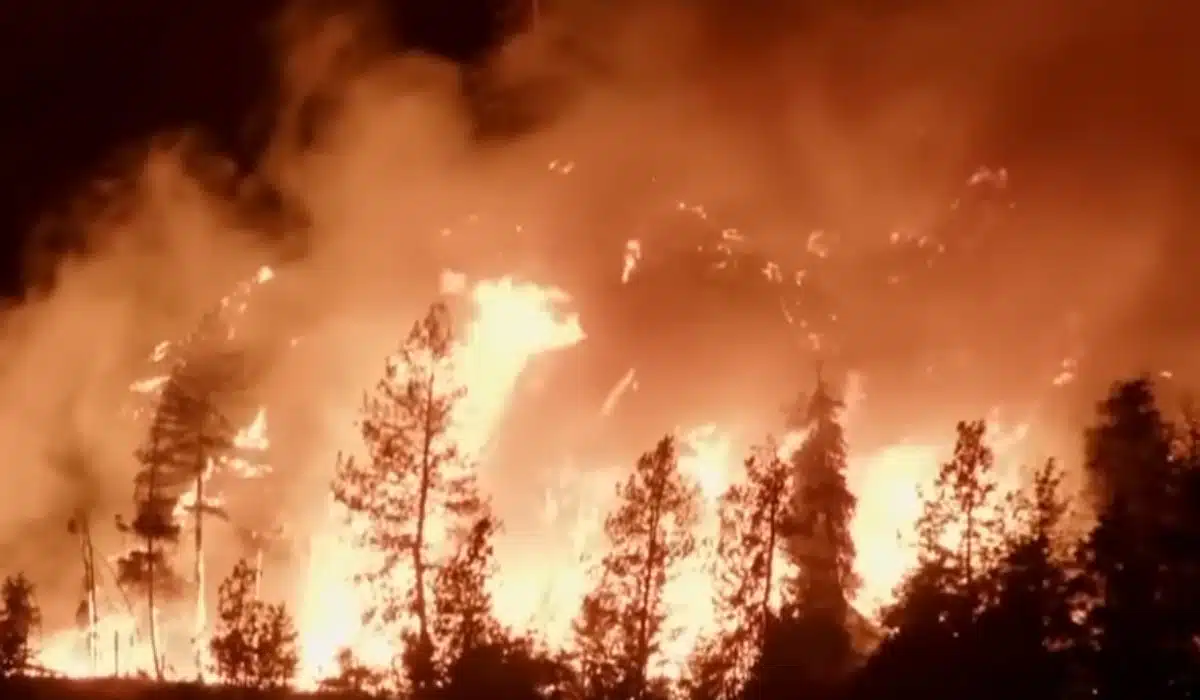
Could wildfires driven by ancient climate shifts and human oversight have led to the mass extinction of large mammals over 13,000 years ago?
A group of scientists from California believe so, and they’re drawing alarming comparisons between the past and present.
The late Ice Age, or the Pleistocene era, is renowned for its significant ecological changes, especially the mysterious disappearance of many large mammals, or megafauna, across different parts of the world.
While debates about the cause of these extinctions often center around global warming and human activities, one overlooked event stands out: the massive wildfires that engulfed California 13,000 years ago.
Did ancient wildfires, supercharged by climate shifts and human activities, wipe out massive mammals over 13,000 years ago? A recent study suggests this might be the case.
In a study just published in Science, F. Robin O’Keefe and his team delved deep into the fossil records from the famous La Brea tar pits in California. Their aim? To uncover a link between a surge in wildfires and the vanishing of these giant creatures.
Imagine a time during the Ice Age when the Americas and Eurasia were bursting with colossal animals. But as the era drew to a close, North America saw over 70% of its large mammals, each weighing more than 44 kilograms, vanish. Australia’s loss was even more staggering, with up to 90% of its giant mammals disappearing.
The team noted in their introduction, “The end of the Pleistocene marked the end for most of Earth’s large mammals. This drastic shift in ecosystems has been debated for years. Was it due to the changing climate of the Ice Age or the growing impact of humans?”
Their research, however, offers some clarity. By turning their attention to the La Brea Tar Pits, a treasure trove of Ice Age fossils, the team could study the preserved bones of mammals that lived throughout those 50,000 years. Thanks to modern radioactive carbon dating, they could take a closer look at the ancient ecosystem’s timeline and collapse reasons.
They focused on fossils from eight species, including the sabertoothed cat, dire wolf, and American lion. All these creatures met their end between 10,000 and 15,000 years ago.
In their abstract, the authors noted, “To better understand the roles played by environmental changes and human influence during the late-Quaternary period, we dove into population structures, compared paleoclimatic data, studied vegetation records, and even modeled human demographic growth.”
Their findings? The large mammals’ disappearance seems to coincide with significant environmental changes, particularly a spike in wildfires.
The latest findings by a team of scientists might have some alarming implications for our current climate crisis. According to researchers Emily Lindsey, Lisa N. Martinez, and Regan E. Dunn, history might be repeating itself in a way that doesn’t bode well for our planet’s biodiversity.
In an article they shared on The Conversation, the team explains how, while humans and their ancestors have harnessed the power of fire for eons, the consequences of those fires can differ dramatically depending on the ecosystem.
Going back in time, California experienced a temperature increase of around 5.5 degrees Celsius. This was soon followed by a punishing 200-year drought, which left trees parched and vulnerable. As human settlements grew, so did the use of fire.
The scientists highlight, “Before the human influence, coastal Southern California witnessed minimal fire activity. However, between 13,200 and 13,000 years ago, as the human footprint expanded, the frequency of fires surged dramatically.”
The team further explained, “Southern California’s postglacial woodland gradually gave way to the chaparral ecosystem we recognize today, a transformation closely tied to the disappearance of megafauna and a significant increase in wildfires. It seems that human-initiated fires, in a landscape already grappling with swift warming, prolonged drought, and the gradual disappearance of large herbivores, catalyzed this shift. Today’s Mediterranean ecosystems are showing disturbingly similar signs.”
By understanding what drove the end of the Ice Age extinctions in California, the researchers believe we can better gauge the threats posed by today’s changing climate and dwindling biodiversity.
The rapid pace of today’s global temperature rise has researchers seriously concerned. Lindsey, Martinez, and Dunn highlight that our current temperature escalation is happening at a rate 10 times faster than during the end of the ice age. What’s more, this acceleration is mainly due to our burning of fossil fuels. As a result, California has seen fire frequency, intensity, and the extent of area burned surge fivefold in just the past 45 years.
Backing this up, the University of California released a report indicating that between 2009 and 2018, California experienced over 3,350 fires. This is a whopping 1.4 times the average fire count for each decade from 1979 to 2009. And while the highly combustible dry vegetation certainly plays a role, human actions, including accidents with power lines and campfires, are major culprits.
Echoing their concerns, Lindsey, Martinez, and Dunn stress the lessons we can learn from history: “Our ecosystems, which we heavily rely on, can buckle under the strain of multiple, converging pressures.”
Their urgent call to action? Swiftly tackle greenhouse gas emissions, enforce fire safety precautions, and make a concerted effort to preserve the world’s remaining large animal species to prevent an impending, and possibly even more devastating, environmental shift.