You spend hours trying to track stock in your online store and it still feels messy. One in four ecommerce brands report errors in real time inventory tracking. This post will show you ten tools, from warehouse management systems to apps that link to ecommerce platforms, so you can tidy your stock fast.
Ready for simpler inventory management?
Key Takeaways
- One in four e-commerce brands report real-time inventory tracking errors. This article profiles ten tools—from Softeon to Odoo WMS—to fix stock chaos fast.
- Prices range from $14.50 per month for Holded and free for Odoo’s open-source plan up to $110 per month for inFlow, with custom quotes for enterprise tools like SAP EWM and Oracle NetSuite WMS.
- All tools use barcode or QR scanning and real-time stock sync. They link to Shopify, WooCommerce, ERP, and CRM to speed picking and cut manual data entry.
- Cloud-based WMS like Zoho Inventory, inFlow, and QuickBooks Commerce scale across multiple warehouses in days. Enterprise systems from SAP and Oracle handle dozens of sites with batch and serial tracking.
- Brands cut picking errors by up to 60% (Park Avenue Goods with Odoo). Automation, analytics, and alerts slash stockouts and overstocks while boosting order fulfillment speed.
What is Softeon and how does it support e-commerce warehousing?
A robust warehouse management system named Softeon ranks among the best eleven e-commerce WMS tools for 2025. This tool offers barcode and QR scanning for inventory management. Users set up stock alerts and manage purchase orders.
Traceability features keep tabs on every pallet. Custom pricing suits businesses needing advanced inventory control.
Real-time inventory updates sync with ecommerce platforms and erp systems. Teams connect Softeon to crm integration and other warehouse applications. High automation capabilities drive data-driven decisions and faster order fulfillment.
Scalable design grows with online stores to maintain tight stock levels and boost customer satisfaction.
How can Zoho Inventory improve your warehouse management?
Zoho Inventory links sales orders to purchase requests with a few clicks. It logs every transaction, and updates stock counts in real time. Managers track inventory levels across warehouses with barcode scanning.
This tool syncs with Zoho CRM, and feeds customer data into your supply chain. Small shops and large brands both gain data-driven decisions through automated reports. Industry reviews list it among top warehouse management solutions for ecommerce.
Shipment tracking tags show order status across multiple locations. Pricing kicks off at $39 per month, and stays clear of surprise fees. A user praised its simple interface for quick onboarding.
Teams reuse the same dashboard to manage purchase orders and shipping software. Real-time inventory tracking drives down stockouts and overstock risks. Developers link data across ecommerce platforms and ERP apps in minutes.
What features does Holded offer for e-commerce brands?
Holded serves as a warehouse management system for SMBs and packs live stock monitoring and branch inventory oversight. The platform syncs data across popular e-commerce platforms like WooCommerce and Shopify.
Price tag begins at $14.50 monthly, aiming at small business owners. It ranks among top warehouse solutions for online sellers. It ties stock control to sales handling tools for faster order fulfillment.
Users get auto bookkeeping alongside advanced analytics and reporting tools. The web-hosted structure lets teams access data anywhere. Adjustable data tiles bring key metrics front and center.
You can link online storefronts and keep numbers fresh, thanks to seamless data integration.
How does Fishbowl Inventory streamline warehouse operations?
Large industries adopt Fishbowl Inventory to tame complex supply chains. It automates purchase order management and traceability. Production planning ties manufacturing runs and wholesale stock.
Workers scan barcodes for real-time inventory tracking. Tasks move faster, thanks to automated replenishment.
Accounting teams love the QuickBooks integration for smooth data integration. Custom pricing hides behind a private quote system, no rates show online. Managers pull detailed reports from the dashboard, spotting bottlenecks by the hour.
This warehouse management software keeps data alive, syncing orders and stock counts. It juggles orders like a circus performer, boosting customer satisfaction.
Why choose inFlow Inventory for your e-commerce business?
inFlow Inventory ranks high among cloud-based WMS platforms for ecommerce brands. It packs inventory management and purchase order management in one package. That package includes barcode scanning and custom B2B portals.
Mobile apps power on-the-go stock checks and picks. You scan items with a smartphone or a wireless scanner. Pricing starts at $110 per month, a fair fee for multi-location support.
Teams can sync stock across warehouses in real time. You dodge overstocks and stockouts like a pro.
The platform logs every sale and stock move in detailed reports. Advanced analytics reveal fast movers and slow sellers. Data integration with Shopify, WooCommerce, and Amazon cuts manual entries.
A clean dashboard helps you make data-driven decisions fast. Order fulfillment speeds up with automation capabilities and clear pick lists. Custom portals boost B2B orders and improve customer experience.
No more frantic hunts for that last blue widget. This WMS streamlines ecommerce warehouse management without extra clutter.
What makes SAP Extended Warehouse Management suitable for e-commerce?
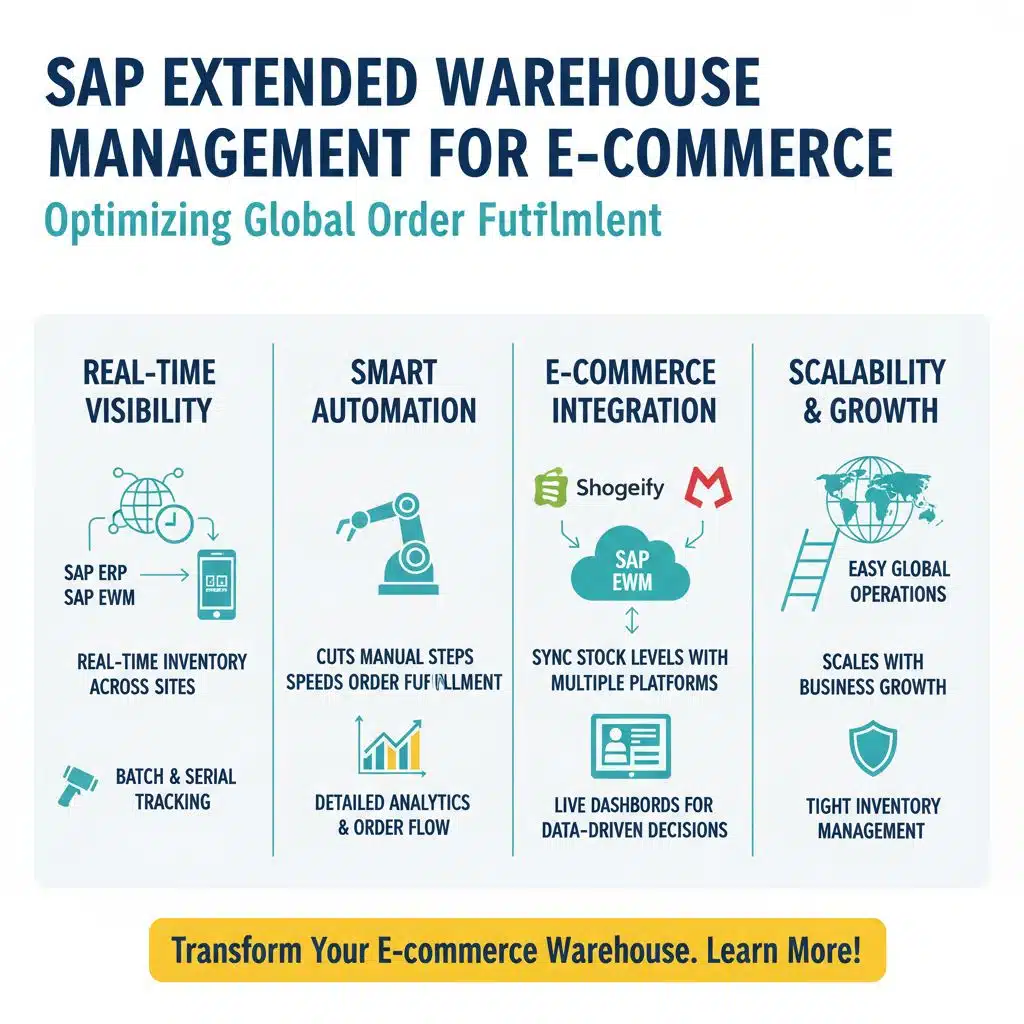
Big e-commerce companies need fast updates on stock. SAP Extended Warehouse Management links with SAP ERP to share order and shipment data. It gives real-time inventory tracking across dozens of sites.
The software uses batch and serial tracking for accurate order picking. Firms see detailed analytics on order flow and warehouse space. Custom pricing fits enterprise budgets. Automation capabilities cut manual steps and speed order fulfillment.
Shops can connect this warehouse management system to Shopify or Magento. Data integration lets teams sync stock levels with multiple ecommerce platforms. Managers get live dashboards for data-driven decisions.
The solution scales with business growth and adds global operations with ease. Inventory management stays tight even in high-volume seasons.
How can Oracle NetSuite WMS enhance your warehouse processes?
Oracle WMS Cloud sits in the sky, syncing stock across all channels. It feeds real-time inventory tracking into your Oracle business management systems. It links your ecommerce platforms to warehouse tasks.
Managers watch a live dashboard, spot low stock before shelves go bare. It supports multi-location warehouse management, so teams in two regions share tasks in one tool, and orders never slip through cracks.
Cloud-based warehouse management comes alive in this warehouse management system. Automation capabilities slash picking errors, they breeze through cycle counts, freeing staff for smarter work.
The tool runs process optimization in every step, logs each barcode scan, and lifts order fulfillment rates. You pay a custom price, matching enterprise needs. This system ties financial data to warehouse data, it extends operational visibility, and it scales as your brand crosses borders.
What benefits does QuickBooks Commerce provide for warehousing?
Small shops need clear stock status in ecommerce warehouse management. QuickBooks Commerce serves them well. It runs sales and purchase order tasks in one platform. It tracks inventory in real time.
It links with QuickBooks accounting software for seamless crm integration. This solution runs in a cloud environment with multi warehouse support. It cuts data entry time and human errors.
Many e-commerce sellers rate it among top warehousing tools.
Vivid dashboards show stock levels and reorder needs at a glance. Sellers connect it to Shopify and WooCommerce. The system sends low-stock alerts and automates replenishment. It uses barcode scanning and shipping and logistics tools to speed order fulfillment.
Plans start at $30 per month and rise to $200. The platform links sales and inventory modules in seconds. You gain insight through analytics and reporting tools that drive better data integration and boost customer experience.
How does HighJump (Korber Supply Chain) optimize warehouse management?
HighJump drives real-time inventory tracking across many warehouses. It syncs data with ERP software and top ecommerce platforms. Managers spot slowdowns with advanced analytics tools.
Dashboards update every minute to guide picking, packing, shipping. Systems adapt to new sites in hours thanks to multi-location support. Custom pricing suits large scale teams.
Teams cut errors and wasted steps with smooth workflow maps. Developers link HighJump to other data systems for deeper insights. Leaders see order fulfillment speed climb as system runs.
Experts list this WMS among top ecommerce tools for brands. Results include fewer stockouts and higher customer satisfaction.
What are the advantages of using Odoo WMS for e-commerce?
Open-source code makes Odoo WMS a warehouse management system you can run free or upgrade to plans up to $22.40 per month. This cloud-based WMS adapts to brand growth. Teams add modules like inventory management, CRM integration, and data integration.
The design gives modular solutions that adjust to each workflow. You can deploy it on the cloud or your own server.
Real-time inventory tracking cuts stockouts and overstocks. The system uses barcode scanning and lot and serial tracking to spot errors fast. It applies rules to automate order picking.
It plans routes to speed up shipping. These automation capabilities boost customer satisfaction.
Key Features to Consider When Choosing a Warehousing Tool
Real-time inventory tracking and barcode scanning keep stock glitches at bay, so you ship fast and dodge angry customers. Pick a cloud ERP or inFlow Inventory with CRM integration, automation, and built-in analytics to sharpen data-driven decisions and speed up order fulfillment.
What scalability options are important for growing e-commerce brands?
Cloud-based WMS adapt to spikes in order volume. They scale data storage and users in inventory management systems and support data integration. Plans range from $14.50 per month on Holded to custom enterprise rates for SAP or Oracle.
Multi-warehouse support in Zoho Inventory, inFlow Inventory, and QuickBooks Commerce helps brands expand to new regions.
Platforms can add new integrations and features as you grow. inFlow Inventory adds mobile and B2B portals to simplify wholesale and remote work. You see up to the minute inventory updates in your dashboard to curb stockouts and overstocks.
Automated resource adjustment means you skip costly system upgrades.
How do warehousing tools integrate with popular e-commerce platforms?
ZhenHub and the Korber system plug into major ecommerce platforms, syncing orders and stock counts with Shopify, Amazon, and Etsy. This warehouse software uses APIs to push real-time inventory tracking and order fulfillment data to your online store.
Holded and Zoho Inventory connect via native add-ons or REST endpoints to update purchase orders and shipping status. QuickBooks Commerce links sales channels with accounting workflows, cutting manual data entry.
Oracle’s cloud suite and SAP’s extended warehouse manager tie deeply into finance, providing data integration across global supply chains. Odoo modules adapt connectors for custom storefronts, fitting diverse marketplaces.
Systems use connectors or custom scripts to sync SKUs across multiple touchpoints. They automate reorder rules, barcode scanning, and shipment labels. They feed CRM platforms via crm integration for better customer engagement.
They share stock levels with marketing tools and payment gateways, driving data-driven decisions. They link shipping and logistics tools to boost on-time delivery and customer satisfaction.
What real-time inventory tracking capabilities should you look for?
Barcode scanning in Softeon and inFlow gives instant stock updates. Holded, Zoho Inventory and ZhenHub show stock levels across warehouses in real time. Fishbowl and HighJump send live reports and alerts the moment counts dip or surge.
SAP EWM and Oracle WMS Cloud give live views of sites around the globe.
Odoo WMS shows up-to-the-minute stock on web pages and mobile apps. Alerts pop up for low or excess items, cutting stockouts and overstocks, and boosting order fulfillment accuracy.
Real-time inventory tracking plugs into ecommerce platforms and crm integration. The data feeds data-driven decisions, data warehousing and analytics, boosting customer satisfaction.
How can automation and workflow optimization improve your warehouse?
Your warehouse hums when a warehouse management system handles inventory management chores. SAP EWM and Oracle WMS Cloud kick off order prep and automate tasks. HighJump and Fishbowl streamline picking, packing, and shipping.
This cuts manual labor and trims costs. Real-time inventory tracking locks down stock counts.
Accounting and routing processes fall into line with Holded and Odoo automations. InFlow speeds up B2B orders and ZhenHub steers e-commerce shipments. Orders race out like a hot knife through butter.
Automated stock alerts flag low levels. This prevents mismatches and cuts errors. Workflow optimization boosts daily throughput, and data integration links systems for smooth flows.
Why is a user-friendly interface important for warehouse management?
Intuitive dashboards help staff learn a cloud-based WMS fast. Odoo WMS uses modular views so each team sees what it needs. Holded shows key data on simple screens, cutting training time and errors.
A clear panel feels like a highway with no toll booths, so workers scan barcodes with fewer mistakes.
QuickBooks Commerce and Zoho Inventory guide new users, so teams see stock levels as they change. inFlow mobile apps put real-time inventory tracking in a worker’s palm, boosting order fulfillment and trimming mistakes.
Smooth tools lift efficiency, spark data-driven decisions and boost job satisfaction.
How do you evaluate the costs of different warehousing tools?
Good cost checks start with a side-by-side look at subscription tiers. Holded plans range from $29 up to $99.50 per month. Zoho Inventory goes from $39 to $299 per month. inFlow Inventory kicks off at $110 and can climb to $549 per month.
QuickBooks Commerce sits between $30 and $200 per month. Odoo WMS runs free up to $22.40 per month. Major players like SAP Extended Warehouse Management, Oracle NetSuite WMS, Softeon, Fishbowl Inventory, ZhenHub, HighJump, EasyWMS, and Infor WMS offer custom quotes.
Extra charges pop up when you add automation capabilities, real-time inventory tracking, CRM integration, or data integration. Analytics and reporting tools can cost more too.
Smaller operations can start on free or low-cost tiers and later upgrade. Larger sellers must plan for fees on more users or extra warehouses. Automation modules cost more, but cut down on manual errors.
Custom solutions require direct quotes, so share your specs with vendors. Good cost analysis mixes sticker price with integration needs, scalability, and expected ROI. That approach keeps your warehouse management system budget in check and your order fulfillment smooth.
What are the differences between cloud-based and on-premise solutions?
Cloud-based WMS such as Zoho Inventory and inFlow deploy in just 1 or 2 days. They scale up or down with stock levels, link to crm systems, and support automation like barcode scanning.
Providers handle updates and maintenance, and you pay as you go. Your team can log in from any device and track inventory in real time.
On-premise warehouse systems like SAP EWM and HighJump need on-site servers and network gear. Teams face weeks to months of setup and large upfront costs. Your IT staff must install patches, secure data, and scale hardware.
Many large brands lower long-term expenses but lose pay-as-you-go perks. Hybrid models let teams keep core processes local and push peaks to the cloud.
How do warehousing tools protect your data and ensure security?
Top-tier warehouse management systems like SAP Extended Warehouse Management and an Oracle warehouse tool encrypt data at rest and in transit. They deliver enterprise-level security with routine software updates and patches.
Admins set granular access controls to manage data in databases and data warehouses. Strong encryption keeps customer behavior and transaction records safe. Secure APIs stop illegal integrations.
Providers run regular backups and design disaster recovery plans to keep order fulfillment records intact. These solutions comply with GDPR and SOC 2 standards that regulated brands need.
You can tie your ecommerce platforms and customer relationship management systems without risking data quality. Automation capabilities, including real-time inventory tracking and automated replenishment, run under a secure shell.
You get a safe path for data-driven decisions.
Why are analytics and reporting tools essential for warehouse management?
Analytics and reporting tools turn raw data into clear charts. Fishbowl and HighJump feed you deep views on operations. SAP EWM and Oracle WMS Cloud bring strong dashboards. DATAFOREST paints custom views through data visualization.
Live analytics support data-driven decisions in real time. Reports flag low inventory and order accuracy. Managers spot underfilled shelves before orders fail. That automated output saves time and cuts manual analysis.
Charts built from live data guide smarter order fulfillment. Advanced analytics track key metrics like inventory turnover. Those insights help forecast demand and avoid stockouts. Automation capabilities flag slow moving items so teams rebalance stock.
Automated reports remove hours of spreadsheet work. Real-time inventory tracking plugs into dashboards. That boost gives visibility across ecommerce platforms and cloud-based wms. Teams manage multiple warehouses without extra apps.
How can AI and machine learning improve warehousing efficiency?
Dataforest uses machine learning to forecast demand. Predictive analytics scan past sales, cutting stockouts. AI-driven solutions automate workflows in your warehouse. These tools speed up picking and packing.
A smart warehouse management system tracks real-time inventory and flags odd counts. ML models boost order picking accuracy and trim errors. AI spots anomalies in operations, and raises alerts fast.
Brands earn an edge with faster shipping and happy customers.
What are the benefits of connecting your WMS with shipping software?
Integrating a warehouse management system with shipping software, like ZhenHub, speeds order fulfillment. It also syncs inventory management data in real time. This integration taps automation capabilities to cut manual entry and shrink errors.
Real time inventory tracking flows to e-commerce platforms instantly. Customers see accurate stock and shipping updates.
Holded ranks among shipping and logistics tools that link a warehouse management system to carriers. This link uses rate optimization to lower shipping costs. It cuts the risk of lost or misrouted packages.
It also smooths returns and reverse logistics. Live tracking details boost customer satisfaction.
How can you reduce stockouts and overstocks using warehousing tools?
Smart warehousing tools send live stock feeds via barcode scanning and web hooks. Zoho Inventory and inFlow Inventory show counts across locations in real time. Cloud-based wms software alerts staff on low levels before items drop to zero.
DATAFOREST uses predictive analytics to forecast demand and set reorder points. Users can set custom thresholds, so the system orders parts automatically. Multi-warehouse management moves goods between sites to match sales.
E-commerce platforms sync with your wms to share order data instantly.
QuickBooks Commerce logs past order patterns in detailed reports. Merchants spot recurring stock outs and overstocks with its analytics and reporting tools. SAP Extended Warehouse Management and Odoo WMS track batches and serial numbers to rotate older lots first.
Automation capabilities cut the need for manual counts and reorder emails. Combined with integration of sales channels, your inventory matches real demand. This method lifts customer satisfaction and lowers carrying costs.
What strategies improve order fulfillment accuracy in e-commerce?
Softeon and inFlow Inventory use barcode scanning to cut picking errors in ecommerce warehouse management. It feels like a GPS on each item. Automated order validation spots mistakes before packing.
Holded and HighJump standardize each step with workflow rules. Cloud-based WMS send real-time inventory tracking and status updates to your store and the shopper.
Analytics and reporting tools track key metrics. They work like a conductor directing a busy warehouse. Multi-location visibility stops wrong routing. Integration with shipping software prints the right label each time.
QuickBooks Commerce user interface helps train staff in minutes, it boosts accuracy.
How do you manage operations across multiple warehouses effectively?
Managing items across four or more sites feels like juggling balls in the air. Zoho Inventory, a leading inventory management software, offers a central dashboard that shows stock levels at each location.
It integrates with ERP and e-commerce platforms to keep orders in sync. Holded and QuickBooks Commerce layer in multi-warehouse support on that same screen. Real-time inventory tracking stops duplicate picks and wrong shipments.
Automated replenishment routines move goods from one site to another. QuickBooks Commerce and ZhenHub let you schedule transfers. Custom permission settings let each team view only their site, and data integration syncs shipping and order updates across locations.
Analytics and reporting tools compare pick rates and lead times across warehouses. Cloud-based WMS lets managers log in from home or the road.
How does efficient warehousing enhance customer satisfaction?
Fast order processing thrills online shoppers. WMS tools like SAP EWM, Oracle NetSuite WMS and HighJump power automation. They cut picking time in half, machines scan barcodes on the spot.
Your warehouse runs like a well-oiled machine. That real-time inventory tracking cuts errors and avoids backorders and delays. Shoppers see live stock info on e-commerce platforms, they trust their orders ship fast.
Integrated shipping updates flow into email and SMS, customers feel looped in. Clear updates fuel customer satisfaction and repeat orders.
Low error rates build trust, they lead to positive reviews and repeat buys. Flexible workflows adapt to gift wraps or custom bundles, shoppers feel special. Analytics and reporting tools spot order spikes, teams tweak processes to match demand.
Returns get fast handling, goods return to inventory in days, not weeks. CRM integration sends custom messages, customers enjoy the personal touch. Data integration between WMS and shipping software speeds transformation, teams make data-driven decisions.
Case Studies: Successful Implementation of Warehousing Tools
Park Avenue Goods cut picking errors by 60% after using Odoo WMS with barcode scanning and real-time inventory tracking—read more.
What challenges do e-commerce brands face in warehousing?
E-commerce brands face scattered data across crm, marketing, finance, and analytics systems. This unsynchronized data causes errors, duplication, and conflicting information. Manual analysis in a cloud-based wms wastes valuable time.
Brands struggle to scale inventory management as data volumes grow.
Teams lack real-time inventory tracking across ecommerce platforms and shipping and logistics tools. They juggle speed and accuracy in order fulfillment while meeting industry security standards.
Poor data quality disrupts decision-making. They need automation capabilities, barcode scanning, crm integration, and analytics and reporting tools from a cloud-based wms.
What tips help streamline the transition to new WMS platforms?
A clear plan saves time and budget. It cuts risk during WMS migration.
- Assess data needs across order fulfillment, inventory management, and shipping to map migration scope.
- Cleanse and enrich data automatically to avoid errors when you load historical stock records.
- Build ETL flows and API integrations to sync your WMS with popular ecommerce platforms.
- Compare vendors on barcode scanning, CRM integration, automation capabilities, and price before you sign.
- Run test scripts in real operations to track scan accuracy, pick rates, and cycle counts.
- Launch a phased rollout in one zone and track real-time inventory before you expand to more areas.
- Offer hands-on training on the new interface and mobile scanning tools to boost staff adoption.
- Monitor data integration logs and use analytics and reporting tools to spot sync errors and tune workflows.
What industry trends are shaping modern warehousing tools?
Warehouse tech now runs in a server farm cluster. This shift gives brands scalability and flexibility. It fuels real-time inventory tracking and data-driven decisions. It taps pattern learning for demand forecasting.
It triggers automated guided vehicles, barcode scanners, and robotic arms. It leverages sensor array to monitor stock in sync with orders on ecommerce platforms.
Brands link multiple sites into a global network. They use API connectivity to share data across shipping, CRM, and payment gateways. They rely on dashboards with advanced analytics and reporting.
They guard data with encryption and compliance audits. They swap manual tasks for automated workflows in an order fulfillment pipeline.
What does the future hold for warehousing technology in e-commerce?
Cloud-based WMS will power smarter systems. They tap artificial intelligence and machine learning to run forecasts. IoT sensors will feed real-time inventory tracking and barcode scanning data.
Users can link these tools to CRM integration and ecommerce platforms. Such links boost data-driven decisions and speed up order fulfillment.
Automation capabilities will cut picking and packing times. Robots may roll down aisles, like a courier on wheels. Analytics and reporting tools will spot slow spots and free up space.
Modular WMS options, like SAP Extended or Oracle Suite, will fit any brand. This clear setup will lift customer experience with transparent shipping.
What are the most common questions about WMS for e-commerce?
Many brands ask if the system syncs with Shopify or Magento. Team members also ask how real-time inventory tracking works, down to scanning each barcode. They ask if automation can send reorder alerts, cut stockouts by 30 percent and stop overstocks.
Leaders want to know if on-premise versus cloud options shift costs or data control. Experts often want to load data using ETL pipelines. They ask if the tool can push info to Snowflake or Azure Synapse for advanced analytics.
Warehouse teams ask if Odoo WMS or Oracle NetSuite WMS suit their niche. They ask if the interface stays simple, even with multiple locations or IoT sensors.
Teams often question total cost of ownership, from license fees to SaaS subscription to training and support. They want transparency in payment flows, like PayPal or Stripe integration.
Security tops the list, with encryption, backup, and compliance checks. Managers play auditor and ask about reporting tools, to build dashboards in Power BI or QuickBooks Commerce.
They probe AI chatbots for pick path suggestions and ask about crm integration to link orders and customer data. They ask if a WMS can scale from a single fulfillment center to a global network without a hitch.
Comparison of Popular Warehousing Tools
Compare WMS, inFlow Inventory, and SAP Extended Warehouse Management side by side to find the best fit for your e-commerce warehouse—read on to see which one wins.
What are the key differences between leading warehousing tools?
Small teams pay $14.50 monthly for Holded while Zoho Inventory starts at $39 for core inventory management. Both shine in real-time inventory tracking, automated replenishment, and barcode scanning.
Softeon adds PO management and custom pricing for big setups. Odoo WMS lets small shops use open-source code free or upgrade at $22.40 a month.
inFlow focuses on mobile apps and B2B portals from $110 per month. Fishbowl Inventory and SAP Extended Warehouse Management demand custom pricing for large industries. Oracle NetSuite WMS Cloud, a cloud-based WMS, delivers tight integration with ecommerce platforms and shipping and logistics tools.
QuickBooks Commerce ramps up CRM integration and order fulfillment through its analytics and reporting tools.
Which tools offer the best features for e-commerce needs?
ZhenHub links major ecommerce platforms, so teams sync orders in a click. Zoho Inventory packs CRM integration, barcode scanning, and automated accounting tools. Holded taps a cloud-based wms, gives multi-warehouse support, and shows real-time inventory tracking for data-driven decisions.
inFlow Inventory adds mobile access for instant scans, so staff fill orders without delay. SAP EWM and NetSuite drive analytics and reporting tools, while Fishbowl powers custom dashboards for deep data management.
QuickBooks Commerce starts fast with friendly onboarding, handles multiple warehouses, and keeps customer satisfaction high. Open-source Odoo WMS flexes with business growth, links to other tools, and makes automation capabilities a breeze.
Best Practices for Maximizing WMS Efficiency
Use RFID scanning, live stock counts, and automation powered by neural nets in a SaaS warehouse platform like Oracle NetSuite WMS to slash errors and rev up order speed.
How can you optimize your warehouse management system?
Track stock in real time to cut picking errors. Time series forecasting models predict demand peaks and trigger automated replenishment. Cloud-based WMS link to parcel routing systems for rapid order fulfillment.
UPC scanning cuts mistakes at packing and picking lines.
Ops teams review performance metrics and tweak dashboards for clearer data-driven decisions. Quarterly audits and system upkeep keep your WMS healthy. CRM integration and real-time stock data boost customer experience.
What techniques improve WMS performance and ROI?
Cloud-based WMS products scale with growing sales. You can enable auto replenishment in Oracle NetSuite WMS or Odoo WMS. AI engines reroute inventory tasks in Fishbowl Inventory. Barcode scanning and real-time inventory tracking cut delays.
The system syncs data with CRM systems and payment gateways. It links with shipping software for seamless order fulfillment.
Managers monitor user adoption and provide ongoing training. They benchmark performance using advanced analytics. Teams use data-driven decisions to tweak workflows. They test robotic picking and pick-to-light modules to speed tasks.
Integrating WMS with financial systems gives unified reporting. Staff feedback drives tweaks that boost ROI quickly.
How do you choose the right warehousing tool for your business?
You should map your order volume, inventory levels, and shipping needs. Then, you can assess data integration with ecommerce platforms and ETL pipelines. Compare top warehouse management software vendors by feature set and price.
Test each tool in a real business scenario with sample orders.
Invite stakeholders from operations, IT, and finance to share feedback on usability and security. Evaluate scalability options and future proof your warehouse processes. Balance subscription fees against long term utility using cost analysis.
Look for real-time inventory tracking, barcode scanning, crm integration, and analytics and reporting tools.
Takeaways
This list helps brands pick the right cloud-based WMS. Our picks include top solutions like Oracle NetSuite WMS and inFlow Inventory. Each tool boosts real-time inventory tracking.
They add automation capabilities and analytics and reporting tools. Brands cut errors. Teams gain speed. Costs stay in check. Growth feels smooth.
FAQs on Warehousing Tools Tailored for E-Commerce Brands
1. What makes a cloud-based WMS key for e-commerce brands?
A cloud-based warehouse management system ties into your ecommerce platforms and moves with you, giving real-time inventory tracking, speeding order fulfillment, and linking to payment gateways. You can run automated replenishment and watch stock levels from any device.
2. How does barcode scanning speed up order fulfillment and cut errors?
Barcode scanning acts like a magnifying glass for your warehouse, picking up exact item data in seconds. It syncs with your inventory management tool and your shipping and logistics tools, so packages go out right the first time.
3. Can CRM integration boost customer engagement across channels?
Yes, crms send customer details to your email marketing platforms, whatsapp chats, instagram stories, your WordPress blog, and social media management platforms in one go. They map the customer journey in an omnichannel way, helping you stay on point with each buyer.
4. Why use ETL tools for data integration in your warehouse?
ETL tools extract, transform, load data from your warehouse management system, ecommerce analytics, social media strategy, and payment gateways into a central hub. Good data governance and data transformation mean smarter, data-driven decisions every day.
5. How do automation capabilities tie into marketing automation and SEO tools?
Automation capabilities can trigger emails or ads the moment a product runs low or a cart goes abandoned. They feed keywords to your SEO tools, dial up your search engine rankings, and boost your SERP position.
6. Do e-commerce brands need advanced analytics and the Internet of Things in their warehouse?
Absolutely, advanced analytics digest sales, customer satisfaction scores, and inventory metrics in real time. Layer in Internet of Things sensors on shelves and boxes, and you get a warehouse that talks back and drives better customer experience.