
Most people hear “Web3” and think of crypto prices, meme coins, and NFT bubbles. But the most important Web3 trends are not loud. They are quiet infrastructure shifts, new business models, and real-world use cases that are slowly changing how money, data, identity, and even physical infrastructure work.
Analyst reports show the global Web3 market is still small in dollar terms but growing extremely fast, with projections of tens of billions of dollars in value over the next decade. At the same time, surveys reveal that while awareness of crypto is high, deep understanding of Web3 concepts is still limited, especially outside tech circles.
Key Takeaways
| Item | What it covers | Why it matters |
| Big-picture overview | Market size, adoption, narratives | Sets context for the rest of the article |
| 30 underrated Web3 trends | Infrastructure, use cases, convergence | Shows where value is quietly being created |
| Actionable takeaways | For builders, investors, and users | Helps you decide what to do next |
| FAQs about Web3 | Simple answers to common questions | Supports search intent and readability |
Snapshot of the Web3 landscape today

Before we zoom into individual trends, it helps to see the bigger picture.
- Market growth: Multiple research firms estimate that the global Web3 / Web 3.0 market is currently in the low single-digit billions of dollars and could grow to tens of billions by 2030 and beyond, with annual growth rates above 40%
- Adoption: Surveys highlight that more than 90% of people worldwide have heard of crypto, but only a smaller share feel “very familiar” with Web3 concepts. Awareness and intention to use Web3 services are higher in emerging markets than in developed ones.
- Activity: Web3 gaming alone has reached over 4 million daily active users and has at times made up more than a quarter of all on-chain activity.
So Web3 is no longer just an idea. It’s a small but fast-growing part of the internet, with real users and real money involved. Yet the discussion is still dominated by a few noisy topics.
Web3 at a glance
| Aspect | Key point | Takeaway |
| Market size | Small today, but projected to grow rapidly | Web3 is early but not tiny |
| Adoption | High awareness, low deep understanding | Big education gap and upside |
| Activity | Gaming and DeFi dominate on-chain usage | Real users already use Web3 daily |
| Narrative | Focused on prices and hype | Many serious Web3 trends stay underrated |
Web3 trends in the infrastructure layer
This first cluster looks at the “plumbing” of Web3: blockchains, networks, and tools that most users never see directly, but that power everything else.
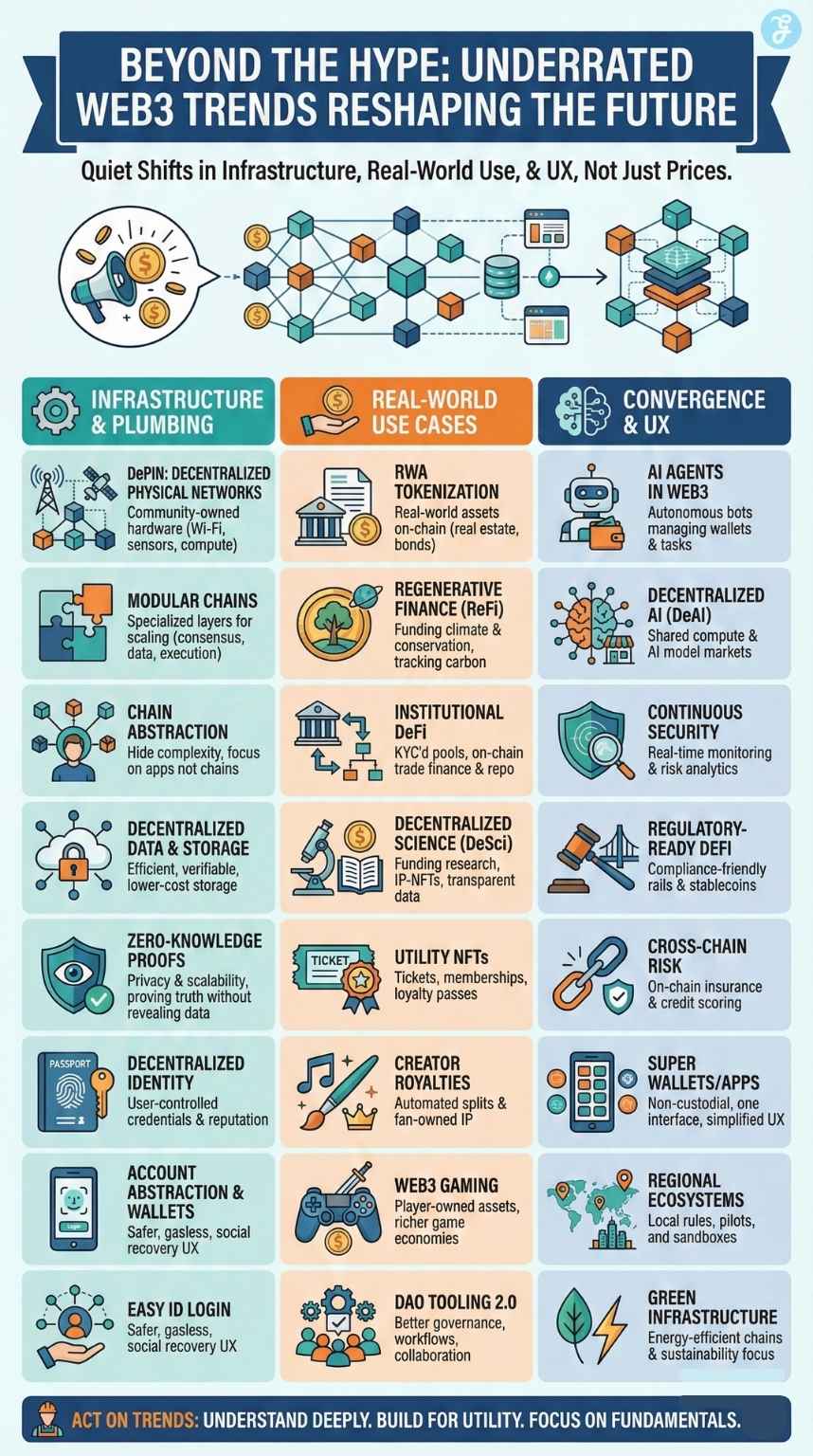
1. DePIN: Decentralized physical infrastructure networks
DePIN (Decentralized Physical Infrastructure Networks) rewards people for deploying real-world hardware such as wireless hotspots, sensors, compute nodes, or storage.
Instead of a single telecom or cloud giant owning everything, communities can build and own infrastructure together. Reports show DePIN’s total token market cap has grown from a few billion dollars in 2024 to tens of billions within a short time, signaling fast adoption of this model.
Examples include:
- Community-owned Wi-Fi networks.
- Decentralized cloud storage and GPU compute markets.
- Sensor networks for cities, logistics, or agriculture.
This Web3 trend is underrated because many people only notice the token symbols, not the physical infrastructure quietly spreading behind them.
2. Modular and app-specific blockchains
Older blockchains tried to do everything on one chain: consensus, data, and execution. Newer “modular” designs split these into separate layers.
This makes it easier to:
- Scale transactions.
- Specialize chains for specific apps (e.g., gaming, DeFi, social).
- Swap and upgrade pieces without breaking everything.
You can think of it like moving from one giant mainframe to modular cloud microservices. It’s not flashy, but it is critical for scaling Web3.
3. Chain abstraction and multi-chain UX
Today, using Web3 often means worrying about which chain you are on: Ethereum, Solana, a layer 2, or something else.
Chain abstraction aims to hide that complexity. In a chain-abstracted world:
- Users interact with apps, not chains.
- Wallets automatically choose the best path and chain.
- Bridging and swapping happen in the background.
This is one of the most important Web3 trends for mainstream adoption, because most people do not want to think about “which blockchain” at all.
Restaking lets users reuse their already staked tokens to secure additional networks or services.
Benefits:
- Better capital efficiency.
- Smaller projects can “borrow” security from bigger networks.
Risks:
- Complex dependencies: if something goes wrong, multiple systems can be affected.
It’s a powerful but still experimental idea, discussed more among protocol designers than regular users.
5. Data availability and decentralized storage layers
As more rollups and chains appear, storing data efficiently becomes a big challenge.
Data availability (DA) layers and decentralized storage networks focus on:
- Keeping transaction data available and verifiable.
- Storing NFT media, game assets, and logs.
- Reducing costs vs putting everything directly on-chain.
You rarely see them in headlines, but without them, many Web3 apps would be impossible or too expensive.
6. Oracles and middleware as the invisible backbone
Smart contracts need real-world data: prices, sports results, weather, identity checks, and more.
Oracles and middleware networks:
- Bring off-chain data on-chain in a secure way.
- Power DeFi (price feeds), RWAs (interest rates), and even gaming (randomness, event results).
They quietly secure huge amounts of on-chain value, but almost never show up in casual conversations about Web3 trends.
7. Zero-knowledge proofs and privacy-preserving compliance
Zero-knowledge (ZK) proofs allow someone to prove something is true without revealing the underlying data.
In Web3, ZK is used to:
- Scale blockchains through ZK-rollups.
- Enable private transactions and private voting.
- Support “selective disclosure” for compliance (prove you passed KYC without revealing every detail).
This mix of privacy, scalability, and compliance is one of the most technically advanced parts of Web3, but it’s often overshadowed by simpler narratives like “numbers go up.”
8. Decentralized identity and self-sovereign credentials
Decentralized identifiers (DIDs) and verifiable credentials let people own their digital identity and reuse it across apps.
Examples:
- One reusable KYC credential across multiple exchanges and DeFi apps.
- Education or employment certificates stored in your wallet, not siloed in a database.
- Community reputation badges that follow your address.
This can reduce friction for users and compliance costs for businesses while giving people more control over their data.
9. Account abstraction, MPC wallets, and better security UX
Many users lose funds because of poor wallet UX, not advanced hacks. Account abstraction and MPC (multi-party computation) wallets try to fix this by allowing:
- Social recovery instead of seed phrases.
- Spending limits and programmable rules.
- Gasless transactions paid by apps.
Security that feels like modern online banking, but remains non-custodial, is a key foundation for the next wave of Web3 adoption.
10. Emerging-market infrastructure and local ecosystems
Surveys show people in emerging markets often express a higher intention to use Web3 services than those in developed markets.
That demand is leading to:
- Local exchanges and wallets in Africa, Latin America, and South Asia.
- City-level or national pilots using blockchain for payments, land records, or identity.
- Regional L1s and L2s tuned to local needs and regulations.
Global coverage still tends to focus on the US and European markets, which is why this shift remains underrated.
Infrastructure Web3 trends (summary)
| Trend | Simple description | Why underrated |
| DePIN | Community-owned physical infrastructure | Seen as “just another token sector” |
| Modular / app-specific chains | Splitting blockchains into specialized layers | Technical topic, not retail-friendly |
| Chain abstraction | Hiding chain complexity from users | Most users don’t know they need it |
| Restaking & shared security | Reusing stake to secure more services | Risks are complex, so the discussion stays niche |
| DA and decentralized storage | Cheaper, verifiable data storage for Web3 | Invisible backend layer |
| Oracles & middleware | Real-world data for smart contracts | Few headlines, huge impact |
| Zero-knowledge proofs | Privacy and scalability tools | Hard to explain in simple words |
| Decentralized identity | User-controlled IDs and credentials | Still in pilot stage |
| Account abstraction & MPC wallets | Safer, easier wallets | Most work happens under the hood |
| Emerging-market infra | Local chains and services in high-growth regions | Western media focus hides the story |
Web3 trends in real-world use cases
Now let’s look at how Web3 is touching everyday industries: finance, climate, science, media, and more.
11. Real-world asset (RWA) tokenization
RWA tokenization puts real-world assets on-chain as tokens.
These can represent:
- Real estate shares.
- Treasury bills, bonds, and private credit.
- Invoices, trade finance instruments, or commodities.
Institutions like banks and asset managers are running pilots to bring traditional assets into programmable, 24/7 markets. RWA is one of the most practical Web3 trends, but much of it happens behind closed doors, so it feels invisible to the public.
12. Regenerative finance (ReFi) and climate-linked systems
ReFi uses Web3 tools to:
- Fund climate and conservation projects.
- Track carbon credits and emissions transparently.
- Incentivize regenerative practices such as reforestation or soil improvement.
On-chain MRV (measurement, reporting, verification) can make climate claims more transparent, but the space is still small and often buried in sustainability discussions.
13. Institutional DeFi and on-chain trade finance
DeFi is not only about retail yield farming.
Institutional DeFi includes:
- Permissioned liquidity pools where only KYC’d entities can participate.
- On-chain trade finance, where invoices or letters of credit are tokenized and financed.
- On-chain repo and collateral management for banks and funds.
These experiments are less flashy than high-APY farms, but they align DeFi with real-world cash flows and large balance sheets.
14. Decentralized science (DeSci)
DeSci aims to improve how research is funded, shared, and rewarded.
Key ideas:
- DAOs that fund open-source research.
- IP-NFTs that represent ownership in a scientific discovery.
- Transparent data and reproducible results stored on-chain or in open networks.
This could reduce reliance on gatekeepers, help niche research get funding, and allow contributors to share upside more fairly.
15. Utility NFTs: Tickets, loyalty, and memberships
The story of NFTs is shifting from speculation to utility.
Utility NFTs can be:
- Tickets to events or conferences.
- Loyalty and membership passes for brands and communities.
- Digital collectibles that unlock perks inside apps or games.
Fans care less about “floor price” and more about what the NFT can actually do, which is a healthier, underrated evolution of the space.
16. Creator royalties and fan-owned IP
Web3 lets creators encode royalties and revenue splits directly into tokens and smart contracts.
This enables:
- Music tracks or albums that automatically pay collaborators.
- Fan-owned characters or worlds, where the community holds a stake in the IP.
- Micro-royalties for writers, photographers, and educators on-chain.
It is still early, but this could change how creative work is funded and monetized.
17. Micropayments and machine-to-machine payments
Traditional payment rails make small payments expensive and slow.
Low-fee Web3 networks enable:
- Micropayments for articles, videos, or API calls.
- Machine-to-machine payments: devices paying each other for data, bandwidth, or energy.
- Streaming payments per minute for content or services.
If this infrastructure spreads, many business models that were never viable before will become possible.
18. Web3 gaming and player-owned assets
Web3 gaming is one of the most visible but still misunderstood Web3 trends.
Key points:
- Reports show blockchain gaming reaching over 4 million daily active users and accounting for more than a quarter of dapp activity in some quarters.
- Players can actually own in-game items as tokens, trade them freely, or port them across games (where supported).
- New infra, like game-specific chains and NFT marketplaces, is built specifically for gaming workloads.
The speculative “play-to-earn” phase got most of the attention, but the long-term story is about deeper ownership and richer game economies.
19. DAO tooling and “DAO 2.0.”
DAOs (decentralized autonomous organizations) let groups manage funds and make decisions on-chain.
The first wave was messy, but newer DAO tooling focuses on:
- Delegated voting and reputation systems.
- Better proposal workflows and discussion tools.
- Integrations with payroll, accounting, and legal wrappers.
As the tools mature, DAOs are used for everything from investment clubs to protocol governance, grants, and communities.
Web3 social protocols seek to change how social graphs and content are owned.
Characteristics:
- User-owned identity and followers.
- Portable social graphs that move across apps.
- Social tokens and NFTs that gate access or share upside with fans.
While token prices can be volatile, the idea of user-owned social data is powerful and still far from mainstream understanding.
Real-world Web3 trends (summary)
| Trend | Example use cases | Why underrated |
| RWA tokenization | Real estate, treasuries, trade finance | Mostly institutional, not retail-focused |
| Regenerative finance (ReFi) | Carbon credits, conservation DAOs | Niche climate + crypto overlap |
| Institutional DeFi | On-chain trade finance, repo, liquidity pools | Happening in closed pilots |
| Decentralized science (DeSci) | Research DAOs, IP-NFTs | Technical and academic, not mainstream yet |
| Utility NFTs | Tickets, memberships, loyalty | Overshadowed by speculative NFTs |
| Creator royalties & fan IP | Music splits, fan-owned characters | Fragmented across small platforms |
| Micropayments & M2M | Pay-per-API, IoT payments | Needs infrastructure and standards to spread |
| Web3 gaming | Player-owned items, game-specific chains | Often misunderstood as pure speculation |
| DAO tooling / DAO 2.0 | Governance dashboards, payroll, legal wrappers | Early, but quietly improving collaboration |
| Web3 social networks | User-owned graphs and feeds | Competes with giant Web2 platforms |
Convergence, UX, and regulation shaping the next wave of Web3
The final group of Web3 trends is about how Web3 interacts with AI, regulation, and everyday user experience.
21. AI agents as autonomous Web3 users
AI agents are software entities that can:
- Hold wallets.
- Sign transactions within limits.
- Trade, play games, or manage on-chain tasks on your behalf.
Early experiments already link AI assistants with wallets or DeFi protocols. Some forecasts suggest millions of AI agents could become active participants in Web3 ecosystems over time, automating tasks that humans don’t want to manage manually.
22. Decentralized AI (DeAI) and compute markets
Running modern AI models is expensive and compute-heavy.
Decentralized AI platforms:
- Match people who have GPUs with those who need compute.
- Tokenize access to models, datasets, or inference capacity.
- Allow open, community-governed AI services.
When combined with DePIN, this could challenge centralized AI clouds and give more people a say in how AI systems are used.
23. Web3 security as a continuous service
Security is not just audits anymore. Web3 security is turning into an ongoing service layer.
This includes:
- Real-time monitoring of contracts and bridges.
- Transaction simulations before you sign.
- On-chain risk scores for addresses and protocols.
The more users and institutions rely on Web3, the more this invisible but crucial layer grows.
24. Regulatory-ready DeFi and compliant rails
As regulators pay more attention, a new set of Web3 trends is emerging around compliance-friendly rails, including:
- Stablecoins and tokens issued under clear regulatory frameworks.
- KYC’d liquidity pools and permissioned DeFi for institutions.
- On-chain identity credentials that meet travel rule and AML standards.
This doesn’t remove decentralized and open finance, but adds options for institutions and regulators who need extra guarantees.
25. Cross-chain risk, insurance, and on-chain credit scoring
When everything is connected, risk management becomes a first-class feature.
We are seeing:
- Protocols that ensure hacks, smart-contract failures, or depeg events.
- On-chain credit scoring that assesses addresses based on history, not just collateral.
- Portfolio tools for DAOs and individuals to track risk across chains.
These are building blocks for a more mature, resilient Web3 financial system.
26. Web3 jobs, skills, and talent markets
Web3 is also a labor market.
- Reports estimate the Web3 workforce includes hundreds of thousands of professionals and tens of thousands of companies worldwide.
- Roles extend far beyond solidity developers: token economists, governance designers, risk analysts, community strategists, and more.
- Decentralized talent platforms and guilds match contributors with DAOs and protocols globally.
This is an underrated social and economic dimension of Web3 trends: how work itself is changing.
27. Chain-abstracted super-apps and non-custodial “super wallets.”
Some wallets are turning into all-in-one Web3 super apps.
Features often include:
- Swaps, bridges, staking, and NFTs in one interface.
- In-app explanations of transactions, gas sponsorship, and risk flags.
- Social features like messaging and feeds.
They give a Web2-like experience while keeping self-custody, which is essential for everyday users.
28. Enterprise Web3 and hybrid architectures
Enterprises are experimenting with hybrid solutions: part public blockchain, part private or permissioned.
Use cases:
- Supply-chain tracking and certifications.
- Media and sports NFTs with loyalty programs.
- Enterprise data sharing and audit trails.
Because many of these projects are under NDA, they rarely become public case studies, which keeps them underrated even when they move real money and data.
29. Regional ecosystems, regulation, and public–private pilots
Countries and cities are building their own Web3 strategies.
Examples include:
- Local rules for crypto exchanges, stablecoins, and tokenization.
- City-level programs to attract Web3 startups.
- Public–private sandboxes for experimentation.
These decisions will shape where capital and talent flow, and which regions lead in different parts of the Web3 stack.
30. Sustainability narratives and green infrastructure
Finally, there is the sustainability angle.
- Proof-of-stake and other modern consensus mechanisms use far less energy than earlier proof-of-work systems.
- Some networks target carbon-neutral or carbon-negative operations.
- DePIN projects link Web3 incentives with renewable energy, battery storage, and grid services.
The broader public debate often stops at “crypto uses energy,” missing these more nuanced developments.
Convergence, UX, and regulation Web3 trends
| Trend | Core idea | Impact on users/business |
| AI agents in Web3 | Bots managing wallets and tasks | Automation and new user experiences |
| Decentralized AI (DeAI) | Shared compute and AI model markets | Lower barriers to AI access |
| Continuous Web3 security | Real-time monitoring and risk analytics | Safer interactions, fewer surprise losses |
| Regulatory-ready DeFi | Compliance-friendly DeFi rails | Bridges Web3 with traditional finance |
| Cross-chain risk & insurance | On-chain coverage and credit scoring | More mature, resilient financial layer |
| Web3 jobs & talent markets | New roles, guilds, and global teams | Changes how and where people work |
| Super wallets / super-apps | All-in-one non-custodial apps | Simpler UX, less friction |
| Enterprise & hybrid Web3 | Public + private blockchain setups | Real-world integration with existing systems |
| Regional ecosystems & pilots | Local rules and sandboxes | Different regions specialize in different uses |
| Green and sustainable Web3 | Energy-efficient chains and climate projects | Counters “crypto = pollution” narrative |
Web3 trends that are still underrated: How to act on them
Now that we’ve mapped the landscape, how can different people actually use these insights?
For builders and founders
- Start where there is real pain: slow payments, opaque supply chains, expensive fees, weak identity systems.
- Look at infrastructure Web3 trends like chain abstraction, DePIN, and decentralized identity as platforms you can build on.
- Focus on UX: wallets, onboarding, and language should feel familiar, even if the back-end is complex.
For investors and decision-makers
- Go beyond token price charts; look at:
- Active users and daily transactions.
- Protocol revenue and fees.
- Real-world partnerships and compliance readiness.
- Diversify across different types of Web3 trends: infra, RWAs, gaming, ReFi, and DeAI instead of putting everything into one narrative.
For everyday users and professionals
- Start small: try a good non-custodial wallet, interact with a reputable DeFi protocol, buy a ticket or membership NFT, or play a Web3 game.
- Treat it like learning a new internet skill, not a get-rich-quick scheme.
- Consider how your existing skills (writing, design, community building, law, finance, data) could plug into Web3 jobs and DAOs.
This is where the focus keyword Web3 trends becomes personal: it’s not just a list of buzzwords, but a menu of possibilities that might match your goals and strengths.
How to act on underrated Web3 trends
| Role | First steps | What to optimize for |
| Builder | Choose a real-world problem, pick an infra stack | Utility, UX, and long-term sustainability |
| Investor | Track users, fees, and partnerships | Fundamentals, not only narratives |
| Professional | Learn wallets, DAOs, and basic DeFi | Transferable skills and reputation |
| Curious user | Test small use cases (games, NFTs, payments) | Education and safety |
FAQs about Web3 trends
What is Web3 in simple terms?
Web3 is the next phase of the internet where users can own assets, identities, and data directly using blockchains, instead of relying only on centralized platforms.
You interact with applications through wallets, and many of these apps are open, programmable, and composable.
Are Web3 trends still relevant after market crashes?
Yes. Market cycles come and go, but underlying usage, infrastructure, and institutional interest have continued to grow. Many of the trends in this article—like DePIN, Web3 gaming, RWA tokenization, and enterprise pilots—are moving forward regardless of price swings.
Which Web3 trends will reach mainstream users first?
Some of the most likely candidates are:
- Web3 gaming and player-owned items.
- Chain-abstracted super wallets that hide complexity.
- RWA tokenization and institutional DeFi, even if users never see the word “Web3.”
- Utility NFTs are used as tickets, memberships, or loyalty passes.
How can I get exposure to Web3 without taking huge risks?
A few ideas:
- Learn first: understand how wallets, private keys, and scams work.
- Use reputable on-ramps and platforms with a clear track record.
- Start with small amounts you can afford to lose.
- Focus on products you actually use (payments, games, memberships) instead of purely speculative bets.
Is Web3 only about cryptocurrencies?
No. Cryptocurrencies are one important building block, but Web3 also touches:
- Identity and credentials.
- Storage and computing.
- Governance, coordination, and DAOs.
- Climate, science, and creative industries.
Tokens are the fuel, not the whole vehicle.
Final Thought: Why Web3 trends still matter
The loudest stories in crypto are usually about prices, booms, and busts. But the most important Web3 trends are quieter: new infrastructure, real-world integration, better UX, and richer ways to own and coordinate things online.
We looked at:
- Infrastructure-level shifts like DePIN, modular chains, oracles, and account abstraction.
- Real-world use cases such as RWAs, ReFi, DeSci, and Web3 gaming.
- Convergence trends around AI, regulation, jobs, and super wallets.
Taken together, they show an internet slowly evolving toward more user ownership, programmability, and openness.
Whether you are a builder, investor, or curious reader, the smartest move is not to chase every hype cycle but to understand these Web3 trends deeply and calmly. That is where the long-term opportunities—and the most interesting stories—will be.