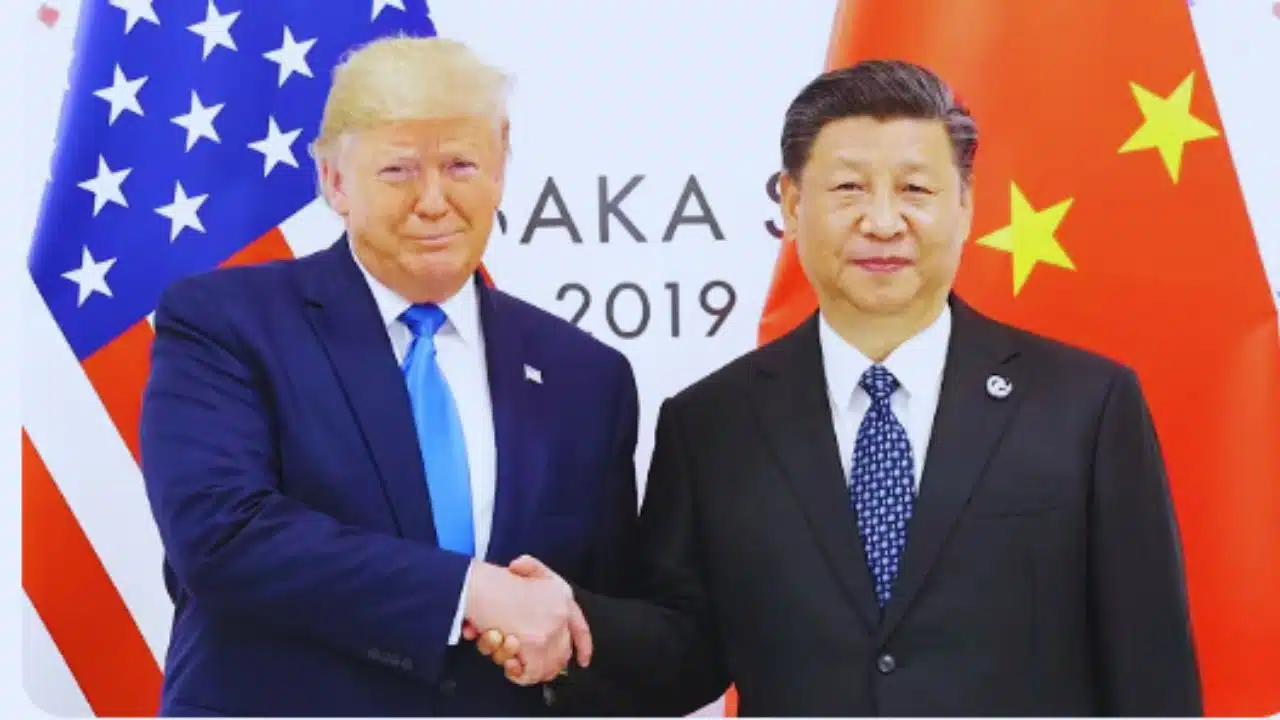
President Donald Trump is embarking on a high-stakes, multi-nation tour of Asia this week, culminating in a critical Trump Xi Jinping meeting, even as the U.S. federal government remains paralyzed by a 26-day-long shutdown.
The decision to proceed with the trip, which includes stops in Malaysia, Japan, and South Korea, has ignited a fierce political firestorm in Washington. Democrats accuse the president of abdicating his domestic responsibilities, while the White House insists that high-level diplomacy with China cannot be held hostage to partisan gridlock.
This move marks a stark departure from the president’s handling of the record-breaking 2018-2019 shutdown, during which he famously canceled his own and other officials’ international travel, including his delegation’s trip to the World Economic Forum in Davos.
A Divided Focus
- The Shutdown: The U.S. government entered a partial shutdown on October 1, 2025, after Congress failed to pass appropriations bills. As of October 26, it has lasted 26 days, furloughing hundreds of thousands of federal workers.
- The Trip: President Trump is scheduled to depart late Friday for Asia, attending the Association of Southeast Asian Nations (ASEAN) summit in Malaysia, followed by bilateral meetings in Japan, and the Asia-Pacific Economic Cooperation (APEC) summit in South Korea.
- The Summit: The White House has confirmed a bilateral Trump Xi Jinping meeting is scheduled for Thursday, October 30, 2025, in South Korea.
- The Stakes (China): The agenda is dominated by efforts to de-escalate a renewed trade war, U.S. demands on fentanyl trafficking, and discussions on global conflicts, including Ukraine and the Middle East.
- The Stakes (Home): The shutdown hinges on a dispute over healthcare reforms demanded by Democrats, who have refused to pass funding bills without them.
A Tale of Two Shutdowns
The president’s decision to travel during the current impasse presents a dramatic contrast to his strategy during the longest shutdown in U.S. history, which ran from December 22, 2018, to January 25, 2019.
2019: The “Hostage” at Home
During the 35-day shutdown over funding for a U.S.-Mexico border wall, President Trump cast himself as a leader singularly focused on the domestic crisis. He remained in Washington over the Christmas holiday, tweeting on December 24, 2018, “I am all alone (poor me) in the White House waiting for the Democrats to come back and make a deal on desperately needed Border Security.”
His most prominent move was the public cancellation of his trip to Davos, Switzerland. On January 10, 2019, he tweeted that he was “respectfully cancelling my very important trip” due to “the Democrats intransigence on Border Security” (Euractiv, Jan. 11, 2019). He later grounded a planned congressional delegation trip for House Speaker Nancy Pelosi, citing the shutdown. The message was clear: all focus must be on the domestic border dispute, and international travel was a luxury that could not be afforded.
2025: “Business as Usual” Diplomacy
Today, the political calculus has evidently shifted. With the government now shuttered for nearly four weeks, President Trump is projecting an image of “business as usual,” arguing that the nation’s foreign policy objectives cannot be paused.
The Washington Post noted that this approach is markedly different, with the president maintaining a schedule of international travel and meetings, including a stop in the Middle East to support a ceasefire deal.
Critics argue this demonstrates a profound disregard for the furloughed federal workers and the disruption of government services. Senate Minority Leader Chuck Schumer lambasted the president’s travel plans, accusing Trump of “running away” from the crisis.
It is outrageous for the president to leave the country while Americans suffer,” Schumer stated in a fiery Senate speech. “Shouldn’t the president listen to the cares of the American people… rather than taking a foreign trip?.
White House Press Secretary Karoline Leavitt has defended the trip, formally confirming the meeting with President Xi and emphasizing that the president can manage both foreign and domestic issues. President Trump will participate in a bilateral meeting with President Xi… before departing to return home,” Leavitt confirmed, brushing off criticism of the timing.
Some Republican operatives have suggested that the president’s distance may even be strategic, allowing congressional leaders to handle negotiations without his unpredictable interventions, which complicated talks in 2019.
High-Stakes Agenda at the Trump Xi Jinping Meeting
The president is flying into a complex diplomatic storm. The Trump Xi Jinping meeting is viewed by all sides as a critical, if unlikely, opportunity to place a floor under the rapidly deteriorating U.S.-China relationship. While officials from both nations have downplayed expectations for a major breakthrough, the agenda is packed with urgent, combustible issues.
1. The Renewed Trade War
Unlike the relative calm of the 2017 “state visit” to Beijing—which yielded over $250 billion in non-binding deals (The White House Archives, Nov. 9, 2017)—the 2025 meeting occurs under the shadow of new tariff threats.
- Tariff Threats: President Trump has threatened to raise tariffs on Chinese imports to a total of 155% as soon as November 1 if a deal is not struck.
- Tech and Minerals: The conflict has expanded beyond simple tariffs. Washington has imposed restrictions on high-end computer chips flowing to Beijing, while China has retaliated by curbing exports of critical rare earth minerals, which are vital for U.S. defense and technology sectors.
2. The Fentanyl Crisis
President Trump has signaled he will take a personal and aggressive stance on China’s role in the fentanyl epidemic. In remarks to reporters this week, the president was unequivocal about his primary talking point.
“I’m meeting with President Xi… The first question I’m going to be asking him about is fentanyl,” Trump said, accusing China of using third-party countries to evade controls on the synthetic opioid’s precursors.
3. Global Conflicts and “Peacemaking”
The president, who has branded himself as a global peacemaker during his second term, is expected to leverage the meeting to discuss global stability. The agenda reportedly includes discussions on the war in Ukraine, the fragile ceasefire in the Middle East, and a regional conflict between Thailand and Cambodia, for which Trump may attempt to oversee a ceasefire signing in Malaysia.
A Gamble on Two Fronts
President Trump is wagering that he can project strength abroad while simultaneously blaming Democrats for the gridlock at home. He is betting that American voters and global partners will see a president at work, rather than one fleeing a domestic political fire.
Experts, however, remain skeptical of a major diplomatic reset. Ryan Hass, a senior fellow at the Brookings Institution, tempered expectations for the Xi meeting, suggesting it will be a “data point along an existing continuum rather than an inflection point in the relationship” (Brookings Institution, Sept. 2, 2025).
The immediate political test will come upon his return. If the shutdown persists, the images of diplomacy in Asia will be weaponized by his opponents as evidence of a president detached from the daily struggles of his own government. But if his team secures even a minor concession from Beijing—be it on fentanyl or a pause in the trade war—the White House will frame the trip as a validation of its “America First” diplomacy, arguing that a strong president cannot be deterred by domestic squabbles.
For now, as Air Force One prepares for its trans-Pacific flight, hundreds of thousands of U.S. federal workers remain off the job, waiting to see which of the president’s two major challenges—the one at home or the one in Asia—blinks first.
The Information is Collected from CBS News and CNN.