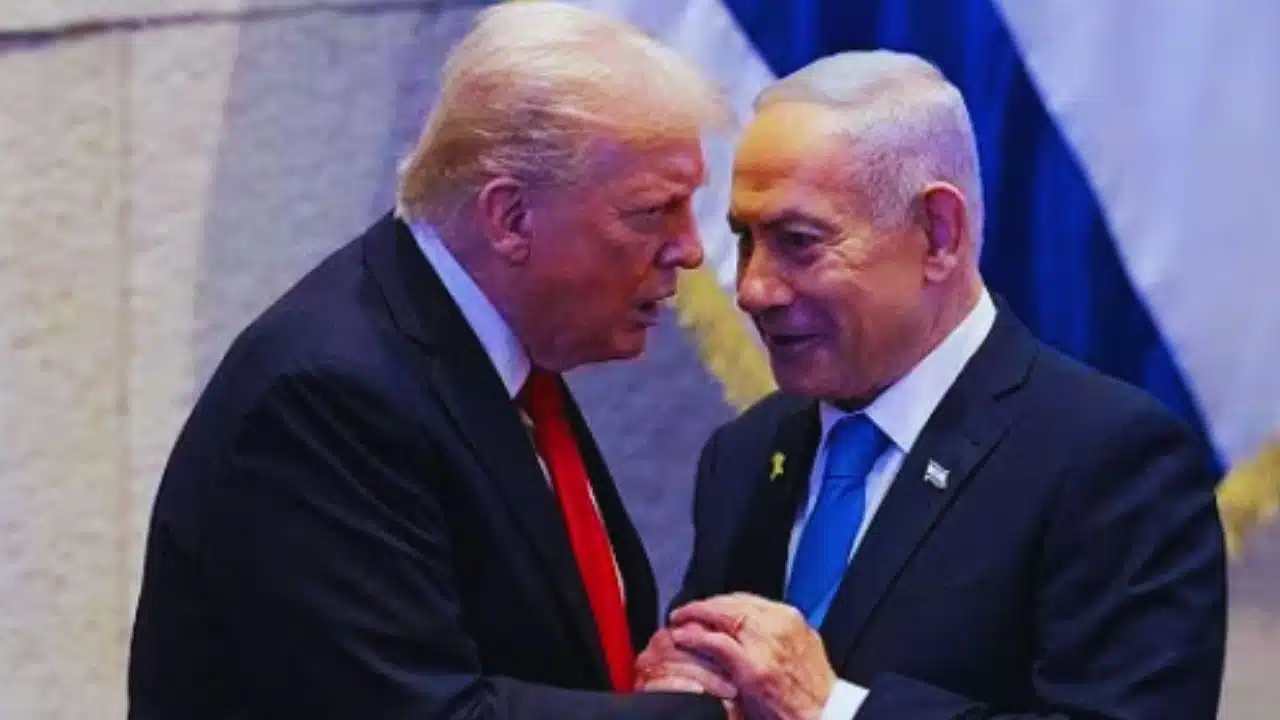
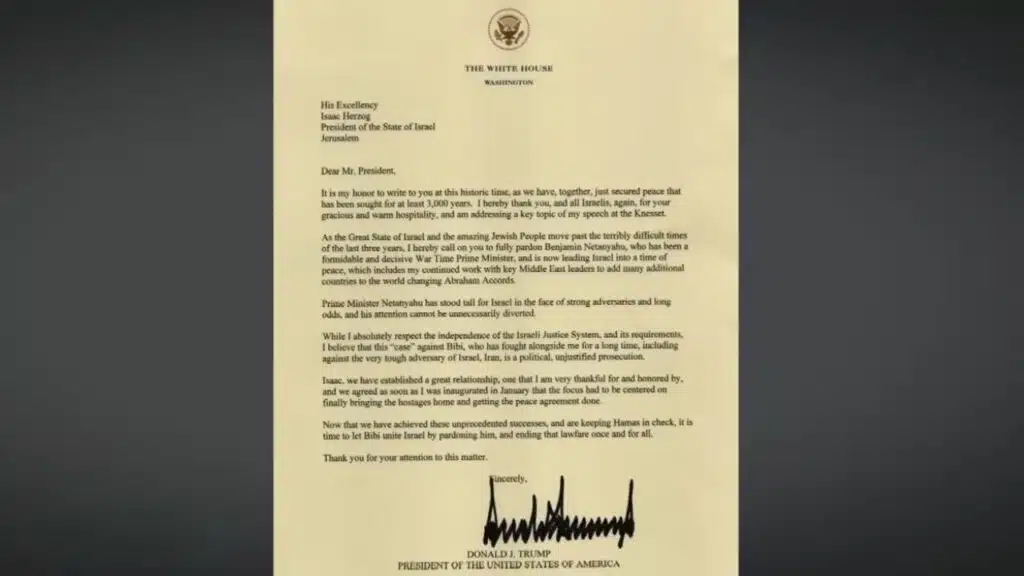
U.S. President Donald Trump has sent a formal letter to Israeli President Isaac Herzog, urging him to grant a “full and unconditional pardon” to Prime Minister Benjamin Netanyahu, who has been on trial for years over corruption charges. The move has stirred intense debate both within Israel and internationally, as it touches on sensitive issues of judicial independence, political alliances, and U.S. influence on Israeli affairs.
Trump’s letter—written in his typically assertive tone—praised Netanyahu as a “formidable and decisive War Time Prime Minister” and described his ongoing trial as a “political, unjustified prosecution.” While Trump insisted he “absolutely respects the independence of Israel’s justice system,” he maintained that the case against Netanyahu was rooted in politics rather than justice. Trump framed his appeal as an act of friendship and solidarity with a leader he called “a great ally who stood shoulder to shoulder with me” during critical moments, including efforts to counter Iran’s regional ambitions and advance Middle East peace agreements.
President Herzog’s office confirmed receipt of the letter, describing Trump as a “great friend of Israel” and expressing appreciation for his long-standing support of the country. However, the office also clarified that under Israeli law, any individual seeking a presidential pardon must file a formal request through established legal procedures. Herzog’s statement was diplomatic, balancing respect for Trump’s influence with a firm reminder that Israel’s legal processes are sovereign and must be followed.
Netanyahu, responding via his social media account on X (formerly Twitter), thanked Trump for what he called “incredible support.” He wrote, “As usual, you get right to the point and call it like it is. I look forward to continuing our partnership to bolster security and expand peace.” His message reflected both gratitude and political calculation—an acknowledgment of his alliance with Trump and a signal to his domestic base that his leadership still commands international backing.
Netanyahu’s legal troubles, which began in 2020 when he became the first sitting Israeli prime minister to stand trial, stem from three separate cases. In the first, prosecutors allege he received lavish gifts, including cigars and champagne, from wealthy businessmen in exchange for political favors. The second case centers on claims that he offered regulatory benefits to the owners of an Israeli newspaper in exchange for more favorable coverage. The third case involves allegations that he supported decisions benefiting a telecom company’s controlling shareholder in return for positive reporting on a news website. Netanyahu has denied all charges, labeling them a “witch hunt” orchestrated by his political opponents to remove him from power.
The legal proceedings have dragged on for years, becoming a defining feature of Israeli politics and polarizing public opinion. Supporters of Netanyahu, particularly within his Likud party and among right-wing voters, see him as a victim of judicial overreach and media bias. They argue that the cases are politically motivated attempts to undermine a leader who has repeatedly won elections and maintained Israel’s strategic strength amid regional turmoil. Critics, however, view Netanyahu’s defense as an assault on Israel’s institutions. They warn that granting him a pardon—especially before a verdict is reached—would erode public trust in the rule of law and diminish Israel’s reputation as a robust democracy.
President Herzog holds the constitutional authority to issue pardons, but historically, such actions are reserved for those who have been convicted and have demonstrated remorse. According to Israel’s Basic Law, the president “has the power to pardon criminals and to reduce or commute sentences.” However, the High Court of Justice has previously ruled that a president can, under rare circumstances, issue a pardon before conviction if doing so serves the public interest or reflects extraordinary humanitarian reasons. In Netanyahu’s case, such a move would be legally possible but politically explosive.
The controversy over Trump’s intervention deepened because of the timing. It came just weeks after Trump had helped broker a ceasefire between Israel and Hamas, marking a rare moment of de-escalation following two years of intense conflict. During a speech to the Israeli parliament, Trump had offhandedly remarked that Herzog should “pardon Bibi”—Netanyahu’s nickname—saying, “Cigars and champagne, who the hell cares about that?” That comment, once dismissed as rhetoric, has now materialized into an official diplomatic appeal.
Israel’s far-right National Security Minister Itamar Ben-Gvir quickly supported Trump’s request, urging Herzog to “listen to President Trump” and arguing that Netanyahu’s trial had become “an indictment against the prosecution itself.” Ben-Gvir claimed that the proceedings had exposed “carelessness and misconduct” within Israel’s justice system and that the time had come to end what he described as “a five-year persecution.”
Opposition leader and former Prime Minister Yair Lapid, however, condemned the appeal in sharp terms. Posting on X, Lapid wrote, “Reminder: Israeli law stipulates that the first condition for receiving a pardon is an admission of guilt and expression of remorse.” He later addressed parliament, warning, “There comes a moment when people must tell themselves—we are a sovereign country. We must also say ‘no’ to an American president. There is a limit to interference.” His statement captured a growing sentiment among many Israelis that foreign figures, even allies, should not influence domestic judicial matters.
The broader political context magnifies the significance of Trump’s letter. For years, Israel has been divided over Netanyahu’s leadership, particularly over his government’s controversial plans to reform the judiciary. Critics argued that the proposed reforms—intended to curb the powers of the Supreme Court—were an assault on judicial independence. The issue sparked mass protests throughout 2023, with hundreds of thousands of Israelis taking to the streets. Those demonstrations subsided only after the October 7, 2023 Hamas attacks on Israel triggered a war in Gaza, uniting the country under emergency conditions.
Trump’s intervention now reopens old wounds, highlighting the delicate balance between loyalty and legality in Israel’s political landscape. For Netanyahu’s supporters, a pardon could restore a sense of justice and close what they see as a politically motivated ordeal. For his opponents, it would symbolize a dangerous erosion of accountability and further blur the line between politics and law.
For Israel’s President Herzog, the situation presents a diplomatic and constitutional test. He must weigh respect for a former U.S. president and Israel’s most influential ally against the sanctity of Israel’s judicial process and public confidence in the rule of law. Though the law allows him to pardon Netanyahu, doing so without a formal request or court conviction would set a precedent that future leaders could exploit.
As of now, Netanyahu has not submitted a formal pardon request, and no official move has been made by the president’s office to consider one. However, speculation in Israeli media suggests that Netanyahu’s allies may be preparing such a request quietly, calculating the political timing carefully. If it happens, it could trigger one of the most consequential constitutional decisions in Israel’s modern history.
For the United States, Trump’s appeal underscores his continued involvement in Israeli affairs even after leaving office. It also reflects his enduring alliance with Netanyahu, forged during their collaboration on the Abraham Accords, the U.S. embassy move to Jerusalem, and their shared hardline stance on Iran. His letter, while personal in tone, carries unmistakable political undertones—reminding both Israelis and Americans of his influence in global politics.
As Israel faces the twin challenges of rebuilding after the Gaza conflict and restoring faith in its democratic institutions, Trump’s intervention adds a new layer of complexity. Whether or not Herzog acts on the appeal, the discussion has reignited old debates about power, accountability, and the independence of the judiciary.
For now, Netanyahu remains defiant, continuing to lead his government while fighting corruption charges in court. His supporters see Trump’s letter as validation, a gesture from one embattled populist leader to another. His critics see it as a troubling reminder of how political loyalty can threaten democratic norms. The outcome—whether a pardon, a conviction, or a prolonged stalemate—will shape not only Netanyahu’s legacy but also Israel’s identity as a state governed by both strength and law.
Israel’s Political Future at a Crossroads
The controversy surrounding Trump’s letter has placed Israel at a crossroads—between loyalty to allies and adherence to democratic principles. For many Israelis, the question now is not only whether Netanyahu should be pardoned, but what kind of country Israel wants to be.
Those who support a pardon argue that Netanyahu’s decades of leadership—his efforts to safeguard Israel, normalize relations with Arab states, and maintain a strong economy—should outweigh allegations of personal misconduct. They point out that his leadership during wartime and his role in stabilizing Israel’s international standing justify leniency.
Opponents argue that such reasoning is dangerous. They believe that justice must apply equally to all, regardless of political stature. Pardoning a sitting prime minister before a verdict would, in their view, send a message that power grants immunity. That perception, they warn, could damage Israel’s moral authority both domestically and abroad.
In the coming weeks, much will depend on Netanyahu’s next move—whether he formally seeks a pardon or continues to fight the charges in court. Either way, the political and legal reverberations of Trump’s intervention are likely to be felt for months, perhaps years, to come.
At its core, this episode reveals the tension between political loyalty and judicial integrity—between friendship and sovereignty. It is a moment that will test not only Israel’s leaders but the strength of its democracy itself.