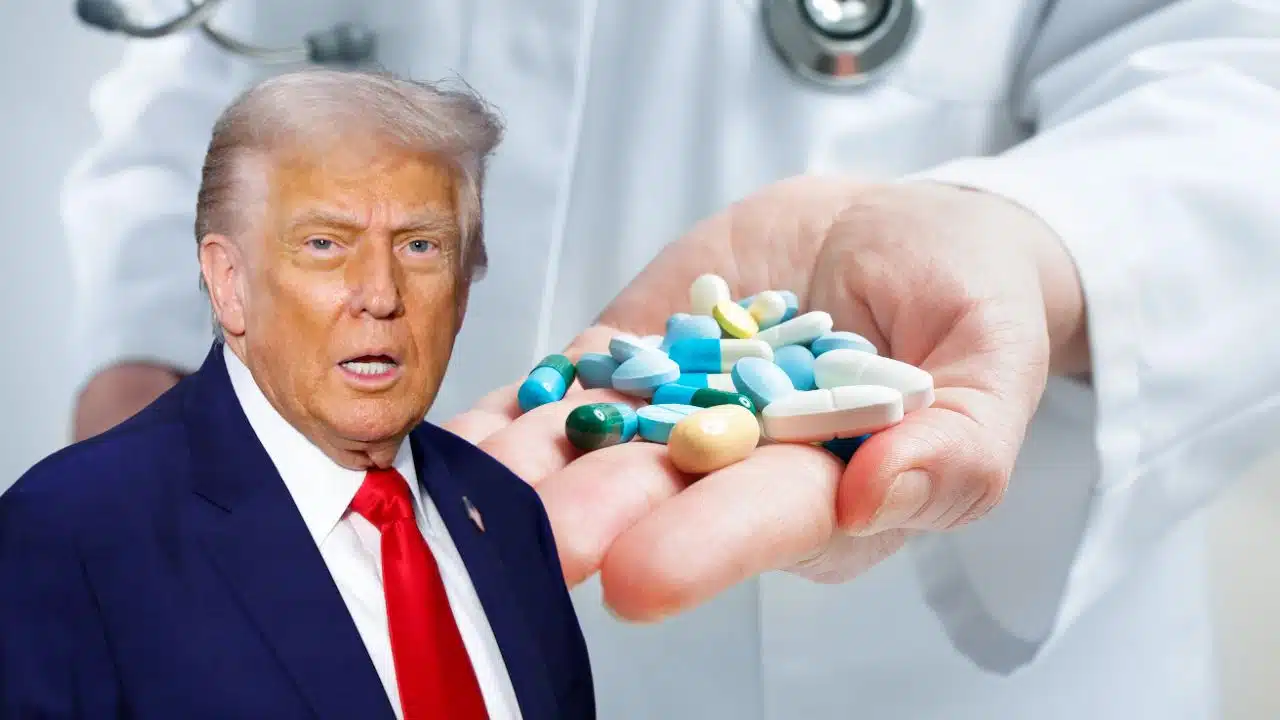
In a dramatic announcement on September 25, 2025, U.S. President Donald Trump revealed that all branded and patented pharmaceutical drugs imported into the United States will face a 100% tariff starting October 1. The measure is part of his administration’s broader push to re-shore manufacturing and reduce reliance on foreign suppliers.
The President clarified that the only exemption would be for companies actively constructing manufacturing plants on U.S. soil. “Breaking ground or being under construction is the deal. No exceptions,” Trump declared on Truth Social, emphasizing that his administration is determined to bring high-value drug production back to America.
This new tariff policy comes alongside a fresh wave of U.S. import duties targeting furniture, trucks, and household items, underscoring Trump’s strategy of sector-wide tariff hikes as both an economic and political tool.
Why Pharmaceuticals Are in the Spotlight
Pharmaceuticals are among the most lucrative global industries, and the U.S. is the world’s largest drug market, valued at over USD 600 billion annually. Branded drugs, typically developed by multinational giants, carry higher price tags because they are still under patent protection. These medicines account for most of Big Pharma’s profits, but they are also the most sensitive to trade barriers because they rely on global supply chains and international patents.
By doubling the cost of imported branded drugs overnight, Trump’s move is aimed at forcing companies like Pfizer, Novartis, Roche, and Sanofi to ramp up U.S. production. It also signals that pharmaceutical supply chains are now a matter of national security, much like semiconductors and clean energy in earlier tariff waves.
Where Does India Stand in the Global Pharma Map?
India is often called the “Pharmacy of the World” because of its massive role in supplying low-cost medicines. According to the Pharmaceuticals Export Promotion Council of India (Pharmexcil), Indian drug exports were valued at USD 25.4 billion in FY25, with the United States accounting for roughly USD 10 billion—about one-third of total exports.
However, the key difference lies in what India exports. Over 90% of India’s U.S.-bound medicines are generics—drugs no longer under patent and typically much cheaper than branded alternatives. Indian companies like Sun Pharma, Dr. Reddy’s, Cipla, Lupin, and Aurobindo Pharma have built their fortunes supplying generics to the U.S. healthcare system, which relies on them to keep costs manageable.
This means that the immediate direct hit is limited. Trump’s 100% tariff is targeted only at branded, patented drugs—not generics.
The Immediate Market Reaction in India
Despite generics being spared, the announcement rattled investor sentiment. On September 26, Indian pharmaceutical stocks suffered a sharp sell-off:
- The Nifty Pharma index dropped nearly 2.6% in early trade, its steepest fall in months.
- All 20 components of the index turned red, reflecting broad-based panic.
- Major companies saw significant dips: Sun Pharma fell 3.4%, Cipla and Dr. Reddy’s each dropped more than 2%.
The sell-off was fueled by fears of “scope creep”—that future tariffs could extend to complex generics, biosimilars, and specialty medicines, which are critical export categories for India.
Experts Weigh In: Real Risks vs. Market Panic
Limited direct impact
According to the Indian Pharmaceutical Alliance (IPA), which represents major Indian drugmakers, “The tariffs announced are not applicable to generics, which form the backbone of Indian exports.” The group noted that many Indian firms already operate packaging and production units in the U.S., which shields them from sudden shocks.
Sentimental impact on markets
However, market analysts stressed that sentiment alone can drive volatility. Dr. VK Vijayakumar, Chief Strategist at Geojit Financial Services, said that while Indian pharma exports may not face immediate business risks, the fall in stock prices reflects investor anxiety about longer-term threats.
Warning of a slippery slope
Other experts, like Rahul Ahluwalia of the Foundation for Economic Development, cautioned that while India’s generics are safe for now, “This is a troubling sign for the future development of the pharma industry in India. It underscores the urgency of securing trade deals with the U.S. and EU to ensure continued market access.”
Brokerage views
Choice Institutional Equities issued a note saying that the U.S. accounts for nearly 35% of India’s pharma exports, valued at USD 10 billion in FY25. While the 100% tariff targets only branded drugs, “ambiguity remains regarding complex generics and specialty medicines,” leaving room for future risks.
Broader Implications Beyond India
Trump’s move is part of a shift from country-specific tariffs to product-specific tariffs. Earlier tariff rounds hit steel, aluminum, EVs, and tech components. By extending them to pharmaceuticals, Trump is signaling that no sector is off-limits.
This has global implications:
- Healthcare costs in the U.S. could rise if companies pass on tariff burdens to patients.
- Global supply chains may see more companies setting up U.S. plants, raising costs but ensuring market access.
- Other countries exporting branded drugs—such as Switzerland, Germany, and Ireland—are likely to be hit harder than India.
- Trade tensions with allies could deepen, especially in Europe, where many branded drugs are manufactured.
Strategic Options for Indian Pharma
Given the uncertainty, experts say Indian drugmakers and policymakers should take proactive steps:
- Accelerate U.S.-based operations: Building or expanding manufacturing and packaging plants in the U.S. would provide immunity from tariffs.
- Diversify markets: Expanding aggressively into Europe, Latin America, Africa, and Asia could reduce dependence on the U.S. market.
- Invest in high-value drugs: Indian firms could move further into complex generics, biosimilars, and specialty treatments, which are harder to replace.
- Strengthen domestic R&D: By boosting innovation, Indian companies can climb the value chain rather than relying only on low-margin generics.
- Government diplomacy: India may seek to negotiate exemptions or trade guarantees with Washington as part of broader bilateral talks.
Should India Be Worried?
- Short-term outlook: The immediate impact on India’s pharma exports is minimal, since generics remain exempt. Investors, however, may continue to see volatility.
- Medium-term risks: The lack of clarity around complex generics and specialty drugs leaves room for concern.
- Long-term picture: Trump’s announcement underscores a new era of trade protectionism. Indian pharma must prepare for a world where tariff walls can rise suddenly, even in traditionally open markets like the U.S.
In other words: India doesn’t have to panic yet—but it must prepare.
The Information is Collected from India Today and The Hindu.