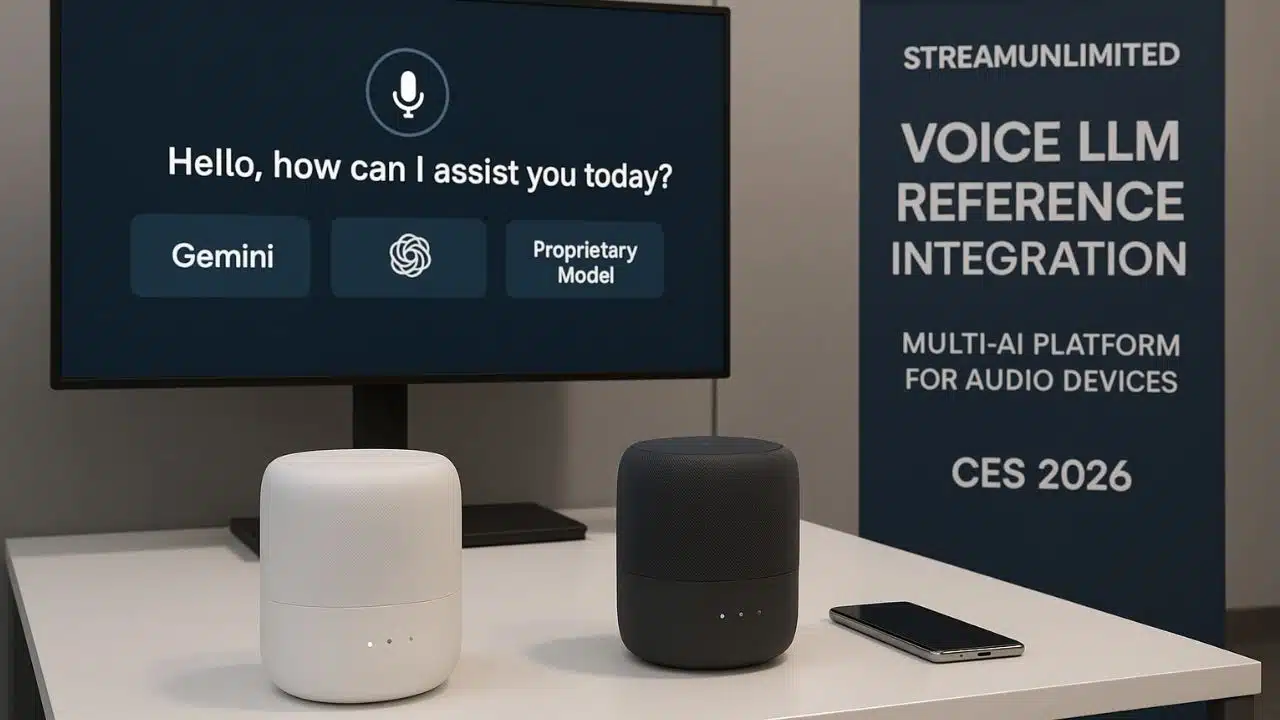
StreamUnlimited is preparing to make a major statement at CES 2026 with the debut of its Voice LLM Reference Integration, a platform designed to change how voice assistants function inside audio devices. Instead of being tied to a single ecosystem such as Amazon Alexa or Google Assistant, audio manufacturers will now have the ability to integrate multiple AI voice systems into their products at the same time.
This new integration system, which operates on the company’s long-standing StreamSDK framework, allows brands to choose from major AI models including Google’s Gemini, OpenAI’s ChatGPT, or bespoke in-house AI agents. The platform’s primary promise is flexibility: manufacturers can mix and match the components of a voice assistant — such as automated speech recognition, the large language model powering the responses, or the text-to-speech engine — without needing to rebuild or reengineer the underlying hardware.
By offering this level of modularity, StreamUnlimited is positioning itself as a key enabler for device makers who want to remain competitive in a rapidly shifting AI landscape. Given how fast AI models improve and how frequently vendors make ecosystem changes, manufacturers need technology that can evolve without massive redevelopment costs. The company’s new system aims to solve exactly that problem, offering a modernized, future-proof architecture for any audio product seeking advanced voice AI capabilities.
A Break from Big-Tech Ecosystem Lock-In
One of the defining themes of StreamUnlimited’s announcement is its push to free device makers from the restrictive nature of existing smart-speaker ecosystems. For the past decade, the market has been dominated by platforms built around Amazon Alexa and Google Assistant. These systems are powerful, but they come with strict certification, hardware requirements, and cloud dependency.
This structure has left many manufacturers dependent on decisions made by Amazon, Google, or other major tech platforms. If a voice assistant changes its policies, deprecates certain features, or shifts to a subscription-based model, device makers must adapt — sometimes at significant cost. The smart speaker market, projected at over $15 billion in 2025, has felt pressure as companies look for more control over their products and customer experience.
StreamUnlimited’s multi-AI approach challenges that old model. With the ability to switch between different AI backends, manufacturers can maintain autonomy. If a certain AI provider changes pricing or introduces content restrictions, they can pivot to a different LLM without replacing hardware or redesigning entire audio lines.
The company’s CTO, Markus Rutz, emphasized that the goal is not just to support multiple voice assistants, but to let OEMs evolve in real time as AI rapidly advances. With large language models now improving on a monthly basis, flexibility has become a critical differentiator. StreamUnlimited’s integration model effectively ensures that audio brands can keep up with advances in generative AI, home automation, and natural language interfaces without depending on a single cloud ecosystem.
The initiative also reflects the company’s history: StreamUnlimited has spent nearly a decade integrating major cloud voice systems into products across both mass-market and high-end audio categories. This includes consumer brands, custom installation manufacturers, and companies producing multi-room or premium smart audio systems. The firm, founded in 2005 and employing more than 120 people across global offices, brings deep experience in streaming technologies, voice integration, and embedded software — all of which support the credibility of this new platform.
Hardware Platforms and Market Positioning for the Voice LLM Solution
To support its voice-AI integration system, StreamUnlimited will offer the platform pre-integrated across three hardware modules. Each module is engineered for a different tier in the audio-device market, expanding the potential reach from basic smart speakers to advanced, multi-channel home audio systems.
The Stream210 serves as the mainstream, cost-effective option. It includes integrated Wi-Fi and Bluetooth with LE Audio support, enabling efficient wireless capabilities. Its design supports over-the-air updates, enabling manufacturers to continually improve device performance or integrate new AI models without physical alterations. This module is expected to be widely adopted for everyday smart speakers, tabletop devices, and entry-level networked audio products.
For larger or more premium devices, StreamUnlimited offers the Stream1955 and Stream1832 modules. These are built for multi-driver smart speakers, Dolby-class soundbars, and high-spec custom installation devices found in home theaters or multi-room audio systems. They deliver greater processing power, support for multiple microphones, higher-fidelity audio pathways, and expanded connectivity options. Manufacturers building flagship devices or premium sound solutions are expected to adopt these modules to offer richer voice interactions, more accurate far-field microphone performance, and smoother integration of high-end audio features with AI.
By aligning the Voice LLM platform with multiple hardware options, StreamUnlimited is presenting an end-to-end solution that works across the entire audio product spectrum. Whether a brand is building an inexpensive smart speaker or a luxury soundbar with cinematic output, the company’s modules allow seamless integration of advanced AI assistants without redesigning around a proprietary voice system. This versatility may encourage broader adoption across the industry.
The Shift Toward AI-Driven Voice Assistants in the Global Market
StreamUnlimited’s announcement comes at a time of major transition in the voice assistant landscape. Across the industry, leading tech companies are rolling out new AI-based systems that rely heavily on generative models. Google recently began transitioning its ecosystem toward Gemini for Home, bringing generative AI features to smart speakers and displays. Amazon likewise has begun promoting Alexa+, a more advanced subscription-based assistant that integrates generative AI features and deeper personalization.
These shifts highlight a growing pattern: next-generation assistants depend on large language models capable of reasoning, multi-step logic, contextual memory, and more human-like conversation. But they also introduce new considerations around licensing, cloud costs, privacy, and monetization. With some advanced features now tied to subscription plans, manufacturers face higher uncertainty when selecting a single AI partner.
StreamUnlimited’s multi-AI platform weaves directly into this changing environment. Instead of committing to one AI model or subscription ecosystem, brands can give consumers more options and reduce their dependency on any single provider. This could be especially important for global markets where regional preferences differ — for example, where certain countries might favor specific LLM providers due to language support, data policies, or regional cloud infrastructure.
The introduction of multiple AI models within the same device could also reshape consumers’ expectations. In the future, users may be able to switch between assistants depending on the type of task — such as using one model for home-automation commands, another for general knowledge queries, and a third for creative or writing tasks. Such multi-agent functionality represents a new generation of voice-enabled devices that go beyond the binary “Alexa or Google” options that currently dominate the market.
Live CES Demonstrations and the Road Ahead for Audio AI Integration
StreamUnlimited will demonstrate its Voice LLM Reference Integration in a private suite at the Venetian Hotel during CES 2026. These demonstrations are expected to showcase how different AI models can run on the same device, how manufacturers can swap individual components with minimal friction, and how the system maintains performance and audio quality even when switching between cloud-based and local AI engines.
The company’s participation in CES marks a strategic moment. As consumer electronics brands increasingly explore generative AI capabilities, StreamUnlimited is positioning itself as a critical technology partner for audio manufacturers looking to modernize their product portfolios. By offering a future-ready architecture and modular framework, the company is not just responding to current industry demands — it is aiming to shape the next phase of voice-enabled audio technology.
With AI assistants becoming more conversational, more personalized, and more deeply integrated into smart home ecosystems, the ability to support multiple AI models could give device makers a powerful competitive edge. StreamUnlimited’s platform places them at the intersection of audio engineering and advanced AI integration, setting the stage for smarter, more adaptable audio products in 2026 and beyond.