Traveling as a family sounds like a dream, right up until you realize school does not fit into a suitcase. Many parents working remotely or living the digital nomad lifestyle struggle with one big question: How can I make sure my child keeps up with learning while we’re always on the move? It’s tough to choose between regular classes, homeschooling, online programs, or jumping straight into local schools around the world. But you are not alone in this challenge.
One interesting fact is that there are now more options than ever for families who live life on the go. Some pick global programs, others mix travel with learning (this is called “worldschooling”), and some lean into full-time virtual classrooms.
If you feel lost about Schooling Options For Nomad Family adventures, I’m here to help. I’ve dug into the data and resources to lay it all out simply for you. So, grab a cup of coffee, and let’s go through it together. I’ll show you the exact schooling choices that actually work for your wild and wonderful lifestyle.
What is a Nomad Family?
A nomadic family moves from place to place instead of staying in one home. Parents may work online or have jobs that allow them to travel. Children live and learn on the go, often visiting new countries or cities each month or even week.
According to a 2024 report by MBO Partners, there are over 18.5 million digital nomads in the United States alone, and about 26% of them travel with children. This isn’t just a fringe movement anymore; it’s a growing lifestyle with real infrastructure supporting it.
Some families stay in a country for months, setting up a temporary base in popular hubs like Playa del Carmen, Mexico, or Lisbon, Portugal. Others keep moving more quickly, hopping between Airbnbs every few weeks.
This lifestyle means kids might study at kitchen tables in Bali today, then read under palm trees next week in Mexico. They connect with local children at playgrounds or parks, pick up words from many languages, and see real-world math by counting coins from different countries.
Nomad families use technology to help with schooling and stay close as a team, no matter where they call “home” for the night.
Challenges of Schooling for Traveling Kids
Kids who travel often may feel like they never put down roots. Switching places all the time can make it hard to keep friends, join clubs, or play on sports teams. New schools might teach things in different ways or use textbooks that do not match up.
Missing lessons because of flights, time zones, or sickness throws off a good learning groove fast. For example, trying to attend a live Zoom class at 9 AM EST while you are in Thailand (where it is 9 PM) can lead to exhaustion and “travel fatigue” very quickly.
Paperwork alone can seem endless for parents doing family travel with their children’s education in mind. Each country sets its own rules for vaccines, language tests, grade levels—and even what counts as proof of learning.
Digital nomad families often need strong WiFi but find spotty connections at some destinations instead; this puts online classes at risk of falling behind. Homeschooling options require lots of planning and energy from grown-ups who already juggle remote work and childcare every day. These schooling hurdles lead families to explore creative solutions next.
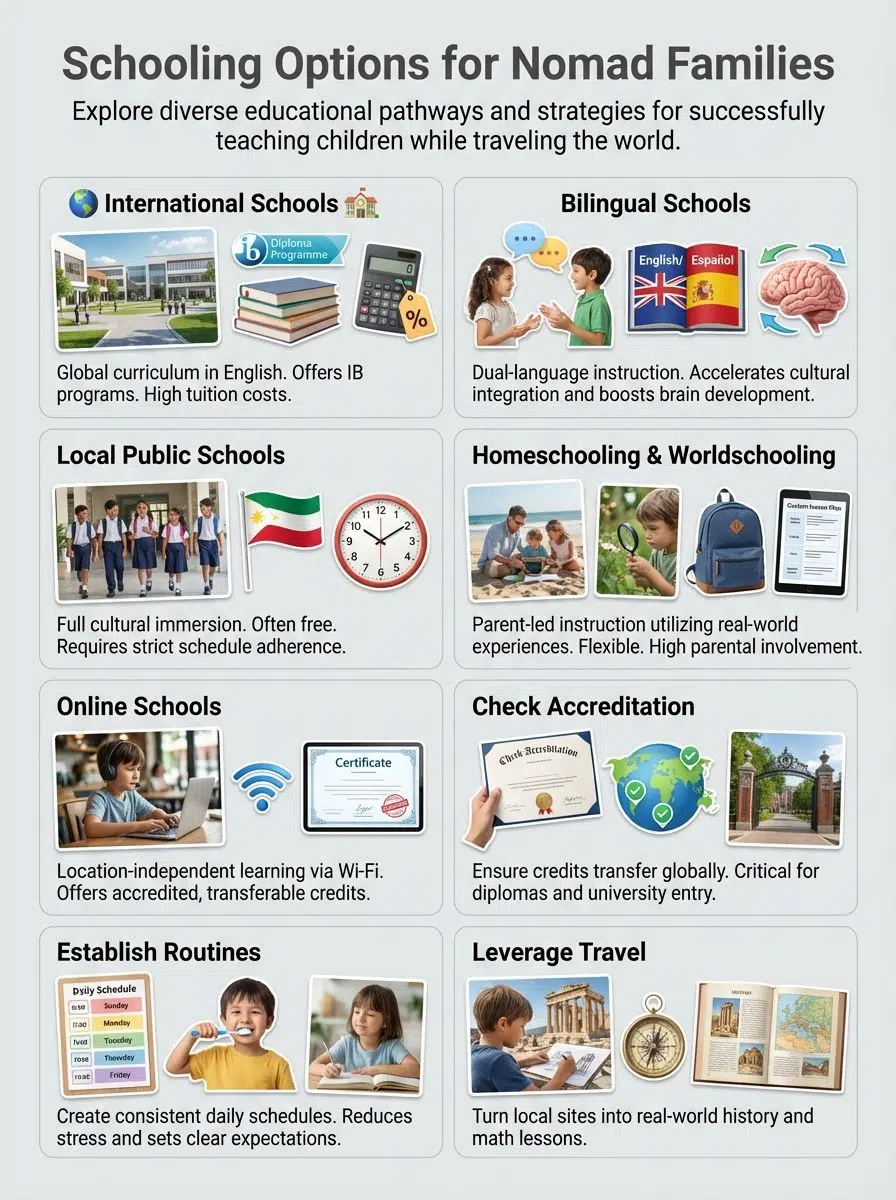
Schooling Options for Nomad Families
Nomad families have many ways to teach their kids on the road, so keep reading to find what might fit your travel lifestyle best.
International Schools
International schools teach classes in English or another major language, like French or Spanish. Kids can meet other students from all around the world. Many of these schools follow international programs, such as IB (International Baccalaureate) or Cambridge IGCSE.
This helps families keep a flexible curriculum while traveling for work, digital nomad jobs, or family travel adventures. Major networks like Nord Anglia Education have schools in dozens of countries, making transfers easier.
The teachers are often trained from different countries. Sports teams and clubs give children plenty of social time. However, tuition can be expensive.
Cost Context: According to the International Schools Database (2024), prices vary wildly by location. Schools in New York City can cost over $40,000 per year, while excellent schools in Malaysia or Thailand might cost closer to $5,000-$10,000.
Still, international schools offer strong educational resources and global citizenship skills to children moving across borders.
School is where kids learn about the world—even if class feels like it starts every time you pack your suitcase.
Bilingual Schools
Bilingual schools teach lessons in two languages. Kids might learn English and Spanish, French, or another local tongue. In Spain and France, many kids go to these kinds of schools.
Bilingual learning helps children adjust faster in new places. They pick up language skills while following a normal schedule. For example, in Spain, “concertado” schools (semi-private) often offer affordable bilingual education, though admission can be competitive.
Some schools use half the day for one language and switch after lunch. This style can boost brain development, sharpen focus, and support global citizenship goals.
Parents like these programs because their child makes friends from different countries while traveling for family work or remote jobs. Students may need help at first if they speak only one language; teachers often offer extra support during those early weeks.
Local (Public) Schools
Enrolling kids in local public schools lets them learn side by side with kids from the area. They pick up new languages fast and see real-life culture every day. Some countries offer free or low-cost spots for foreign students, but rules can change a lot between places and regions.
Public school classes might follow a strict schedule, so families must stick around longer. In countries like Portugal or Germany, you often need official residency status to enroll.
School days at these schools often start early and run through the afternoon, Monday through Friday. Kids may face big class sizes, unfamiliar customs, or language barriers at first, but they can find friends quickly once they adjust.
Choosing this path gives young nomads a deep look into daily life, where you travel next door to bilingual schools on our list of options for moving families.
Homeschooling and Worldschooling Hubs
Parents take charge of lessons with homeschooling. Kids might use workbooks, online classes, or projects at home or on the road. Most U.S. states allow families to homeschool if they follow simple rules like sending in paperwork once each year.
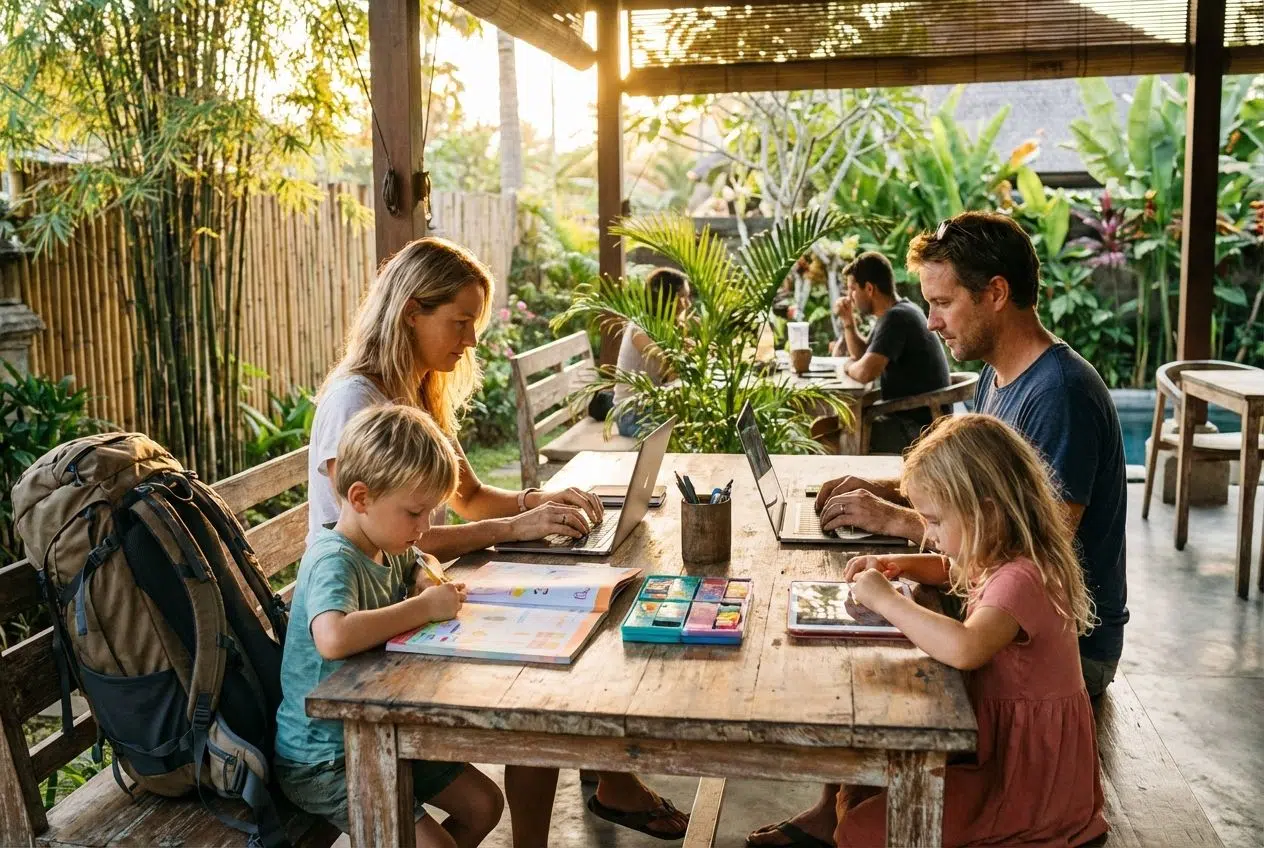
Pro-Tip: Many U.S. nomads maintain residency in states with “homeschool-friendly” laws, like Florida, Texas, or South Dakota, to simplify the legal paperwork while traveling abroad. Using a legal defense service like HSLDA can also provide peace of mind.
Worldschooling takes learning outside the classroom walls and uses real places and people as teachers. Families visit museums, explore markets, join local festivals, and learn languages while moving from one country to another.
Recently, “Worldschooling Hubs” have become a game-changer. Programs like Boundless Life (with locations in Portugal, Greece, Italy, and Bali) offer 3-month cohorts where families live in a community, and kids attend a “world school” together.
These kids gain global citizenship skills by meeting other children around the world and seeing many cultures up close every day. Many nomad families pick both options for flexible learning before considering online schools in their next step.
Online Schools
After trying homeschooling or worldschooling, some families lean into online schools for their kids. Digital nomad parents find these programs helpful because school happens wherever there’s Wi-Fi.
Online classes let children study English, math, science, and more at any time zone on the map. This is often the most stable option because the curriculum travels with you.
From Prisma to Wolsey Hall Oxford, many options exist for remote learning. Some offer live video lessons with teachers; others use self-paced workbooks and quizzes. Credits often transfer between countries if you pick an accredited program.
Families like this path since it mixes flexibility with structure during travels across continents or even just hopping different U.S. states in a camper van!
Popular Online Schools for Nomad Families
Smart families on the move have some cool online school choices, and you might find your child’s next classroom with just a click. Keep reading to discover which fits your adventures best!
Prisma Online School
Prisma Online School offers a flexible learning path for kids on the move. Classes run live in small groups, so children from Dubai, Bali, or Peru can join right in. Kids follow projects that fit their interests and meet global standards.
Prisma covers grades four through twelve and has rolling admissions, which means families do not need to wait for fall or spring. They are fully accredited by Cognia, ensuring the transcripts are valid for colleges.
Teachers at Prisma have strong backgrounds in remote learning and travel education. Many students connect across different time zones thanks to the digital platform. Parents get clear updates on progress with regular feedback and easy-to-read reports.

Cost Breakdown: Tuition is generally around $10,000 to $12,500 per year, which is significantly lower than that of many private international schools. They also offer a scholarship fund to help make it accessible.
Galileo XP
For families who want something less traditional and more self-directed, Galileo XP is a top choice among worldschoolers. It operates as a global online school that focuses on student-led learning, entrepreneurship, and digital skills.
Galileo is designed specifically for “unschoolers” and worldschoolers who want community without a rigid 8-hour-a-day schedule. Kids join “clubs” and “nanodegrees” that interest them, from coding to creative writing.
Families can pick how much or how little schoolwork fits their lives each week. Learning often connects with real places kids see on their trips; exploring cultural sites becomes part of history or social studies projects.
Tuition is generally more affordable than that of standard private schools, and the flexibility allows students to balance education with deep travel experiences.
Other Notable Options
Some nomadic families pick accredited programs like Keystone School or Laurel Springs. Both schools have strong records and offer flexible learning for kids who travel.
Comparative Options:
- Wolsey Hall Oxford: Perfect for families who want a British curriculum (Cambridge) while traveling. It’s self-paced and highly respected.
- Time4Learning: A budget-friendly tool (approx. $30-$40/month) that automates grading and lessons, often used by parents who want to handle the teaching themselves.
- Sora Schools: A project-based online high school similar to Prisma, known for its engaging, “future-focused” curriculum.
Families looking for global citizenship or child mobility often find these options helpful during family travel seasons or sudden moves. Each platform supports learning on the go, whether that means studying in a camper van or from a cozy rental abroad.
Key Factors to Consider When Choosing a Schooling Option
Every family has its own needs, and schooling is not one-size-fits-all. A few key things shape what will work best for your child’s learning on the move.
Curriculum Flexibility
Curriculum flexibility gives nomadic families breathing room. Online schools and worldschooling programs let parents pick subjects that fit their child’s interests, not just checkboxes on a list.
Some families mix local classes in Spain for Spanish language skills with science lessons online, keeping travel at the center of their daily learning. Others use global resources like Khan Academy or Prisma so kids can learn math while soaking up culture in Thailand or France.
Parents love that flexible education lets them pause for jet lag days and fill gaps as needed. It is easier to switch time zones, seasons, or even countries without missing out on reading or math practice.
Accreditation and Credit Transfers
Official accreditation proves that a school or program meets set education standards. This matters for nomadic families who want their kids to get valid diplomas, credits, or move between schools with less stress.
U.S.-based online schools like K12 and Laurel Springs have regional recognition (like WASC or MSA), so credits often transfer easily. Some European options use the International Baccalaureate (IB), which many countries accept.
Why It Matters: If your child plans to attend a university or play college sports (NCAA), attending an accredited school is often a strict requirement.
Credit transfers can get tricky while living the digital nomad lifestyle or choosing worldschooling paths. One country may ask for transcripts; another may need placement tests before accepting new students.
Ask each school about its rules before signing up. If you use a mix of travel education methods and formal classes, keep detailed records of work and grades; this helps avoid headaches down the road.
Cost and Budget
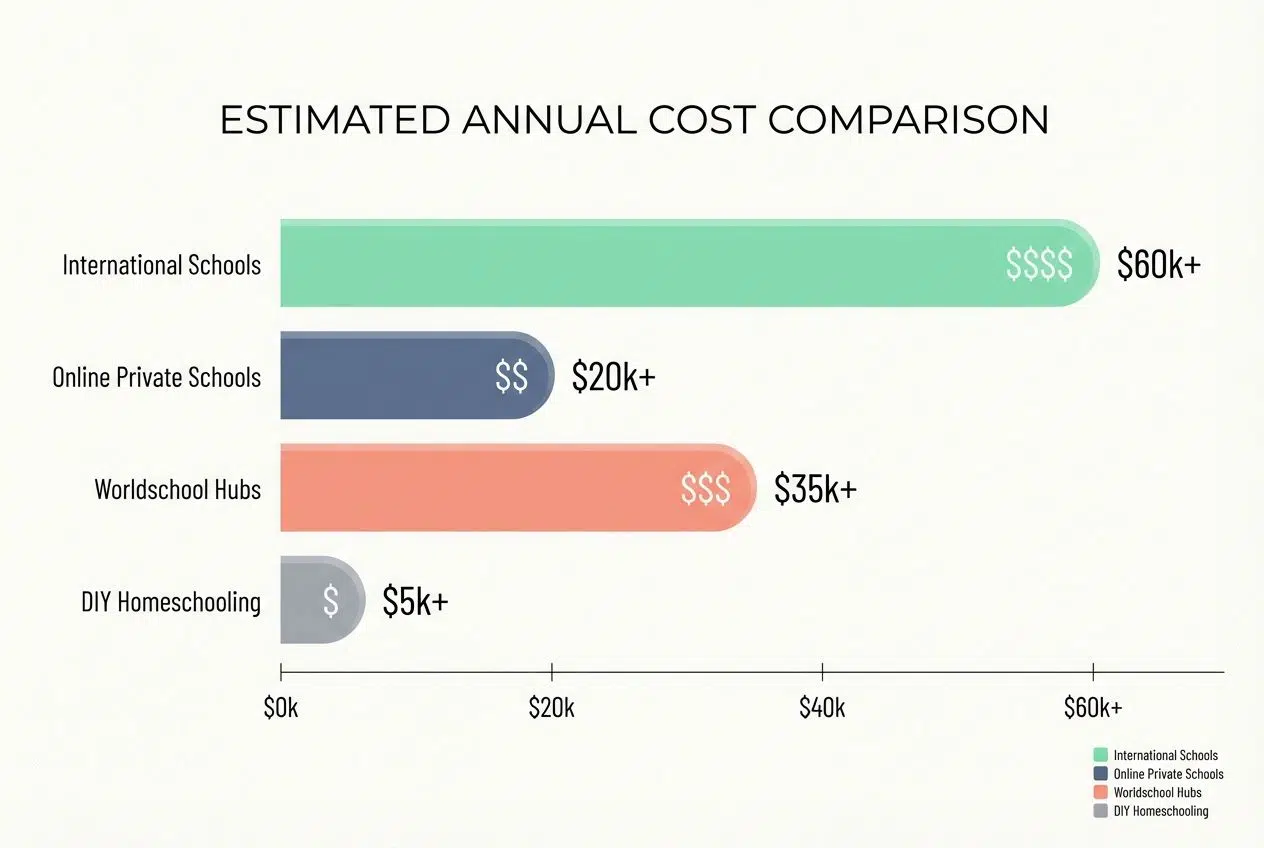
Costs can swing from low to sky-high, depending on your schooling choice. To help you compare, here is a quick look at the estimated annual costs for 2026/2027:
| School Type | Estimated Annual Cost | Best For |
|---|---|---|
| International Schools | $15,000 – $40,000+ | Stability, prestige, and seamless transfers. |
| Online Private Schools | $6,000 – $15,000 | Consistent curriculum with teacher support. |
| Worldschool Hubs | $1,500 – $2,000 / month | Community and social life (often includes housing). |
| DIY Homeschooling | $500 – $2,000 | Maximum flexibility and budget control. |
Smart budget planning means listing out all costs beforehand: tuition, enrollment fees, tech tools, travel for field trips, and even snacks for brainpower during lessons! Some parents blend options to save money while still getting great learning experiences.
Social Interaction Opportunities
Kids need friends. Online schools like Prisma hold live classes and fun clubs, so students can talk, laugh, and share ideas. Some remote learning groups also plan real-life meetups in big cities around the world.
Families who try worldschooling often join Facebook groups (like the massive “Worldschoolers” group with over 60,000 members) to find “pop-up” hubs. Local parks, museums, and libraries work well for meeting other children during family travel.
Finding these chances helps kids feel connected no matter where their suitcase lands next.
Parent Involvement Requirements
Social interaction helps kids grow, but strong parent involvement keeps learning on track during family travel. Homeschooling or worldschooling needs the most hands-on help from parents since adults plan lessons and check work each day.
Online schooling can give families more support with teachers and advisors, yet parents still need to manage Wi-Fi connections, deadlines, and class communication.
Parents often find themselves as both teacher and tech helper while living the digital nomad life. Worldschoolers might join local classes or cultural events together; this means adults play a big part in connecting their child with others.
No matter what option you pick, homeschooling, online school, or switching local schools, staying involved is key to keeping up progress and making remote learning work for traveling education.
Tips for Successfully Educating Kids While Traveling
Keep each day simple, yet keep it fun. Every new place can teach your child something fresh if you let curiosity take the wheel.
Establish a Routine
Kids thrive with a simple daily plan, even on the road. Breakfast can start at 8 a.m., lessons at 9, and time for exploring after lunch. Some digital nomad families use apps like Trello or Notion to keep track of classwork and field trips. Blocks of learning time help your child know what comes next, cutting down stress.
Travel brings surprises, but clear routines offer comfort in new places. Setting regular bedtime hours can help kids adjust faster in different time zones. Mix up reading, math practice, playtime, and local adventures so your child stays eager to learn each day, no matter which country stamps their passport next.
Leverage Technology for Learning
Tablets and laptops travel well in backpacks, making lessons easy on the road. Video calls help kids connect with teachers from any place, even while waiting for a flight or sitting in a cafe.
Websites like Khan Academy offer free lessons in math and science, perfect for families moving between time zones. Outschool is another favorite, letting you book single classes on everything from Minecraft coding to creative writing for $10-$15.
Many families use educational apps that turn reading or geography into fun games. Virtual whiteboards let children share ideas or work together with other nomadic friends miles away.
Some online platforms even track progress so no one falls behind during long trips through South America or Europe. With decent Wi-Fi and the right tools—like a portable monitor (e.g., ASUS ZenScreen) for extra screen space, traveling education becomes less stressful for parents juggling remote work.
Incorporate Travel Experiences into Education
Tools like laptops and apps bring lessons to life, but travel gives learning its own spark. Instead of reading about the Great Wall, families can walk on its stones in China, feeling history under their feet. Local markets turn math into real-life counting practice as kids compare prices or weigh fruit in Spain.
Worldschooling takes classroom topics and ties them to daily adventures. Kids learn geography by finding Italy’s cities on a train map or practice new languages by ordering lunch in French at a Paris café.
Travel makes every day part of the lesson plan, helping children see global citizenship up close. Even common tasks, like figuring out bus routes or converting currency, sharpen problem-solving skills that no textbook covers quite this way.
Final Words
Choosing how to teach kids while traveling is not as hard as it seems. We touched on options like local schools, online classes, and worldschooling hubs; each has easy steps you can follow. You can switch between them or mix them up based on your child’s needs and your travel pace. Think about things like cost, social time for your kid, and if moving credits will be a headache later.
Have you picked which way fits your family best yet? If you want more details or other parents’ stories, search blogs or join groups like “Worldschoolers” on Facebook; there are tons out there ready to help.
Giving children a solid education while seeing new places helps build their confidence and flexibility in life. I once saw my own daughter learn three new words just chatting over street food abroad, learning truly finds us everywhere!