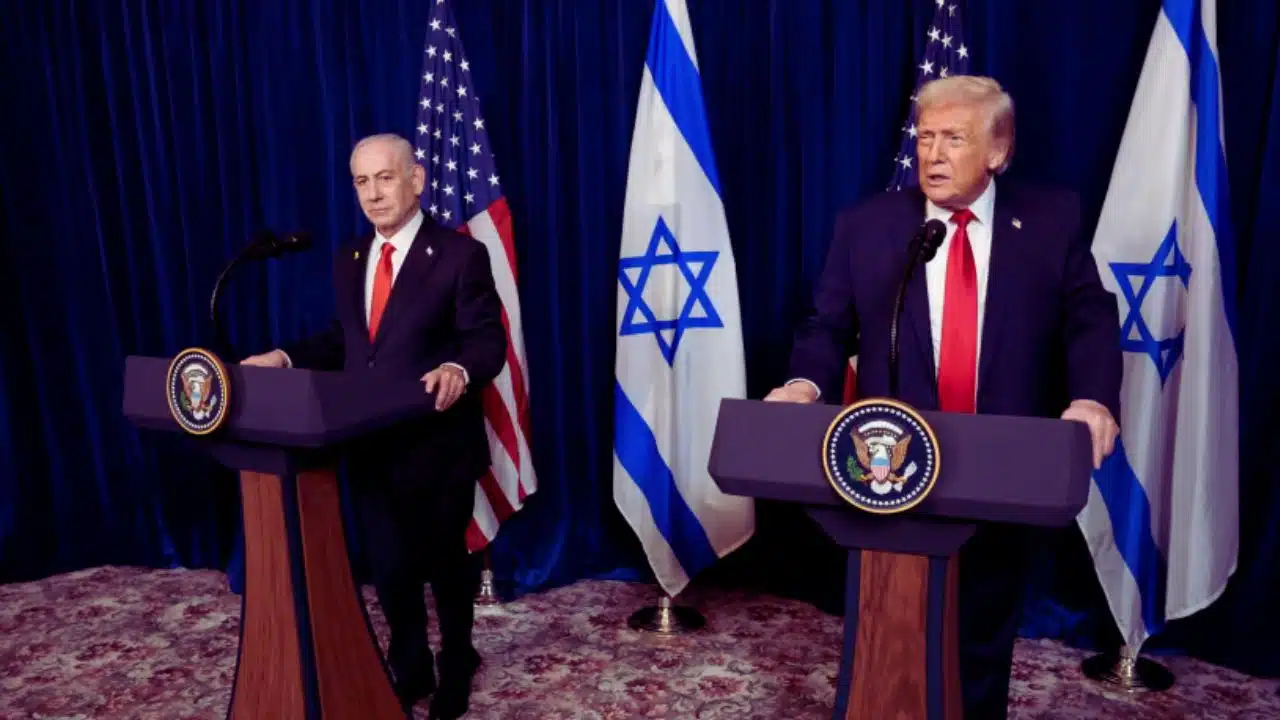
The Kremlin urged all parties to avoid escalation after U.S. President Donald Trump, standing alongside Israeli Prime Minister Benjamin Netanyahu, warned of potential strikes against Iran if Tehran attempts to rebuild its nuclear weapons programs following devastating attacks in June 2025.
Trump Issues Stark Warning During Netanyahu Meeting
President Donald Trump issued a forceful warning to Iran on Monday, December 29, 2025, suggesting that Washington could authorize another massive military strike against the Islamic Republic. Speaking at a joint news conference with Israeli Prime Minister Benjamin Netanyahu at the White House, Trump expressed concerns that Tehran might be working to restore its weapons capabilities after the U.S. destroyed three major nuclear facilities earlier this year.
“Now I hear that Iran is trying to build up again,” Trump stated during the news conference. “And if they are, we’re going to have to knock them down. We’ll knock them down. We’ll knock the hell out of them. But hopefully that’s not happening.”
The president added that if reports of Iran rebuilding its nuclear infrastructure are confirmed, “they know the consequences, and the consequences will be very powerful, maybe more powerful than the last time”. Trump suggested that while Iran is not using the obliterated sites from the June strikes, they may be utilizing different locations for weapons development.
Kremlin Responds with Call for Dialogue
The Kremlin responded swiftly on Tuesday, December 30, 2025, urging restraint and diplomatic engagement rather than further military escalation. Kremlin spokesman Dmitry Peskov told reporters that Moscow believes dialogue with Iran is essential to preventing regional instability.
“We believe that it is necessary to refrain from any steps that could escalate tensions in the region, and we believe that, first and foremost, dialogue with Iran is necessary,” Peskov stated during a press briefing. He emphasized that Russia would continue to cultivate close ties with Tehran despite international pressure.
The Russian response highlights Moscow’s deepening relationship with Iran, which has grown significantly closer since the start of Russia’s military operations in Ukraine. The two nations signed a 20-year Comprehensive Strategic Partnership Treaty on January 17, 2025, aimed at strengthening bilateral cooperation across defense, energy, trade, and cultural sectors.
Background: June 2025 Military Strikes
Trump’s latest warnings reference the devastating U.S. military operation against Iran conducted in June 2025, known as Operation Midnight Hammer. On June 22, 2025, the United States Air Force and Navy attacked three nuclear facilities in Iran: the Fordow Uranium Enrichment Plant, the Natanz Nuclear Facility, and the Isfahan Nuclear Technology Center.
The operation utilized fourteen GBU-57A/B MOP “bunker buster” bombs carried by B-2 Spirit stealth bombers and Tomahawk missiles fired from submarines. President Trump declared the mission “a spectacular military success” and claimed that Iran’s key nuclear enrichment facilities had been “completely and totally obliterated”.
The 12-day conflict in June resulted in significant casualties, with nearly 1,100 Iranians killed, including senior military commanders and scientists. Iran’s retaliatory missile barage killed 28 people in Israel. The strikes represented a dramatic escalation in the ongoing tensions between Washington, Tehran, and Tel Aviv over Iran’s nuclear ambitions.
Iran Denies Nuclear Weapons Program
Iran has consistently denied that it possesses or is developing a nuclear weapons program. However, Iranian Foreign Minister Abbas Araghchi acknowledged in July 2025 that the June strikes caused “serious and severe” damage to the country’s nuclear enrichment capabilities.
“It is stopped because, yes, damages are serious and severe. But obviously, we cannot give up on enrichment because it is an achievement of our own scientists. And now, more than that, it is a question of national pride,” Araghchi told Fox News.
Trump responded to these comments on social media, writing: “Of course they are, just like I said, and we will do it again, if necessary!”.
Russia-Iran Strategic Partnership
Moscow’s call for restraint comes amid unprecedented closeness between Russia and Iran. The Comprehensive Strategic Partnership Treaty signed in January 2025 encompasses cooperation across various domains, including defense cooperation, economic collaboration, and joint military exercises.
While the agreement does not contain a formal mutual defense clause, it significantly strengthens military ties between the two nations. The partnership includes measures to boost economic relations, particularly in energy, finance, and trade, helping both countries mitigate the impact of Western sanctions.
President Vladimir Putin emphasized the treaty’s importance, stating: “This Treaty marks a new chapter in our relations, ensuring long-term cooperation across all key sectors and fortifying our collective resilience against external pressures”.
Regional Tensions and Diplomatic Challenges
The current situation reflects broader Middle Eastern tensions that have escalated throughout 2025. Russia has positioned itself as a mediator and has condemned the U.S. and Israeli strikes on Iranian nuclear sites. Kremlin officials have warned that regime change in Iran would “open Pandora’s box” and deepen instability across the Middle East.
Some Democratic lawmakers in the United States, following classified briefings on the June strikes, argued that Trump had misled the American public about the level of success achieved. Questions remain about the extent of damage to Iran’s nuclear infrastructure and Tehran’s ability to rebuild its programs.
International Community Watches Closely
The exchange of threats and diplomatic statements has raised concerns about the possibility of renewed military conflict in the region. Trump has previously suggested confidence in reaching a diplomatic agreement with Tehran to constrain its nuclear program, but his recent rhetoric indicates a shift toward more aggressive posturing.
The president made clear during his address following the June strikes that there are “many targets left” in Iran for U.S. forces to attack. He vowed to pursue additional military action if Iran does not agree to negotiations on its nuclear activities.
Netanyahu’s Role in Regional Strategy
Israeli Prime Minister Netanyahu has remained focused on reducing threats from Iran to Israel throughout his nearly 30 years in office. The discussions between Trump and Netanyahu on December 29 centered on the possibility of renewed military action against Tehran.
Israel initiated strikes against Iran on June 13, 2025, aiming to prevent Tehran from acquiring nuclear weapons. Israel is widely believed to possess nuclear arms, though it neither confirms nor denies this status.
Key Timeline of Events
| Date | Event |
| January 17, 2025 | Russia and Iran sign 20-year Comprehensive Strategic Partnership Treaty |
| June 13, 2025 | Israel initiates strikes against Iran |
| June 22, 2025 | U.S. conducts Operation Midnight Hammer, striking three Iranian nuclear sites |
| July 22, 2025 | Trump warns U.S. could strike Iran’s nuclear sites again “if necessary” |
| December 29, 2025 | Trump meets with Netanyahu, issues new warning to Iran |
| December 30, 2025 | Kremlin urges restraint and dialogue with Iran |
Final Thoughts
The diplomatic standoff between Washington and Tehran shows no signs of immediate resolution, with Russia positioning itself as a counterweight to U.S. and Israeli pressure on Iran. The Kremlin’s call for restraint reflects Moscow’s strategic interests in maintaining stability in a region where it has significant political and economic investments.
Whether Trump will follow through on his threats depends largely on intelligence assessments of Iran’s nuclear activities and the broader geopolitical calculations involving regional allies and adversaries. The international community continues to monitor the situation closely, with fears that further escalation could trigger a wider regional conflict with unpredictable consequences.
The coming weeks will be critical in determining whether diplomatic channels can prevent another round of military strikes or if the Middle East will witness renewed hostilities between major powers and their regional proxies.