
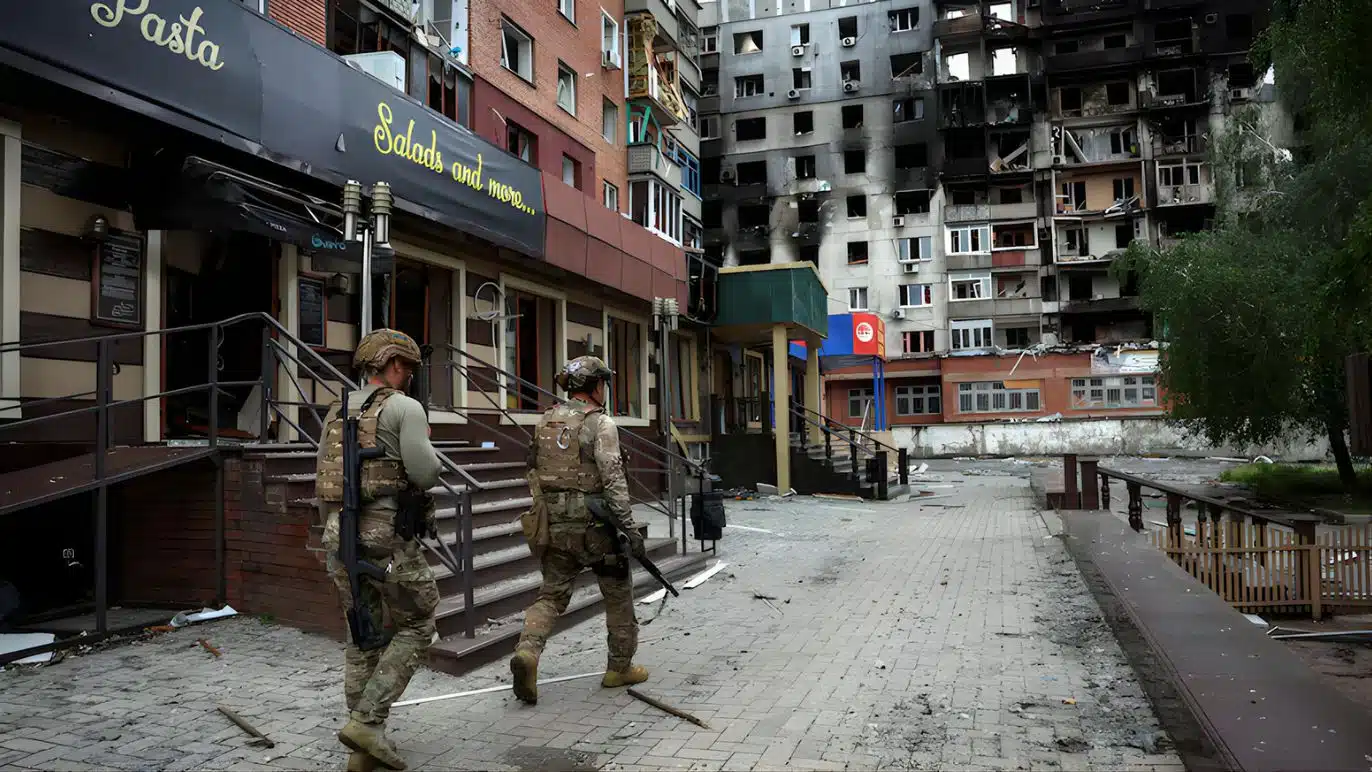
The Russian Ministry of Defense has announced the capture of two strategic settlements in eastern Ukraine, marking a significant psychological and tactical escalation in the nearly four-year-old conflict. In a briefing released late Saturday, Kremlin officials claimed their forces had secured full control over Prylipka in the Kharkiv region and Andriivka in the Dnipropetrovsk region.
If confirmed, the capture of Andriivka would represent a particularly perilous development for Kyiv, signaling that Russian ground forces have successfully breached the administrative borders of the Dnipropetrovsk oblast—a region that has served as a vital logistical hub and medical rear for the Ukrainian Armed Forces since the full-scale invasion began in 2022.
The announcement comes amidst a brutal winter offensive that has seen Moscow pour tens of thousands of fresh troops into the “contact line,” exploiting ammunition shortages and fatigue among Ukrainian defenders. While Kyiv has not officially conceded the loss of the towns, military spokespersons acknowledged “difficult defensive battles” in both sectors, citing overwhelming enemy artillery superiority and relentless “meat wave” assaults.
The Dnipropetrovsk Breach: A New Phase of the War?
The claimed seizure of Andriivka is arguably the more critical of the two developments. Located on the fringes of the Dnipropetrovsk region, the settlement’s fall would confirm that the frontline is shifting westward out of the Donbas heartland and into central Ukraine.
For years, the war has largely been contained within the Donetsk, Luhansk, Zaporizhzhia, and Kherson oblasts. The encroachment into Dnipropetrovsk threatens to sever the “road of life” supply routes that sustain Ukrainian garrisons in the remaining free pockets of Donetsk.
“The enemy is no longer just trying to capture the Donbas,” said Colonel Serhiy Hrabsky, a military analyst based in Kyiv. “They are attempting to shatter the logistical spine of our defense. Andriivka is small, but its location is a gateway. If they establish a foothold in Dnipropetrovsk, the cities of Pavlohrad and eventually Dnipro itself come within the range of standard field artillery, not just long-range missiles.”
Russian military bloggers (milbloggers) celebrated the news as a “breaking of the dam,” posting geolocated footage purportedly showing Russian tricolors being hoisted over ruined municipal buildings in Andriivka. The footage, while unverified by independent western analysts, shows a landscape pulverized by months of glide-bomb airstrikes and thermobaric shelling.
Kharkiv Front: The Fall of Prylipka
Simultaneously, the Russian Ministry of Defense reported the capture of Prylipka in the Kharkiv region. This advance appears to be part of a renewed push to create a “buffer zone” along the Russian border, a stated goal of President Vladimir Putin earlier this year.
Prylipka, located near the Oskil River basin, has been a flashpoint for weeks. Its capture would allow Russian forces to tighten the noose around the strategic railway hub of Kupiansk, which was liberated by Ukraine in the lightning counter-offensive of autumn 2022 but has faced renewed threats since early 2025.
Local reports from the Kharkiv Regional Military Administration describe a “scorched earth” tactic employed by advancing Russian units. “There is no Prylipka left to capture,” stated Governor Oleh Syniehubov in a Telegram post. “They have captured a graveyard of bricks and ash. But the Ukrainian Armed Forces remain in positions on the dominating heights nearby.”
Military experts suggest that the dual thrust—pushing into Dnipropetrovsk in the center and squeezing Kharkiv in the north—is designed to stretch Ukrainian reserves to their breaking point. With Ukrainian brigades already rotating rapidly to plug gaps near Pokrovsk (claimed by Russia earlier in December), the ability of the General Staff to reinforce these new breach points is severely tested.
The “Meat Grinder” Strategy: Attrition in 2025
The timing of these captures aligns with what Western intelligence agencies have described as Russia’s “Winter Attrition Strategy.” Despite suffering catastrophic casualty rates—estimated by UK Intelligence to be upwards of 1,500 killed or wounded daily in December 2025—the Kremlin has shown no sign of reducing the intensity of its attacks.
“The Russian command is trading bodies for meters,” noted a report from the Institute for the Study of War (ISW). “They are leveraging their quantitative advantage in manpower to exhaust Ukrainian defenders who are often fighting with depleted ammunition stocks. The capture of Prylipka and Andriivka, while tactically incremental, contributes to the strategic goal of cumulative exhaustion.”
This strategy has been compounded by the widespread use of guided aerial bombs (KABs). These munitions, launched from Russian aircraft well beyond the range of most Ukrainian air defense systems, demolish fortifications that would otherwise hold for months. Survivors from the Andriivka sector described the bombardment as “unrelenting,” with 500kg and 1500kg bombs leveling entire defensive lines before infantry assaults even began.
Geopolitical Fallout: The Shadow of Failed Talks
The battlefield losses cast a long shadow over the diplomatic arena. The captures come just days after reports emerged of a stalemate in “track two” peace negotiations held in Florida earlier this month. The failure to reach a preliminary ceasefire agreement seems to have emboldened Moscow to seek leverage on the ground before the inauguration of the next U.S. administration in January 2026.
President Volodymyr Zelensky, who is scheduled to meet with U.S. President-elect Donald Trump on December 28, faces an increasingly complex map. The loss of territory weakens Kyiv’s negotiating hand, fueling arguments from skeptics in the West who push for a “land for peace” deal—a concept Kyiv has vehemently rejected.
“Putin is trying to present a fait accompli,” said Dr. Fiona Hill, a former official at the U.S. National Security Council. “By pushing into Dnipropetrovsk, he is signaling that his ambitions are not limited to the four annexed regions. He wants to show the incoming U.S. administration that Ukraine cannot win, and that the price of continued support will be exponentially higher.”
In a video address late Saturday night, President Zelensky did not directly name the two captured towns but acknowledged the “extremely difficult” situation in the East. “We are doing everything to strengthen our boys,” he said, appearing visibly tired. “We are expecting vital packages from our partners. But speed is life. Every delay in delivery is measured in the lives of our best people.”
Humanitarian Crisis: Winter’s Bitter Bite
For the civilians remaining in these frontline zones, the situation is apocalyptic. Evacuation teams known as “White Angels” have been working under fire to extract the elderly and immobile from settlements near Andriivka, but the rapid Russian advance has left many trapped.
“We couldn’t get to the last three streets in Andriivka,” said police paramedic Vasyl, who operates an armored evacuation van. “The drones were swarming like wasps. FPV drones were hunting anything that moved—cars, bicycles, even dogs. People are hiding in basements without heat, electricity, or water. It is minus 10 degrees outside. If the shelling doesn’t kill them, the cold will.”
The United Nations Humanitarian Coordinator for Ukraine warned on Friday that the infrastructure damage in the Dnipropetrovsk region could trigger a new wave of displacement. If Russian artillery begins to systematically target the energy grid of Dnipro city, millions could face a winter without heat, mirroring the dark days of 2022 but with even fewer resources to repair the damage.
International Reaction and Future Outlook
The international community has reacted with alarm to the news of the Dnipropetrovsk breach.
-
United States: A State Department spokesperson condemned the “brutal conquest” and reiterated that the U.S. does not recognize any Russian territorial claims. However, political gridlock in Washington continues to delay the approval of the proposed “2026 Freedom Package” of military aid.
-
European Union: EU Foreign Policy Chief Josep Borrell called for an emergency meeting of defense ministers, stating, “The war is at Europe’s doorstep. If Dnipro falls under siege, the security architecture of the entire continent is at risk.”
-
NATO: Intelligence briefings suggest that Russia is preparing for a larger offensive in spring 2026, aiming to encircle the major industrial hubs of the east.
Despite the gloom, Ukrainian forces continue to exact a heavy toll on the invaders. The General Staff reported destroying 24 Russian tanks and over 40 armored vehicles in the past 24 hours alone, mostly in the fields surrounding the two captured towns. Ukrainian drone operators continue to strike deep into the Russian rear, hitting refineries and airfields to disrupt the supply chains fueling the offensive.
Conclusion: A War of Wills
The fall of Prylipka and Andriivka serves as a grim reminder that the war in Ukraine is far from a “frozen conflict.” It remains a dynamic, high-intensity war of maneuver and attrition. As 2025 draws to a close, the frontline is moving—slowly, painfully, and at a terrible cost—bringing the reality of occupation to new regions and forcing Kyiv and its allies to confront hard questions about the strategy for the year ahead.
For now, the soldiers on the “zero line” dig deeper into the frozen earth, waiting for the next wave, knowing that the defense of their nation is measured one village, one trench, and one life at a time.