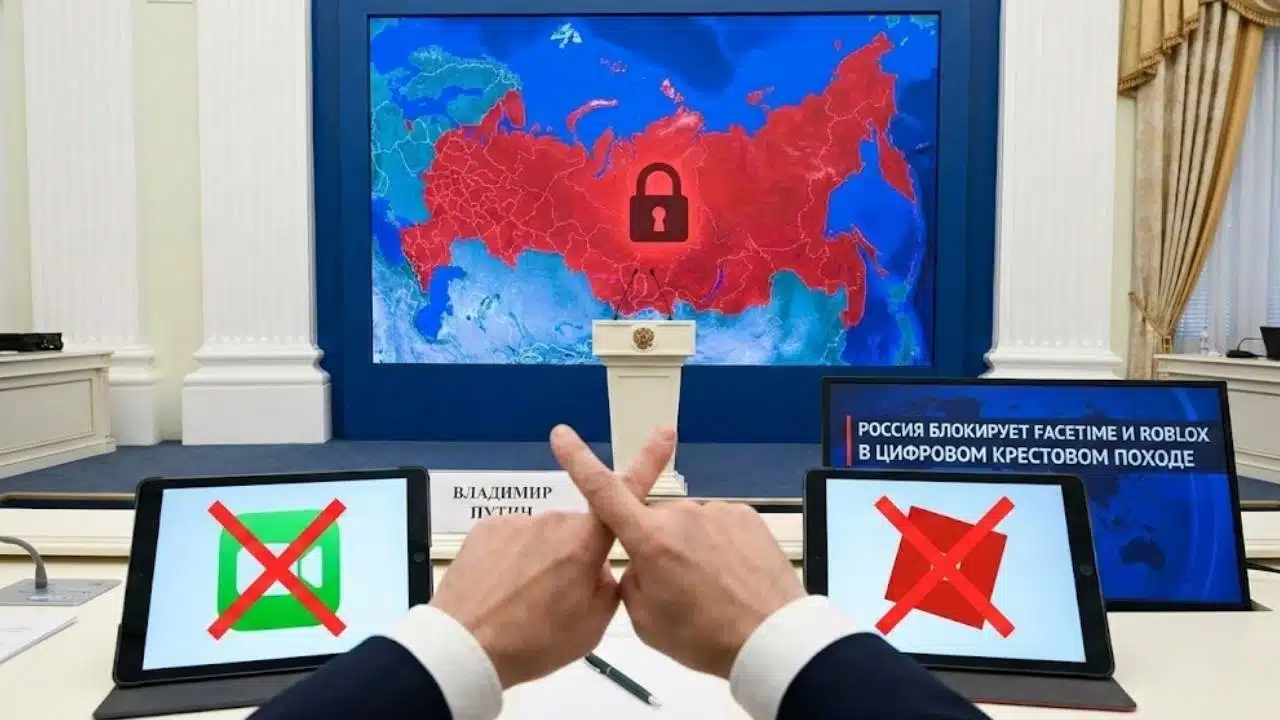
Russia has moved to block two major global platforms — Apple’s FaceTime and the gaming giant Roblox — in a sweeping escalation of its long-running effort to tighten control over online communication and foreign technology. The decisions were announced by Roskomnadzor, the country’s state communications watchdog, which framed the bans as necessary steps to protect national security and public order.
According to the agency, FaceTime was allegedly being used to organize terrorist activity, facilitate communication among extremist groups, and commit fraud. Officials did not provide evidence supporting these claims, but the accusations were enough to justify immediate restrictions across the country.
The block on Roblox followed a similar pattern. Authorities accused the platform of hosting extremist materials and distributing “LGBT propaganda,” a term frequently used by the Russian government to justify limiting access to global digital spaces. Roblox, a platform that allows users — including millions of children — to create and share their own virtual worlds, was among the most popular gaming environments in Russia.
By Thursday, many residents reported that attempting to place a FaceTime call returned an error reading “User unavailable,” a typical indicator of network-level blocking. Calls became functional only when users activated virtual private networks (VPNs), which reroute internet traffic through servers outside the country.
Cybersecurity specialists note that FaceTime had become a preferred tool for millions of Russians in recent years, especially after previous restrictions hampered WhatsApp and Telegram voice services. Experts warn that any platform refusing to comply with government demands is now vulnerable to the same fate.
New Restrictions Add to a Growing List of Blocked Western Services
The bans on FaceTime and Roblox are only the latest examples in a sweeping digital clampdown that has accelerated since Russia’s invasion of Ukraine and the subsequent deterioration of relations with Western governments and companies.
In the same week, Roskomnadzor also blocked Snapchat, claiming that the image-sharing platform was being used for terrorist activity. This follows earlier actions against YouTube, which faces ongoing pressure and periodic restrictions; WhatsApp, where call features were previously limited; and Telegram, which has been intermittently targeted for not cooperating with data requests.
Although some services remain technically accessible, their performance is degraded to the point of impracticality. Users report slower loading speeds, unpredictable outages, or sudden disconnections — all of which send a clear message: foreign platforms are increasingly unwelcome in Russia’s digital space unless they agree to share user information or adapt to government oversight.
In addition to platform-specific bans, Russia has tightened control over VPN usage. Many VPN services have been blocked outright, while others are aggressively throttled. This severely restricts the ability of citizens to bypass censorship and maintain access to international websites and apps.
Digital rights groups argue that these measures collectively represent a strategic effort to restrict access to independent information, weaken personal privacy, and consolidate government influence over online communication.
State-Backed Messaging App MAX Emerges as the Kremlin’s Preferred Alternative
As foreign tech platforms face growing limitations, Russian authorities are actively promoting a government-backed alternative: MAX, a state-sponsored messaging and multi-utility app that is increasingly being positioned as the default communication tool for millions of users.
MAX is already required by law to be pre-installed on every smartphone sold in the country, ensuring its reach extends from the moment a device is activated. The app combines messaging features, payment systems, and digital services, but it has drawn sharp criticism from privacy experts for its data-handling practices.
Unlike many Western messaging apps that offer strong encryption and limit government access, MAX openly states that it will share user information with authorities upon request. Reports indicate that the app can access detailed user metadata, including geolocation, message logs, and internet usage patterns. Some assessments suggest the platform has the technical ability to activate a device’s microphone and camera remotely — a capability that has raised alarm among human rights groups.
By late 2025, pro-government media claimed that MAX had nearly 50 million users across Russia. Analysts believe that the rapid rise of MAX is not simply the result of convenience, but part of a coordinated effort to channel digital communication through a system the state can monitor and control.
Growing Concerns Over Surveillance, Censorship, and Loss of Digital Freedom
Digital rights advocates warn that the bans on FaceTime, Roblox, Snapchat, and other global platforms signal a significant shift in Russia’s approach to the internet. What began years ago as sporadic censorship of political content has evolved into a broad attempt to remake the country’s digital ecosystem into one dominated by domestic platforms with built-in government oversight.
Civil society groups argue that the official explanations — often citing terrorism or extremism — mask a deeper intention to reduce the influence of unregulated global platforms that allow free expression and anonymous communication. As more foreign services are restricted, users lose access not only to tools but to entire communities, business resources, and information networks.
Every new restriction further isolates Russian users from the open internet. Young people who relied on platforms like Roblox for creativity and social interaction now face abrupt disconnection. Professionals who use FaceTime for encrypted video calls must scramble to find alternatives that remain operational. Ordinary citizens increasingly rely on domestic platforms that offer fewer privacy protections and comply readily with government monitoring requests.
The cumulative effect is a narrowing of the digital space, where communication choices shrink, independent voices weaken, and surveillance becomes normalized. Experts caution that without meaningful pushback, these changes may permanently reshape how people in Russia communicate, access information, and participate in global digital culture.
A Broader Strategy to Reengineer Russia’s Online Environment
Taken together, Russia’s recent actions point toward a deliberate, long-term strategy to redefine the country’s online environment. Blocking foreign services, limiting VPN access, and promoting surveillance-friendly domestic apps all serve to consolidate state authority over digital life.
While officials justify these measures as necessary to fight extremism and criminal activity, critics counter that the pattern reflects the government’s desire to maintain political stability by controlling the flow of information. As global tech companies refuse to hand over user data or comply with censorship demands, the Kremlin appears determined to replace them with systems it can fully oversee.
This latest wave of bans — targeting platforms popular with both adults and children — highlights the expanding scope of Russia’s digital crackdown. Whether this strategy will succeed in the long term remains uncertain, but its immediate impact is unmistakable: a rapidly shrinking digital landscape where choices are limited, privacy is precarious, and the state plays an increasingly dominant role in shaping the online experiences of millions of people.