With all the talk in the media about flexible work and working from home in the past few weeks, you could be forgiven for thinking that it was all a failed experiment.
Ross McEwan, the CEO of National Australia Bank, has told top managers to come back to the office five days a week. Elon Musk, in his latest attack on people who work from home, said that people who work outside of the office are “morally” dubious.
I don’t think the reasons for having people back in the office are the ones that are mentioned almost every day in the media. But more about that later.
Since I got my PhD on the subject in 2017, I’ve continued to use real-world data to study how our physical surroundings affect our mental and physical states.
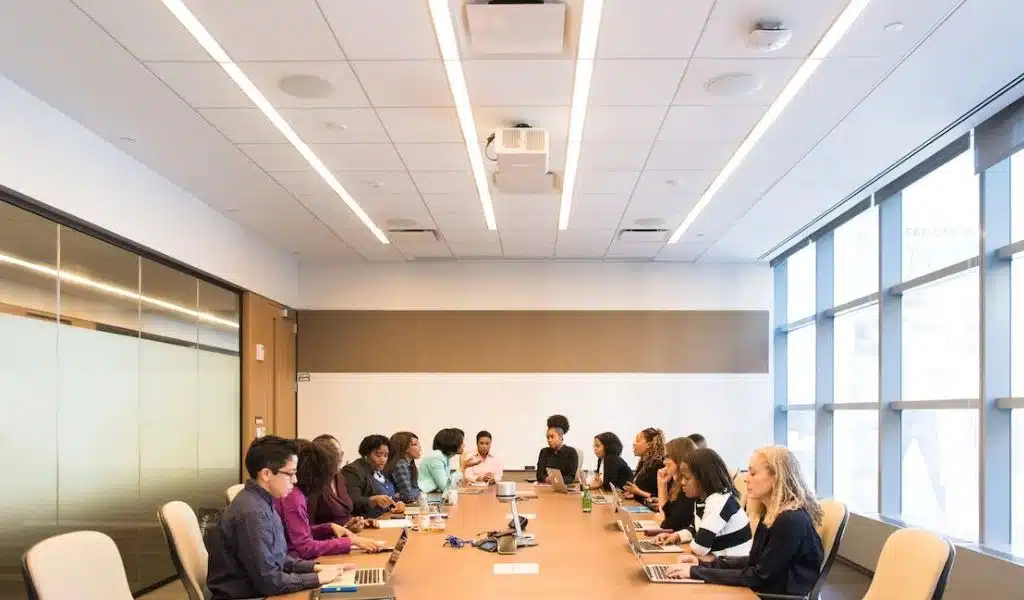
It’s hard to be motivated or creative in a noisy open-plan office with rows of the same desks and chairs. Background noise, noisy coworkers, loud phone conversations, impromptu stand-up meetings in the middle of the office, and interruptions make it hard to do work that takes concentration.
Also, my study partners and I found a strong link between open-plan office noise and physiological stress.
In a controlled experiment, we used heart rate, skin conductivity, and AI to read the emotions on people’s faces. This showed that negative mood rose by 25% and physiological stress by 34%.
This could be one of the reasons why “work from home” has been the most searched-for word on Seek for months. That, and not having to drive for hours every day.
But what about all the chance talks that lead to great ideas and the magical collaboration that happens when everyone is in the same room? Except that it almost never does.
Because of the pandemic and the time spent away from the office, most people have forgotten what study shows and what most modern offices are like.
It’s no surprise that the focus part is very important. My own study showed that when noise or other distractions make it hard for people to think and focus on their work, they become more shy and less likely to work together. And a lot of real-world study done over many years has shown that just putting everyone in the same room doesn’t lead to more collaboration and new ideas.
But I think the arguments for and against being all in the office are pointing us in the wrong way.
Most attempts to change an organization fall into the trap of focusing on the problem at hand instead of the real problem. Focused work without interruptions, creativity and innovation, building social and professional networks, knowledge sharing, learning and growth, and unplanned meetings are all important. So are freedom and adaptability.
People have different traits, different ways of working, and do different kinds of work. During the course of a single day at work, different parts of our jobs require us to be in different mental, emotional, and physical states. Late afternoon, when we’re probably a little tired, is a good time for creative thought but not so good for making big decisions.
Having a clean and organized desk is helpful for some types of work (and for controlling how coworkers see us), but a messy desk tells our brains that it’s OK to color outside the lines and look for new patterns in the chaos. Having a messy desk can help you think of new ideas.
We need to stop focusing on the workplace and instead focus on the work states that will help us do our best work.
In my doctoral study, I made a scale that measured the most important psychological responses to the physical workplace. The results, which were published in an empirically validated scale, showed that the most important reactions we need from our workplaces are focus (a cognitive response that helps us think and concentrate on our work), a sense of beauty (an emotional response that is an essential, constitutive element of organizations and has important implications for organization theory), and connectedness (a relational response that measures the extent to which the environment makes it easier for people to interact with each other).
We need all three of them, but not all at once. Not in the same place, either. And it’s much more important than you may think.
This is true for a scientific reason.
In addition to the noise, the sameness of most modern businesses makes it hard to stay motivated or creative.
On a psychological level, we are naturally predisposed to look for places that are complicated, interesting, and where messages are sent in different ways.
These places make people feel awe and a sense of beauty, which are basic human needs and important steps toward good mood, creativity, wellbeing, and trust in organizations. Researchers have found that a preference for beautiful environments plays a part in bringing people to restorative environments and keeping them there longer than they would be otherwise, which helps them recover from attentional fatigue and stress.
It’s not surprising that we don’t feel good when we’re surrounded by miles of grey rugs, computer screens, and melamine.
When Jonas Salk was having trouble making the polio vaccine, he would often leave his boring office and work from the Basilica in Assisi. He said that the room put him in a state that helped him figure out how to deal with the problems he was having.
The place we work must be able to give us situations that match the state we need to be in to do the work.
By serving as a cognitive scaffold, a library can give a sense of order, structure, and focus.
At other times, a busy cafe may be the right place for a team to share emotions and work together.
Instead of spending so much on the workplace, we should focus on the work state we’re trying to reach.
Our places have a deeper effect on our physical and mental health than we realize.
Julio Bermudez used mobile fMRI brain imaging machines to find that putting people in certain types of buildings (ones that inspired awe and a sense of beauty) was enough to put them into a mindful and meditative state.
Walking talks have been shown to increase divergent creative thinking by 81%, and even a short time in nature has big benefits for our mental and physical health.
LinkedIn has changed the layout of its San Francisco office, which now has 75 different places to work. There are places to work where you can concentrate without being interrupted, places to work outside, cafes, meeting rooms with or without tables to change the balance of power, and a lot of other spaces.
LinkedIn also encourages employees to come in and use places to help them do the work they need to do, then leave and use other spaces outside the office as they see fit.
Truth about ‘lazy’ Aussie workers
I think there are two things that are making some people want to get everyone back to the office most of the time.
The first is worry about the value of business property.
The second is a strange return by some managers to a Theory X method from the 1950s. Theory X says that everyone who works is lazy, needs to be watched all the time, and needs to be told what to do and how to do it.
The number of managers and businesses that still use command-and-control methods is much higher than you might think.
Because of this, the way we create work has changed for good.
The future of work will be based on planning our days around how we want to feel and then choosing places that meet these needs.
And the lobby lounge of the Shangri-la in Singapore has an amazing area where I could work for days.