
In an era where digital distractions dominate everyday life, Perplexity AI CEO Aravind Srinivas is making a bold call to action. His message is directed especially at the youth: cut back on Instagram and start learning Artificial Intelligence (AI)—or risk falling behind in tomorrow’s job market.
During a conversation with tech YouTuber Matthew Berman, Srinivas strongly emphasized the importance of gaining proficiency in AI tools. He warned that those who ignore the rise of AI might soon find themselves unemployable or irrelevant in a rapidly evolving economy.
“Spend less time doomscrolling on Instagram and more time using AIs,” said Srinivas, referring to the endless, mindless scrolling that’s become routine for many.
My interview with @AravSrinivas, CEO of @perplexity_ai.
We discuss their new AI-first browser Comet, how the internet is changing with agents, competition with Google and others, workforce automation and more! pic.twitter.com/POUiKyDrBn
— Matthew Berman (@MatthewBerman) July 17, 2025
His comments reflect growing concerns among tech leaders that the younger generation may be missing critical opportunities to build future-ready skills by spending excessive time on entertainment-driven platforms.
AI Proficiency Becoming a Key Job Skill
Srinivas went further to explain that familiarity with AI tools is already becoming a key marker of employability. Whether it’s content creation, programming, design, data analysis, or marketing—AI is being integrated into nearly every industry.
“People who really are at the frontier of using AIs are going to be way more employable than people who are not,” he stated. “That’s guaranteed to happen.”
The Perplexity AI CEO emphasized that those who embrace AI early will have a clear advantage, while those who don’t will risk being left behind in both career opportunities and technological relevance.
The Speed of Change Is Testing Human Adaptability
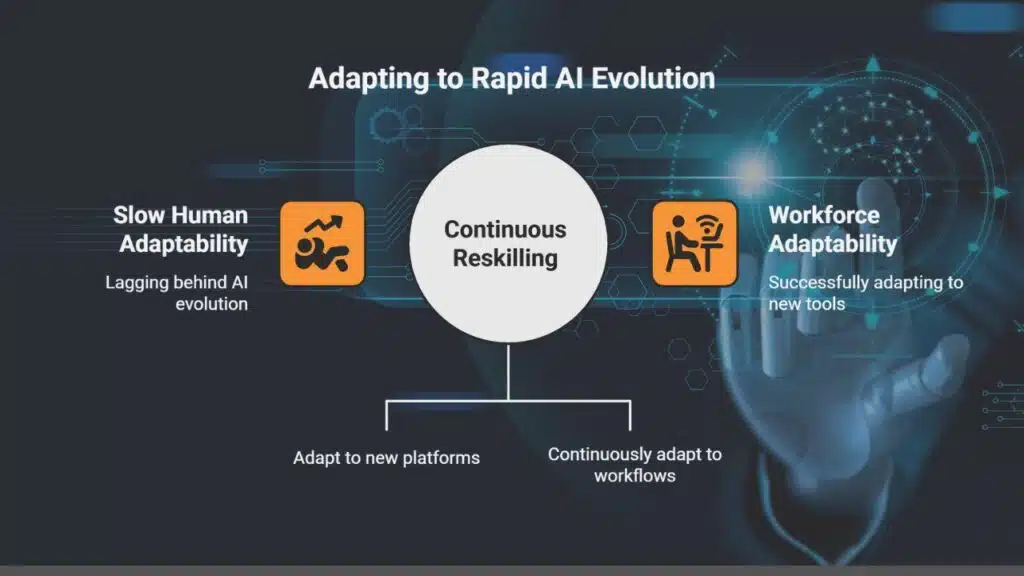
A significant concern raised by Srinivas is the rapid pace at which AI tools are evolving. Innovations that were cutting-edge just months ago may already be outdated, and new capabilities are being added every 3 to 6 months across platforms like OpenAI’s GPT-4o, Google Gemini, Anthropic’s Claude, and Perplexity’s own tools.
“The human race has never been extremely fast at adapting,” he admitted. “What we’re seeing now is testing the limits of how quickly we can learn and evolve.”
Srinivas believes the pressure to reskill is intensifying, not just for tech workers, but for employees across all sectors. The challenge is not just to learn once—but to continuously adapt to new tools, platforms, and workflows.
According to a McKinsey & Company report (2023), nearly 375 million workers globally may need to switch occupational categories by 2030 due to automation and AI-driven transformation. That reality puts added urgency behind Srinivas’ message.
The Future of Work: Risk of Job Loss, But Also Room for Creation
Srinivas acknowledged the concern that AI will eliminate traditional jobs, especially in roles involving repetitive or routine tasks. He joined a growing list of tech leaders who believe that while automation will reduce demand for certain types of work, it can also unlock new opportunities—particularly through entrepreneurship.
“Either the people who lose jobs end up starting companies themselves and make use of AIs, or they learn the AIs and contribute to new companies,” he explained.
This reflects a broader trend in the AI landscape, where job creation is increasingly linked to those who can innovate with AI, not merely adapt to it.
Industry Leaders Echo the Warning
Aravind Srinivas isn’t the only one sounding the alarm. Several other top voices in the AI industry have made similar predictions:
- Dario Amodei, CEO of AI firm Anthropic, recently predicted that up to 50% of entry-level white-collar jobs—including roles in finance, marketing, HR, and customer service—could vanish in the next five years due to AI automation.
- Geoffrey Hinton, often called the “Godfather of AI” and a former senior researcher at Google, warned in a 2023 interview with The New York Times that AI might replace humans in mundane intellectual tasks, posing deep existential and ethical challenges.
- Jensen Huang, CEO of Nvidia, has offered a more optimistic view, suggesting that AI will enhance—not replace—human jobs. He argues that AI will augment human intelligence, automate repetitive tasks, and free up time for more creative and strategic work.
Srinivas’ perspective appears to fall somewhere in between—acknowledging the threats while encouraging proactive adaptation and entrepreneurship.
AI Replacing Recruiters? Perplexity’s “Comet” Could Do It
In a separate appearance on The Verge’s “Decoder” podcast, Srinivas detailed how AI tools could soon replace entire job roles, such as recruiters.
He showcased his company’s tool called Comet, an AI-powered productivity assistant that can automate everything from candidate sourcing to interview scheduling.
“A recruiter’s one week of work can be done in just one prompt,” he explained.
Comet can:
- Identify and source potential candidates
- Send follow-up emails
- Track response statuses in a Google Sheet
- Schedule interviews via Google Calendar
- Generate meeting briefs
- Update candidate progress in real-time
Srinivas added that Comet is designed to work proactively, even without the need for constant prompting, making it far more efficient than a human recruiter who has to manage these tasks manually.
Currently, Comet is available only to paid users, but Perplexity is gradually rolling out access for free users, hinting at broader integration in workplaces soon.
What This Means for Today’s Youth and Workers
Srinivas’ comments come at a time when many students and early-career professionals are still uncertain about how AI will impact their future.
With college curriculums still catching up to the speed of technological change, Srinivas believes it’s individual responsibility to learn AI tools outside traditional classrooms. Platforms like ChatGPT, Claude, Perplexity, Midjourney, Replit, and GitHub Copilot are free or low-cost ways to begin experimenting with AI in real-world scenarios.
Don’t wait for your job or your college to teach you AI—start now, or risk being obsolete,” is the implied message.
The Bottom Line: Time to Rethink How We Use Our Time
The message from Aravind Srinivas is loud and clear: Your time is your most valuable asset. If it’s spent endlessly on Instagram, TikTok, or YouTube shorts with no value return, it’s time to reconsider.
Whether you’re a student, professional, freelancer, or entrepreneur, building AI fluency can be the difference between leading in the next era or being left behind.
In Summary:
| Key Takeaway | Details |
| Focus on AI | Learning and using AI tools will be essential for future jobs |
| Time Waste Warning | Excessive social media use could delay personal growth and learning |
| Jobs at Risk | 50% of entry-level white-collar jobs may be lost to AI |
| Tools Like Comet | AI can now automate full recruitment workflows |
| Adapt or Fall Behind | Continuous learning and reskilling are now critical |
As AI reshapes the global economy, the advice from Perplexity AI’s CEO is both timely and essential: learn, adapt, and innovate—or be prepared to be replaced.
The good news? The tools are at your fingertips, and learning AI has never been more accessible. The question is—will you take the first step?
The Information is collected from NDTV and MSN.