Homeowners now face a simple but uncomfortable truth. Energy prices fluctuate, weather extremes increase, and conventional homes struggle to keep up. In that context, passive design principles move from specialist jargon to basic literacy for anyone planning an energy-efficient home design.
Rather than relying on large mechanical systems, passive house design and related approaches ask a different question: how much comfort and efficiency can you achieve before you switch anything on? The answer, proven in thousands of homes built to Passive House and similar standards around the world, is: a lot. In many cases, careful passive design can slash heating and cooling demand by 70–90% compared with typical construction.
What Passive Design Principles Mean for Today’s Homeowners
Passive design starts from a simple premise: design the building so it can stay comfortable using the least possible energy. It treats the house as a system where site, envelope, windows, air-tightness, shading, and ventilation work together.
Modern passive house design builds on older passive solar design traditions. It combines insulation, airtightness, thermal bridge-free detailing, high-performance windows, and balanced heat-recovery ventilation with smart control of sunlight and airflow.
For homeowners, three outcomes matter most:
- Comfort. Stable indoor temperatures, fewer drafts and cold spots, and good daylight.
- Resilience. Homes that stay habitable longer during heatwaves, storms, or power outages.
- Costs. Lower energy bills over decades, often with modest extra upfront cost when decisions are made early in the design process.
15 Passive Design Principles Every Homeowner Should Learn
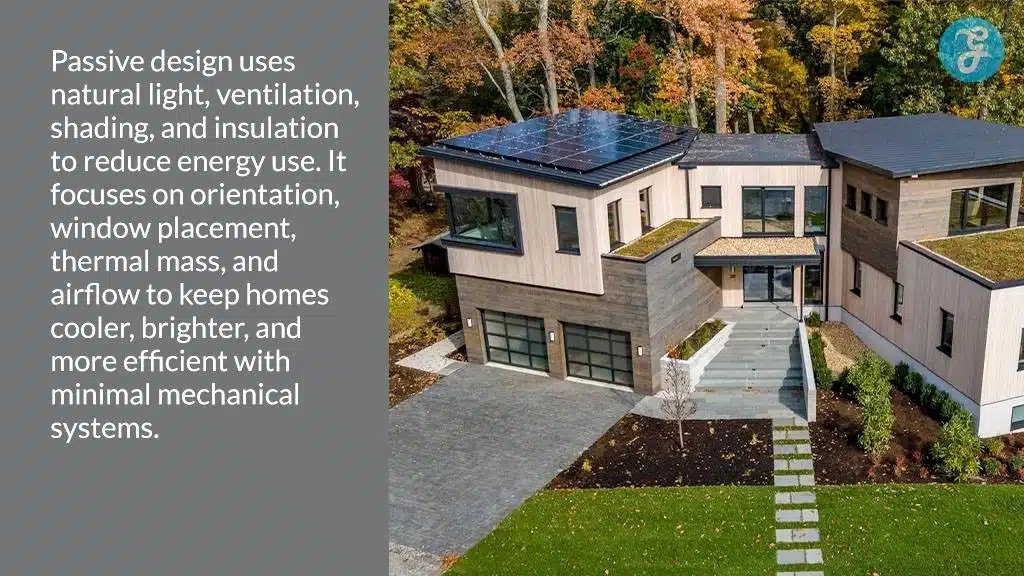
The following 15 passive design principles provide a practical checklist for any new build or deep renovation. Moreover, it shapes a comfortable, resilient, and energy-efficient home. Also, help homeowners cut costs while maximizing natural light, airflow, and year-round comfort.
1. Read the Site and Climate Before You Draw a Line
Every climate asks for a different emphasis. In cold regions, passive design principles focus on solar gain, airtightness, and insulation. In hot or humid climates, shading, natural ventilation, and moisture control take the lead. Mixed climates demand flexible, seasonal strategies.
Before sketching floor plans, a design team should map:
- Sun path through the seasons
- Prevailing winds and local breezes
- Nearby obstructions, such as taller buildings or trees
- Noise sources and pollution, which affect window placement
This early work shapes almost every other decision in energy-efficient home design.
2. Use Building Orientation as a Free Energy System
Orientation is one of the most powerful passive design principles and one of the cheapest to implement. A well-oriented home captures winter sun while limiting summer heat and harnesses breezes for passive cooling.
In many temperate regions, designers favour:
- Longer facades facing north (in the southern hemisphere) or south (in the northern hemisphere) to capture winter sun
- Reduced glazing on east and west facades, where low sun can cause overheating
- Aligning windows with prevailing winds to support natural ventilation
Good orientation does not add technology. It simply uses geometry to reduce the work your building fabric and systems must do.
3. Keep the Building Form Compact and Efficient
The shape of a house affects how easily it can apply passive design principles. A compact form has less external surface area relative to its volume, reducing heat loss in winter and heat gain in summer.
Architects often describe this as the surface-area-to-volume ratio. Simple shapes with fewer external corners and projections lose less energy and are easier to insulate and air-seal. A visually interesting home can still respect this principle; complexity can shift to internal spaces, materials, and landscape rather than deep, jagged external forms.
4. Invest in Super Insulation, Not Oversized Equipment
High levels of insulation are a cornerstone of both passive house design and broader passive design strategies. Super-insulated walls, roofs, and floors slow heat transfer and reduce the size and workload of heating and cooling systems.
Key questions for homeowners include:
- Are insulation levels consistent for the roof, walls, and slab?
- Is insulation continuous, or broken by structural elements and services?
- Are edge conditions—like slab perimeters or balcony connections—carefully detailed?
Better insulation also supports acoustic comfort and more even internal temperatures.
5. Eliminate Thermal Bridges Before They Leak Energy
Thermal bridges occur where heat can bypass insulation through more conductive materials, such as steel beams, slab edges, or poorly detailed window frames. They can create cold spots, increase energy loss, and trigger condensation or mould.
Passive design principles call for:
- Continuous insulation layers wherever possible
- Thermally broken window frames and balcony connections
- Careful coordination between structure and envelope early in design
Finding and eliminating thermal bridges on paper costs less than trying to fix them once a building is standing.
6. Make Airtight Construction Non-Negotiable
Airtightness does not mean a home cannot breathe. It means air should move in controlled ways through designed openings, not through random gaps. Airtight construction lets insulation work as intended, reduces drafts, improves acoustic performance, and supports better indoor air quality when paired with mechanical ventilation.
Modern passive house design targets very low air-leakage rates, typically verified by blower-door tests. Even if you do not aim for certification, asking your builder about blower-door testing sends a clear signal: heat, cooled air, and moisture should not leak through the envelope unnoticed.
7. Choose High-Performance Windows and Smarter Glazing Layouts
Windows sit at the intersection of passive solar design, daylight, and heat loss. High-performance glazing and frames—often double or triple-glazed with low-emissivity coatings—limit unwanted heat transfer and reduce condensation risk.
Good passive design principles treat windows as part of the energy strategy:
- Larger, better-insulated windows on sun-facing sides where solar gain is useful
- Smaller, shaded, or higher-performance windows where overheating is a risk
- Attention to airtight installation and proper flashing
Rather than asking, “How big can the windows be?”, the better question is, “What do the windows need to do here—for light, view, and comfort?”
8. Control the Sun with External Shading, Not Heavy Air-Conditioning
Shading is one of the most cost-effective passive design principles. Well-designed overhangs, louvers, pergolas and screens block high summer sun while allowing winter sunlight to enter. External shading stops heat before it reaches the glass, which is far more effective than internal blinds alone.
Different elevations often need different shading strategies:
- Fixed overhangs above north/south glazing tuned to local sun angles
- Vertical fins or operable shutters on the east and west facades
- Shading coordinated with the window type and placement
In hotter climates, shading often does more to curb cooling loads than additional insulation.
9. Use Passive Solar Design Principles for Winter Warmth
Passive solar design is a subset of broader passive design principles. It relies on the sun as a free heat source in cooler seasons, using building elements to collect, store, and distribute warmth.
Key steps include:
- Orienting main living spaces and larger glazing toward the low winter sun
- Ensuring those windows have adequate shading to avoid summer overheating
- Providing exposed thermal mass—such as concrete or masonry floors—that can absorb heat during the day and release it gradually
Used correctly, passive solar design can reduce or even eliminate the need for conventional heating in mild climates.
10. Design for Natural Ventilation and Night Purge Cooling
Natural ventilation uses wind and temperature differences to move air through a home. When combined with good shading, it forms a powerful strategy for passive cooling.
Effective natural ventilation design considers:
- Cross-ventilation: aligned openings on opposite sides of rooms
- Stack effect: higher outlets that let warm air escape
- Operable windows sized and positioned for breeze capture
- Night purge: flushing warm interiors with cooler night air, often aided by thermal mass
In humid climates, natural ventilation must pair with moisture management to avoid bringing in unmanageable humidity.
11. Add Thermal Mass Where It Can Actually Work
Thermal mass refers to materials that store heat, such as concrete, brick, or stone. Well-placed mass smooths out temperature swings, absorbing heat when spaces warm and releasing it as they cool.
However, not every slab or masonry wall delivers useful benefits. For thermal mass to support passive design principles, it should:
- Be exposed to indoor air and, ideally, to direct or reflected sunlight in winter
- Be paired with night ventilation in hot climates so it can cool down
- Avoid unnecessary insulation between the mass and the interior
Adding heavy materials in the wrong location, or without ventilation strategies, can lock in discomfort rather than relieve it.
12. Bring in Daylight Without Glare or Heat Penalties
Daylight improves well-being and can cut lighting energy use, but uncontrolled light can create glare and unwanted heat. Contemporary passive design principles frame daylight as a quality issue, not just a quantity issue.
Strategies include:
- Modest, well-placed windows rather than full glass walls
- Light shelves and reflective surfaces to bounce light deeper into rooms
- Shading that blocks direct sun while allowing soft sky light
- Skylights and roof windows are carefully oriented and shaded
The goal is even, comfortable light that supports daily life without forcing blinds shut for much of the day.
13. Manage Moisture and Vapour as Carefully as Heat
As insulation levels and airtightness improve, moisture control becomes critical. Poor detailing can lead to condensation within walls or roofs, mould growth, and long-term damage.
Passive design principles address moisture through:
- Vapour control layers positioned correctly for the climate
- Continuous air barriers that limit moist indoor air from reaching cold surfaces
- Drainage planes and ventilated cavities behind cladding
- Attention to kitchens, bathrooms, and laundries as moisture hotspots
Good moisture management protects both building fabric and indoor air quality.
14. Use Balanced Mechanical Ventilation with Heat Recovery Wisely
In very airtight homes, mechanical ventilation with heat recovery (HRV) or energy recovery (ERV) becomes a key part of passive house design. These systems extract stale indoor air, bring in fresh outdoor air, and transfer heat between them, often recovering 70–90% of that heat.
For homeowners, the benefits are tangible:
- Consistent supply of filtered fresh air
- Reduced condensation on windows and in bathrooms
- Lower heating and cooling loads because exhaust air preconditions incoming air
In milder climates and retrofit situations, decentralised units can target specific rooms while still supporting broader passive design principles.
15. Shape the Landscape to Support Passive Design Principles
Landscape is often treated as decoration, but it plays a structural role in passive design. Trees, pergolas, ground surfaces, and even water features can reinforce or undermine the performance of an energy-efficient home design.
Examples include:
- Deciduous trees that shade windows in summer but allow winter sun
- Evergreen windbreaks in cold, windy climates
- Light-coloured paving near windows to reflect light without much heat gain
- Carefully positioned pergolas that carry seasonal vines or fixed shading devices
When building and landscape design work together, the house relies less on mechanical systems and more on its setting.
How to Apply Passive Design Principles in an Existing Home
New builds can weave all 15 passive design principles into one coherent concept. Existing homes face more constraints, but many ideas still apply.
Start with the envelope. Improving insulation, sealing obvious air leaks, and upgrading windows often deliver the largest gains. Shading, especially for east and west windows, usually ranks as a close second. Work with what the house already offers. Existing orientation and structure limit how far you can go.
But you can:
- Rezone spaces so daytime living areas sit in the best-performing parts of the home
- Add external shading devices or awnings
- Select lighter-coloured roofing and external finishes during regular maintenance
- Introduce targeted natural ventilation through new or improved openings
Deep retrofits may consider external insulation, new cladding, and, in some cases, mechanical ventilation with heat recovery. The core passive design principles remain the same; only the sequence and scope change.
Common Myths About Passive House Design and Passive Homes
Several myths still cloud the conversation around passive house design.
“Passive homes only work in cold climates.”
In reality, Passive House and related standards have been applied from polar regions to hot deserts and humid tropics, with climate-specific targets and strategies.
“You can’t open the windows.”
Airtight construction and mechanical ventilation do not ban operable windows. They simply mean the home does not depend on open windows for basic air quality. Occupants can still open windows for enjoyment or seasonal cooling.
“Passive design is only for new builds.”
Many of the most ambitious passive retrofits apply the same core principles to older structures, often in stages. Insulation upgrades, air-sealing, new windows, and shading can all be phased in over time.
Understanding these myths matters because they often discourage homeowners from even exploring passive design principles.
Final Thoughts: Building a Home That Works With, Not Against, Nature
For most households, the biggest “energy decision” is not which tariff to choose or which appliance to buy. It is how the home itself handles heat, light, and air. That is exactly what passive design principles address.
By learning the basics—site analysis, orientation, super insulation, airtightness, high-performance glazing, shading, natural ventilation, thermal mass, moisture control, and heat-recovery ventilation—homeowners gain a more informed voice in conversations with designers and builders. The result is not just an energy-efficient home design on paper, but a real building that stays comfortable, resilient, and affordable to run.
For homeowners, that makes passive design less of a niche specialty and more of a basic language. Once learned, it changes how you look at every floor plan, window, and roofline—and it helps ensure your next home works with, not against, the climate around it.