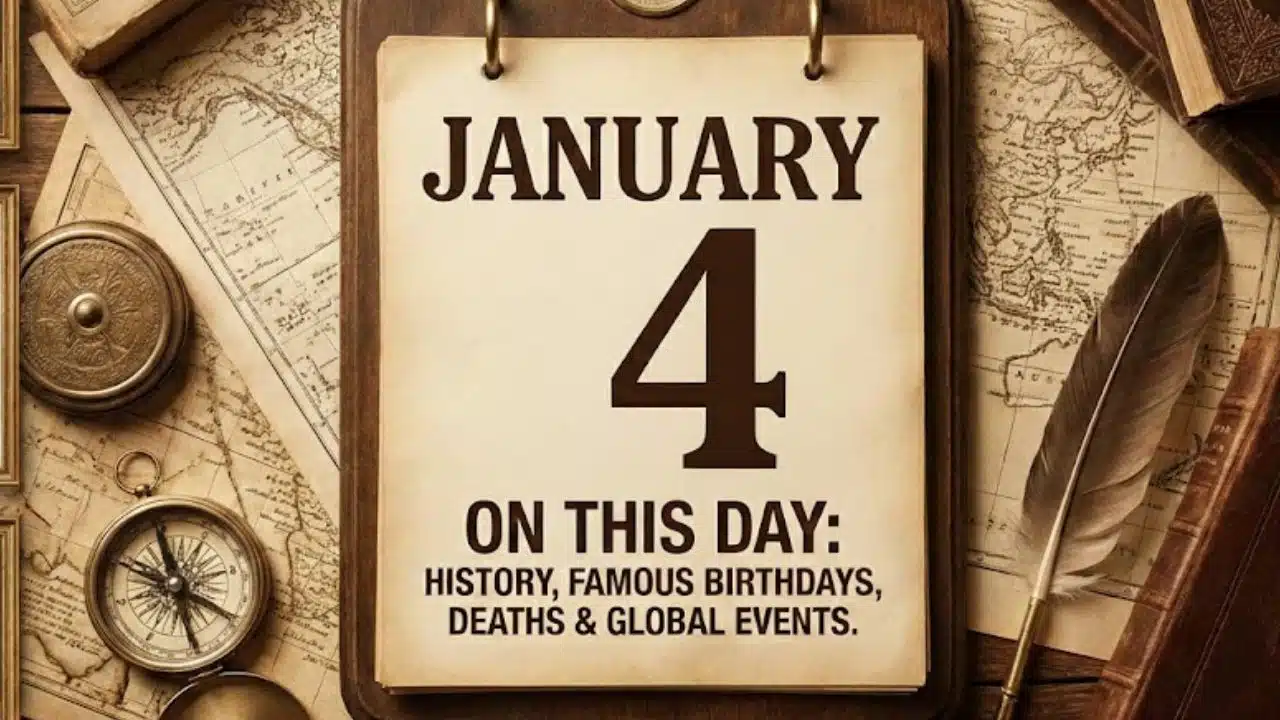
January 4 rarely feels “quiet” once you zoom out. On This Day January 4, the calendar links literacy rights to the dots of Braille, national identity to independence anniversaries, and modern life to moments in aviation, politics, and even Mars exploration.
This date also reminds us of something cultural anthropologists notice everywhere: history is not a single storyline. The same day can hold a nation’s birth, a social uprising, a scientific milestone, and a poet’s last chapter. Below is a reader-friendly deep dive that centers the Bangalee sphere while keeping truly global balance.
At A Glance: January 4 In One Table
| What To Remember | Why It Matters Today |
|---|---|
| World Braille Day | A global push for disability rights, accessible education, and inclusive public information |
| Myanmar Independence Day (1948) | A modern case study of decolonization, identity, and the struggle to build stable governance |
| Bangladesh’s national airline founded (1972) | Post-1971 nation-building and the role of connectivity in sovereignty |
| DRC “Day of the Martyrs” (linked to 1959 Léopoldville riots) | How public protest accelerated African decolonization |
| Spirit rover lands on Mars (2004) | A landmark in planetary science that reshaped how we explore other worlds |
| Burj Khalifa opens (2010) | A symbol of Gulf-era globalization, urban spectacle, and economic ambition |
The Bangalee Sphere
Historical Events
Bangladesh: A New Nation Builds Its Wings (1972)
On January 4, 1972, Biman Bangladesh Airlines was established as Bangladesh’s national carrier. The timing matters. Bangladesh had only just emerged from the trauma of 1971, and the early years of any new state are about proving sovereignty in practical ways, not only through flags and speeches.
A national airline is not just a business. In postwar state-building, it becomes:
-
A tool of diplomacy and visibility
-
A way to connect diaspora networks and labor routes
-
A symbol of “we exist, and we can move on our own terms”
For Bangladesh, where rivers can isolate communities and where international trade and labor migration shape livelihoods, air connectivity also carries a social meaning: being linked to the wider world without depending entirely on someone else’s infrastructure.
India And The Wider Bengal Region: Remembering Colonial Afterlives
January 4 does not have a single universally observed Bengal-centered political anniversary like February 21 (Language Movement) or March 26 (Independence Day of Bangladesh). Still, it sits inside a season of remembrance, when many families, institutions, and cultural groups revisit Partition-era trauma, refugee histories, and the long shadow of colonial administrative boundaries.
In West Bengal and Bangladesh, winter cultural life often intensifies through:
-
Literary addas and book fairs (seasonal tradition, even when dates vary)
-
Recitals and tributes to modern Bengali poetry and song
-
University and theater circuits that treat “history” as a living conversation
So while January 4 may not be a headline national memorial day in Bengal, it often functions as part of a broader winter “memory season” in which communities actively narrate their past.
Famous Births (Bangladesh & India Focus Where Available)
Because globally prominent January 4 births skew European and American, Bangalee-sphere lists tend to be more specialized and sometimes disputed in common databases. Still, in Bengali cultural spaces, January is frequently used for literary tributes and archival projects, especially in universities and local cultural associations.
If you publish this on Editorialge, one effective approach is a “regional spotlight” box that invites readers to contribute verified names over time, with year and source checks.
Famous Deaths (Regional Lens)
Similarly, widely documented January 4 deaths more often feature European intellectual history. In the Bangalee sphere, a meaningful editorial approach is to connect global losses (like great philosophers and writers who died on this date) with how they shaped curricula, translations, political debates, and theater traditions in Bengal and India.
Cultural / Festivals (Bangladesh & India)
There is no fixed pan-India or Bangladesh-wide major religious festival always tied to January 4. However, a few seasonal observances often frame the day culturally:
-
Many Christian communities remain within the broader Christmas–New Year season (dates vary by tradition).
-
In South Asia, this period builds toward Makar Sankranti / Uttarayan / Pongal season (mid-January, not January 4).
-
Winter fairs, folk performances, and local shrine urs events may occur, but they vary by year and region.
Editorial note: For reader value, it helps to mention that January 4 is more about observances and anniversaries than a single shared festival.
International Observances & Holidays
Major International Days
World Braille Day (January 4)
The United Nations proclaimed January 4 as World Braille Day, aligning the date with the birthday of Louis Braille. The day is not “symbolic only.” It speaks to a hard reality: literacy access is power access.
In practical terms, Braille affects:
-
School participation and exam fairness
-
Job opportunity pipelines
-
Independent mobility and safety (public signage, transport, medicine labels)
-
Digital inclusion through refreshable Braille displays
A cultural-anthropology lens adds something deeper: societies often decide whose knowledge “counts” by deciding whose communication gets funded, printed, and standardized. World Braille Day pushes back against that exclusion.
National Days
Myanmar Independence Day (January 4)
Myanmar marks Independence Day on January 4, commemorating independence from British rule in 1948. Independence anniversaries are often framed as triumphant endings, but Myanmar’s modern story shows how independence can also be the beginning of new internal struggles.
Why it matters today:
-
Myanmar’s independence is a key chapter in Asian decolonization history
-
The country’s long conflicts remind us that “post-colonial” does not automatically mean “peaceful”
-
The date is also politically sensitive in contemporary Myanmar, where state ceremonies and public life reflect ongoing tensions
Democratic Republic of the Congo: Day Of The Martyrs (Linked To January 1959)
In the DRC, January 4 is associated with remembrance connected to the Léopoldville riots of 1959, which became a major turning point in the road toward Congolese independence. It stands as a reminder of how colonial systems often collapsed not only through negotiations, but through mass pressure, grief, and sacrifice.
Global History
United States
1853: Solomon Northup Regains His Freedom
On January 4, 1853, Solomon Northup regained freedom after being kidnapped and held in slavery, later documenting his experience in Twelve Years a Slave. The significance is not only personal. It exposes how slavery relied on systems that could swallow even free citizens when law enforcement and economics aligned against them.
Why it matters now:
-
It remains one of the clearest narratives showing how “legal status” did not guarantee safety for Black Americans
-
It shaped modern public history, museum work, and memory debates about race and freedom
1896: Utah Enters The Union
Utah became the 45th U.S. state on January 4, 1896. Statehood stories often sound bureaucratic, but they reveal long negotiations over identity, religion, governance, and federal power.
1965: First Televised Evening State Of The Union
On January 4, 1965, President Lyndon B. Johnson delivered a televised evening State of the Union, helping transform the address into a mass-media civic ritual. This shift matters because political persuasion increasingly moved from parliament-style audiences to living rooms and screens.
2007: Nancy Pelosi Becomes First Woman Speaker Of The House
On January 4, 2007, Nancy Pelosi became the first woman to serve as Speaker of the U.S. House of Representatives. Beyond the headline, this moment reflects the slow restructuring of political opportunity, and how representation can change what citizens imagine as possible.
2021: Alphabet Workers Union Announced
On January 4, 2021, the Alphabet Workers Union was announced, signaling a new era of labor organizing in the tech economy. Even without traditional collective bargaining structures, it represented a cultural shift: white-collar tech workers increasingly adopting union language to contest workplace power.
Russia
January 4’s most widely repeated “on this day” lists often lean Western, but Russia’s modern historical rhythm reminds us that dates gain meaning through institutions: state commemorations, school curricula, media rituals, and church calendars. For an Editorialge-style archive, the best Russia approach on January 4 is to highlight global events that shaped Russia’s world position (Cold War media politics, space exploration culture, and the broader history of revolutions and civil war memory), even when the exact “January 4” hook varies by source tradition.
China
As with Russia, many popular January 4 lists underrepresent China unless the day has a major political turning point. A stronger approach is to connect January 4 themes to China’s modern transformations:
-
Literacy and state-building narratives
-
Disability inclusion and education access debates
-
The global supply chain economy that made “modern life” portable
This is where World Braille Day becomes a useful bridge: it lets you discuss disability rights as a global development question, not a Western-only story.
United Kingdom
1642: King Charles I Attempts To Arrest The “Five Members”
On January 4, 1642, King Charles I entered the House of Commons to arrest five MPs. The attempt failed, and it became one of the sparks that pushed England toward civil war.
Why this still matters:
-
It is a classic case of what happens when executive power tries to physically dominate a representative institution
-
It shaped future ideas about parliamentary privilege and the limits of monarchy
-
It remains a reference point whenever modern democracies argue about “rule by force” versus “rule by law”
Europe
Europe’s January 4 legacy appears strongly through births and deaths of intellectual figures whose work shaped global education. This date is a reminder that “European history” is not only about wars and borders. It is also about the production of ideas that traveled worldwide through translation, colonial education systems, and global universities.
Australia
Australia’s January political calendar is heavily shaped by summer timing and national debates that often peak later in the month (especially around Australia Day discussions). For January 4 specifically, the most meaningful global hook is how Australia participates in international observances like World Braille Day through disability advocacy and inclusive public services.
Canada
Canada’s strongest January 4 link in global coverage is through shared North American political culture and labor questions. The Alphabet Workers Union story matters here because it explicitly included workers in the U.S. and Canada, reflecting how tech workplaces cross borders even when labor law does not.
Rest Of World (Asia, Africa, South America)
Democratic Republic of the Congo: From Riot To Independence Momentum (1959)
The Léopoldville riots, associated with January 4, 1959, are widely remembered as a turning point that accelerated Congolese independence. It is one of the key examples of how colonial administrations underestimated urban political organizing and mass anger.
United Arab Emirates: Burj Khalifa Opens (2010)
On January 4, 2010, Burj Khalifa officially opened in Dubai. Beyond architecture, it symbolizes:
-
Global capital flows
-
Migrant labor realities
-
City branding as economic strategy
-
The Gulf’s role in 21st-century “spectacle modernity”
In cultural terms, towers like this function as national storytelling devices. They tell the world, “we are modern,” even while debates continue about who benefits from that modernity.
Israel: Ariel Sharon Suffers A Major Stroke (2006)
On January 4, 2006, Israeli Prime Minister Ariel Sharon suffered a massive stroke, reshaping Israel’s political landscape. It shows how leadership health can become a political turning point, especially in regions where security decisions carry immense consequences.
Space As A Global Story: Spirit Lands On Mars (2004)
On January 4, 2004, NASA’s Spirit rover landed on Mars. Although it’s an American mission, space exploration is inherently global in impact because:
-
Scientific data becomes shared human knowledge
-
Technologies spin into global industries
-
The achievement shapes how societies imagine the future
Notable Births & Deaths
Famous Births
-
Louis Braille (1809, France): Inventor of the Braille system, central to global literacy access for blind and visually impaired people.
-
Isaac Newton (1643, England, New Style date): A foundational figure of the Scientific Revolution. Note: his birth date appears as Dec 25, 1642 in Old Style records and Jan 4, 1643 in New Style dating.
-
Jacob Grimm (1785, Germany): Co-collector of Grimm’s Fairy Tales and a major linguist who helped shape modern study of language and folklore.
-
Doris Kearns Goodwin (1943, United States): Historian known for influential works on American presidents and political culture.
-
Michael Stipe (1960, United States): Lead singer of R.E.M., an iconic figure in alternative rock and modern cultural expression.
Famous Deaths
-
Albert Camus (1960, France): Nobel Prize–winning writer and philosopher, famous for works exploring absurdism, ethics, and human dignity.
-
T. S. Eliot (1965, U.K., American-born): A defining modernist poet and critic whose work reshaped 20th-century literature.
-
Erwin Schrödinger (1961, Austria): A founder of quantum mechanics, associated with the Schrödinger equation and the famous “Schrödinger’s cat” thought experiment.
-
Henri Bergson (1941, France): Philosopher and Nobel laureate whose ideas on time, consciousness, and change influenced modern thought.
Takeaways
On This Day January 4, the world offers a powerful mix: the dignity of accessible literacy, the pride and pain of independence, the drama of constitutional conflict, and the quiet persistence of science pushing beyond Earth.
If you publish this for Editorialge readers, the strongest editorial angle is not “a list of facts.” It is the connecting idea: societies reveal their values by what they celebrate, what they mourn, and whose access to knowledge they protect.