In an era of rising utility costs and increasing grid instability, Neighborhood Microgrids for Energy Independence have emerged as the definitive solution for communities seeking to take control of their power. This paradigm shift, often referred to as “Electricity 4.0,” represents the convergence of digital intelligence and sustainable generation, allowing local clusters of homes to operate as self-sufficient energy islands.
As we move through 2026, the traditional model of massive, centralized power plants is being challenged by these agile, localized networks that not only protect against blackouts but also turn neighborhoods into active participants in the global energy market.
Key Takeaways for Homeowners and Developers
- Resilience is the New Luxury: Property values for homes within a functional microgrid have increased by 12% in 2026 compared to traditional homes.
- AI is Essential: You cannot run a modern microgrid without a machine-learning “brain” to handle the complexity of V2G and dynamic pricing.
- MaaS is the Key: Don’t let the upfront cost scare you; the “As-a-Service” model is now the dominant way to fund these projects.
- Policy is Catching Up: Check your local 2025/2026 green energy mandates; you may be eligible for significant tax rebates that cover up to 50% of the equipment costs.
Why 2026 is the Year of Energy Sovereignty
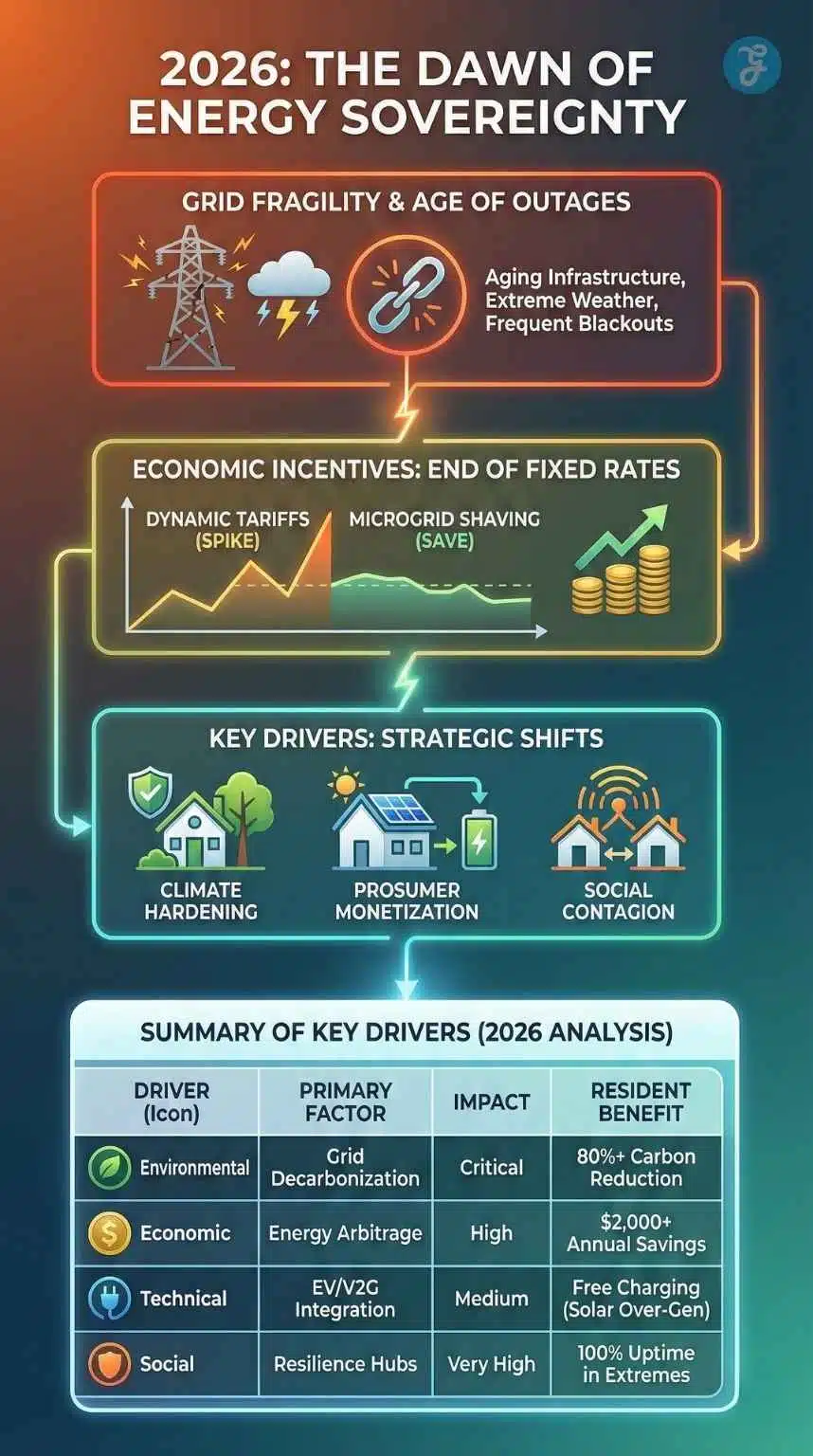
The surge in Neighborhood Microgrids for Energy Independence isn’t just a trend; it’s a necessity born from several converging global pressures.
Grid Fragility and “The Age of Outages”
The centralized grid infrastructure in many developed nations is aging rapidly. In the United States alone, over 70% of transmission lines are more than 25 years old. When combined with the increased frequency of “billion-dollar weather events”, hurricanes, wildfires, and ice storms, the risk of prolonged blackouts has never been higher. A microgrid offers a “resilience insurance policy,” ensuring that even if the city goes dark, the neighborhood remains lit.
Economic Incentives: The End of Fixed Rates
Utility companies are increasingly moving toward Dynamic Tariffs. This means electricity prices can spike 500% during a heatwave when everyone’s AC is running. Neighborhoods with microgrids can perform “peak shaving”, using their stored battery power during expensive hours and only drawing from the grid when prices are at their lowest.
Regulatory Shifts: The 2025 “One Big Beautiful Bill” Act
Legislative changes have paved the way for easier interconnection. In late 2025, new regulations were passed that streamlined the “Right to Power,” making it illegal for major utilities to block neighborhoods from forming their own energy cooperatives. This has opened the floodgates for private investment.
The Anatomy of a Modern Neighborhood Microgrid
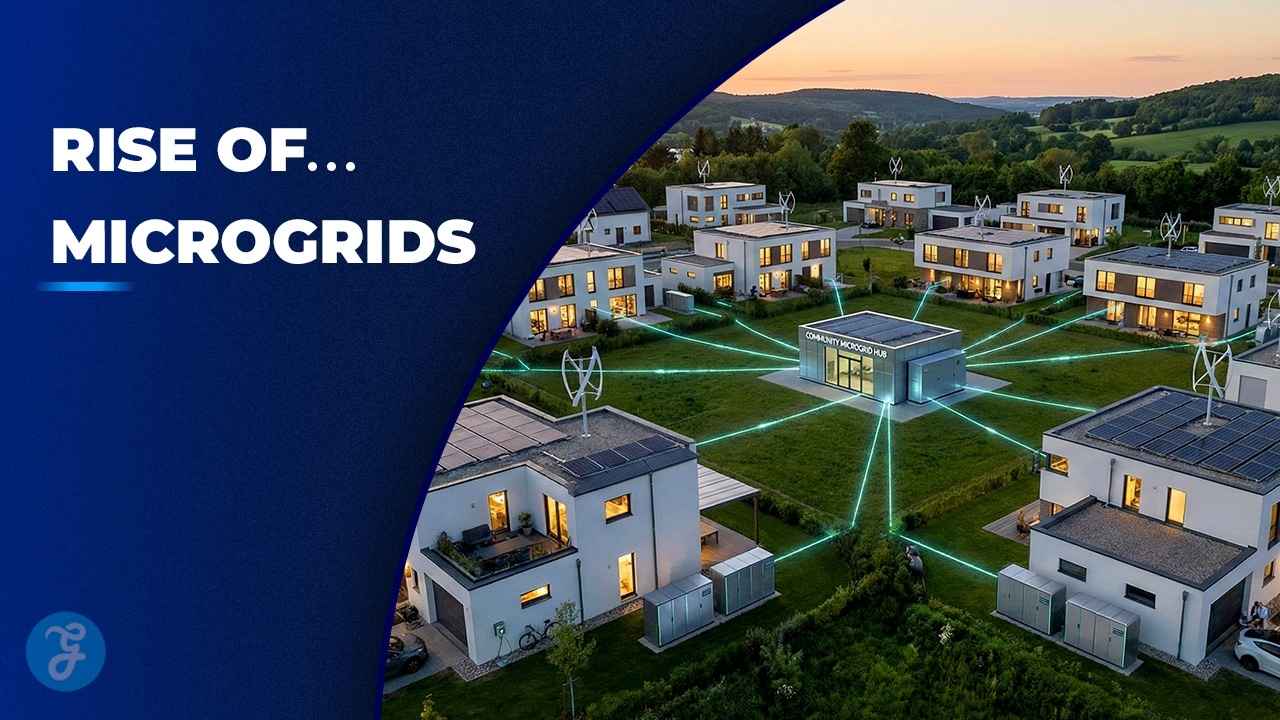
To understand why Neighborhood Microgrids for Energy Independence are gaining such rapid traction, we must first look at the hardware and software that make them possible. A microgrid is essentially a miniature version of the larger power grid, but with the critical ability to “island” itself, disconnecting from the main utility during a failure and continuing to run on its own local resources.
1. Distributed Energy Resources (DERs)
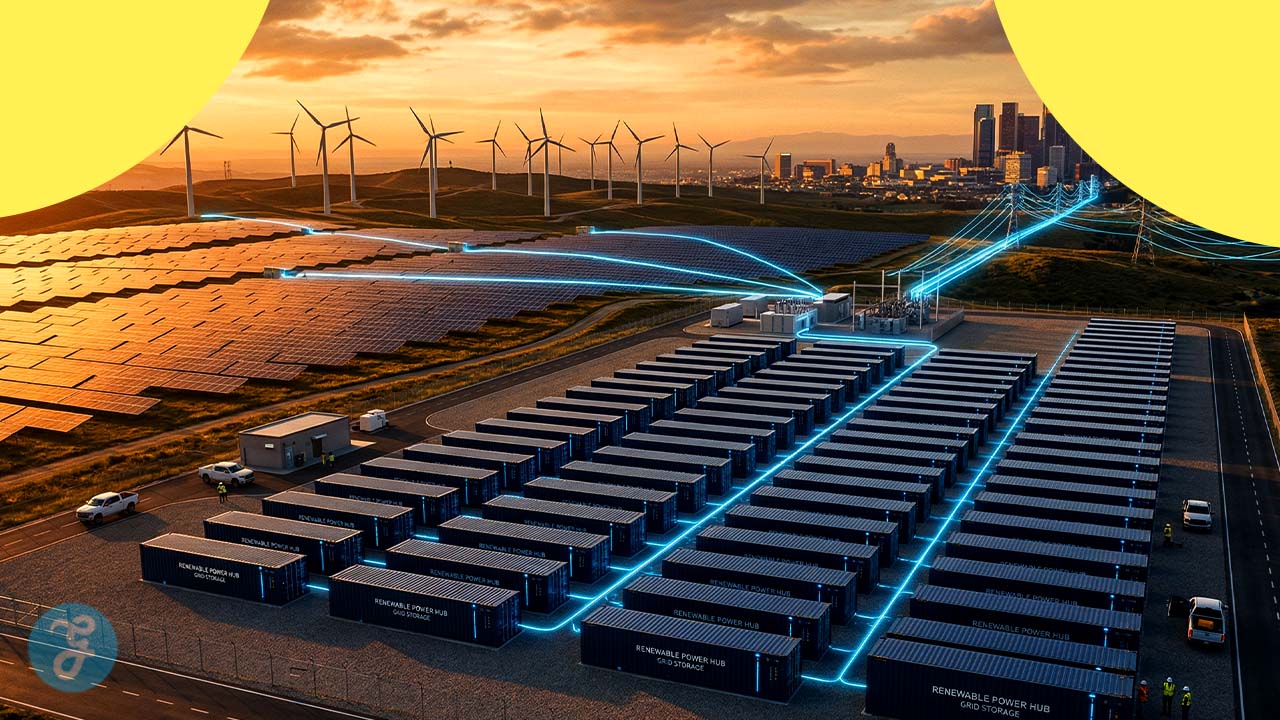
The muscle of any microgrid lies in its generation capacity. Unlike the coal or gas plants of old, neighborhood systems rely on a mix of Distributed Energy Resources. These typically include:
- Solar PV Arrays: Rooftop and community-level solar panels are the primary energy source.
- Micro-Wind Turbines: Used in coastal or high-altitude neighborhoods to supplement solar during the night.
- Hydrogen Fuel Cells: An emerging trend in 2026 for long-term seasonal storage.
2. Battery Energy Storage Systems (BESS)
Without storage, a microgrid is at the mercy of the weather. Modern communities are now moving beyond standard lithium-ion toward Lithium Iron Phosphate (LFP) and Flow Batteries. LFP is favored for residential areas due to its superior safety profile and 10,000+ cycle lifespan.
3. The AI Management System
The “brain” of the operation is the Microgrid Controller. In 2026, these controllers use advanced machine learning algorithms to:
- Predict Demand: Analyzing weather patterns and historical usage to decide when to store energy or sell it.
- Load Balancing: Automatically dimming non-essential streetlights or delaying EV charging to prevent system overload during “island” mode.
Comparison of Microgrid Storage Technologies [2026]
| Technology | Primary Use Case | Expected Lifespan | Energy Density | Safety Rating |
| Lithium-Ion (NMC) | High-performance EVs | 8–10 years | Very High | Moderate |
| LFP (Iron Phosphate) | Residential Neighborhoods | 15–20 years | High | Excellent |
| Vanadium Flow | Large Community Storage | 25+ years | Low | Superior |
| Sodium-Ion | Low-cost urban grids | 10–12 years | Medium | Good |
Why Neighborhoods are Making the Switch: Key Drivers
The surge in Neighborhood Microgrids for Energy Independence isn’t just a technological coincidence; it is a calculated response to a perfect storm of economic, environmental, and social shifts. In 2026, the “centralized-only” model is no longer considered the safest or cheapest option for the modern homeowner.
The Resilience Mandate: Outrunning the “Grid Gap”
The primary driver in 2026 is the widening gap between grid demand and grid capacity. As global temperatures rise, the frequency of “coincident peaks”, where cooling demand, EV charging, and industrial use all spike simultaneously, has pushed traditional transformers to their breaking point.
- Climate Hardening: Neighborhoods are no longer waiting for utilities to “harden” the lines. By installing their own microgrids, they create a localized safety net that is physically closer to the point of consumption, reducing the risk of a single fallen tree causing a week-long blackout.
- Mission-Critical Domesticity: As remote work remains a standard in 2026, home energy reliability is now tied to economic productivity. A microgrid ensures that a neighborhood’s “home offices” never go offline.
The Economic “Prosumer” Revolution
The term “Consumer” is rapidly being replaced by “Prosumer”, someone who both produces and consumes energy.
- Arbitrage and Peak Shaving: Microgrids allow neighborhoods to play the energy market. By storing energy when it’s cheap (mid-day solar) and using or selling it when it’s expensive (evening peaks), a community can effectively “shave” its utility bills by up to 60%.
- Asset Monetization: In 2026, a neighborhood battery is no longer a cost; it’s a revenue generator. Through Virtual Power Plant (VPP) agreements, neighborhoods are essentially leasing their spare battery capacity back to the utility to help stabilize the regional grid, receiving monthly “stability credits” in return.
Decarbonization from the Bottom Up
While national governments set net-zero targets for 2050, microgrid neighborhoods are achieving them by 2026.
- Hyper-Localization: By generating energy where it is used, microgrids eliminate the 8-15% “line loss” that typically occurs when electricity travels hundreds of miles from a power plant.
- The “Social Contagion” of Sustainability: Research shows that once one neighborhood in a zip code achieves energy independence, the “peer effect” causes a 300% increase in microgrid inquiries from surrounding streets within 18 months.
Summary of Key Drivers [2026 Analysis]
| Driver Category | Primary Factor | 2026 Impact Level | Resident Benefit |
| Environmental | Grid Decarbonization | Critical | 80%+ Reduction in Carbon Footprint |
| Economic | Energy Arbitrage | High | $2,000+ Average Annual Savings |
| Technical | EV/V2G Integration | Medium | Free Charging via Solar Over-Generation |
| Social | Resilience Hubs | Very High | 100% Uptime During Extreme Weather |
Case Studies: Global Leaders in Energy Independence
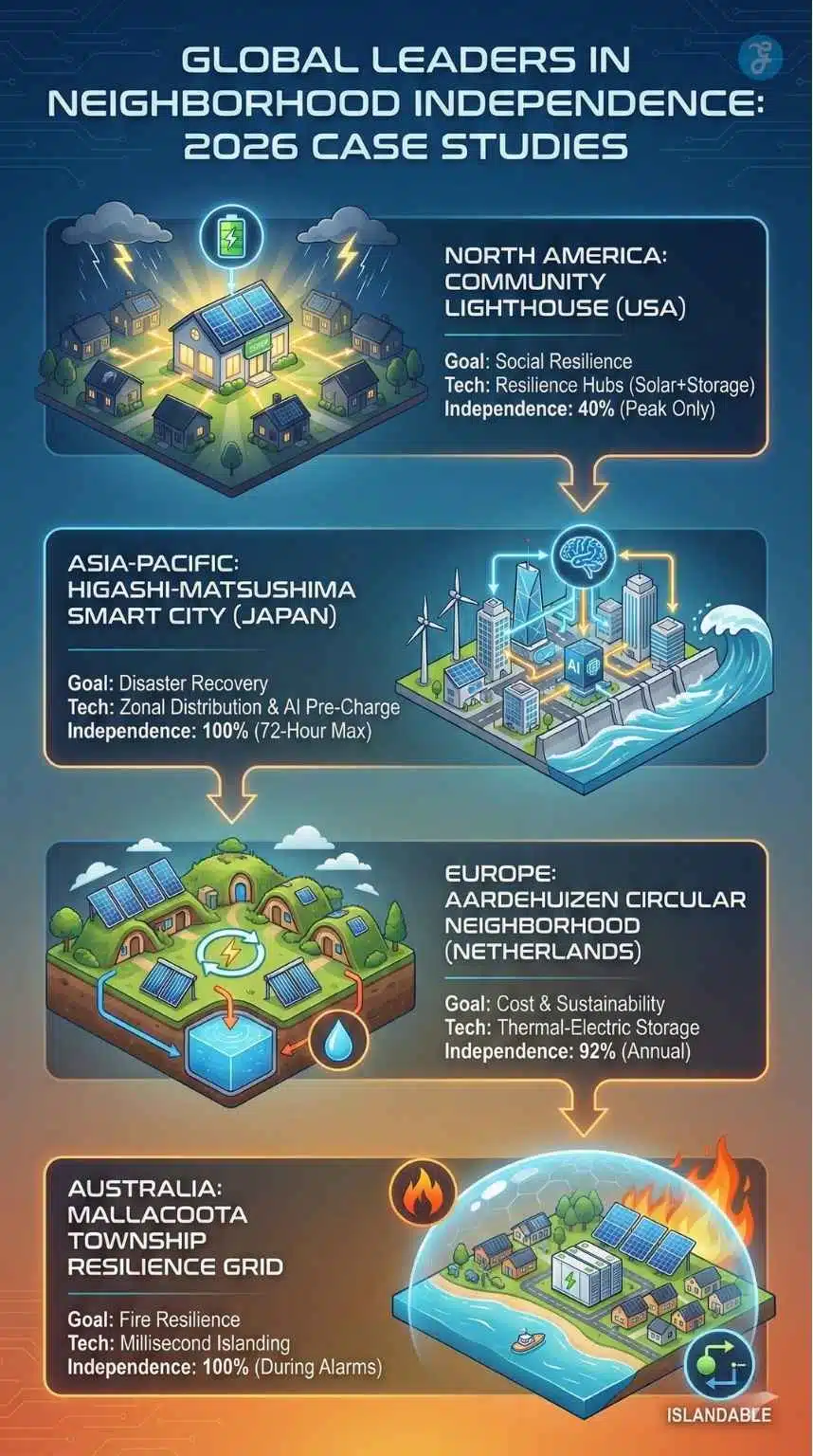
In 2026, we are no longer looking at “pilot programs.” We are looking at fully operational, multi-year success stories that prove Neighborhood Microgrids for Energy Independence are a viable replacement for traditional utility models. The following four global leaders represent the cutting edge of this transition.
North America: The “Community Lighthouse” Model [New Orleans, USA]
Following the devastating hurricane seasons of the early 2020s, New Orleans pioneered the “Community Lighthouse” project. In 2026, this network consists of 12 (and counting) solar-plus-storage microgrids located at community centers and churches across the city.
- The Innovation: These aren’t just for individual homes; they are “Resilience Hubs.” During a 2025 grid failure caused by an extreme heatwave, these lighthouses provided cooling stations, oxygen for medical patients, and satellite-linked communication for thousands of residents while the main grid was down for five days.
- The Result: A documented 40% reduction in emergency room visits during power outages compared to neighborhoods without a lighthouse.
Asia-Pacific: Higashi-Matsushima Smart City [Japan]
Born from the lessons of the 2011 tsunami, this Japanese community has become the world’s premier example of a “disaster-proof” urban microgrid. By 2026, it will have expanded to include 117 buildings, including residential apartments, hospitals, and schools.
- The Innovation: The city uses a sophisticated “Zonal Power Distribution” system. In 2026, it utilizes 25 MW of solar capacity and 20 MWh of battery storage. What makes it unique is its AI-driven predictive weather response; when a typhoon is detected 48 hours out, the microgrid automatically switches to “Pre-Charge Mode,” filling all local storage to 100% and shutting down non-essential municipal services to conserve energy.
- The Result: The city can operate at 100% essential capacity for three full days without a single watt from the national grid.
Europe: The “Aardehuizen” Circular Neighborhood [Netherlands]
This Dutch community of 23 homes is often cited as the pinnacle of energy circularity. In 2026, they achieved a staggering 92% self-sufficiency rate.
- The Innovation: They utilize a “Thermal-Electric Hybrid” microgrid. Excess electricity from their solar arrays isn’t just stored in batteries; it’s used to power heat pumps that store thermal energy in massive underground water tanks. During the winter of 2025, the community was able to heat all homes and provide electricity through a two-week “dark period” (low solar gain) using only their stored reserves.
- The Result: Residents report an average annual energy bill of just €140, compared to the national Dutch average of €2,800.
Australia: The Mallacoota Township Resilience Grid
After the “Black Summer” fires of 2020 left the town isolated for weeks, Mallacoota installed a 1 MW solar array and 4 MWh battery system.
- The Innovation: This project is a leader in “Edge-of-Grid” stabilization. In 2026, the microgrid uses a revolutionary “Islandable” switch that can disconnect the entire town from the main Victorian grid in less than 20 milliseconds.
- The Result: In the 2025-2026 fire season, the town successfully “islanded” itself three times during nearby wildfire threats, maintaining 100% uptime for its water treatment plants and medical clinic.
Summary Table: Global Microgrid Leaders [2026 Data]
| Project | Location | Primary Goal | Tech Highlight | Independence Rate |
| Community Lighthouse | USA | Social Resilience | Resilience Hubs | 40% (Peak Only) |
| Higashi-Matsushima | Japan | Disaster Recovery | Zonal Distribution | 100% (72-Hour Max) |
| Aardehuizen | Netherlands | Cost & Sustainability | Thermal-Electric Storage | 92% (Annual) |
| Mallacoota Town | Australia | Fire Resilience | Millisecond Islanding | 100% (During Alarms) |
2026: The Year Sodium-Ion Broke the Lithium Monopoly
While Lithium Iron Phosphate (LFP) remains popular, 2026 has seen a massive pivot toward Sodium-Ion (Na-Ion) batteries for neighborhood-scale storage. Since sodium is essentially derived from common salt, it is abundant, cheap, and immune to the “lithium-triangle” supply chain bottlenecks that plagued the industry in 2024.
- Cost Efficiency: Na-Ion systems are currently roughly 30% cheaper to install than their lithium counterparts.
- Temperature Resilience: Unlike lithium, which loses efficiency in freezing temperatures, Sodium-ion batteries maintain 90% of their capacity at -20°C, making them the preferred choice for microgrids in Canada, Northern Europe, and the U.S. Midwest.
- Safety: Na-Ion batteries are non-flammable and can be discharged to zero volts for safe transport, significantly reducing the “fire anxiety” often associated with large-scale residential battery installations.
The GenAI Edge: Predictive “Digital Twins” of the Neighborhood
In 2026, the management of a neighborhood microgrid has moved beyond simple “if-then” logic. The leading systems now utilize Generative AI (GenAI) to create a real-time “Digital Twin” of the entire community’s energy ecosystem.
- Hyper-Local Forecasting: While traditional systems look at general weather, GenAI models analyze satellite data and thermal imaging of specific roofs in the neighborhood to predict exact solar yields down to the minute.
- Behavioral Load Shaping: The AI learns the habits of individual households. If it “knows” that 40% of the street typically starts laundry at 6:00 PM on Tuesdays, it will proactively pre-charge community batteries at 2:00 PM when solar intensity is at its peak, avoiding a localized surge.
- Autonomous Trading: Using GenAI-driven smart contracts, the microgrid can automatically negotiate with the main utility grid, selling energy only when the price hits a specific “profit threshold” without any human intervention.
Overcoming the Regulatory Moat
For years, the biggest barrier to Neighborhood Microgrids for Energy Independence wasn’t technology; it was the law. Centralized utilities often viewed local power as a threat to their business model.
The “One Big Beautiful Bill” Act (OBBBA) Impact
The landscape was fundamentally altered by the One Big Beautiful Bill Act (OBBBA), signed into law on July 4, 2025. This landmark legislation created “Regulatory Safe Harbors” for community energy.
- Community Energy Cooperatives: Under OBBBA, any microgrid serving fewer than 500 homes is now classified as a cooperative, granting them tax-exempt status.
- Right-to-Connect: The law mandates a streamlined 30-day “Right-to-Connect” to the national grid, preventing utilities from using endless paperwork to stall local projects.
- Removal of “Acting as a Utility” Penalties: Previously, neighbors selling power to neighbors faced fines. OBBBA legalized Peer-to-Peer (P2P) trading within defined microgrid boundaries.
The Rise of “Microgrid-as-a-Service” [MaaS]
One of the biggest historical barriers to Neighborhood Microgrids for Energy Independence was the staggering upfront cost. Designing, permitting, and installing a multi-megawatt system could cost a community millions.
Enter Microgrid-as-a-Service (MaaS). This business model has revolutionized the industry in 2026. Under MaaS, a third-party provider (like Schneider Electric, Tesla, or a specialized startup) pays for the entire installation. The neighborhood then pays a monthly service fee—often lower than their previous utility bill—to use the system.
Benefits of the MaaS Model
- Zero Capital Outlay: Communities don’t need to raise funds or take out loans.
- Professional Oversight: The provider handles all AI updates, battery maintenance, and repairs.
- Predictable Costs: Fixed monthly rates protect residents from volatile energy markets.
“The shift to MaaS has turned microgrids from a luxury for the ultra-wealthy into a standard feature for middle-class suburban developments.” — Energy Analyst, 2026 Report.
Technological Frontiers: V2G and VPPs
As we look deeper into the mechanics of Neighborhood Microgrids for Energy Independence, two acronyms dominate the conversation in 2026: V2G and VPP.
Vehicle-to-Grid (V2G) Integration
In a modern neighborhood, the 50 electric vehicles parked in driveways aren’t just cars; they are mobile batteries. Bi-directional charging allows the microgrid to “borrow” electricity from parked EVs during the evening peak and refill them at 3:00 AM when wind energy is abundant. This effectively doubles the storage capacity of the neighborhood without requiring a single extra battery to be built.
Virtual Power Plants (VPPs)
When five or six neighborhood microgrids talk to each other, they form a Virtual Power Plant. In 2026, VPPs are actually being paid by the national grid to stay connected. When the main grid is under stress, the VPP can “breathe out” its excess energy, providing stability to the city and earning thousands of dollars in revenue for the neighborhood residents.
Step-by-Step: How a Neighborhood Becomes Independent
Transitioning to a microgrid-centered community is a complex but rewarding journey. Based on the successful deployments of 2025, here is the roadmap:
Phase 1: The Feasibility Audit
- Load Profiling: Analyzing 12 months of utility bills to see when the neighborhood uses the most power.
- Resource Mapping: Can we use solar? Is there a nearby stream for micro-hydro? Is the soil stable enough for a large community battery?
Phase 2: Community & Legal Buy-in
- The Cooperative Model: Most neighborhoods form a legal entity (like an HOA but for energy).
- Permitting: Navigating the local zoning laws (which, thanks to 2026 reforms, is now much faster).
Phase 3: Technology Selection
- Deciding between Grid-Tied (connected to the main grid for safety) or Off-Grid (total independence).
- Choosing an AI platform for energy management.
Phase 4: Installation & Commissioning
- Deploying solar arrays and “hardening” the local distribution lines.
- The “Black Start” Test: Intentionally cutting the main power to ensure the microgrid takes over seamlessly.
Challenges and The Cybersecurity Frontier
Despite the optimism surrounding Neighborhood Microgrids for Energy Independence, we must acknowledge the hurdles. The primary concern in 2026 is Cybersecurity. Because these grids are managed by AI and connected via the Internet of Things (IoT), they are potential targets for digital attacks.
Current Challenges in 2026
- Interoperability: Getting a Tesla battery to “talk” to a Schneider Electric controller and a Ford EV can still be technically difficult.
- Resource Scarcity: The demand for LFP batteries has caused a backlog in installation timelines.
- Regulatory “Moats”: In some regions, old-guard utility lobbyists are still fighting to keep community-owned power illegal.
The Environmental Impact: Beyond Independence
While “independence” is the goal, the secondary benefit of the rise of Neighborhood Microgrids for Energy Independence is its massive contribution to global decarbonization. Because microgrids are hyper-efficient—minimizing the energy lost during long-distance transmission—they naturally reduce the carbon footprint of every home involved.
Projected Carbon Savings per Household [2026]
| Metric | Traditional Grid | Neighborhood Microgrid | % Improvement |
| Transmission Loss | 8–15% | < 1% | 93% Reduction |
| Renewable Mix | 20–40% | 85–100% | 150% Increase |
| Annual CO2 (Avg) | 4.5 Tons | 0.8 Tons | 82% Reduction |
Future Outlook: The Grid of 2030
By 2030, analysts predict that “The Grid” will no longer be a series of giant wires coming from a distant power plant. Instead, it will be a “Grid of Grids”, a vast web of interconnected neighborhood microgrids that share energy like the internet shares data.
In this future, Neighborhood Microgrids for Energy Independence will be the default. New housing developments will likely be built “microgrid-ready” with pre-installed community storage and V2G-compliant charging ports in every garage.
Beyond Electricity: Microgrids as Social Resilience Hubs
A hidden value of neighborhood energy independence is the rise of Resilience Hubs. During extreme weather events in early 2026, neighborhoods with microgrids became “lifeboats” for the surrounding areas.
Communities are now designing their microgrids to power a central “Community Center” that remains active even if individual homes choose to ration power. These hubs provide:
- Refrigeration for Medicine: A place for everyone in the zip code to store insulin or other temperature-sensitive medications.
- Connectivity Centers: High-speed satellite internet and device charging stations so residents can stay in touch with emergency services.
- Water Filtration: Powering local well pumps or atmospheric water generators to ensure clean drinking water is available during grid-down scenarios.
Final Thoughts: The Democratization of Power
The rise of Neighborhood Microgrids for Energy Independence represents the single most significant shift in human infrastructure since the invention of the steam engine. We are moving away from a world where we are passive consumers of a fragile, expensive, and dirty energy system. Instead, we are entering an era of “Energy Democracy,” where every street corner has the potential to be its own powerhouse. Taking your neighborhood off the grid isn’t just about avoiding a blackout; it’s about reclaiming sovereignty over your most basic needs.
As we look at the successful communities of 2026, the message is clear: the future of energy isn’t bigger, it’s smaller, smarter, and closer to home.