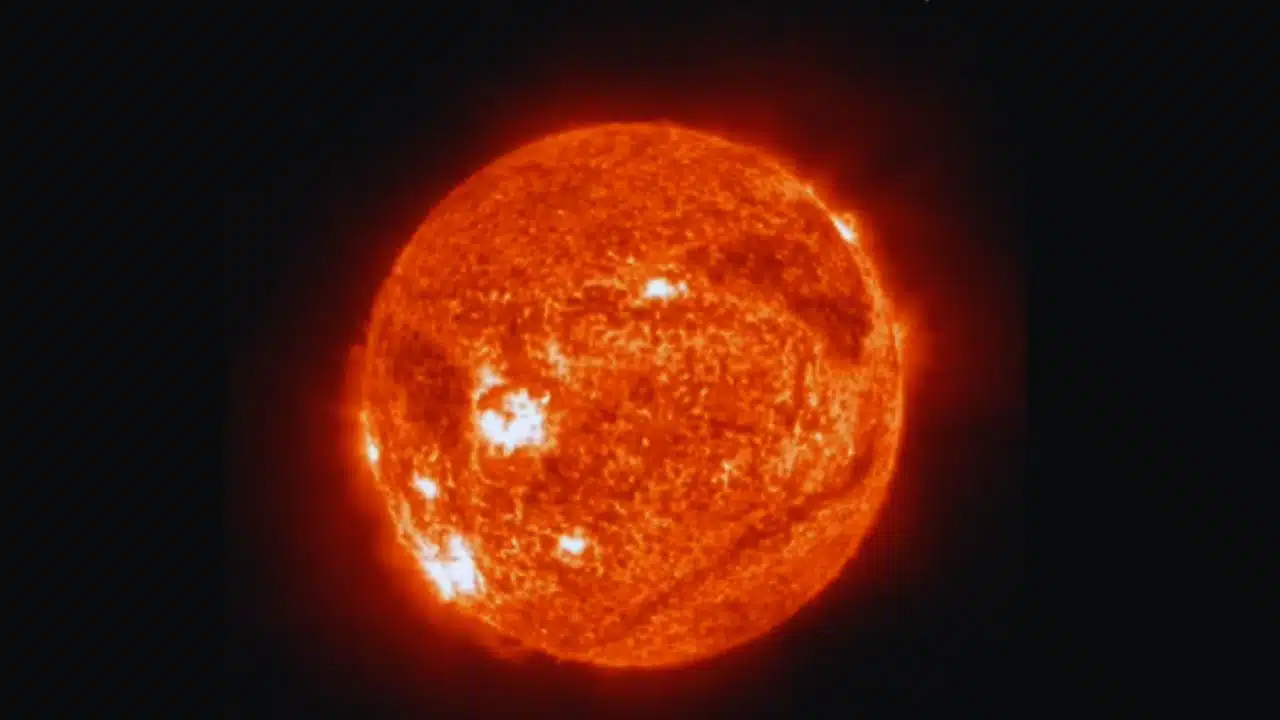
NASA scientists have confirmed that the Sun, once believed to be entering a long-term period of weakness, is becoming more active again. The finding reverses earlier expectations and has major implications for both space science and everyday technology on Earth.
According to a new peer-reviewed study published in Astrophysical Journal Letters in September 2025, solar activity has increased steadily since 2008 after decades of decline. This shift caught researchers by surprise, since many believed the Sun was heading toward a “grand solar minimum,” similar to historical lulls in activity.
From Decline to Rebound
Between the 1980s and 2008, data showed a clear downward trend in solar output. Solar wind density, magnetic field strength, and plasma activity had all weakened. By 2008, scientists said the Sun had reached its lowest point in recorded history. Many expected the trend to continue for decades, ushering in a prolonged quiet era.
But lead researcher Jamie Jasinski, a space plasma physicist at NASA’s Jet Propulsion Laboratory (JPL), and co-author Marco Velli discovered that things changed after 2008. Their analysis revealed steady increases across multiple solar measurements:
- Solar wind density rose by about 26%.
- Solar wind temperature climbed by nearly 29%.
- Thermal pressure increased by around 45%.
- Magnetic field strength rose by about 30%.
- Mass and momentum flux of solar wind jumped by 27–34%.
These increases show that the Sun is not just producing more sunspots but is also pumping out stronger magnetic fields and more energetic charged particles into the solar system.
Solar Cycles and What They Mean
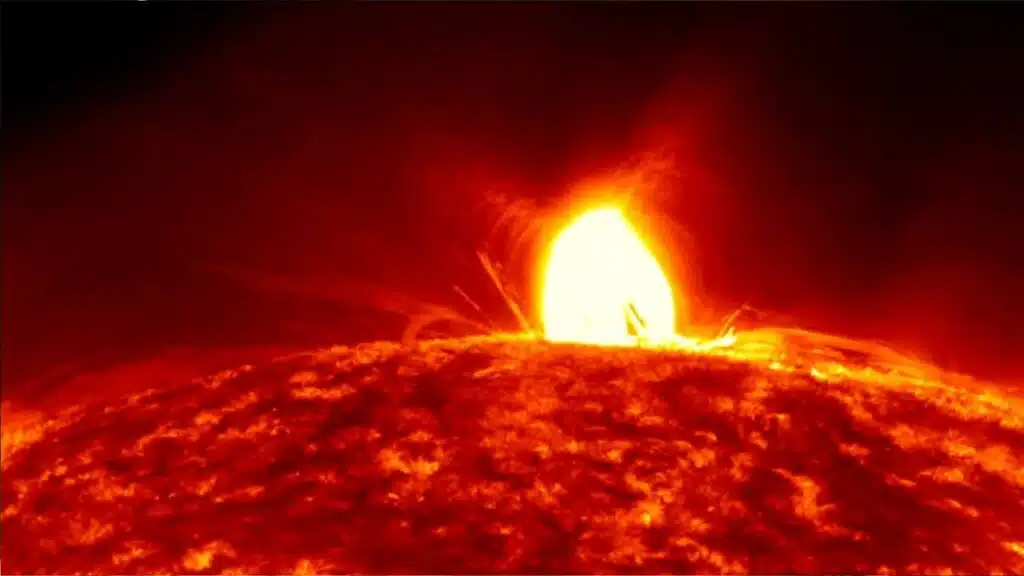
The Sun’s activity follows roughly 11-year solar cycles, marked by rising and falling numbers of sunspots, flares, and coronal mass ejections (CMEs).
- Solar Cycle 24 (2008–2019): One of the weakest cycles in over a century, sparking fears of a long-lasting “deep solar minimum.”
- Solar Cycle 25 (2020–present): Stronger than expected, showing a clear rebound in solar intensity.
- Solar Cycle 26 (expected 2029–2032): Still uncertain; forecasts are pending from NOAA and other space agencies.
Historically, deep quiet periods like the Maunder Minimum (1645–1715) coincided with colder global climates, such as the “Little Ice Age” in Europe. This is one reason scientists carefully watch solar trends — they can affect Earth’s climate and technological systems in complex ways.
Why the Change Matters
The Sun’s increased activity affects more than space science — it has direct consequences for modern life.
Space Weather and Technology Risks
- Geomagnetic Storms: Solar flares and CMEs can send massive bursts of charged particles toward Earth. If they hit, they can disrupt power grids, satellites, navigation systems, and internet infrastructure.
- Communications Disruption: GPS signals, aviation communications, and marine navigation systems can all be affected. Shortwave and ship-to-shore radio systems are especially vulnerable.
- Astronaut Safety: Increased solar radiation raises risks for human missions beyond Earth’s magnetic shield, such as NASA’s Artemis program to the Moon.
A Recent Example: May 2024 Storm
In May 2024, Earth experienced the strongest geomagnetic storm in more than two decades. Several X-class solar flares caused dazzling auroras to appear far south — even in Mexico — while also threatening communication networks. This event highlighted how vulnerable technology can be to solar outbursts.
NASA’s Next Steps in Tracking the Sun
To prepare for stronger solar weather, NASA is launching several missions aimed at improving monitoring and prediction:
- Interstellar Mapping and Acceleration Probe (IMAP): Will study how solar wind interacts with the edge of the solar system.
- Carruthers Geocorona Observatory: Designed to investigate Earth’s outermost atmospheric layers and how they interact with solar radiation.
- NOAA’s SWFO-L1 mission: To be launched aboard a SpaceX Falcon 9, this will provide early warnings of space weather from the Sun-Earth Lagrange Point 1.
These come after the launch of TRACERS twin satellites, which are currently studying how the solar wind interacts with Earth’s magnetic field.
NASA stresses that these missions are critical not only for scientific knowledge but also for protecting astronauts and spacecraft operating in increasingly hazardous conditions.
Scientists Still Searching for Answers
While the increase in activity is clear, the reasons behind it are not. Researchers admit they do not fully understand what caused the decades-long decline to end or why the Sun suddenly “woke up.”
Possible factors under investigation include:
- Internal solar dynamo changes (how magnetic fields are generated).
- Interactions between long-term solar cycles beyond the 11-year rhythm.
- Unknown feedback processes within the Sun’s plasma layers.
This uncertainty makes it difficult to predict exactly how strong future solar cycles will be.
The Bigger Picture: Living With a Restless Star
Earth’s magnetic field shields the planet from much of the Sun’s radiation, but extreme solar storms remain a real concern. Past events, such as the Carrington Event of 1859, caused telegraph systems worldwide to fail. A similar event today could disrupt internet services, satellite communications, and global power grids on a massive scale.
NASA’s research underscores the importance of constant monitoring and preparedness. As humanity becomes more dependent on space-based systems and gears up for deeper exploration of the Moon and Mars, understanding the Sun’s behavior is no longer just a matter of science — it is a matter of global safety and resilience.
The Information is Collected from CBS News and Yahoo.