Mobile Graphics Vs PC is a hot topic that shows just how fast things change in technology. For years, the gap was massive—PCs were the undisputed kings of performance, while mobile devices struggled with basic 3D rendering. But today, that dynamic is shifting rapidly.
From what I’ve seen in recent hardware benchmarks, the line between a high-end smartphone and a mid-range laptop is blurrier than ever. You have phones now capable of running console-quality ports like Resident Evil Village and Death Stranding natively.
However, raw power isn’t the whole story. While mobile chips are efficient marvels, desktop PCs still hold the crown for brute force and thermal management. The real question isn’t just “which is faster,” but “how close is mobile getting to the experience we actually care about?”
Let’s look at the data, what it’s actually telling us about 2026 hardware, and then explore how cloud technology is making this comparison even more interesting.
Evolution of Graphics Technology
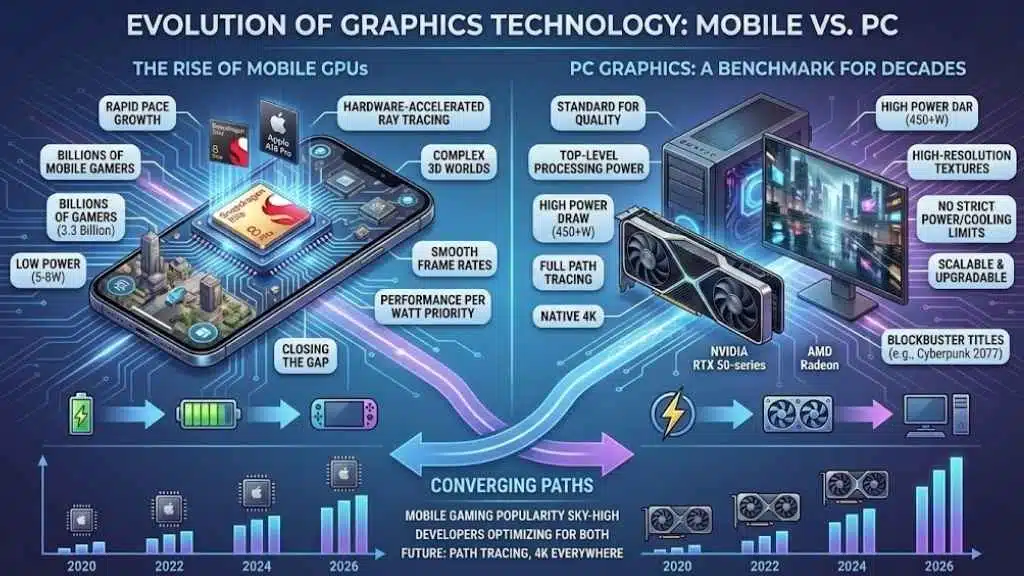
Graphics tech has changed fast. Mobile chips now surprise many with their power. PC graphics still shine, but the race is much closer than people think, and there’s more to see ahead.
The rise of mobile GPUs
Mobile GPUs have grown at a rapid pace. In just a few years, chips in phones and tablets have become far more powerful. Engineers use new designs like Qualcomm’s Snapdragon 8 Elite and Apple’s A18 Pro series to push the limits.
These tiny chips now handle complex 3D worlds, smooth frame rates, and even some virtual reality features once only seen on PCs. For example, the A18 Pro now supports hardware-accelerated ray tracing, a lighting technique that was exclusive to high-end desktops just four years ago.
Smartphones from companies like Samsung and Apple keep getting faster every year. Modern mobile devices can run games that used to need big desktop computers with lots of cooling power. Mobile gaming popularity is sky-high; about 3.3 billion people play on their phones today.
Chip designers know this and work hard to close the performance gap between mobile graphics vs PC systems faster than ever before. They are achieving this by prioritizing “performance per watt,” delivering impressive visuals without draining your battery in ten minutes.
PC graphics: A benchmark for decades
PC gaming has set the standard for graphics performance and quality for many years. Powerful desktop GPUs like NVIDIA’s RTX 50-series and AMD’s latest Radeon cards deliver top-level processing power, stunning frame rates, and full path tracing.
These chips work without strict power or cooling limits. While a phone chip might sip 5 to 8 watts of power, a top-tier desktop GPU like the RTX 4090 or 5090 can draw over 450 watts. This massive power difference lets them run larger games with high-resolution textures and smoother frame rates at native 4K.
Custom PCs are also highly scalable. Gamers add more RAM or swap out GPUs to boost system capabilities as new technology arrives. Game studios design blockbuster titles such as Cyberpunk 2077 and Microsoft Flight Simulator first for powerful desktops because only these machines can handle their demanding visual details at ultra settings.
This focus on benchmarking keeps pushing PC hardware forward, making sure gamers get the very best graphics experience each year.
Comparing Mobile and PC Graphics Performance
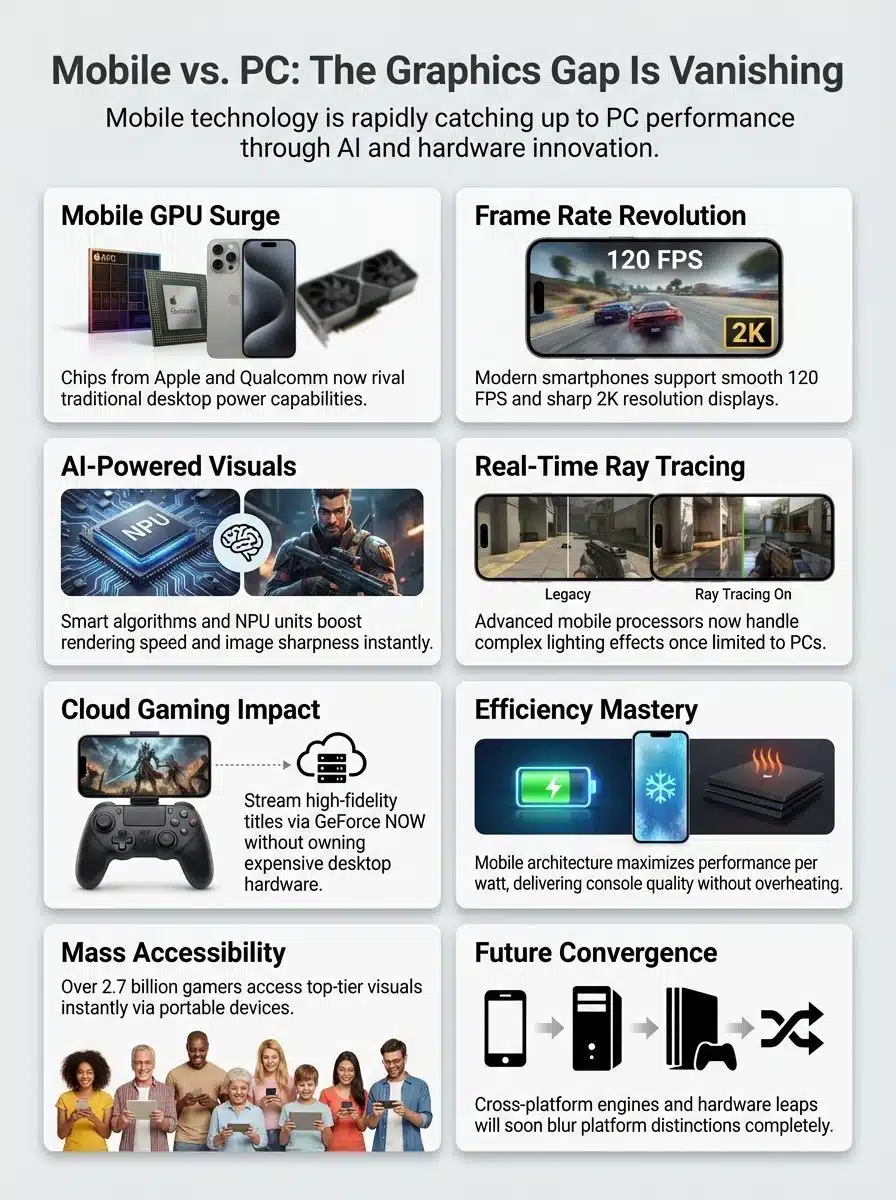
Mobile graphics are catching up fast in quality and speed, surprising many gamers. PC systems still offer some clear advantages, yet the difference is shrinking with each new device release.
Resolution and frame rates
PC gaming often sets the benchmark for high resolution and fast frame rates. Top computers can run games at 4K resolution with silky-smooth 120 frames per second or more. That means clear, sharp images, even during fast action scenes.
Mobile graphics are catching up quickly as new chips push phones to support HD and even 2K displays, along with smooth frame rates around 60 FPS in many top titles. Features like 120Hz ProMotion displays on iPhones and high-refresh screens on Android gaming phones make the experience feel incredibly fluid.
Pro Tip: To get the best frame rates on mobile, look for “Game Mode” settings in your phone’s battery menu. This prioritizes graphics performance over battery life, often unlocking higher FPS caps in supported games.
Just a few years ago, this type of performance on mobile devices sounded impossible. Now new mobile GPUs deliver better rendering quality while using less power compared to before. The gap between mobile computing and PC hardware shrinks each year as engineers add more processing power without sacrificing battery life.
Rendering capabilities
Modern mobile GPUs now support advanced rendering technology that once belonged only to desktop PCs. Phones and tablets can create stunning 3D graphics, real-time shadows, and detailed textures. For example, many top games use the same game engines, like Unreal Engine 5, across both platforms.
Hardware on phones has improved fast. Powerful chips from Qualcomm and Apple handle tasks like ray tracing and high frame rates with increasing ease. In 2026, mobile devices run games at up to 120 frames per second in full HD or more, something rare just a few years ago outside of PC gaming rigs.
This rapid progress is closing the performance gap between mobile computing and traditional desktops faster than most expected. Technologies like MetalFX Upscaling (Apple) and FSR (AMD/Android) allow phones to render games at a lower resolution and use AI to upscale them, looking sharp while saving battery.
Hardware optimization vs. Raw Power
Hardware optimization shapes graphics performance on both mobile and PC platforms. Chip designers have pushed the limits over the years, making smaller chips that use less power yet deliver more processing power.
| Feature | High-End Mobile (e.g., A18 Pro / Snapdragon 8 Elite) | High-End PC (e.g., RTX 4090 / 5090) |
|---|---|---|
| Power Consumption | 5W – 10W (Extremely Efficient) | 300W – 450W+ (High Power Draw) |
| Cooling | Passive (No fans, relies on case) | Active (Large fans, liquid cooling) |
| Ray Tracing | Basic Hardware Acceleration (Shadows/Reflections) | Full Path Tracing (Realistic lighting simulation) |
| Upgradeability | None (System on a Chip) | High (Swap GPU, RAM, CPU) |
PCs still use bigger cooling systems and larger chips without worrying about battery life. This gives PCs an edge in high frame rate gaming and virtual reality support. But mobile hardware is catching up fast due to efficient design.
For example, mobile GPUs can handle complex tasks once limited to desktops, such as real-time ray tracing and AI-powered image enhancements. More developers focus on optimizing games for low-power chips too; this has helped shrink the performance gap between PC gaming and mobile gaming at a speed no one expected even five years ago.
Factors Driving the Closing Gap
New tech keeps pushing mobile graphics closer to PC levels. These changes make games look better and run smoother on smaller devices, much faster than many expect.
Advancements in mobile GPU technology
Mobile GPU technology is moving fast. In 2026, companies like Qualcomm and Apple pack more processing power into smaller chips. Modern phones now support high frame rates and detailed graphics once found only on gaming PCs.
For example, games using Unreal Engine 5 or Unity deliver smooth visuals even on portable screens. Chipmakers keep shrinking transistors—now utilizing 3nm process nodes—so mobiles use less power while still achieving high performance.
AI built into these GPUs boosts rendering quality and speed by handling complex tasks in real time. This means mobile gaming can now handle virtual reality features that were once limited to desktops. Developers optimize hardware and software together, squeezing out every bit of graphics performance from each device.
Efficiency improvements in mobile hardware
Engineers keep making chips for mobile devices smarter and faster. Modern phones use less power but give more graphics performance than ever before. For example, new GPUs in 2026 handle advanced rendering tasks that used to need larger PC hardware.
Smaller transistors and better cooling systems help these tiny devices run bigger games with high frame rates. Phones do not have the same space or energy as PCs, yet today’s mobile gaming experience is smoother thanks to efficient designs from top chip designers.
Companies blend clever software with specialized processors to boost both processing power and battery life. Mobile graphics now support virtual reality features and demanding visuals once only possible on desktop computers, shrinking the gap between PC gaming and mobile gaming every year.
Growing use of AI in graphics processing
AI is now shaping mobile graphics and PC gaming in new ways. Chips in phones use smart algorithms to boost visuals, save power, and improve frame rates at the same time. For example, AI can fill in missing frames or make fuzzy images look sharp during fast action scenes.
Top smartphones use special AI units (NPUs) built into their chips to help with real-time rendering. Game companies like NVIDIA have used AI for years on PCs with features such as DLSS (Deep Learning Super Sampling) that sharpen game images without extra strain on the hardware.
Now similar tools are moving to mobile devices. This helps close the performance gap between mobile computing and desktop systems faster than experts predicted just a few years ago. These advances also allow cloud gaming services to run complex games smoothly on low-cost phones and tablets, opening up high-quality graphics access around the world.
Key Differences That Still Exist: Mobile Graphics vs PC
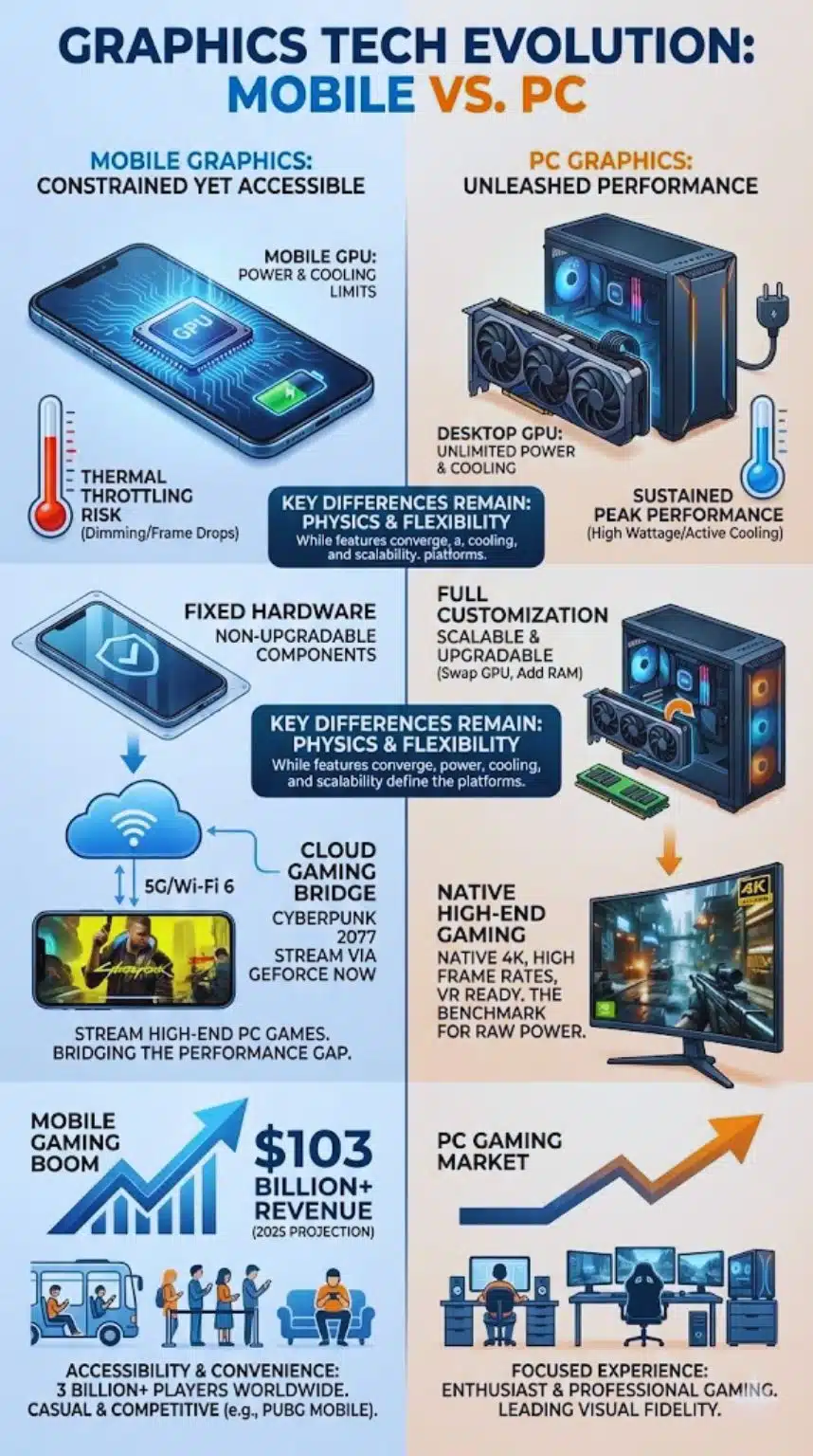
Some limits, like power and cooling, still keep mobile graphics from matching PC performance, but the gap is closing fast. While features are becoming similar, the physics of the devices keeps them apart in raw capability.
Power and cooling limitations
Mobile devices must work within tight power and cooling limits. Unlike desktop PCs, phones use small batteries and have less space for fans or heat sinks. As a result, mobile GPUs need to balance graphics performance with staying cool.
If a smartphone’s chip gets too hot, the system slows down to avoid damage. This is known as thermal throttling. You might notice your screen dimming or frame rates dropping after playing a heavy game like Genshin Impact for 30 minutes.
PC gaming systems handle more intense graphics tasks because they plug into wall power and use large cooling systems. This helps them keep top processing power without overheating. Mobile gaming is catching up fast in efficiency but still faces these hardware hurdles each day.
Customization and scalability on PCs
PC gaming stands out because users can change and upgrade almost every part of their system. You can swap graphics cards, add more RAM, or pick a faster processor. Gamers often build their own PCs using top chips from NVIDIA or AMD for higher performance than most mobile devices.
Over the years, desktop systems have set the benchmark in graphics capability due to these options. Scalability sets PC gaming apart even further. Need better frame rates? Just upgrade your GPU or tweak your settings. Running virtual reality games with high demands is possible because you are not limited by space or cooling like on phones.
This freedom means PC hardware continues to lead in raw processing power and render quality, keeping it a strong choice for competitive gamers and those who want the best graphics performance available today.
The Impact of Cloud Gaming
Cloud gaming now lets people play high-quality games on mobile, matching PC graphics more and more. This technology effectively erases the hardware gap by moving the processing power to a remote server.
Bridging the performance gap
Cloud gaming continues to break barriers. Services like NVIDIA GeForce NOW and Xbox Cloud Gaming allow mobile devices to run games that once needed powerful desktop PCs. Players can now stream high-quality graphics titles, enjoy smoother frame rates, and even try virtual reality features on their phones or tablets.
With a solid 5G or Wi-Fi 6 connection, the input lag has dropped significantly, often to below 40ms. This makes the experience feel almost native for many genres. Gaming market trends show the gap between mobile graphics and PC hardware is shrinking quickly because of this streaming capability.
Mobile GPUs have become smarter with AI support and better chips since 2020. Responsive game engines raise rendering quality on both platforms. Game companies now tune updates for cloud systems, giving more players access to top-level visuals without big investments in PC setups.
Expanding access to high-quality gaming
Game streaming services now let people play high-quality games on almost any device. Phones and tablets can run games that once needed a powerful PC. Services like NVIDIA GeForce Now use remote servers equipped with top-tier RTX 4080 graphics cards.
These servers handle the heavy work, then send smooth gameplay back to players over the internet. Developers are improving mobile GPUs every year. In 2026, new chips offer more processing power at lower costs, making high-end gaming more affordable worldwide.
This helps gamers in places where PCs are expensive or hard to get. More children and adults can join online communities, enjoy stunning graphics performance, and compete in global tournaments, all from their pocket devices.
Mobile Gaming’s Growing Popularity
Mobile gaming is booming, drawing in players everywhere. In fact, mobile gaming revenue is projected to hit nearly $103 billion in 2025, vastly outpacing the PC market.
Accessibility and convenience
People can play games almost anywhere now, thanks to advances in mobile graphics. Phones and tablets fit into pockets or bags, giving quick access to high-quality games at home, on buses, even while waiting in line.
In 2024 alone, more than 3 billion people worldwide played mobile games. Touch screens make controls easy to use for all ages, and controller attachments like the Backbone One or Razer Kishi turn phones into ergonomic handheld consoles.
Game updates come fast over Wi-Fi or cellular networks. Many titles support crossplatform gaming with PC users too. Cloud gaming expands these choices even further by letting players enjoy the latest graphics performance without expensive hardware upgrades. No need for big computers or special equipment, just tap a screen and start playing.
Appeal to casual and competitive gamers
Mobile gaming has seen a huge rise, thanks to improved graphics performance and better hardware. Games like PUBG Mobile and Call of Duty: Mobile attract millions of players each day.
These games offer high frame rates, sharp rendering quality, and low lag, making mobile devices a strong contender for anyone who enjoys fast-paced action. Players can enjoy quick matches during short breaks or longer sessions at home.
- Quick Matches: Games are designed for 5-10 minute sessions, perfect for busy schedules.
- Esports Ready: Tournaments for mobile games now feature multi-million dollar prize pools.
- Social Integration: Built-in voice chat and social sharing make connecting easier than on many PC platforms.
Competitive gamers now use powerful mobile GPUs that handle complex effects once possible only on PCs. Mobile eSports tournaments have grown in popularity across the world. The easy access and convenience of phones let more people play at any skill level.
The Future of Mobile and PC Graphics
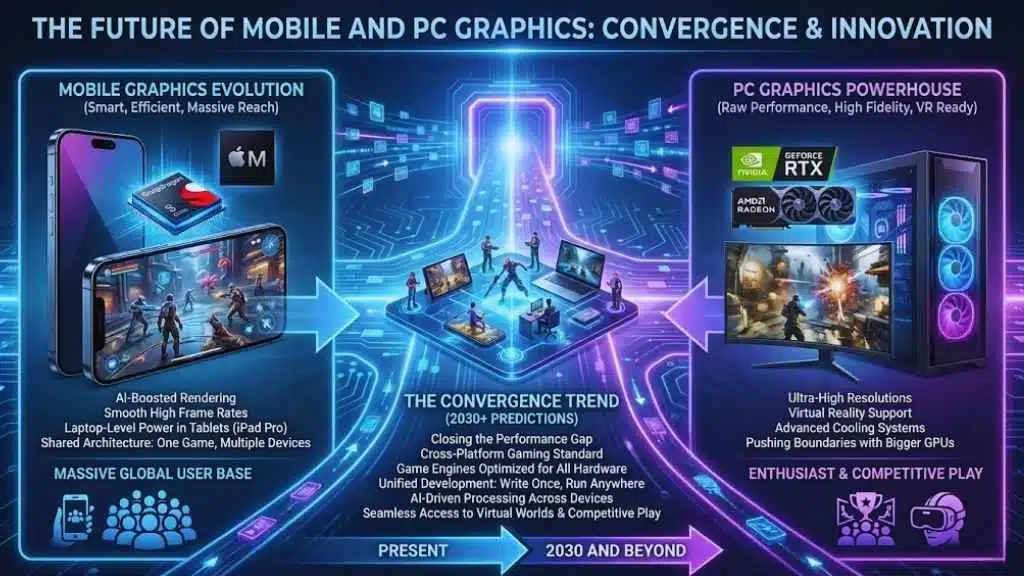
Gamers and tech fans can expect even smarter, faster graphics soon. The convergence of these two worlds is the most exciting trend in the industry.
Innovations in graphics hardware
Chip makers like Qualcomm, Apple, and NVIDIA have made huge leaps in graphics hardware. Mobile GPUs are now handling tasks that once needed desktop power. The latest Snapdragon chips use AI to boost frame rates and improve rendering quality for smooth mobile gaming.
In recent years, Apple’s M-series chips brought laptop-level processing power into tablets like the iPad Pro. This shared architecture means a game can be developed once and run beautifully on a phone, a tablet, and a laptop.
PCs still lead with bigger GPUs and better cooling systems. New cards from NVIDIA or AMD push ultra-high resolutions and support virtual reality features that need lots of processing power. However, the sheer volume of mobile users means developers are prioritizing mobile optimization first.
Predictions for gaming platform evolution
Mobile graphics now close the gap with PC faster than ever before. Mobile devices grow stronger each year, rivaling traditional PC gaming hardware that once led for decades. AI boosts mobile graphics processing speeds while smart chip design makes phones more efficient.
Many experts expect even more blending between platforms by 2030. Companies like NVIDIA and AMD keep improving both mobile and desktop GPUs every year. Game engines now get updates for crossplatform gaming and better visual fidelity across hardware types.
As access grows, millions of new gamers join from every corner of the globe using both mobile computing and PCs as their gateway into virtual reality worlds or competitive play, no matter which device they hold in their hands.
Final Thoughts
The race between mobile graphics and PC gaming has become closer than ever. Graphics performance on phones is catching up fast, thanks to better chips, smarter hardware, and the power of AI in rendering.
Game visuals are sharper, frame rates are smoother, and the line between systems keeps blurring with every update. Anyone can enjoy high-quality games anywhere now; just pick up a phone or sit at your desk, both offer rich experiences tuned for fun or competition.
For a great experience, remember these quick tips: check your device specs before buying a demanding game, and consider a cloud gaming subscription if you want PC-level visuals on the go. Players willing to try new platforms will find fresh ways to play, and who knows what amazing worlds you might discover next?