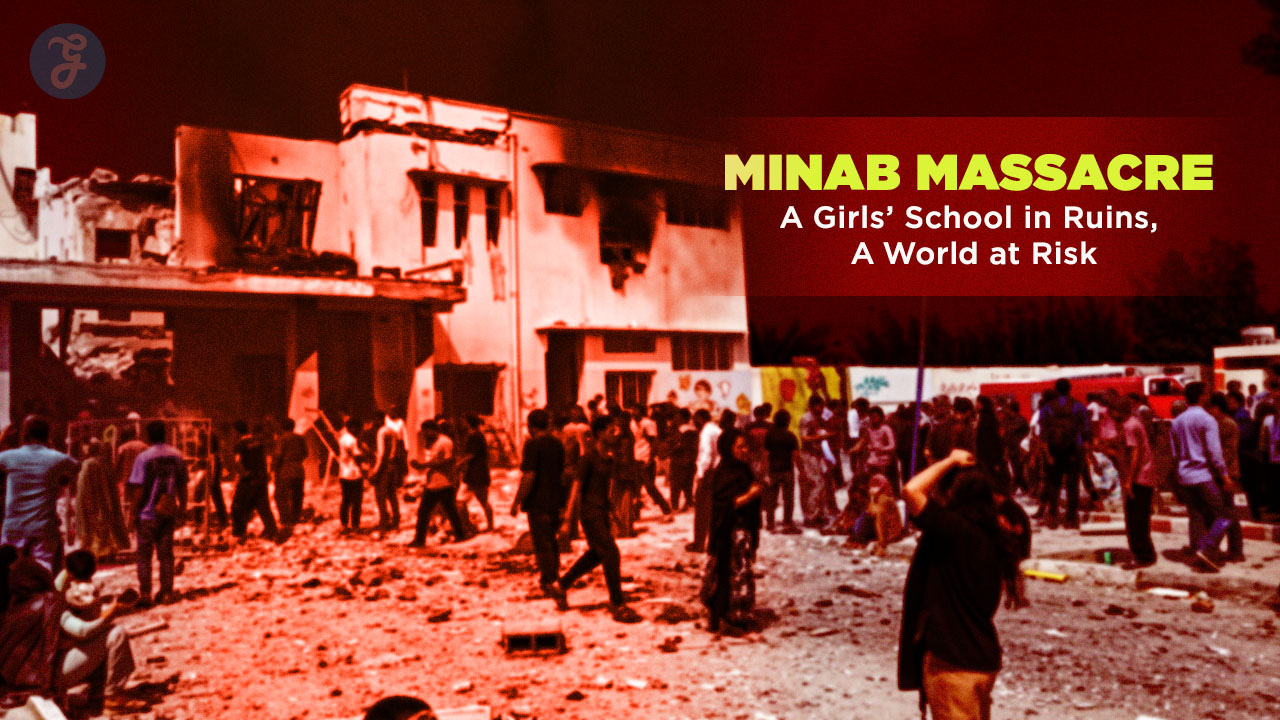
The phrase Minab Massacre does not sound like geopolitics. For me, it sounds like a wound. It begins not with maps or military briefings, but with a classroom at a girls’ school. With desks. With half-written homework. With a blackboard that still carries the outline of a lesson that will never be finished. When a girls’ school is reduced to rubble and young students perish beneath concrete and dust, war stops being a strategy and becomes a tragedy.
Inside the Minab Massacre
Beneath vibrant murals of painted forests and microscopes, charcoal smoke drifts toward a fractured sky. Shuttered windows have vanished, leaving only jagged glass and shredded curtains dancing in the heat. Against a scorched wall, the remnants of childhood are strewn across the dirt: a crimson slide, tangled chairs, and a toppled shelf. There, a pair of pink sandals sits with haunting neatness, now buried under a thick shroud of grey debris.
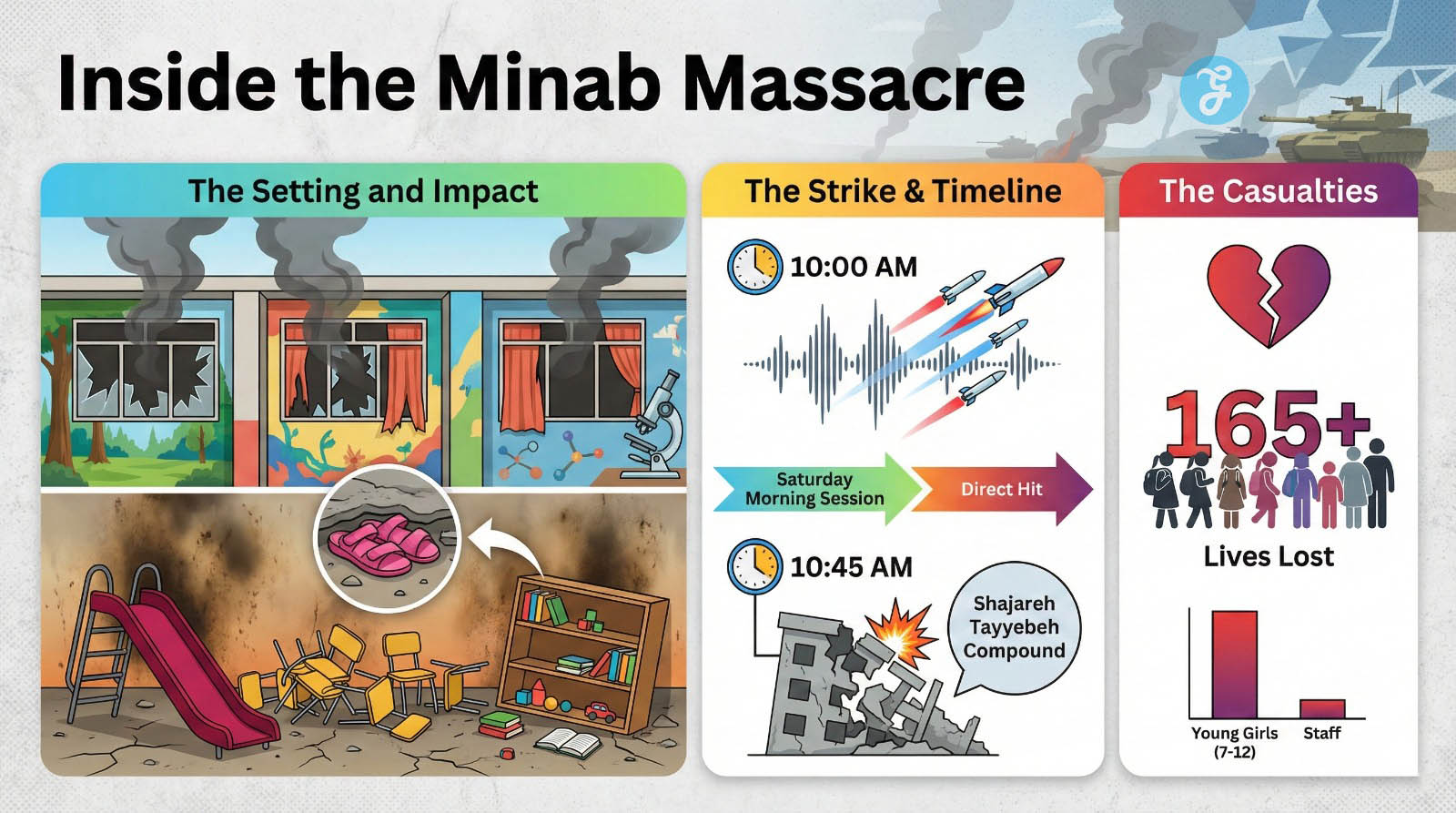 The strike arrived with cruel precision during the Saturday morning session. While lessons were in full swing around 10am, American and Israeli ordnance tore through the silence. Between that moment and 10:45am, a direct hit obliterated the Shajareh Tayyebeh compound in southern Iran. In an instant, the concrete sanctuary collapsed, extinguishing the lives of at least 165 students and staff, with some reports placing the toll as high as 168. Most were young girls aged seven to twelve. This was not a tactical success; it was a graveyard of unfinished dreams.
The Human Cost Behind the Statistics
The Minab Massacre must not be reduced to a statistic. Minab, a city in Iran’s Hormozgan province, lies far from the grand diplomatic halls where conflicts are debated. Yet it is precisely in such cities that the consequences of escalation are felt most brutally. When violence enters a school compound, it does not merely break walls. It fractures the idea of safety.
Across modern conflicts, schools have repeatedly become collateral damage. According to verified reporting by global agencies such as UNICEF and UNESCO, thousands of schools worldwide have been damaged or destroyed in war zones over the past decade. In conflicts from Syria to Ukraine, children have lost years of learning. The destruction of education infrastructure is not incidental. It is devastatingly predictable.
The attack on Minab girls’ school fits into this grim pattern, serving as a heartbreaking anchor for the broader Minab Massacre.
When a girls’ school is struck, it carries layered symbolism. Education for girls has historically been fragile in many regions. In Afghanistan, after the Taliban takeover in 2021, secondary schools for girls were restricted for extended periods. That decision alone affected millions of students. When a school is bombed, the message is even more brutal. It tells young girls that their futures are negotiable.
But the tragedy does not stop at the school gates.
Global Infrastructure and Economic Aftershocks
War’s shockwaves travel quickly. Civilian infrastructure becomes the next casualty. Airports, roads, power grids, and water systems are not military symbols. They are lifelines. Disruptions at major transit hubs such as Dubai International Airport remind the world how interconnected modern economies are. Dubai International Airport has consistently ranked among the busiest international airports globally, handling tens of millions of passengers annually before and after the pandemic recovery. Damage or disruption at such a hub reverberates through global aviation, tourism, cargo logistics, and insurance markets.
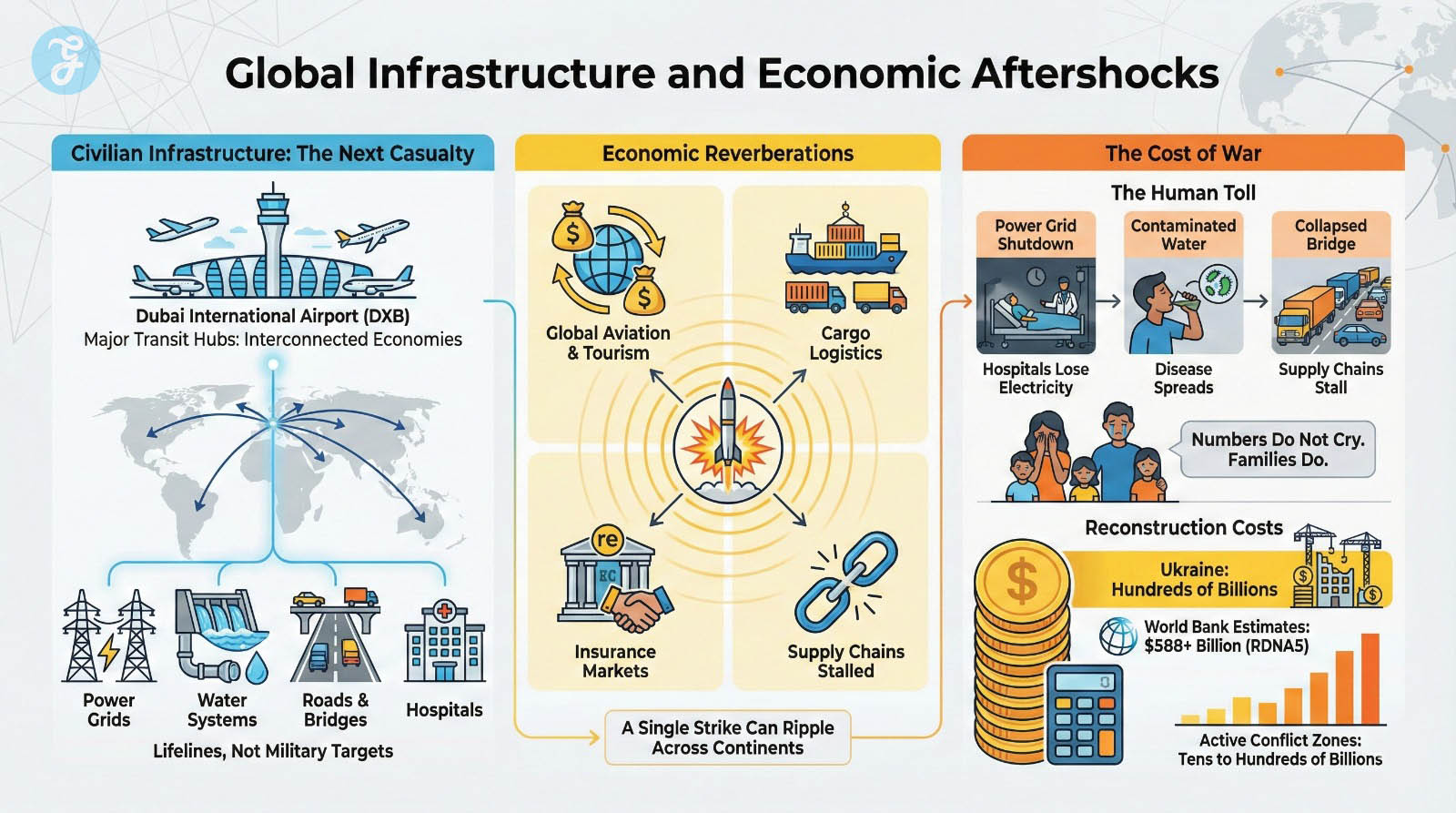 A single strike can ripple across continents.
When power grids shut down, hospitals lose electricity. When water systems are contaminated, disease spreads faster than missiles. When bridges collapse, supply chains stall. Verified data from the World Bank estimates that reconstruction costs in active conflict zones often reach tens or even hundreds of billions of dollars. In Ukraine, the World Bank and partners estimated reconstruction and recovery needs in the hundreds of billions of dollars following sustained infrastructure damage. The numbers are staggering. But numbers do not cry. Families do.
The Breakdown of Diplomacy and Leadership
The Minab Massacre, if understood honestly, is not an isolated outrage. It is part of a cycle that modern warfare has normalised.
Diplomatic breakdown often follows or precedes such violence. Embassies are attacked. Foreign nationals are evacuated overnight. Ambassadors are withdrawn. International treaties are suspended. Peace talks collapse. When diplomatic missions close, it signals more than a security precaution. It signals that dialogue has failed.
In the vacuum left by this silence, the language of leadership turns from negotiation to raw accusation. Following the tragedy, Iranian Foreign Minister Seyed Abbas Araghchi captured this sentiment in a widely shared post on X, stating:
“These are graves being dug for more than 160 innocent young girls who were killed in the US-Israeli bombing of a primary school. Their bodies were torn to shreds. This is how “rescue” promised by Mr. Trump looks in reality. From Gaza to Minab, innocents murdered in cold blood.”
See Iranian Foreign Minister Seyed Abbas Araghchi’s X post:
These are graves being dug for more than 160 innocent young girls who were killed in the US-Israeli bombing of a primary school. Their bodies were torn to shreds.
This is how “rescue” promised by Mr. Trump looks in reality.
From Gaza to Minab, innocents murdered in cold blood. pic.twitter.com/cRdJ3BELOn
— Seyed Abbas Araghchi (@araghchi) March 2, 2026
History shows us that once embassies shutter and back channels fall silent, escalation becomes easier. In recent decades, conflicts in the Middle East and Eastern Europe have repeatedly demonstrated that miscalculation thrives in silence. When communication breaks down, suspicion fills the vacuum.
Leadership crises add another volatile layer. Targeted assassinations, bombings of government buildings, emergency rule declarations, and suspended democratic processes create an atmosphere of instability that extends far beyond borders. Political assassinations are not new to warfare, but each one destabilises institutions further. Emergency powers, though sometimes justified for security, can erode civil liberties long after the conflict subsides.
Strategic Chokepoints and Market Volatility
And then comes the economic fallout.
Global markets react to uncertainty with speed. Oil prices spike at the hint of instability in energy-producing regions. Stock markets plunge on news of escalation. Insurance premiums for shipping through strategic waterways surge. Currency values fluctuate sharply. Businesses shut down, not only in the conflict zone but in dependent economies.
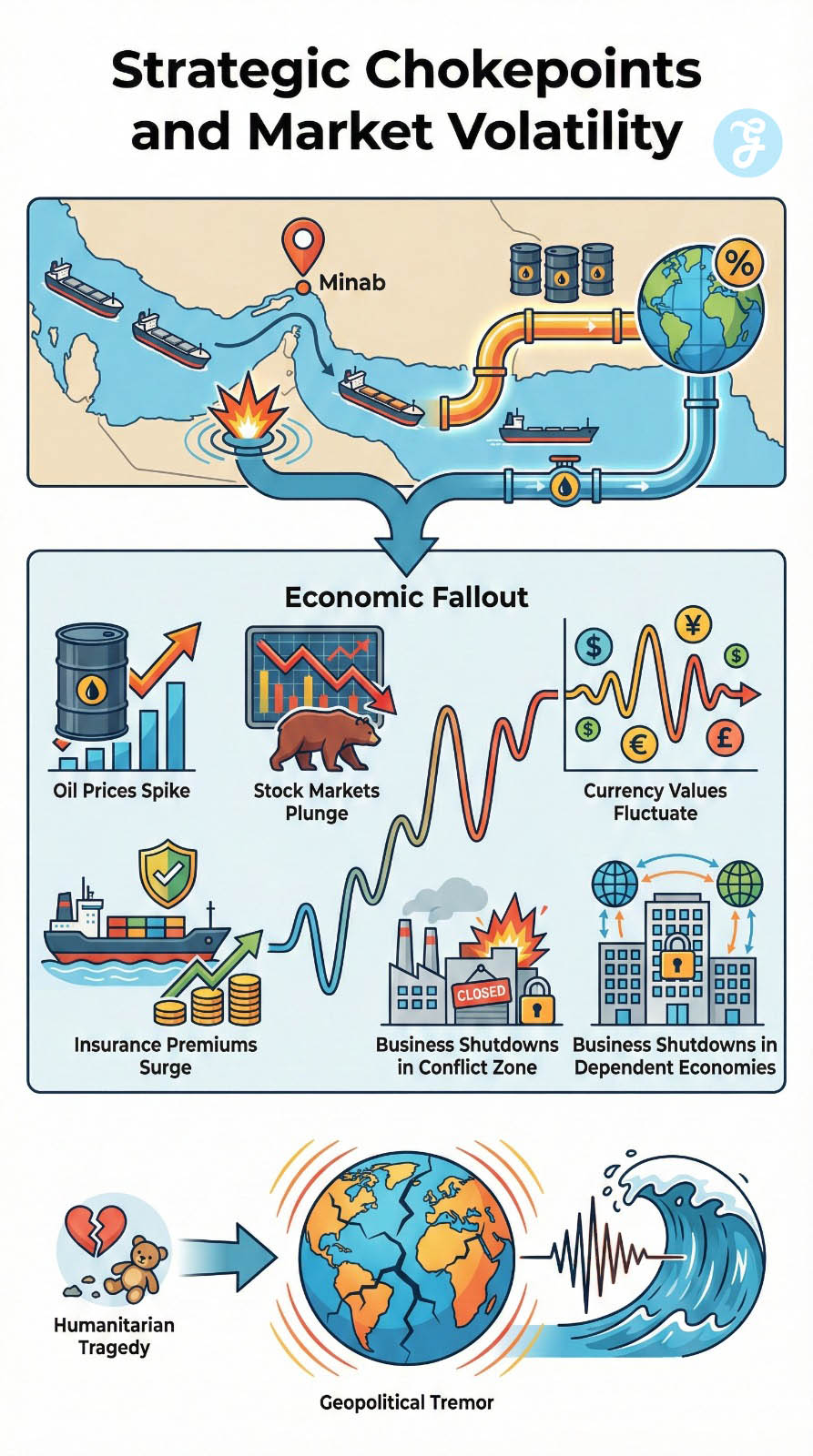 The Strait of Hormuz, near which Minab is located, is one of the world’s most strategically significant maritime chokepoints. According to the U.S. Energy Information Administration, a significant percentage of global petroleum liquids consumption passes through this narrow passage daily. Instability in or near this region does not remain local. It becomes global.
Thus the Minab Massacre is not merely a humanitarian tragedy. It is a geopolitical tremor.
Invisible Scars and the Cycle of Displacement
Yet even economic shockwaves fail to capture war’s deepest scar: psychological trauma.
Children who survive bombings often carry invisible injuries. Studies published in reputable medical journals have documented elevated rates of post-traumatic stress disorder, depression, and anxiety among children exposed to armed conflict. Trauma does not dissolve when ceasefires are signed. It persists into adulthood, affecting education outcomes, employment prospects, and social cohesion.
A child who watches her classroom collapse may never feel fully safe again in any classroom.
Refugee flows are another predictable consequence. The United Nations High Commissioner for Refugees reports that global forced displacement has reached record levels in recent years, exceeding one hundred million people. Wars do not create temporary inconvenience. They create permanent displacement for millions. Refugee camps become semi-permanent cities. Host nations strain under economic and political pressures. Social tensions rise.
And in that atmosphere, radicalisation often finds fertile ground.
Grief, humiliation, and anger can be manipulated. When generations grow up amid rubble, narratives of revenge gain emotional traction. Extremism does not arise in a vacuum. It grows in environments where justice feels distant and trauma feels immediate.
The Limits of Retaliation and the Need for Restraint
Supporters of military escalation often argue that strength deters aggression. There is historical truth in the idea that credible defence can prevent conflict. But strength and escalation are not identical. Diplomacy is frequently mischaracterised as weakness. In reality, sustained diplomatic engagement is one of the most complex and demanding forms of statecraft.
It requires patience in the face of provocation. It requires domestic political courage. It requires leaders willing to risk criticism for compromise.
The Minab Massacre should force a reckoning with the language we use about war. Too often, we speak in abstractions. Strategic depth. Proportional response. Tactical strike. These phrases sanitise what is fundamentally human suffering.
When a girls’ school is destroyed, the abstraction collapses.
Verified historical records across conflicts confirm a sobering pattern. Civilian casualties consistently form a significant portion of war deaths in modern conflicts. The Geneva Conventions exist precisely because history demonstrated that without legal frameworks, civilians bear unbearable costs. Yet even with international humanitarian law, enforcement remains inconsistent.
This is not an argument for passivity in the face of aggression. States have the right to defend themselves. It is, however, an argument for proportionality, restraint, and relentless pursuit of negotiation before escalation becomes irreversible.
A Legacy Defined by Choice
The Minab Massacre must not become another name in a long list that fades from headlines within days.
Editorial responsibility demands that we widen the lens. From one destroyed classroom to damaged airports. From embassies under attack to leaders targeted. From economic tremors to refugee waves. From immediate casualties to intergenerational trauma.
War does not only destroy buildings. It destroys trust.
Trust between citizens and leaders. Trust between neighbouring states. Trust in international institutions. Trust in the possibility that disputes can be resolved without annihilation.
And once trust erodes, rebuilding it is more expensive than reconstructing bridges or airports.
There is also a moral dimension that statistics cannot quantify. What does it mean for a society when children become symbols in geopolitical chess games? When education becomes collateral damage? When will the phrase Minab Massacre be explained to future generations?
The answer cannot simply be retaliation.
Retaliation may satisfy a demand for visible strength. It rarely satisfies the deeper demand for stability. Escalation invites counter-escalation. In interconnected regions, alliances draw additional actors into spirals that are difficult to control.
The twentieth century offered brutal lessons about how quickly localized violence can expand into regional or global catastrophe. The twenty-first century, with its advanced weaponry and instantaneous communication, carries even higher stakes.
The True Cost of Escalation
If the Minab Massacre teaches us anything, it is that the first victims of war are often the least responsible for it.
Young girls studying mathematics and literature did not draft military strategies. Teachers did not negotiate treaties. Parents did not design escalation pathways. Yet they paid the price.
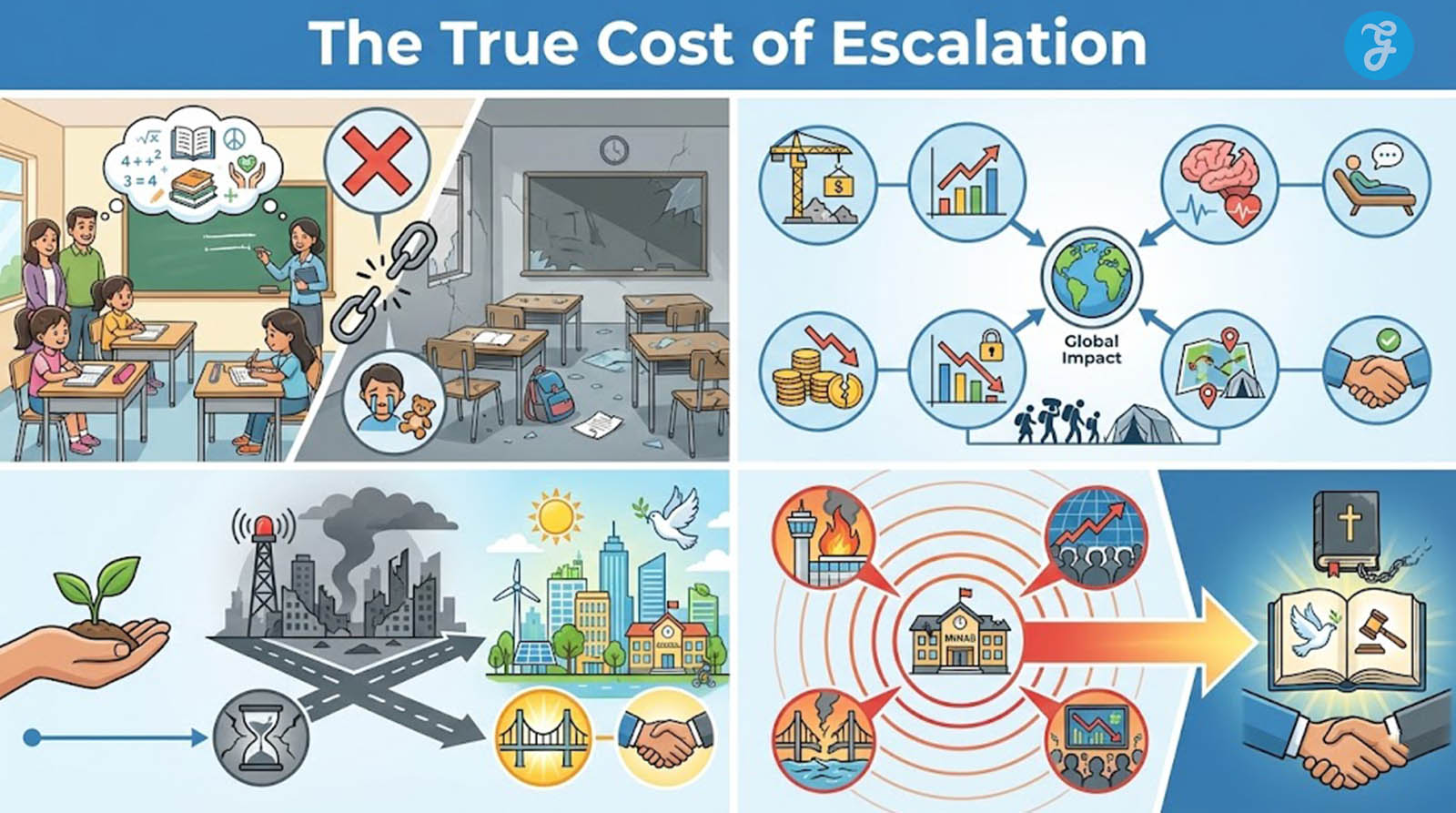 An anti-war stance is sometimes dismissed as idealistic. But it is grounded in empirical observation. Reconstruction costs are measurable. Trauma statistics are measurable. Displacement numbers are measurable. Economic losses are measurable. The evidence across continents converges on one truth: war extracts a cost far beyond battlefield objectives.
The Minab Massacre should not trend briefly and disappear. It should provoke sustained scrutiny of policy choices that make such tragedies possible.
In the end, the most powerful argument against war may not be ideological. It may be generational.
What kind of world do we bequeath when classrooms are considered acceptable casualties? What stability can be built on rubble? What future thrives under the shadow of sirens?
When classrooms fall silent and airports burn, the illusion of contained conflict evaporates. The damage radiates outward, from one city to the global system, from one day’s headlines to decades of consequence.
The Minab Massacre is a warning. Whether the attack on Minab girls’ school becomes a turning point depends not on outrage alone, but on whether leaders and citizens insist that diplomacy, restraint, and human dignity take precedence over the politics of destruction.
War does not only end lives. It ends possibilities.
And that is a cost no nation can afford.
Core Implications
- Sanctuary to Symbol: Modern warfare transforms schools into targets, trading the lives of students for tactical positioning.
- Infrastructure Shocks: Local strikes ripple into global disruptions, threatening major aviation hubs and energy corridors like the Strait of Hormuz.
- Diplomatic Decay: Shuttered embassies and broken channels create a vacuum where suspicion and radicalisation easily take root.
- Generational Deficit: The cost of war is not just financial; it is found in the permanent psychological trauma and displacement of survivors.
- Diplomacy as Strength: True stability arises from the difficult work of restraint, proving that retaliation is a poor substitute for peace.
Disclaimer: Editorialge maintains a steadfast commitment to responsible reporting on the evolving conflicts in West Asia involving Israel, Iran, U.S., Gulf nations and non-state actors like Hezbollah, Hamas, Houthis, Islamic State, and others. In an environment where digital disinformation is widespread, we cannot independently verify every social media post or claim involving national and non-state actors. Our priority remains factual accuracy and the exercise of extreme caution when documenting all regional media.